Transportation Screening Equipment Cybersecurity Briefing
Edam Colón (Cybersecurity Specialist · Transportation Security Administration)
Aerospace Village @ DEF CON 31 · Day 1 · Aerospace Village
Overview
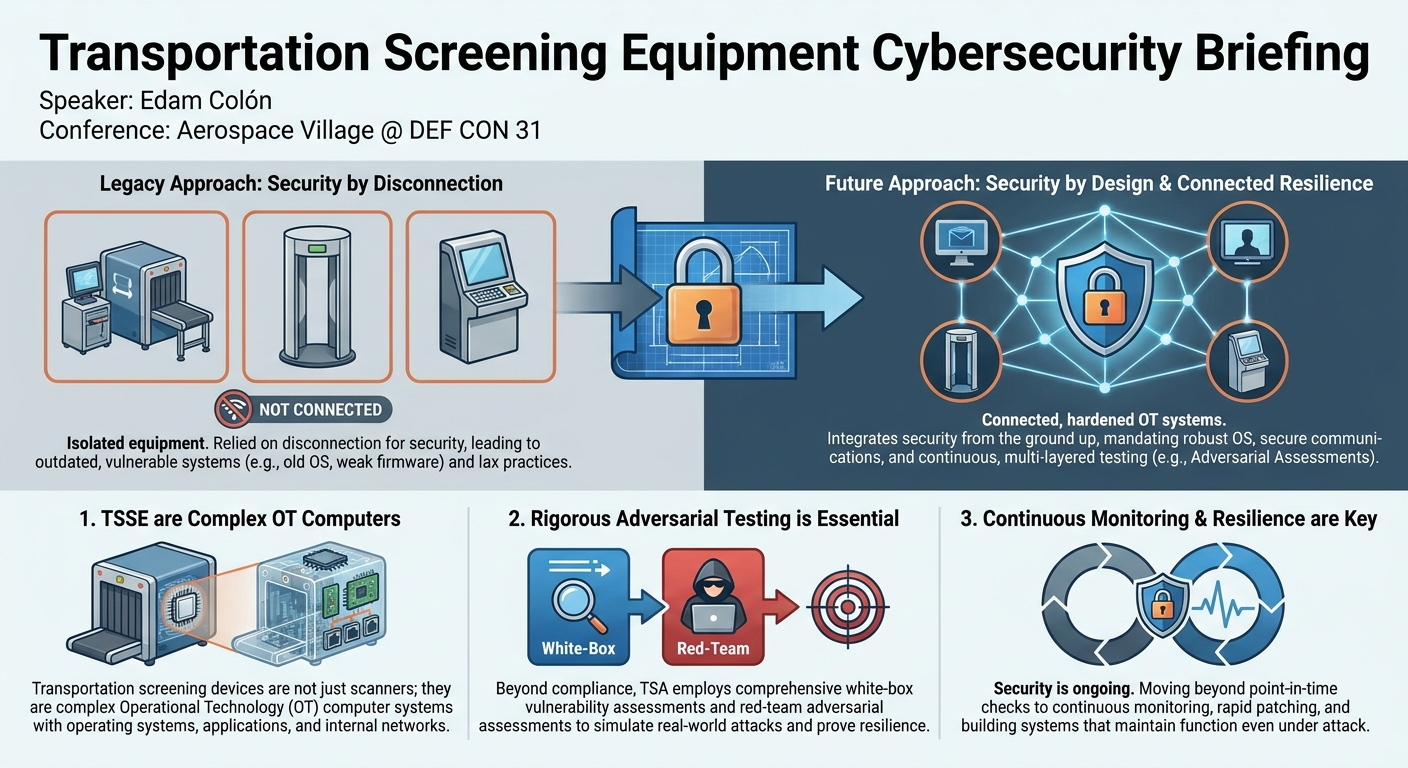
In this insightful talk from DEF CON 31's Aerospace Village, Edam Colón, a Cybersecurity Specialist at the Transportation Security Administration (TSA), sheds light on the critical and often overlooked realm of cybersecurity for Transportation Screening Equipment (TSSE). Colón details the TSA's aggressive push to secure the myriad of devices that travelers encounter daily at airport checkpoints – from X-ray machines and body scanners to credential authentication terminals. Far from being simple, isolated devices, Colón emphasizes that these are complex Operational Technology (OT) systems, essentially networks of computers running sophisticated operating systems and applications. The talk highlights a pivotal shift within the TSA from a historical reliance on "security by disconnection" to an imperative for integrating these systems into a connected network, necessitating robust, "security-by-design" hardening from the ground up.
Key moments
- 0:00 Introduction to TSA's transportation equipment cybersecurity
- 5:00 Shifting focus: Operational Technology (OT) security is paramount
- 13:00 Securing firmware and industrial control systems (ICS) challenge
- 17:00 TSA's rigorous multi-stage security testing and adversarial assessments
- 20:40 Building cyber resilience and continuous monitoring strategies
- 28:00 Overcoming OEM vendor lock-in with open architecture
- 33:20 TSA's strict policy on facial recognition and biometric data retention
- 40:00 Addressing microelectronics and software supply chain risks (Q&A)
Transportation Screening Equipment Cybersecurity Briefing
Speakers: Edam Colón (Cybersecurity Specialist, Transportation Security Administration)
Conference: Aerospace Village @ DEF CON 31
YouTube: https://www.youtube.com/watch?v=YgIUr2iHinI
Overview
In this insightful talk from DEF CON 31's Aerospace Village, Edam Colón, a Cybersecurity Specialist at the Transportation Security Administration (TSA), sheds light on the critical and often overlooked realm of cybersecurity for Transportation Screening Equipment (TSSE). Colón details the TSA's aggressive push to secure the myriad of devices that travelers encounter daily at airport checkpoints – from X-ray machines and body scanners to credential authentication terminals. Far from being simple, isolated devices, Colón emphasizes that these are complex Operational Technology (OT) systems, essentially networks of computers running sophisticated operating systems and applications. The talk highlights a pivotal shift within the TSA from a historical reliance on "security by disconnection" to an imperative for integrating these systems into a connected network, necessitating robust, "security-by-design" hardening from the ground up.
Colón's presentation is crucial for understanding the evolving threat landscape facing critical infrastructure. As the TSA moves towards a future of connected screening operations, the cybersecurity posture of these systems directly impacts national security and public safety. The talk outlines the significant challenges of securing equipment from diverse vendors, often designed without security as a primary concern, and details the rigorous, multi-layered testing methodologies the TSA now employs to ensure these systems can withstand sophisticated adversarial attacks. This shift represents a proactive stance against potential compromises that could disrupt travel, facilitate illicit activities, or even endanger lives.
Background
▶ Watch: Introduction to TSA's transportation equipment cybersecurity (0:00)
The security of transportation infrastructure is paramount, and at its frontline are the devices used to screen passengers and baggage. Edam Colón, representing the Transportation Security Administration (TSA), detailed the extensive array of Transportation Screening Equipment (TSSE) deployed across U.S. airports. These include the familiar Computer Tomography (CT) scanners that produce 3D images of bags, older Advanced Technology (AT) X-ray systems, Automated Screening Lanes (ASLs) with self-returning bins, Credential Authentication Technology (CAT) devices that verify IDs and detect fraud, Advanced Imaging Technology (AIT) body scanners, traditional metal detectors, and Explosive Trace Detection (ETD) systems. While often perceived by the public as mere "scanners" or "detectors," Colón underscored a fundamental truth: each of these pieces of equipment is, at its core, a sophisticated computer system. They run operating systems, host applications, and often contain internal networks, even when physically disconnected from external networks.
Historically, the security model for these OT systems, much like in other industrial control system (ICS) environments, relied heavily on security by disconnection. The belief was that if a system was not connected to the internet or a broader network, it was inherently secure. This perspective led manufacturers, whose primary focus was on operational functionality, to treat cybersecurity as an afterthought or even irrelevant, often claiming, "This is OT, not IT, so we don't need to secure it." Consequently, many deployed TSSE operated on outdated and vulnerable operating systems, with lax security practices.
However, this paradigm is rapidly changing. The TSA, driven by the need for improved operational efficiency, real-time data analysis, and advanced screening capabilities, aims to connect these systems. This planned connectivity transforms them from isolated islands to potentially vulnerable network endpoints. Recognizing this, the Department of Homeland Security (DHS) and TSA are exerting significant pressure on the industry, revising policies, and mandating stringent cybersecurity requirements. The evolving regulatory landscape, including draft NIST regulations specifically addressing OT security, further reinforces the notion that Operational Technology (OT) and Information Technology (IT) are two sides of the same coin, both requiring robust hardening to prevent compromise and ensure consistent, certified performance.
Key Findings
▶ Watch: Securing firmware and industrial control systems (ICS) challenge (13:00)
The TSA's journey to securing its vast fleet of Transportation Screening Equipment has led to several critical findings and a fundamental re-evaluation of its approach to OT cybersecurity. The most significant finding is the absolute necessity of treating TSSE as complex computer systems, not just simple machines, and demanding security by design from vendors. The era of "security by disconnection" is over, replaced by an imperative to connect these systems securely.
Key findings from the TSA's experience include:
- Multilayered Vulnerability: Initial assessments revealed that security weaknesses extend beyond physical access, encompassing communications protocols, deeply outdated operating systems (e.g., Windows XP, Windows 7, Fedora 12), and particularly vulnerable firmware, PLCs, and HMIs within the OT stack.
- Vendor Accountability Gap: Many vendors historically prioritized functionality over security, resisting investments in hardening, secure software development lifecycles, and rapid patching. This led to pervasive issues like default credentials and infrequent updates.
- Inadequate Traditional Testing: Standard compliance-based "check-the-box" security assessments (like NIST 800-53 SCA) were insufficient to identify deep-seated vulnerabilities or assess real-world adversarial resilience.
- Need for Continuous Vigilance: Security is not a one-time achievement. Penetration tests and vulnerability assessments provide only a "snapshot in time"; continuous monitoring and rapid patch deployment are essential given the dynamic threat landscape.
- Hidden Attack Surfaces: Many systems contained undocumented or unknown network components, databases, and web interfaces, representing significant, unmanaged attack surfaces that vendors themselves were often unaware of ("leave no IP address behind").
- Operational Constraints: Integrating new, secure technology is challenging due to physical limitations of existing checkpoint designs and the need to update systems without invalidating operational certifications.
- Proprietary Lock-in: Vendors' preference for closed, proprietary architectures hindered interoperability, complicated officer training, and limited the TSA's flexibility in procurement and maintenance.
These findings have propelled the TSA to implement a rigorous, three-tiered testing methodology and to actively push for industry-wide changes, moving towards a future where TSSE are inherently secure, resilient, and continuously monitored.
Technical Deep Dive
▶ Watch: Building cyber resilience and continuous monitoring strategies (20:40)
Securing Transportation Screening Equipment (TSSE) is a complex endeavor that transcends traditional IT security. Edam Colón meticulously detailed the technical layers and challenges involved, emphasizing that these systems are sophisticated Operational Technology (OT) environments requiring a holistic security approach.
At the most fundamental level, TSSE are not merely scanners but embedded computer systems. They comprise operating systems, run custom applications, and often contain internal networks with routers and switches. This realization drives the TSA's push for comprehensive security across multiple domains.
Securing the Layers of TSSE
- Physical Security (Foundational but Insufficient):
Historically, vendors argued that blocking physical ports (e.g., USB) rendered a system secure. However, as Colón pointed out, a Windows XP system with blocked USB ports is still inherently vulnerable. While physical port security remains a baseline requirement, it is no longer considered adequate.
- Communications Security (Data Integrity and Confidentiality):
TSSE communicate internally and, increasingly, externally. This involves both traditional IT protocols like HTTP and SSH, and OT-specific protocols such as Modbus for Programmable Logic Controllers (PLCs). Critical concerns include ensuring the integrity of scanned images from the device to the screening officer and securing data related to alarm resolution. The TSA is mandating the use of digital signatures as part of a zero-trust architecture to verify communication authenticity. A significant victory in this area is the absolute prohibition of Telnet, a notoriously insecure protocol, which Colón noted has been an "instant fail" for vendors.
- Operating System (OS) Hardening (The Foundation of Application Security):
A major vulnerability has been the deployment of TSSE on insecure and end-of-life operating systems, such as Windows XP, Windows 7, and even Fedora 12. Colón stressed that a robust application sitting on a vulnerable OS is "garbage." The TSA now rigorously enforces OS standards, demanding hardened, long-term support (LTS) operating systems with a minimum 5-year lifecycle. While vendors often resist due to the perceived higher cost of licensed enterprise solutions like Red Hat, Colón highlights that open-source LTS distributions like Ubuntu offer a viable, cost-effective alternative. The goal is to ensure systems remain supported and patchable throughout their operational lifespan, accounting for the "speed of government" in update cycles.
- Firmware, PLCs, and Human-Machine Interfaces (HMIs) (The OT Core):
This layer represents the most challenging and often the most vulnerable component of TSSE. Unlike operating systems, where robust hardening guidelines (e.g., DISA STIGs) and development best practices (e.g., OWASP for web applications) exist, standards for securing firmware, PLCs, and HMIs are "minimal." Vendors often have little guidance beyond generic "best practices." Common issues include readily discoverable default credentials (often found with a simple Google search) and infrequent, difficult-to-deploy firmware updates. The TSA is actively pushing vendors to address these deep-seated vulnerabilities, enforcing that systems with such flaws "fail hard."
Rigorous Testing and Verification
To enforce these standards, the TSA employs a "trust but verify" approach with a three-tiered testing methodology:
- Security Controls Assessment (SCA): This is the baseline, government-mandated compliance review. It involves checking policies and ensuring adherence to frameworks like NIST 800-53, often perceived as a "check-the-box" exercise. While necessary, it's recognized as insufficient for real-world security.
- Cooperative Vulnerability Penetration Assessment (CVPA): This is a collaborative, white-box engagement where TSA works directly with vendors. It includes vulnerability scanning, manual evaluation of web applications and databases, and targeted penetration testing. The goal is to identify and help remediate vulnerabilities, focusing on hardening the system collaboratively.
- Adversarial Assessment (AA): This represents the highest bar and is a red team activity. Tailored scenarios are developed to simulate real-world attacks. Examples include attempting to bypass bomb detection (making a bag with a simulated explosive register as "cleared"), circumventing body scanners for contraband, or manipulating the CAT to incorrectly grant a passenger pre-check status. These assessments are not quick, typically lasting around four weeks per engagement. A failure in an AA can result in a system being rejected for acquisition, forcing vendors to re-engineer and re-submit months or even years later.
Building Cyber Resilience and Continuous Monitoring
Recognizing that 100% security is an unattainable ideal, the TSA is developing a Cyber Resilience Rating. This roadmap, still in progress, aims to move beyond a simple "pass/fail" model to a graded scale (e.g., 1-5). It will evaluate a system's ability to maintain its mission function even while under attack. Basic requirements, such as enforcing strong, complex passwords (e.g., "more than eight characters long," not "password1"), are foundational to this rating.
A critical shift is towards continuous monitoring. Colón highlighted that a pentest is merely a "snapshot in time," with its findings rapidly deprecating. The TSA seeks to mandate continuous updates (e.g., monthly or every six weeks) and immediate patching for critical vulnerabilities. This requires vendors to provide ongoing support and monitoring capabilities.
Furthermore, the TSA's internal teams actively work to "leave no IP addresses behind," often discovering undocumented PLCs, HMIs, databases, and web interfaces within vendor systems that even the manufacturers were unaware of. These hidden components represent significant, unmanaged attack surfaces.
Architectural and Supply Chain Considerations
The TSA is also tackling systemic challenges:
- Open Architecture: Historically, vendors favored proprietary, closed systems. The TSA is now demanding open architecture to standardize interfaces. This allows officers to be trained once on a common interface, regardless of the underlying vendor's equipment (e.g., Analogic, Smith's, L3), improving operational efficiency and reducing training overhead. It also shifts power from vendors to the TSA, enabling greater flexibility and competition.
- Account Management: The proliferation of maintenance, user, and officer accounts with often weak or default credentials is being addressed by requiring two-factor authentication (2FA) and robust account management practices.
- Supply Chain Risk: Colón expressed significant concern about the supply chain for microelectronics and software components, citing incidents like the SolarWinds compromise. The TSA is developing processes to evaluate hardware and software origins, particularly guarding against components from adversarial nations.
In essence, the TSA's technical deep dive reveals a comprehensive, aggressive strategy to transform the cybersecurity posture of critical airport screening equipment, ensuring that these vital systems are secure by design, rigorously tested, and continuously monitored against an ever-evolving threat landscape.
Demo / Proof of Concept
▶ Watch: Overcoming OEM vendor lock-in with open architecture (28:00)
While the talk itself did not feature a live technical demonstration or "proof of concept" in the traditional sense, Edam Colón extensively detailed the Adversarial Assessment (AA) methodology, which functions as the TSA's highest-level, internal "proof of concept" testing. These assessments are essentially simulated red team engagements designed to prove whether an adversary could compromise the system's core function.
Colón provided concrete examples of these internal "demonstrations of vulnerability":
- Bypassing Bomb Detection: A scenario where an adversary attempts to manipulate a bag containing a simulated explosive to be categorized as "cleared" rather than flagged for secondary screening.
- Circumventing Body Scanners: Testing how a system could be tricked into not detecting contraband or explosives on a person.
- Manipulating Credential Authentication Technology (CAT): Demonstrating how an adversary might coerce a CAT device to incorrectly send a standard passenger to a pre-check lane, thereby bypassing more thorough screening.
These are not public demonstrations but highly controlled, internal tests conducted by TSA's red teams and pentesters. The goal is to push the boundaries of system security, identify critical flaws, and force vendors to address them before deployment. The results of these adversarial assessments serve as the ultimate proof of a system's resilience or lack thereof, directly impacting its eligibility for acquisition and deployment.
Defensive Implications
▶ Watch: Addressing microelectronics and software supply chain risks (Q&A) (40:00)
The detailed insights from Edam Colón's talk provide crucial defensive implications for various stakeholders, from equipment manufacturers to airport operators and government agencies. The overarching message is a call to action for proactive, "security-by-design" practices in all OT environments.
For Transportation Screening Equipment Manufacturers (OEMs):
- Embrace Security by Design: Integrate cybersecurity from the initial design phase, rather than attempting to bolt it on later. This includes secure coding practices, threat modeling, and vulnerability assessments throughout the development lifecycle.
- Prioritize Hardened, LTS Operating Systems: Move away from outdated, unsupported OS versions (e.g., Windows XP) to modern, hardened, and long-term support (LTS) operating systems (e.g., Red Hat, Ubuntu) with a minimum 5-year lifecycle. This ensures ongoing security updates and reduces maintenance burdens.
- Secure Firmware and PLCs: Develop and adhere to specific security standards for firmware, PLCs, and HMIs, addressing the current lack of robust guidelines. This includes eliminating default credentials, implementing secure boot, and enabling authenticated firmware updates.
- Faster Patching and Update Cycles: Establish and commit to aggressive patch cycles (e.g., monthly or every six weeks) and rapid deployment of critical vulnerability fixes, rather than annual updates.
- Implement Strong Account Management: Mandate multi-factor authentication (MFA), eliminate default or hardcoded credentials, enforce password complexity, and ensure proper role-based access control for all system accounts (maintenance, user, administrator).
- Adopt Open Architecture: Collaborate on open, standardized interfaces for equipment. This benefits not only the TSA by simplifying officer training and procurement but also fosters innovation and competition within the industry.
- Supply Chain Transparency: Scrutinize the supply chain for microelectronics and software components to mitigate risks from potentially compromised or untrustworthy sources.
For Airport Operators and Government Agencies (TSA, DHS, etc.):
- Enforce Rigorous Testing Methodologies: Implement and expand comprehensive testing regimes, including Cooperative Vulnerability Penetration Assessments (CVPA) and especially Adversarial Assessments (AA). These go beyond compliance and truly evaluate real-world resilience.
- Demand Continuous Monitoring Capabilities: Require vendors to provide robust continuous monitoring solutions for deployed systems, allowing for real-time detection of anomalies and vulnerabilities. Move beyond snapshot assessments.
- Prioritize Cyber Resilience: Develop and implement resilience ratings that evaluate a system's ability to maintain critical functions even under cyberattack, shifting focus from merely preventing attacks to enduring them.
- Understand OT as IT: Recognize that all operational technology contains IT components that require the same, if not greater, cybersecurity rigor as traditional IT systems.
- "Leave No IP Addresses Behind": Conduct thorough discovery of all network-connected components within OT systems, including undocumented PLCs, HMIs, and hidden web interfaces, to ensure all attack surfaces are known and secured.
- Invest in Talent: Actively recruit and empower cybersecurity specialists with diverse perspectives and red-teaming skills to continuously challenge and improve the security posture of critical infrastructure.
- Plan for Infrastructure Upgrades: Develop strategies to modernize physical checkpoint infrastructure to accommodate larger, more advanced, and inherently more secure screening technologies.
- Establish Clear Certification Boundaries: Define clear parameters for applying security patches and updates without invalidating operational certifications, allowing for continuous security improvements while maintaining regulatory compliance.
Ultimately, the defensive implications underscore a paradigm shift: securing critical infrastructure like airport screening equipment is an ongoing, collaborative effort that requires proactive engagement, stringent enforcement, and a deep understanding of the interwoven complexities of IT, OT, and the human element.
Key Takeaways
- TSSE are Complex Computer Systems: Airport screening equipment are not simple machines but sophisticated OT systems running operating systems, applications, and internal networks, demanding comprehensive cybersecurity.
- Shift from Disconnection to Hardened Connectivity: The TSA is moving away from "security by disconnection" towards securely connecting TSSE, necessitating robust "security by design" from the ground up.
- Multi-Layered Security is Paramount: Security must encompass physical access, secure communications (e.g., digital signatures, no Telnet), hardened, long-term support operating systems, and especially secure firmware/PLCs/HMIs.
- Rigorous Adversarial Testing is Essential: Beyond compliance checks, the TSA employs white-box vulnerability assessments and red-team adversarial assessments to simulate real-world attacks and force vendors to deliver truly resilient systems.
- Continuous Monitoring and Resilience are the Future: Security is an ongoing process, requiring continuous monitoring, rapid patching, and developing systems that can maintain mission functionality even under cyberattack, moving beyond a simple "pass/fail" approach.
- Vendor Accountability and Open Architecture: The TSA is actively enforcing higher cybersecurity standards on vendors, pushing for open architecture to improve interoperability, officer training, and overall system security.
About the Speaker(s)
Edam Colón is a Cybersecurity Specialist with the Transportation Security Administration (TSA). In his role, he is responsible for developing and enforcing cybersecurity requirements for the vast array of Transportation Screening Equipment (TSSE) used at airports. His work is critical in ensuring the security of these operational technology (OT) systems as the TSA transitions towards more connected and technologically advanced screening operations. Colón brings a practical, hands-on perspective to his work, having served 12 years in the Army, which he humorously mentioned contributed to a "bad shoulder." He leads teams in developing and executing rigorous testing methodologies, including adversarial assessments, to challenge vendors and drive significant improvements in the cybersecurity posture of critical airport infrastructure.
Reviews
Dr. Zero (Offensive Security Researcher) — STRONG ACCEPT
This isn't a zero-day drop, but it's exactly what a government policy talk should be. Colón puts ICS/OT vendors on notice: ship Windows XP or Telnet, and the TSA will nuke your acquisition contract. Real leverage, concrete requirements, zero regulatory bullshit.
Heather Calloway (CISO) — STRONG ACCEPT
The TSA is finally using its massive procurement leverage to force OT vendors to stop selling insecure black boxes. This is a blueprint for how large enterprises should handle their own specialized equipment suppliers. If you manage a fleet of medical devices, manufacturing robotics, or facility OT, this is how you rewrite your vendor contracts.