Pen Test Partners Power Hour
Ken Munro (Pen Test Partners), Alex Lomas (Pen Test Partners)
Aerospace Village @ DEF CON 31 · Day 1 · Aerospace Village
Overview
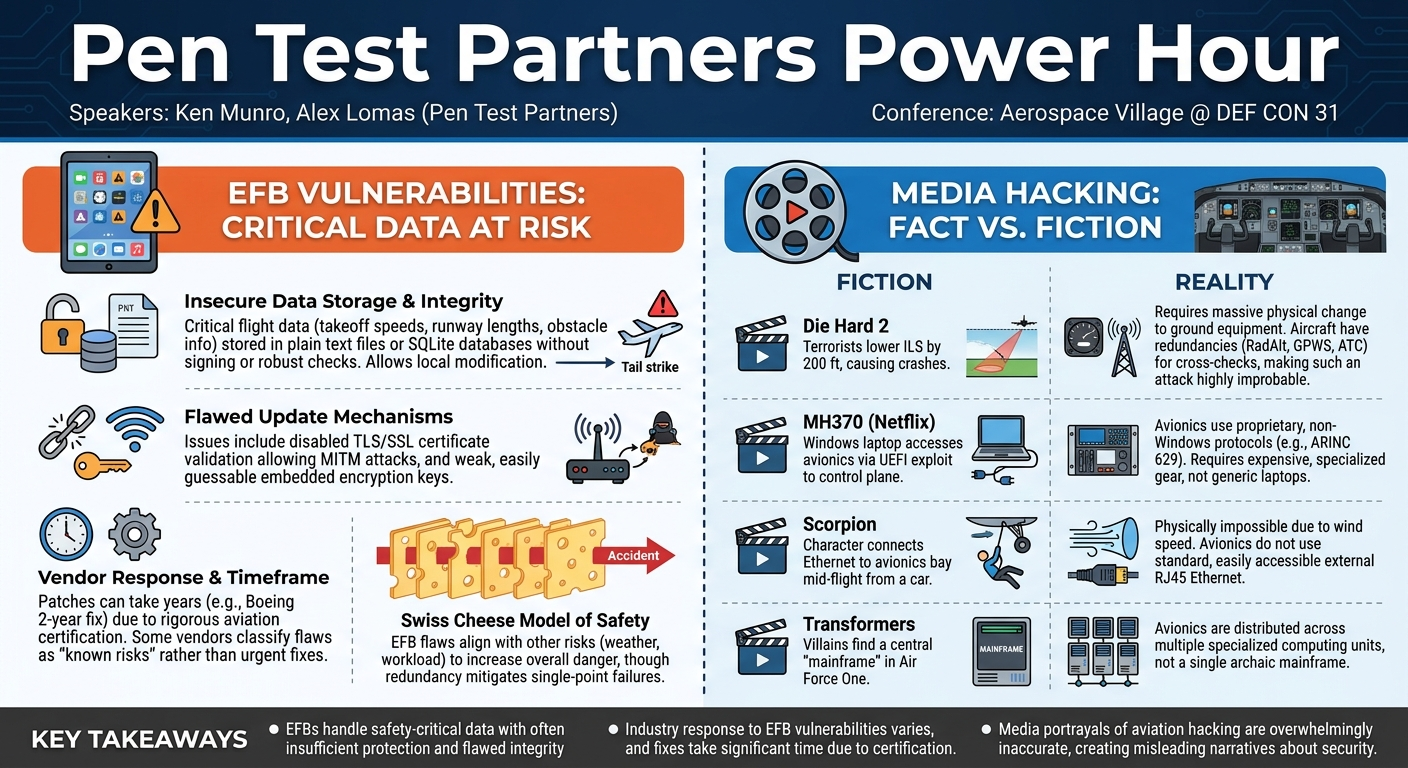
This talk, presented by Ken Munro and Alex Lomas of Pen Test Partners at DEF CON 31's Aerospace Village, delves into two distinct yet related facets of aviation security: the critical vulnerabilities found in Electronic Flight Bags (EFBs) and a critical deconstruction of aviation hacking portrayed in popular media. Alex Lomas leads the first, more serious segment, detailing recent findings in EFB applications from major aerospace vendors like Boeing, Airbus, and Lufthansa Systems, building upon previous research. He highlights persistent issues with data integrity, update mechanisms, and the general hardening of these safety-critical devices.
Key moments
- 0:30 What are Electronic Flight Bags (EFBs)?
- 4:40 Boeing EFB (OPT) vulnerabilities and disclosure
- 9:30 Lufthansa LIDO: Flawed crypto and weak keys
- 12:00 EFB security common threads and Swiss Cheese Model
- 17:00 Debunking Die Hard 2's Instrument Landing System hack
- 29:00 Netflix MH370 conspiracy theory debunked
- 39:00 Pen Test Partners' "plausible" Scorpion movie hack
Pen Test Partners Power Hour
Speakers: Ken Munro (Pen Test Partners); Alex Lomas (Pen Test Partners)
Conference: Aerospace Village @ DEF CON 31
YouTube: https://www.youtube.com/watch?v=sl7v_hc2pJ4
Overview
This talk, presented by Ken Munro and Alex Lomas of Pen Test Partners at DEF CON 31's Aerospace Village, delves into two distinct yet related facets of aviation security: the critical vulnerabilities found in Electronic Flight Bags (EFBs) and a critical deconstruction of aviation hacking portrayed in popular media. Alex Lomas leads the first, more serious segment, detailing recent findings in EFB applications from major aerospace vendors like Boeing, Airbus, and Lufthansa Systems, building upon previous research. He highlights persistent issues with data integrity, update mechanisms, and the general hardening of these safety-critical devices.
Ken Munro then shifts gears to a highly entertaining, yet equally insightful, segment, dissecting popular movie and TV show portrayals of airplane hacking. He meticulously exposes the technical inaccuracies and implausibilities in iconic scenes from films like Die Hard 2, the Netflix documentary MH370, the TV show Scorpion, and Transformers. This segment serves not only as comedic relief but also as a crucial commentary on the damaging narratives perpetuated by sensationalized media, which often misinform the public and the industry about the realities of aviation cybersecurity. The talk ultimately emphasizes the complex layers of aviation safety and the importance of robust security measures, both in real-world systems and in public understanding.
Background
▶ Watch: What are Electronic Flight Bags (EFBs)? (0:30)
Electronic Flight Bags (EFBs) are tablet computers that have revolutionized the cockpit by replacing cumbersome paper charts, manuals, and flight documents. These devices are indispensable for modern pilots, providing a suite of applications for critical tasks such as calculating takeoff performance (determining safe and efficient engine thrust for a given runway), weight and balance (ensuring correct center of gravity for passenger and freight loads), and landing distance calculations (adjusting for weather conditions and air traffic control requirements). A miscalculation in any of these areas can have severe consequences, ranging from a Runway Excursion (going off the end of the runway) to a Tail Strike (the aircraft's tail scraping the runway during rotation), though pilot training and redundancies significantly mitigate the risk of fatalities.
The problem, as highlighted by Pen Test Partners, stems from the inadequate security posture often applied to these devices. Many airline operators, especially with the proliferation of commercial off-the-shelf tablets, do not treat EFBs with the necessary rigor. Issues include a lack of Mobile Device Management (MDM), simple or no PINs, and even pilots using personal devices or allowing family members to access them, exposing corporate and passenger data. Beyond device hardening, the core issue lies in the integrity of the data itself. Previous research by Pen Test Partners, disclosed at the Aerospace Village, found vulnerabilities in Boeing's Performance Tool (OPT), where critical flight data was stored in plain text SQLite databases without signing mechanisms or integrity checks. This allowed an attacker with local access to modify values, potentially impacting flight calculations. The talk uses the Swiss Cheese Model analogy, where an accident occurs only when multiple layers of defense (or "slices of cheese") align their "holes" or vulnerabilities, suggesting that EFB issues alone may not cause an accident, but can significantly increase risk in conjunction with other factors like bad weather or high cockpit workload.
Key Findings
▶ Watch: Lufthansa LIDO: Flawed crypto and weak keys (9:30)
Pen Test Partners presented several significant findings across multiple major EFB applications, highlighting a recurring pattern of insufficient data integrity and security controls.
- Boeing's Performance Tool (OPT) - Revisited:
- Vulnerability: Data was stored in plain text SQLite databases lacking signing mechanisms or integrity checks. This allowed an attacker with local access to modify critical values like runway length (e.g., from actual to 10 km) and calculated takeoff speeds.
- Impact: While gross changes would likely be noticed, subtle alterations could go undetected when operating on the margins of performance (termed "hot, high, and heavy"), potentially leading to a tail strike or runway excursion.
- Resolution: Boeing was highly responsive, and the issue was fully patched after a two-year disclosure and testing process, emphasizing the time required for safety-critical fixes in aviation.
- Airbus FlySmart Paperless Cockpit (LPC):
- Vulnerability: Similar to Boeing OPT, this application used plain text files to store critical data, including obstacle information (cranes, chimneys, pylons around runways) and runway lengths.
- Impact: Local access allowed modification of these values, directly affecting the flight management system (FlySMART UI).
- Resolution: Airbus acknowledged the disclosure in 2021 but deemed it a "known risk" and a "product improvement" rather than an urgent vulnerability fix, leaving the onus on operators to harden their EFBs.
- Airbus FlySmart Updata:
- Vulnerability: This separate application, responsible for updating charts and data monthly via the Airac cycle, had consciously disabled TLS certificate checking.
- Impact: This design flaw enabled Man-in-the-Middle (MITM) attacks. An attacker could set up a rogue Wi-Fi access point (e.g., mimicking a common layover hotel network), intercept update traffic, and inject malicious data directly into both EFBs in a cockpit, bypassing the "two-pilot check" mechanism.
- Resolution: This issue has since been fixed in FlySmart Updata.
- Lufthansa Systems Lido:
- Vulnerability: While Lufthansa Systems attempted to implement cryptographic integrity updates, their implementation was flawed. They calculated an MD5 hash of the data and encrypted it with a key, but the encryption keys were embedded within the client software. Furthermore, a default key in use was trivially weak:
1234567890123. - Impact: An attacker could easily create custom data, calculate the correct MD5 hash, encrypt it with the accessible key, and inject it as a legitimate update. This allowed modification of vector-based charting application data, such as changing descent profiles (potentially leading to terrain conflict) or altering critical airspace restrictions (e.g., advising pilots to ignore calls to Iranian radar).
- Resolution: Lufthansa Systems engaged positively with the disclosure (May 2021, published May 2023). It was noted that the tested software version, taken from a real-life aircraft in 2021, was already End-of-Life (EOL) in 2017, underscoring the challenge of keeping aviation software updated.
Beyond EFB vulnerabilities, Ken Munro's segment highlighted a pervasive "key finding" regarding media portrayals of aviation hacking: they are overwhelmingly technically inaccurate, often to a ludicrous degree, and contribute to damaging public narratives about cybersecurity risks in aviation.
Technical Deep Dive
▶ Watch: EFB security common threads and Swiss Cheese Model (12:00)
The technical deep dive of the talk encompasses both the specific vulnerabilities identified in Electronic Flight Bag (EFB) applications and a meticulous deconstruction of aviation hacking depicted in popular media.
EFB Vulnerabilities: A Closer Look
The core of the EFB vulnerabilities lies in insufficient data integrity and secure update mechanisms.
- Boeing OPT & Airbus FlySmart LPC (Plain Text Data):
- Both applications stored critical flight data in easily accessible formats (plain text SQLite databases for Boeing OPT, plain text files for Airbus LPC).
- The absence of cryptographic signing or robust integrity checks meant that any local attacker with device access could modify parameters. For Boeing OPT, this included runway lengths and calculated takeoff speeds. For Airbus LPC, it involved obstacle data (e.g., cranes, pylons) and runway lengths.
- The danger is not necessarily a pilot blindly accepting a grossly incorrect value (e.g., a 10 km runway at Heathrow) but rather subtle modifications that push the aircraft's performance envelope in critical scenarios (e.g., "hot, high, and heavy" conditions), potentially leading to a tail strike or runway excursion.
- Airbus FlySmart Updata (Disabled TLS):
- The deliberate disabling of TLS certificate checking in the update application created a critical window for Man-in-the-Middle (MITM) attacks.
- Pilots routinely update their EFBs monthly following the Airac cycle. By setting up a rogue Wi-Fi access point with a familiar SSID (e.g., a common layover hotel name), an attacker could intercept the update traffic.
- Without TLS validation, the attacker could present a fake certificate, decrypt the traffic, modify the data (e.g., charts, performance parameters), re-encrypt it, and send it to the EFB as if from a legitimate source. This is particularly dangerous as it could simultaneously compromise both EFBs in a cockpit, bypassing any cross-check by pilots.
- Lufthansa Systems Lido (Flawed Cryptographic Integrity):
- Lufthansa Systems attempted a security measure by calculating an MD5 hash of the data and encrypting it with a key to ensure integrity. However, the implementation failed because the encryption keys were bundled within the client software itself.
- Compounding this, one of the default encryption keys was a simple, sequential string:
1234567890123. - This allowed an attacker to reverse-engineer the integrity check. They could craft malicious data, compute its MD5 hash, encrypt that hash with the known key, and then bundle it with the malicious data. The EFB would then validate the manipulated data as legitimate.
- The impact included altering vector-based charting data, such as modifying descent profiles to depict a lower, unsafe trajectory (potentially leading to Controlled Flight Into Terrain), or instructing pilots to bypass critical communication protocols (e.g., ignoring calls to Iranian radar).
Movie Hacking: Dissecting the Implausible
Ken Munro's segment meticulously dismantled various movie and TV show portrayals of aviation hacking, highlighting their technical absurdities.
- Die Hard 2 (ILS Attack):
- Movie Premise: Terrorists compromise the Instrument Landing System (ILS), making it appear 200 ft lower, causing planes to crash.
- Technical Reality:
- ILS Components: The ILS consists of a localizer (providing horizontal guidance to the runway centerline) and a glide slope (providing vertical guidance, typically 3 degrees).
- Cat III AutoLand: The movie depicts clear weather, but a Cat III AutoLand (where the ILS is critical) is for near-zero visibility.
- Redundancy: Aircraft have multiple redundancies: Radio Altimeter (RadAlt) for flare (more plausible target for 5G interference, as discussed recently), Distance Measuring Equipment (DME) for distance cross-checks, Barometric Altimeter (manually set), Ground Proximity Warning Systems (GPWS) ("Pull Up" warnings for excessive descent rates), and Air Traffic Control (ATC) monitoring.
- Physicality: To genuinely lower the ILS signal's intersection point by 200 ft, one would need to physically dig a 200 ft deep quarry at the runway threshold. Altering the glide slope (e.g., London City Airport's 5.5-degree approach) requires special aircraft software, but not for arbitrary vertical shifts.
- Impact: A 200 ft lower ILS at a typical 700 ft/min descent rate would result in a heavy landing, not a catastrophic explosion, and is often survivable.
- Plausible Attack: Taking the ILS offline entirely to force a less precise non-precision approach (e.g., VOR letdown) is more realistic. The Charles de Gaulle incident (wrong barometric pressure setting, 300 ft altitude error, near-miss) illustrates how data errors in non-precision approaches can be dangerous. GPS spoofing is also technically more plausible, though practically difficult due to receiver placement.
- MH370 (Netflix Documentary):
- Movie Premise: Russian special ops team accesses the avionics bay, connects a Windows laptop to flight controls, depressurizes the cabin, and uses UEFI BIOS exploits and DNS exfiltration to control the plane, then spoofs satcom signals.
- Technical Reality:
- Avionics Bay Access: Requires opening a hatch behind the cockpit, unnoticed access, and replacing carpets – highly implausible in-flight.
- Windows Laptop & Avionics: Avionics systems do not run Windows. Modern aircraft use specialized protocols. Older systems use ARINC 429 (relatively easy to decode, e.g., with a Raspberry Pi). Newer systems (A380, 787) use ARINC 664 (Ethernet-based). The Boeing 777 (MH370) uses a unique, complex, and proprietary protocol called ARINC 629, which requires exceptionally expensive gear (e.g., a $20,000 decoder) to interact with, making it the "wrong plane" to hack with a generic laptop.
- Cabin Depressurization: Triggers multiple cockpit alarms. Modern aircraft have automatic crash dive capabilities, and crew oxygen provides time to descend to a safe altitude (10,000 ft). It would not instantly kill everyone.
- Software Upload: Avionics software is highly controlled, requiring Loadable Software Air Parts (LSAP), dedicated loaders (historically floppy disks), weight-on-wheels checks (aircraft must be on the ground), and digitally signed firmware. Uploading from a random laptop is impossible.
- UEFI BIOS/DNS Exfiltration: These are entirely irrelevant to aircraft flight control systems.
- Scorpion (TV Show):
- Movie Premise: A character dangles from an aircraft's undercarriage at speed to connect an Ethernet cable to the avionics bay and download software from a Ferrari driving below.
- Technical Reality:
- Avionics Bay: Not like the spacious, accessible area in the show. It's a tight, noisy space with sharp edges.
- Ethernet Cabling: Flight control systems do not use standard RJ45 Ethernet connectors. While some specialized aviation Ethernet connectors exist (e.g., ARINC 664), they are not for flight control and are secured with screws.
- Physical Impossibility: Hanging onto an undercarriage at 160 mph (140 knots) approach speed is physically impossible due to wind resistance.
- Plot Holes: The landing gear remains down for the entire segment, the Ferrari's braking is unrealistic, and "buzzing the tower" after the "hack" adds to the absurdity.
- Transformers:
- Movie Premise: Bad guys find a "mainframe" labeled "P-O-U-S" in Air Force One's avionics bay.
- Technical Reality: Aircraft avionics bays contain racks of specialized, distributed computing units, not a single, archaic "mainframe."
The common thread across these media portrayals is a complete disregard for aviation physics, protocols, redundancy, and system architectures, creating a misleading and ultimately unhelpful narrative about aircraft security.
Demo / Proof of Concept
▶ Watch: Netflix MH370 conspiracy theory debunked (29:00)
While the talk did not feature live hacking demonstrations of the EFB vulnerabilities (due to the extensive disclosure process and the sensitive nature of the findings), Pen Test Partners presented several forms of proof-of-concept and evidence:
- Screenshots and UI Demonstrations: For the EFB vulnerabilities, Alex Lomas showed screenshots of modified data reflected in the user interfaces of the affected applications. For instance, an image displayed the correct runway length at Heathrow, juxtaposed with a manipulated value of "10 km," and original takeoff speeds compared to modified ones. Similarly, the talk showed how plain text modifications in Airbus FlySmart LPC immediately reflected changed obstacle data in the cockpit UI. Lufthansa Lido's vector-based charting was shown with manipulated descent profiles and altered airspace restriction text.
- Physical Hardware and Protocols: Alex Lomas referenced specific hardware and protocols, such as the use of plain text SQLite databases and the unique, expensive decoder required for ARINC 629 on the Boeing 777, lending credence to the technical analysis. Ken Munro also referenced Alex's previous highly-watched DEF CON talk during COVID, which demonstrated how software was uploaded via floppy disks on older aircraft, providing a real-world contrast to the fictional laptop uploads.
- "Scorpion" Parody Video: To counter the absurdity of the Scorpion TV show, Ken Munro presented a humorous, yet technically grounded, proof-of-concept video. In this demonstration, Pen Test Partners attached a laptop to an actual RJ45 Ethernet connector found in the E-Bay of a retired Boeing 747 (not on flight controls, but on the In-Flight Entertainment system). A colleague then "dangled" out of the aircraft (while stationary, on the ground) to show how, hypothetically, one could upload data to the In-Flight Entertainment (IFE) system from a vehicle. This served as a practical, albeit tongue-in-cheek, illustration of what might be genuinely plausible versus the show's outlandish claims.
- Boneyard Hacking Experience: Ken Munro also mentioned Pen Test Partners' prior experience hacking real aircraft (747s, A320s) in boneyards, where they paid operators to power up and experiment with retired airframes. This background provides strong credibility to their claims about the inner workings and security postures of aircraft systems.
These proofs and demonstrations, combined with detailed technical explanations, effectively conveyed the nature and impact of the vulnerabilities and the inaccuracies of media portrayals.
Defensive Implications
▶ Watch: Pen Test Partners' "plausible" Scorpion movie hack (39:00)
The findings presented by Pen Test Partners carry significant defensive implications for various stakeholders in the aviation industry:
- Airline Operators:
- Comprehensive EFB Hardening: Operators must move beyond basic mobile device management. This includes implementing robust MDM policies that are carefully tailored to pilot workflows (e.g., considering issues with Face Unlock for pilots wearing sunglasses or oxygen masks). Simple PINs are insufficient, and corporate devices should be strictly controlled, never used for personal entertainment or taken home without strict security protocols.
- Rigorous Software Update Management: The case of Lufthansa Lido highlights the danger of running End-of-Life (EOL) software. Operators must prioritize keeping all EFB applications and underlying operating systems fully updated and ensure they are within vendor support lifecycles. This requires significant testing and validation but is crucial for security.
- Supply Chain Security for Data: The talk briefly touched on the supply chain of aviation data. Operators need to scrutinize the integrity and authenticity of data feeds, whether directly from vendors (Airbus, Lufthansa) or from internal systems that generate and push out databases. This includes securing the update mechanisms, whether online or through in-cockpit systems (e.g., TFTP updates when aircraft are at the gate).
- Awareness of Local Access Risks: Many vulnerabilities required local access to the EFB. This reinforces the need for physical security of devices, strict access controls, and robust authentication.
- Aerospace Vendors (Boeing, Airbus, Lufthansa Systems, etc.):
- Security by Design: Vendors must embed security into the design phase of EFB applications, rather than treating it as an afterthought or a "product improvement." This includes adopting secure coding practices and architectural principles from the outset.
- Robust Data Integrity: The recurring theme of plain text data and flawed integrity checks demands a universal shift to strong cryptographic integrity checks for all safety-critical data. This means proper digital signing of data and updates, with keys managed securely and not embedded in client software.
- Secure Update Mechanisms: All update processes must use properly implemented TLS/SSL certificate validation to prevent Man-in-the-Middle (MITM) attacks. Disabling such critical security features, even for perceived convenience, is unacceptable.
- Strong Cryptography: When cryptography is used, it must employ strong, industry-standard algorithms and robust, randomly generated keys, not easily guessable default values like
1234567890123.
- Regulatory Bodies (EASA, FAA, ICAO, etc.):
- Clearer Security Standards: Current regulations, while addressing EFB standards, may lack specificity regarding data integrity. Regulators should provide clearer, more prescriptive guidance to vendors, explicitly requiring cryptographic integrity rather than ambiguous terms like "integrity" that can be interpreted as simple checksums (CRCs).
- Shared Responsibility: While operators are ultimately responsible for hardening their EFBs, regulators should consider shifting more baseline security responsibility onto vendors to ensure that applications are inherently more secure "from the get-go." This would reduce the repetitive burden on individual airlines.
- Public and Media:
- Dispelling Myths: The extensive debunking of movie hacking scenarios serves as a vital defensive measure against misinformation. The public needs to understand that aviation security is layered and robust, and that sensationalized, unrealistic portrayals can erode trust and create undue fear.
- Informed Discourse: Journalists and content creators should strive for accuracy when discussing aviation cybersecurity, consulting experts to avoid propagating harmful myths that can impact industry reputation and public perception.
The overarching implication is that while aviation has a strong safety record built on layered defenses (the Swiss Cheese Model), the digital transformation brought by EFBs introduces new attack surfaces that require continuous vigilance, proactive security measures, and a collaborative effort from vendors, operators, and regulators to ensure the integrity of critical flight data.
Key Takeaways
- EFBs Handle Safety-Critical Data with Insufficient Protection: Electronic Flight Bags, despite being commercial tablets, manage information directly impacting flight safety (takeoff performance, weight & balance, navigation data). Historically, this data has been stored in plain text or with easily circumvented integrity checks, making it vulnerable to local modification.
- Flawed Data Integrity and Update Mechanisms are Common: Multiple major vendors (Boeing, Airbus, Lufthansa Systems) exhibited vulnerabilities stemming from a lack of robust cryptographic integrity checks for data and insecure update processes (e.g., disabled TLS certificate validation, easily discoverable encryption keys).
- Industry Response Varies, Fixes Take Time: While some vendors like Boeing and Lufthansa Systems were highly responsive and implemented fixes, the disclosure-to-patch cycle can take years due to the rigorous testing and certification required for aviation software. Airbus, in one instance, classified a vulnerability as a "known risk" for operators to mitigate.
- Aviation Safety Relies on Layered Redundancy and Pilot Judgment: The "Swiss Cheese Model" illustrates that EFB vulnerabilities, while serious, are rarely a single point of failure. Multiple layers of safety systems, pilot training, and cross-checks are designed to catch errors, but these vulnerabilities increase overall risk, especially under challenging conditions.
- Media Portrayals of Aviation Hacking are Largely Inaccurate and Harmful: Popular movies and TV shows consistently depict technically impossible and absurd hacking scenarios. These fictional narratives can misinform the public, create undue fear, and damage the industry's reputation, underscoring the importance of accurate technical communication.
- Continuous Vigilance and Proactive Security are Essential: Operators must prioritize comprehensive EFB hardening, rigorous software update management, and supply chain security. Vendors must adopt "security by design" principles and implement strong cryptographic controls, while regulators need to provide clearer, more prescriptive security standards.
About the Speaker(s)
Ken Munro and Alex Lomas are cybersecurity experts from Pen Test Partners, a UK-based firm specializing in penetration testing and security research, particularly in the aviation sector.
Alex Lomas is presented as the "serious one" of the duo, focusing his expertise on the technical intricacies of Electronic Flight Bag (EFB) vulnerabilities. His work includes detailed analysis of data integrity issues, update mechanisms, and the impact of these flaws on flight safety. He has a history of presenting significant findings at the Aerospace Village, including previous disclosures on Boeing's Performance Tool. Alex also has a notable background in demonstrating how software is traditionally uploaded onto older aircraft systems, such as via floppy disks, showcasing his deep understanding of aviation avionics.
Ken Munro brings a blend of technical insight and engaging presentation style to the stage. Describing himself as a "lousy pilot" who once landed at the wrong airport, Ken highlights his practical, if sometimes imperfect, experience with aviation. He is a key figure in the DEF CON Aerospace Village community and has been involved in hands-on hacking of retired aircraft (like 747s and A320s) in boneyards. Ken leads the highly entertaining segment dissecting the technical inaccuracies of aviation hacking in movies and TV shows, using humor to underscore serious points about misinformation and industry perception. Together, their complementary expertise provides a comprehensive and insightful look into aviation cybersecurity.
Reviews
Dr. Zero (Offensive Security Researcher) — STRONG ACCEPT
Pen Test Partners drops concrete, vendor-named EFB vulnerabilities proving aerospace giants are still failing at basic appsec. Half the talk is a comedy roast of Hollywood hacking, but the first half brings enough receipts to make this a strong watch.
Heather Calloway (CISO) — SOLID
A sharp look at how commercial tablets used in safety-critical paths—specifically aviation Electronic Flight Bags—are riddled with elementary software flaws. Half the talk is a comedy roast of Hollywood hacking, but the core is a stark warning about third-party risk and unacceptable vendor patching SLAs in operational technology.