CON trolling the weather
Paz Hameiri
Aerospace Village @ DEF CON 31 · Day 2 · Aerospace Village
Overview
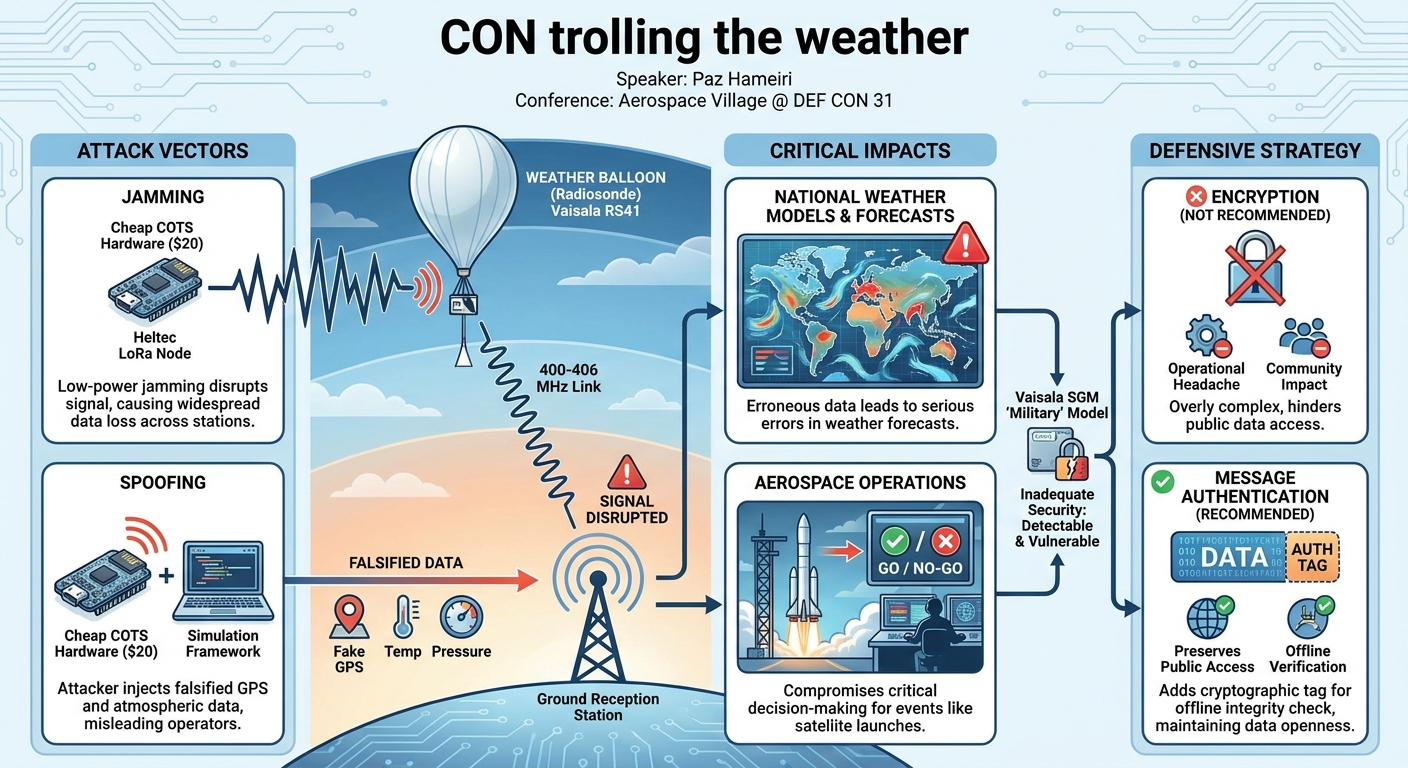
In his talk "CON trolling the weather" at DEF CON 31's Aerospace Village, Paz Hameiri unveiled critical vulnerabilities within the radio communication links of weather balloons, specifically targeting the widely used Vaisala RS41 radiosonde. Hameiri, leveraging his background in aerospace systems engineering and a history of hacking, demonstrated how readily available, inexpensive hardware can be used to perform jamming and spoofing attacks against these vital meteorological instruments. The implications of such attacks are far-reaching, potentially disrupting national weather models, compromising critical decision-making for events like satellite launches, and undermining the integrity of publicly collected atmospheric data.
Key moments
- 2:00 Weather balloon data critical for launches
- 6:00 RS41 RF properties and public tracking
- 10:00 Demonstration of a simple jamming attack
- 10:40 Birthday balloon jamming for wide area impact
- 14:20 Sophisticated spoofing attack methodology
- 20:00 Visual impact of spoofed weather data
- 23:00 Authentication as a solution for spoofing
CON trolling the weather
Speakers: Paz Hameiri
Conference: Aerospace Village @ DEF CON 31
YouTube: https://www.youtube.com/watch?v=feeOLtDYWdQ
Overview
In his talk "CON trolling the weather" at DEF CON 31's Aerospace Village, Paz Hameiri unveiled critical vulnerabilities within the radio communication links of weather balloons, specifically targeting the widely used Vaisala RS41 radiosonde. Hameiri, leveraging his background in aerospace systems engineering and a history of hacking, demonstrated how readily available, inexpensive hardware can be used to perform jamming and spoofing attacks against these vital meteorological instruments. The implications of such attacks are far-reaching, potentially disrupting national weather models, compromising critical decision-making for events like satellite launches, and undermining the integrity of publicly collected atmospheric data.
The presentation highlighted the severe consequences of falsified weather data, ranging from economic impacts due to inaccurate forecasts to catastrophic failures in aerospace operations. Hameiri emphasized that the data from these radiosondes is directly fed into national weather databases and models, making it a high-value target for disruption. The research not only exposed the technical feasibility of these attacks but also critically assessed the inadequate security measures, even in purportedly "military-grade" radiosonde models, underscoring an urgent need for robust defensive strategies.
Background
▶ Watch: Weather balloon data critical for launches (2:00)
Weather balloons, formally known as radiosondes, are indispensable tools for atmospheric science and meteorological forecasting. These devices consist of a partially helium-filled balloon, an instrumentation payload (the radiosonde itself), and a small parachute for safe descent after the balloon bursts at high altitudes. Launched daily from numerous sites worldwide, radiosondes ascend to altitudes exceeding 100,000 feet, continuously sampling atmospheric data such as temperature, humidity, pressure, and wind speed/direction. This data is then transmitted via radio link to ground reception stations, providing a real-time, vertical profile of the atmosphere.
The criticality of radiosonde data extends beyond general weather forecasting. As a senior meteorologist at Vandenberg Space Force Base highlighted, this information is paramount for sensitive operations like satellite launches. Launch decisions hinge on highly accurate and up-to-date weather intelligence, not just at the launch site but also across the downrange trajectory. A weather officer, examining the latest radiosonde data, makes the final determination on whether to proceed with or delay a launch. The speaker noted that NASA's stringent requirements necessitate favorable weather conditions across a broad operational area, relying on data from both military and numerous civilian launch stations. This distributed dependency on civilian infrastructure widens the attack surface for malicious actors who might be deterred by direct assaults on military bases but not by targeting a "simple civil station." The ubiquity and perceived benign nature of weather balloons have historically led to a neglect of their radio link security, creating the vulnerabilities explored in this research.
Key Findings
▶ Watch: Demonstration of a simple jamming attack (10:00)
Paz Hameiri's research uncovered several critical vulnerabilities and demonstrated effective attack vectors against weather balloon radio communications. The primary findings revolve around the feasibility of jamming and spoofing the Vaisala RS41 radiosonde, a leading model in the market, using readily available and low-cost hardware.
First, Hameiri demonstrated that the GFSK-modulated transmissions of the RS41, operating between 400 MHz and 406 MHz, are easily intercepted and analyzed using a simple RTL-SDR receiver and antenna. This accessibility is further evidenced by a global community of thousands of enthusiasts who operate similar home stations to track and decode radiosonde data, often sharing it publicly. This open ecosystem, while beneficial for citizen science, inadvertently provides a fertile ground for attackers to understand and exploit the communication protocols.
Second, the talk conclusively proved the effectiveness of jamming attacks. Using a commercial off-the-shelf (COTS) Heltec Automation LoRa Node 151 transmitter, costing merely $20 on eBay and weighing almost nothing, Hameiri showed that a low-power jamming signal (20 dBm) could easily disrupt the RS41's 18 dBm transmissions. The ability to attach such a lightweight jammer to a small balloon, releasing it to follow a radiosonde, extends the attack's impact from a local ground station to all reception stations along the radiosonde's flight path. This could lead to widespread disruption, causing "serious errors in the weather models and the forecasts" across a nation.
Third, Hameiri successfully demonstrated a sophisticated spoofing attack. This attack involved not just disrupting the signal but actively injecting falsified data into the system. The technique leverages jamming as a cover to transition between legitimate and malicious data, making the spoofing difficult for operators to detect. By manipulating GPS data, temperature, and pressure readings, an attacker could create highly anomalous data points, forcing weather officers to make critical decisions based on fabricated information, potentially approving a launch in bad weather or canceling one in good weather. The key to successful spoofing lies in achieving a sufficient signal-to-noise ratio (SNR), ideally a 25 dB margin, which can be achieved by positioning the attacker's transmitter closer to the receiver than the legitimate radiosonde.
Finally, the research critically assessed the security claims of the "military-intended" Vaisala SGM model. Despite claims of silent operation until a certain altitude/time and 128-bit encryption, Hameiri found that the SGM uses the same frequency and framing as civilian models. Furthermore, it often identifies itself as an SGM in its unencrypted frame ID, making its presence and even launch site easily detectable by anyone with basic receiving equipment and wind modeling software. This exposes a significant gap in the security design, suggesting that current "military-grade" solutions offer little practical advantage against a determined adversary.
Technical Deep Dive
▶ Watch: Birthday balloon jamming for wide area impact (10:40)
Hameiri's technical deep dive focused on the Vaisala RS41 radiosonde, specifically the SG and SGP sub-models, which differ only by the presence of a pressure sensor in the SGP. The communication protocol relies on a structured transmission frame and specific RF properties.
The transmission frame is a fixed size of 320 bytes, organized into several blocks. This structure includes:
- Header bytes: Initial bytes identifying the frame.
- Forward Error Correction (FEC) bytes: Used for error correction across the entire frame.
- Frame type byte: A simple identifier for the frame's content.
- Data Blocks:
- Block 79: Contains general-purpose data, including the radiosonde's ID, serial numbers, calibration data, battery voltage, and various diagnostic information. This block also houses 51 subframes, each 16 bytes long, carrying additional detailed data.
- Block 7A: Dedicated to all air data measurements, such as temperature, humidity, and pressure.
- Blocks 7C, 7D, 7B: Three distinct blocks carrying comprehensive GPS information, crucial for position and velocity tracking.
- Block 76: An empty block.
To ensure data integrity, the RS41 employs two layers of error detection and correction:
- CRC16: Applied to each individual block for error detection.
- Reed-Solomon (REED Solomon): Applied to the entire frame for Forward Error Correction, allowing the receiver to correct a certain number of errors without retransmission.
The RF properties of the RS41 are key to its vulnerability:
- Frequency Range: Operates between 400 MHz and 406 MHz.
- Output Power: Transmits at 18 dBm (decibel-milliwatts).
- Modulation: Uses Gaussian Frequency Shift Keying (GFSK).
Hameiri emphasized that these properties make the signals "very, very easy to pick up with a simple RTL-SDR receiver and a good antenna." This accessibility has fostered a large global community of enthusiasts who set up home stations to decode and share radiosonde data.
For the jamming attack, Hameiri selected the Heltec Automation LoRa Node 151. This device was chosen for its:
- LoRa chip and microcontroller: Providing robust RF capabilities.
- Transmission Power: Outputs 20 dBm, which is sufficient to overpower the RS41's 18 dBm signal.
- Portability: Carries its own lithium battery and weighs "close to nothing."
- Cost-effectiveness: Available for approximately $20 on eBay.
The spoofing attack leveraged a custom-developed simulation framework. This framework, primarily a Python script, allowed the attacker to:
- Generate/Manipulate Messages: Create entirely new frames and blocks or modify existing ones read from log files.
- Falsify GPS Data: For instance, retransmit a year-old GPS file as current data.
- Operate in Two Modes: Send generated data either to the decoding software via the computer's audio channel (for local simulation) or to a radio transmitter for over-the-air transmission to an RTL-SDR receiver and then to the decoding software.
A critical decision in the spoofing framework was the approach to generating realistic data. While synthesizing frames and subframes from scratch (building a behavioral model for each measurement, including interdependencies) was considered, Hameiri opted for a more pragmatic approach: taking existing log files from legitimate RS41 flights, modifying non-critical identifiers (like serial numbers and IDs) to prevent easy detection, and then inserting falsified data, particularly GPS information. This method, described as "much more easier," allows for convincing spoofing without the immense effort of creating a full weather simulation.
The core of the spoofing technique relies on carefully timed jamming to create "windows" for data injection:
- Initial Jamming: Disrupts the legitimate signal, causing the operator's display to freeze. This prepares the system for the incoming spoofed data.
- Spoofing Transmission: The attacker transmits their falsified data. The goal is to make the receiver perceive the attacker's stronger signal as the legitimate one, requiring a signal-to-noise ratio (SNR) margin of at least 25 dB over the legitimate radiosonde's signal. This margin is achieved by placing the attacker's transmitter closer to the reception station than the radiosonde, whose signal weakens as it drifts away.
- Post-Spoofing Jamming: After injecting the malicious data, another jamming period is initiated. This covers the transition back to the legitimate radiosonde's signal. If the original radiosonde has drifted significantly, the operator will observe a brief freeze and then a "small jump," which is likely to be dismissed as packet loss or natural drift rather than a malicious intervention.
Hameiri also investigated the "military-intended" Vaisala SGM model. While it claims to maintain radio silence until a certain height/time and encrypt data with a 128-bit key, Hameiri found its security to be largely superficial. The SGM uses the same frequency and framing as civilian models. Crucially, it often identifies itself as an SGM in its unencrypted frame ID, even when its measurement data is encrypted. This means that anyone with an RTL-SDR can detect its presence, and by applying wind models, can even estimate its launch site, completely undermining the claim of operational stealth. The speaker wryly noted, "it's shouting it right out in the sky which is not so really military."
Demo / Proof of Concept
▶ Watch: Visual impact of spoofed weather data (20:00)
Paz Hameiri's presentation incorporated several compelling demonstrations and proofs of concept to illustrate the feasibility and impact of his attack vectors.
The first demonstration showcased a basic jamming attack. On the right side of the screen, an emulating transmitter (connected to a computer) broadcasted a simulated Vaisala RS41 signal. On the left, a standard reception station (RTL-SDR software displaying the RF spectrum and a decoding application) successfully received and decoded this signal, showing real-time position, velocity, general information, GPS time, and measurement data. In the middle, the small Heltec Automation LoRa Node 151 jammer, powered by its own lithium battery, was activated. The immediate effect was visible: the RF spectrum showed the original broadcast being overpowered by the interfering jamming signal. Crucially, the audio channel, which connects the RTL-SDR to the decoding software, became a "mess," and the decoding software instantly failed to process any valid data. This visually confirmed that a simple, cheap device could effectively deny service to a radiosonde ground station.
Expanding on the jamming concept, Hameiri proposed a mobile jamming scenario. He suggested that due to the Heltec transmitter's minimal weight, it could be tied to a small "birthday balloon" and released to follow a legitimate radiosonde. This would allow the jammer to continuously disrupt the radiosonde's signal along its entire flight path. The implication is severe: instead of attacking just a local reception station, "all of the stations along the path of the radio sound" would be affected, leading to "serious errors in the weather models and the forecasts" nationwide, particularly given that the US National Weather Service supports 102 sites, each launching balloons twice daily.
The most sophisticated demonstration involved a spoofing attack. This was presented as an extended scenario where an emulated RS41 flight had been ongoing for "a couple of hours," reaching an altitude of 20 km.
- Initial Jamming: The spoofing sequence began with a period of jamming. The operator's display would freeze, indicating a loss of signal. During this jamming phase, the attacker would "adjust the data," taking the last known good packet from the active radiosonde and offsetting all subsequent spoofing data to align with it, ensuring a smooth transition.
- Spoofing: The attacker then began transmitting the spoofed messages. The demonstration showed manipulated data, specifically focusing on temperature and pressure measurements, and also subtly altering GPS data. The operator interface, previously frozen, would now display the falsified data, appearing as a continuation of the legitimate flight. Hameiri highlighted that this makes the spoofing "hard to detect."
- Post-Spoofing Jamming: After the spoofing period, another jamming signal was introduced. This again caused the operator's display to freeze. The purpose here was to cover the return of the original radiosonde's signal. When the legitimate signal eventually reappeared, the operator might observe a "small jump" in the data (due to the radiosonde having drifted during the spoofing period) but would likely attribute it to lost packets or natural movement, dismissing it as harmless.
Hameiri presented a visual impact of the spoofing by showing a pressure versus temperature diagram. The spoofed data created an anomalous "small circle" on this diagram, representing a highly unusual atmospheric condition. The speaker emphasized the dilemma this would pose to a weather officer: "what does it mean? Do I launch? Do I not launch? I don't know what to do with it." This effectively demonstrated how spoofed data could introduce critical uncertainty and potentially lead to erroneous launch decisions. All these simulations, including RS41 emulation, spoofing, and decoding, were effectively run on a single computer using the audio path instead of the RF path for convenience in the live demonstration.
Defensive Implications
▶ Watch: Authentication as a solution for spoofing (23:00)
Paz Hameiri provided clear, actionable recommendations for defending against radiosonde jamming and spoofing, emphasizing what not to do as much as what should be done.
He strongly argued against the implementation of encryption for radiosonde data. His reasoning was multifaceted:
- Operational Headaches: For the vast majority of entities launching weather balloons (which are non-military), managing encryption keys and synchronizing them across different reception stations would be an "headache." They would likely resist such a complex system.
- Impact on Community: Encryption would be "bad for the radiosonde community," which thrives on open access to data and tools for decoding. This community contributes significantly to data collection and analysis.
- Public Information: Crucially, radiosonde data is often collected with "public money," and Hameiri believes "the public should have the opportunity to enjoy it." The information itself is not inherently secret, but its integrity is paramount.
Instead of encryption, Hameiri advocated for message authentication. The recommended approach is to:
- Add an Authentication Tag: A cryptographic tag should be appended to each message transmitted by the radiosonde.
- Preserve Data Access: This approach allows existing users and the public community to continue using the same data, as the core meteorological information remains unencrypted and accessible.
- Offline Verification: The authentication mechanism can be designed for offline verification. If a ground station suspects data falsification during or after a flight, the recorded data (including the authentication tag) can be sent to the manufacturer or a trusted authority. This entity can then "test the data" and provide a definitive reply, confirming whether the data is legitimate or "was spoofed." This provides a robust method to ensure data trustworthiness without impeding open access or burdening operators with real-time cryptographic key management.
Hameiri concluded by noting that the simulation framework developed for his research, which proved invaluable for investigating decoding software across different platforms, would be publicly released. This release aims to empower further research and development in radiosonde security and analysis.
Key Takeaways
- Critical Infrastructure Vulnerability: Weather balloon (radiosonde) data is a critical input for national weather models and essential for high-stakes operations like satellite launches, making its communication link a high-value target.
- Feasibility of Attacks: Jamming and spoofing of Vaisala RS41 radiosondes are highly feasible with inexpensive, commercial off-the-shelf (COTS) hardware, such as a $20 Heltec Automation LoRa Node 151 transmitter and an RTL-SDR receiver.
- Widespread Disruption Potential: Attacks can cause significant disruption, leading to "serious errors" in national weather forecasts and models, potentially influencing critical launch decisions based on falsified data.
- Inadequate "Military" Security: The Vaisala SGM, marketed for military use, offers little real security advantage, as it uses the same frequencies and framing as civilian models and often reveals its identity, making launch sites detectable.
- Authentication Over Encryption: Message authentication, rather than encryption, is the recommended defense strategy. This preserves public access to data while allowing for offline verification of data integrity.
- Open-Source Tools for Research: The speaker's simulation framework for radiosonde analysis will be released to the public, fostering further research into these vulnerabilities and potential mitigations.
About the Speaker(s)
Paz Hameiri began his professional journey by engaging in game hacking and tool development. He later transitioned into the aerospace industry, where he has held the role of a systems engineer, leading multidisciplinary systems development projects. His unique blend of offensive security experience and deep understanding of aerospace systems positions him uniquely to identify and analyze vulnerabilities in critical infrastructure like weather balloon radio communications.
Reviews
Dr. Zero (Offensive Security Researcher) — STRONG ACCEPT
Hameiri proves that the atmospheric data feeding billion-dollar aerospace launch decisions is essentially a flying trust-me network. Solid RF reverse engineering of the Vaisala RS41 paired with a highly practical $20 spoofing rig. It's a great reminder that critical infrastructure often relies on completely unprotected civilian telemetry.
Heather Calloway (CISO) — SOLID
A highly effective demonstration of how unauthenticated, trusted third-party data feeds can be manipulated with trivial effort. For organizations relying on external sensor data—whether for logistics, weather, or physical security—this is a stark reminder that data provenance cannot be assumed.