Building Space Attack Chains using SPARTA
Brandon Bailey (Senior Project Leader · The Aerospace Corporation)
Aerospace Village @ DEF CON 31 · Day 2 · Aerospace Village
Overview
In this insightful talk, Brandon Bailey, a Senior Project Leader in the Cyber Assessments and Research Department at The Aerospace Corporation, introduces and elaborates on SPARTA (Space Attack Research and Tactic Analysis) – a groundbreaking framework designed to decompose and document adversary behaviors against space systems. The presentation highlights a critical gap in space cybersecurity: the over-reliance on basic security measures like encryption and authentication, which are often the sole defenses implemented. Bailey argues that a more comprehensive approach is needed to address sophisticated threats, including supply chain attacks and insider threats, that exploit vulnerabilities beyond simple communication interception.
Key moments
- 6:00 Introducing SPARTA: MITRE ATT&CK for Space Systems
- 9:00 Practical applications and target users of SPARTA
- 14:00 Documenting multi-stage attack chains with SPARTA
- 32:00 Analyzing the OPS-SAT cyber experiment with SPARTA
- 38:40 Key takeaways: Focus on known threats and basics
- 42:50 New SPARTA features: ISO, TTP risk analysis
- 45:40 Tailoring SPARTA countermeasures to mission objectives
Building Space Attack Chains using SPARTA
Speakers: Brandon Bailey, Senior Project Leader, The Aerospace Corporation
Conference: Aerospace Village @ DEF CON 31
YouTube: https://www.youtube.com/watch?v=hc04jhMMz8E
Overview
In this insightful talk, Brandon Bailey, a Senior Project Leader in the Cyber Assessments and Research Department at The Aerospace Corporation, introduces and elaborates on SPARTA (Space Attack Research and Tactic Analysis) – a groundbreaking framework designed to decompose and document adversary behaviors against space systems. The presentation highlights a critical gap in space cybersecurity: the over-reliance on basic security measures like encryption and authentication, which are often the sole defenses implemented. Bailey argues that a more comprehensive approach is needed to address sophisticated threats, including supply chain attacks and insider threats, that exploit vulnerabilities beyond simple communication interception.
The core problem SPARTA seeks to solve is the "cyber boogeyman" phenomenon, where "cyber" is vaguely cited as a threat to space systems without detailed understanding or actionable mitigation strategies. By providing a granular breakdown of Threats, Tactics, and Procedures (TTPs) specific to the space domain, SPARTA empowers developers, defenders, and policymakers to move beyond abstract threats to concrete, measurable security improvements. This framework is not merely a theoretical exercise; it integrates with existing cybersecurity standards and offers practical tools to build and analyze attack chains, thereby fostering a more resilient space infrastructure.
Background
▶ Watch: Introducing SPARTA: MITRE ATT&CK for Space Systems (6:00)
The space domain faces an escalating cyber threat landscape, marked by a significant increase in security incidents correlating with the proliferation of operational satellites since the 1960s. Historically, discussions around cyber threats to space systems have been largely abstract, describing "cyber" as an undifferentiated problem without decomposing it into manageable components. This lack of specificity makes it challenging to implement effective countermeasures, often leading to an over-reliance on basic encryption and authentication as the primary, and sometimes only, lines of defense.
Recognizing this critical gap, The Aerospace Corporation, a federally funded research and development center (FFRDC), initiated the SPARTA project. The motivation stemmed from Space Policy Directive 5, which mandates the identification and mitigation of existing and anticipated threats at the holistic space system level, encompassing ground, link, and vehicle segments. Rather than focusing on "who" is attacking, SPARTA prioritizes "what" adversaries are doing and "how" they are doing it, shifting the focus to actionable TTPs.
Inspired by the industry-standard MITRE ATT&CK framework, which provides a comprehensive knowledge base of adversary tactics and techniques for enterprise IT, the SPARTA team developed a similar open-source framework tailored for space systems. While MITRE ATT&CK effectively covers ground-based systems, it lacks the specific context for attacking space platforms. SPARTA serves as a crucial "pivot" from ground-centric TTPs to those directly impacting spacecraft. This pioneering effort aggregates a vast body of knowledge, providing the first-of-its-kind detailed documentation of space-specific TTPs. Importantly, SPARTA is a collaborative effort, incorporating contributions from international partners such as the European Space Agency (ESA), Johns Hopkins University, NASA, and integrating data from organizations like Cyber-In-Flight, which maintains a database of historical space system attacks.
Key Findings
▶ Watch: Documenting multi-stage attack chains with SPARTA (14:00)
SPARTA's fundamental contribution is its ability to demystify space cyber threats by breaking them down into quantifiable Threats, Tactics, and Procedures (TTPs), each directly linked to specific countermeasures. This direct correlation is a crucial "means to implement the countermeasure," addressing the common question of "why do I need to do X?" by clearly articulating the underlying threat. Every individual technique within SPARTA is tied to one or more countermeasures, making it an invaluable resource for various stakeholders.
The framework is primarily intended for space system developers and engineers, educating them on specific adversary TTPs that could impact their systems, thereby enabling the implementation of appropriate defenses from the outset. It bridges the gap between high-level security guidance (like NIST Cybersecurity Framework) and concrete threat intelligence. SPARTA also aids defensive cyber operations teams by providing context for monitoring ground infrastructure and building dashboards to detect space-specific TTPs in telemetry and command (TT&C) data. Furthermore, it enhances threat intelligence and reporting, with organizations like the Space ISAC already adopting SPARTA TTPs to tag their threat intelligence reports.
For assessments and compliance, SPARTA correlates its information with established frameworks such as NIST 800-53 and ISO 27001. This allows users to understand the space-specific implications of not implementing certain controls (e.g., "What space context does ISO control 5.6 have?"). Crucially, SPARTA serves as a vital education and training tool, consolidating collective knowledge on space cyber threats into a publicly accessible repository. This crowdsourced approach aims to raise the "common knowledge" bar, moving away from information gatekeeping and fostering a broader understanding of space cybersecurity challenges and solutions. Recent updates include integration with ISO 27001:2022 and a 5x5 risk matrix for all TTPs, allowing users to prioritize mitigations based on perceived risk, with techniques like jamming and supply chain software/firmware corruption identified as high-risk.
Technical Deep Dive
▶ Watch: Analyzing the OPS-SAT cyber experiment with SPARTA (32:00)
Building effective cyber defenses for space systems necessitates a detailed understanding of adversary actions, which SPARTA addresses through its robust framework for developing attack chains. Unlike the sequential phases of the traditional Cyber Kill Chain, SPARTA's approach, similar to MITRE ATT&CK, provides a more granular breakdown of adversary behaviors, detailing how they achieve initial access, execution, privilege escalation, and lateral movement. This granularity is critical because real-world incidents, like the ViaSat attack, often involve multiple stages where specific countermeasures could have disrupted the chain.
One of SPARTA's key benefits is its aggregation of TTPs and their corresponding countermeasures in a single platform, eliminating the need to consult disparate, lengthy documents such as 700-page NIST documents or 1,000-control ISO standards. The process of building an attack chain with SPARTA begins by identifying adversary behaviors, mapping them to tactics (e.g., initial access, execution), and then specifying the technique or sub-technique. Resources from CISA and DHS, originally developed for MITRE ATT&CK, are directly applicable to SPARTA due to their similar structure.
A recurring theme in space system attacks, as highlighted by Brandon Bailey, is the critical role of reconnaissance and the protection of design artifacts. Adversaries often gain significant advantage by exfiltrating documents like fault management guides, interface control documents (ICDs), and command dictionaries. These documents contain "juicy data" that reveals system vulnerabilities and operational logic, serving as a pre-attack step to craft effective exploits. Without this design information, attackers cannot simply send a signal and expect an impact; they need to understand the system's internal workings. Bailey emphasizes that some of the biggest vulnerabilities in space stem from "using the system against itself," exploiting inherent trust between ground and spacecraft rather than sophisticated buffer overflows. Space systems, being cyber-physical systems, often execute commands without sufficient internal validation or protection, assuming benign intent.
SPARTA addresses this by mapping reconnaissance TTPs, among others, to specific countermeasures. The framework's Navigator tool allows users to model attack chains and then export comprehensive data to Excel, including countermeasure names, correlating NIST controls, ISO standards, and even specific "shall" statement requirements. This facilitates threat modeling and the generation of a prioritized list of critical controls, moving beyond compliance-driven security to threat-informed defense. The latest SPARTA release further enhances this by including a 5x5 risk matrix for all 150+ TTPs, identifying high-risk areas such as jamming, supply chain software/firmware corruption, and physical access to system components.
Demo / Proof of Concept
▶ Watch: New SPARTA features: ISO, TTP risk analysis (42:50)
Brandon Bailey illustrated SPARTA's utility by breaking down several attack chains, including past demonstrations and a recent operational cyber experiment.
- Replay Attack (DEF CON 2020): This basic attack, pre-dating SPARTA's public release, involved eavesdropping on a simulated RF signal and then replaying it. Initially, replaying a benign command merely incremented a command counter. However, by modifying bits within the replayed signal, the attacker could trigger a reset failure on the vehicle. SPARTA, applied retrospectively, immediately highlights countermeasures like encryption and authentication as essential defenses against such TTPs. The ability to analyze historical incidents through SPARTA helps identify prevalent TTPs and high-risk areas over time.
- Memory Injection Attack (DEF CON 2022): This more complex attack involved significant reconnaissance to understand the target's memory layout and fault management. Initial access was gained through the ground system to send a specially crafted CCSDS frame to a simulator. The frame, designed to corrupt the memory space, caused a segmentation fault on the PowerPC 750 processor, rendering the embedded system useless. SPARTA maps these TTPs to corresponding countermeasures, such as stringent access controls for ground systems and robust memory protection mechanisms.
- Supply Chain Attack (NASA's CORITE System): Using NASA's open-source CORITE system as an example, Bailey demonstrated how a subtle supply chain attack could be executed. By injecting a single line of C code into the flight software (e.g., a command to reboot after 60 seconds), an attacker could cause a continuous denial of service. This attack leverages the inherent trust in the system, turning legitimate commands against the vehicle itself. Static code analysis might not detect such an injection if the command is ostensibly legitimate. SPARTA helps identify TTPs related to code integrity and supply chain verification, offering countermeasures against such subtle manipulations.
- CubeSat Maneuverability Attack: This demonstration highlighted the vulnerability of smaller, academic CubeSats that often lack basic security like encryption and authentication. After reconnaissance to obtain the command database, an attacker could send an unauthenticated command, for example, to drastically increase the momentum of a reaction wheel. This would cause the CubeSat to enter an uncontrolled free fall tumble, demonstrating how a simple, unverified command can lead to catastrophic mission failure due to a lack of "less trust" principles.
- Opat Cyber Experiment (ESA/Thales Group, April 2023): Bailey analyzed a controlled cyber experiment on ESA's Opat platform, designed for user-uploaded software.
- Initial Access: Granted by design, as users upload software for execution.
- Evasion: Researchers injected their own Java deserialization vulnerability into their permitted software upload, bypassing security checks that might look for known malware or static code analysis.
- Execution/Lateral Movement: Exploiting the vulnerability allowed shellcode execution. They then leveraged the CAN bus, which typically lacks segmentation or security, to laterally move across the system.
- Persistence: A Java library injection established a backdoor.
- Impact: They successfully modified imagery being downlinked from the satellite.
SPARTA's analysis demonstrated that a defense-in-depth strategy, incorporating proper ground-side analysis, segmentation on the CAN bus, least privilege execution, and onboard intrusion detection, would have mitigated this attack at various stages, validating the framework's practical application.
Defensive Implications
▶ Watch: Tailoring SPARTA countermeasures to mission objectives (45:40)
The detailed analysis of space attack chains through SPARTA provides crucial insights for defenders. The primary implication is that countermeasures can and should be deployed at every step of an attack chain to disrupt or degrade adversary progress. This multi-layered defense-in-depth approach is vital, as relying on a single point of failure (e.g., initial access prevention) is insufficient.
A significant takeaway is the paramount importance of securing reconnaissance and resource development precursors. Bailey notes that approximately 60% of analyzed space cyber incidents involve early-stage reconnaissance or exfiltration of design artifacts. Protecting design documents, fault management guides, and command dictionaries is often the most critical pre-attack defense, as this information empowers adversaries to craft effective exploits.
While initial access to the space segment can be difficult if proper authentication and encryption are in place, Bailey warns that the increasing interconnectedness of ground systems, their migration to the cloud, and the prevalence of supply chain and insider threats make ground system access significantly easier. Once initial access is gained, space vehicles often lack basic resilience against common TTPs like execution, privilege escalation, and lateral movement. This is attributed to a pervasive lack of segmentation, ubiquitous root privileges, insufficient onboard monitoring, and the absence of secure boot or digital signature validation – fundamental embedded system security practices that are often overlooked in spacecraft design.
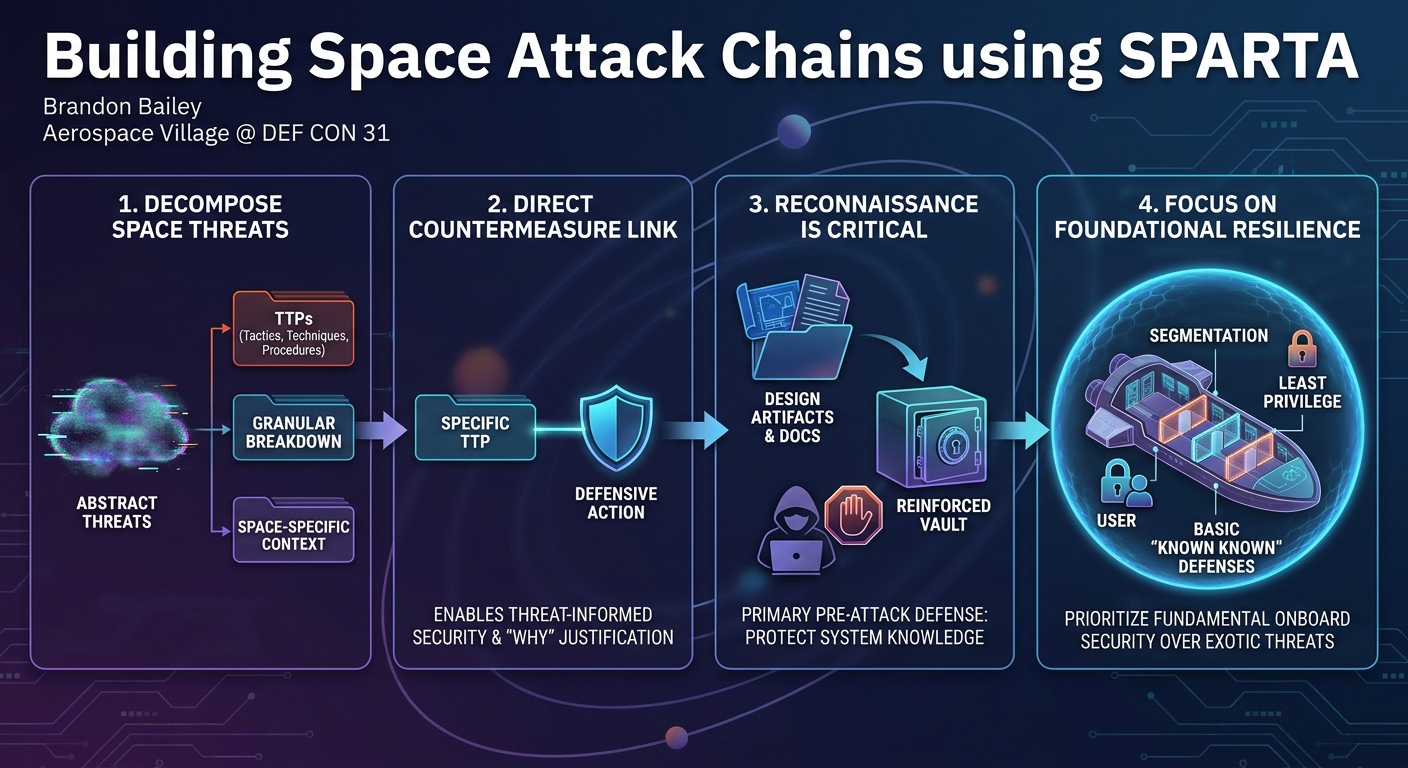
Therefore, defenders must prioritize implementing "known knowns" – foundational security measures that SPARTA clearly identifies. Instead of solely focusing on elusive "zero-day" vulnerabilities, the emphasis should be on shoring up these basic defenses. SPARTA champions the tenets of zero trust in space, advocating for a model where spacecraft do not inherently trust commands from the ground. This translates into concrete countermeasures such as robust segmentation, strict least privilege enforcement, and onboard validation of commands rather than blind execution. SPARTA provides a comprehensive "laundry list" of potential countermeasures, allowing users to tailor their defensive posture based on mission criticality (high, medium, or low) and specific operational constraints, ensuring that security investments are threat-informed and effective.
Key Takeaways
- SPARTA Decomposes Space Threats: The Space Attack Research and Tactic Analysis (SPARTA) framework provides a first-of-its-kind, granular breakdown of Threats, Tactics, and Procedures (TTPs) specific to space systems, moving beyond abstract "cyber boogeyman" threats.
- Direct Link to Countermeasures: SPARTA uniquely ties each space-specific TTP to corresponding countermeasures, enabling developers and defenders to understand the "why" behind security implementations and build threat-informed defenses.
- Reconnaissance is Paramount: Protecting design artifacts, fault management documentation, and command dictionaries is a critical pre-attack defensive measure, as adversaries heavily rely on this information for effective exploitation.
- Lack of Onboard Resilience: Space vehicles often lack fundamental embedded security practices like segmentation, least privilege, onboard monitoring, and secure boot, making them highly vulnerable once initial access is achieved.
- Prioritize "Known Knowns": The focus for space cybersecurity must shift to implementing basic, well-understood defenses identified by SPARTA, rather than solely chasing advanced threats or zero-day vulnerabilities.
- Crowdsourced and Evolving: SPARTA is an open-source, collaborative effort integrating insights from international partners and continually updated with new TTPs, risk assessments, and correlations to standards like NIST 800-53 and ISO 27001.
About the Speaker(s)
Brandon Bailey is a Senior Project Leader in the Cyber Assessments and Research Department at The Aerospace Corporation. In his role, he conducts extensive cybersecurity research focused on both ground systems and spacecraft systems. His work is dedicated to enhancing the protection of critical space infrastructure. With over a decade of experience, Bailey has a strong background in offensive security, having engaged in hacking ground systems, digital twins, and even real spacecraft. This practical expertise informs his development and advocacy for frameworks like SPARTA.
Reviews
Dr. Zero (Offensive Security Researcher) — STRONG ACCEPT
Framework talks usually make me want to gouge my eyes out, but Bailey actually delivers here. He maps out SPARTA—basically MITRE ATT&CK for orbital bodies—and backs it up with concrete attack chains instead of theoretical hype. If you are building or defending space systems, this is mandatory tooling.
Heather Calloway (CISO) — STRONG ACCEPT
The Aerospace Corporation has done the hard work of translating space-based cyber risk from abstract fear-mongering into an actionable, NIST-mapped control framework. SPARTA does for space what MITRE ATT&CK did for enterprise IT, giving defenders and procurement teams a measurable way to track threats and justify mitigations. If your organization operates in the aerospace supply chain or relies on commercial space assets, this is required reading for your risk committee.