Elon, Twitter and the PIA: How not to achieve privacy in aviation
Martin Strohmeier (Senior Scientist · armasuisse Science + Technology)
Aerospace Village @ DEF CON 31 · Day 2 · Aerospace Village
Overview
In his compelling talk at Aerospace Village @ DEF CON 31, Martin Strohmeier, a Senior Scientist at armasuisse Science + Technology and co-founder of the Open Sky Network, dissected the persistent and often ineffective attempts to achieve privacy in aviation. Titled "Elon X and the PIA: How not to achieve privacy in aviation," Strohmeier’s presentation served as a stark reminder that despite decades of effort and the introduction of various programs, the ability for anyone to track aircraft globally remains largely unhindered. This issue, while once niche, has been propelled into the mainstream spotlight by high-profile incidents involving celebrities and public figures, most notably Elon Musk.
Key moments
- 2:00 Real-world consequences of public aircraft tracking
- 3:20 History of US aviation privacy programs (BAR, LAB)
- 8:40 The Privacy ICAO Address (PIA) program
- 10:40 Why PIA's "mixnet" approach is ineffective
- 14:30 Elon Jet incident brings tracking mainstream
- 18:40 Global push for aviation privacy, still flawed
- 21:20 The only current solution: chartering aircraft
Elon X and the PIA: How not to achieve privacy in aviation
Speakers: Martin Strohmeier, Senior Scientist, armasuisse Science + Technology
Conference: Aerospace Village @ DEF CON 31
YouTube: https://www.youtube.com/watch?v=pK-KpG0T9QQ
Overview
In his compelling talk at Aerospace Village @ DEF CON 31, Martin Strohmeier, a Senior Scientist at armasuisse Science + Technology and co-founder of the Open Sky Network, dissected the persistent and often ineffective attempts to achieve privacy in aviation. Titled "Elon X and the PIA: How not to achieve privacy in aviation," Strohmeier’s presentation served as a stark reminder that despite decades of effort and the introduction of various programs, the ability for anyone to track aircraft globally remains largely unhindered. This issue, while once niche, has been propelled into the mainstream spotlight by high-profile incidents involving celebrities and public figures, most notably Elon Musk.
The core of Strohmeier's argument is that current privacy mechanisms, whether policy-based or technical, fail to address the fundamental realities of modern aircraft tracking. These systems are either easily circumvented by readily available crowdsourced data or are technically flawed, allowing for straightforward de-anonymization. The talk meticulously details the historical progression of these programs, from the early 2000s to the present day, exposing their limitations and the critical gap between intended privacy and actual security.
This topic is profoundly important because the consequences of pervasive aircraft tracking extend far beyond mere inconvenience. As Strohmeier highlighted, it impacts legal proceedings, influences financial markets through insights into mergers and acquisitions, and subjects individuals to unwanted scrutiny regarding their movements and environmental footprint. The continued failure to implement meaningful privacy in aviation not only exposes high-profile individuals to risk but also raises broader questions about transparency, public interest, and the responsibilities of governments and industry in an increasingly data-driven world.
Background
▶ Watch: Real-world consequences of public aircraft tracking (2:00)
The premise of the problem is straightforward: aircraft are globally trackable, and this capability is accessible to virtually anyone. The most well-known method is Automatic Dependent Surveillance-Broadcast (ADS-B), a system where aircraft broadcast their position, altitude, speed, and identification information. This data can be collected with inexpensive Software-Defined Radios (SDRs) and aggregated by numerous online platforms, making real-time flight tracking a commonplace activity. While seemingly innocuous, this pervasive transparency has significant real-world consequences. Strohmeier cited examples such as the Vice President of Equatorial Guinea, whose movements were tracked, impacting legal proceedings, and the use of flight data to infer information about mergers and acquisitions in the business world, providing an unfair advantage to those monitoring private jet movements.
Recognizing these issues, efforts to introduce some form of aviation privacy have been ongoing for over two decades, primarily driven by concerns about safety and, more recently, privacy.
The first significant attempt was the Blocked Aircraft Registration Request (BAR) program, initiated in the US around the 2000s. This program allowed individuals with safety concerns (e.g., related to stalkers) to request that their aircraft data not be publicly displayed. Administered by the National Business Aviation Association (NBAA) in conjunction with the FAA, the BAR program operated in two ways: either the FAA would withhold data about these aircraft from industry data feeds, or they would provide the data but instruct industry partners not to display it publicly. However, this program was inherently limited. It was US-only, applied only to those using FAA data feeds, and crucially, had no legal bearing on entities collecting data independently, such as through crowdsourced ADS-B networks. As Strohmeier emphasized, "security never works if you rely on policy."
A decade later, a technical attempt was made by the FAA to implement privacy through the DO-282B standard. This approach focused on randomizing the unique transponder ID of general aviation aircraft flying under Visual Flight Rules (VFR). The intention was to make continuous tracking more difficult by frequently changing the identifier. However, this initiative proved largely futile. Research by Krishna S. demonstrated that the randomized IDs could be easily correlated back to the original, real transponder ID. Furthermore, the FAA itself discouraged its use due to safety concerns, stating that it could impede search and rescue efforts in emergencies.
In 2018, the BAR program was rebranded as the Limiting Aircraft Data Display (LADD) program. While it moved the responsibility of maintaining the list of privacy-concerned individuals directly to the FAA, lending it more legal weight, it offered no substantial technical changes. It remained a policy-based exclusion from FAA data feeds, leaving it equally vulnerable to circumvention by non-FAA data sources.
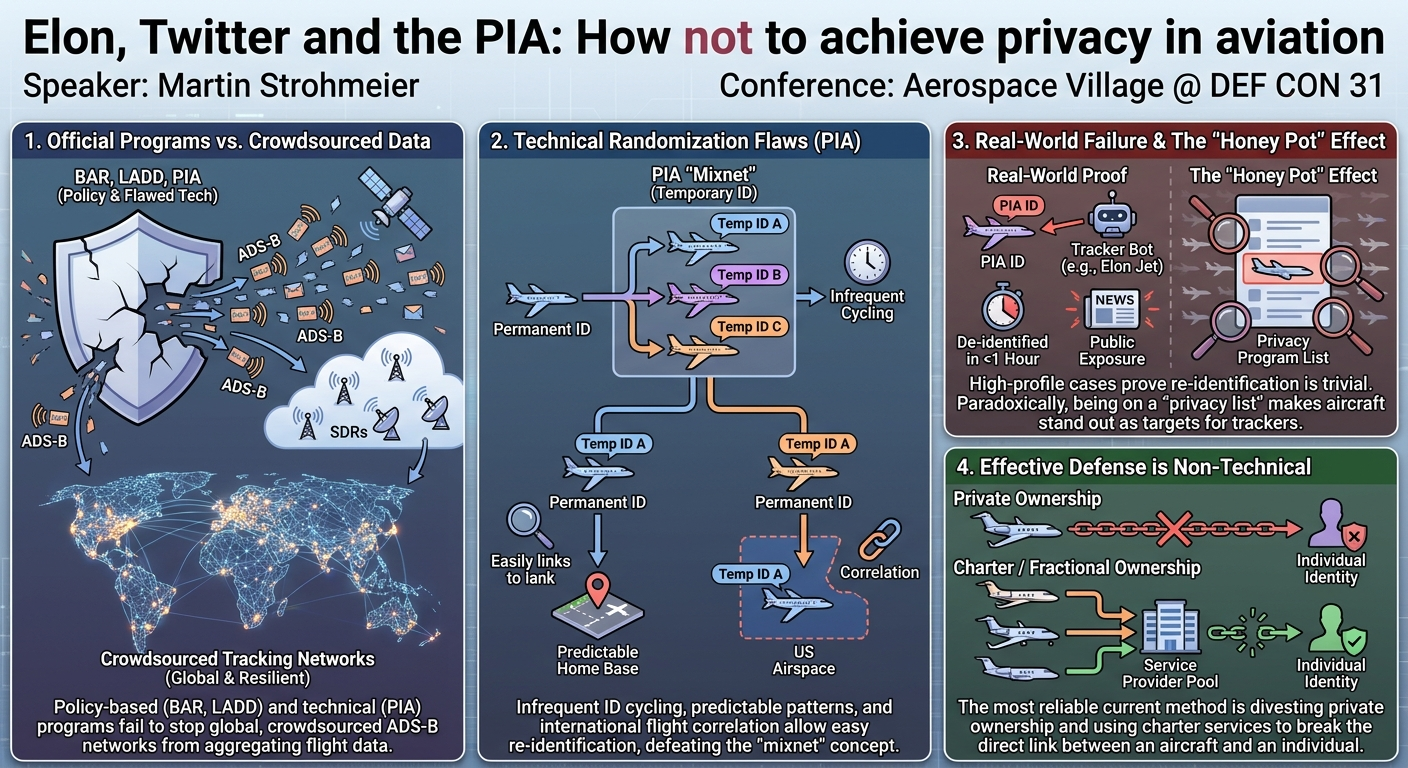
Finally, the most recent and significant effort is the Privacy ICAO Address (PIA) program. This program, also run by the FAA, is a second attempt at using temporary, random identifiers, this time for all aircraft in US airspace. The goal is to provide a periodically changing ICAO address to prevent continuous tracking. However, as Strohmeier elaborates, the PIA program is fraught with practical and technical limitations that render it largely ineffective.
Key Findings
▶ Watch: The Privacy ICAO Address (PIA) program (8:40)
Martin Strohmeier's talk revealed several critical findings regarding the state of aviation privacy:
- Ineffectiveness of Current Programs: Existing privacy schemes like BAR, LADD, and PIA are fundamentally ineffective against determined tracking, particularly when leveraging widely available crowdsourced ADS-B data. These programs primarily rely on policy or flawed technical implementations that are easily bypassed.
- Flawed Technical Randomization: Attempts to randomize aircraft identifiers, such as the DO-282B standard and the PIA program, suffer from inherent technical vulnerabilities. These flaws, including insufficient participant numbers, infrequent identifier cycling, and predictable flight patterns, allow for straightforward de-anonymization and correlation of temporary IDs with permanent aircraft identities.
- Mainstream Awareness via "Elon Jet": The "Elon Jet" phenomenon and similar tracking bots brought the issue of aviation tracking into the mainstream, demonstrating the ease with which high-profile individuals can be tracked and exposing the public to the climate impact of private jet usage. This incident served as a real-world, high-visibility validation of the technical weaknesses Strohmeier and others had identified.
- The "Honey Pot" Effect: Counterintuitively, participation in privacy programs like PIA can make an aircraft more conspicuous. By providing lists or filters for "privacy-concerned" aircraft, these programs inadvertently create a "honey pot" for aviation enthusiasts and trackers, who specifically target these few, easily identified aircraft rather than the thousands of others in the sky.
- Non-Technical Solutions are Currently Most Effective: For individuals seeking genuine privacy from programmatic tracking, the only currently effective solution is non-technical: divesting private jets and utilizing charter services or fractional ownership. This approach breaks the direct attribution of a specific aircraft to an individual, making automated tracking much harder.
- Growing Policy Push, Lacking Honest Discussion: There is increasing pressure from various stakeholders, including international bodies (e.g., ICAO via Saudi Arabia), national governments (US Congress), and regional blocs (Europe), to implement more robust aviation privacy. However, Strohmeier notes a lack of "honest discussion" about the necessary trade-offs between privacy, safety, and transparency, raising concerns that future efforts may repeat past mistakes without a fundamental re-evaluation.
Technical Deep Dive
▶ Watch: Why PIA's "mixnet" approach is ineffective (10:40)
The technical core of aircraft tracking revolves around the Automatic Dependent Surveillance-Broadcast (ADS-B) system. Aircraft equipped with an ADS-B transponder continuously broadcast their position, altitude, speed, and a unique 24-bit ICAO address (also known as a Mode S transponder ID). This data is unencrypted and openly transmitted on the 1090 MHz frequency. Crucially, this signal can be readily received by inexpensive Software-Defined Radios (SDRs), which cost as little as $10-20. Networks like FlightRadar24, FlightAware, and the speaker's own Open Sky Network aggregate data from tens of thousands of volunteer-operated ground receivers globally, creating a comprehensive, real-time picture of global air traffic.
Early attempts at aviation privacy, such as the BAR and LADD programs, were not technical solutions at all. They relied purely on policy: the FAA would either filter data before providing it to commercial tracking services or request that these services voluntarily withhold specific aircraft data. This approach was inherently weak because it only applied to data originating from FAA radar feeds and had no legal or technical control over independent, crowdsourced ADS-B networks. As Strohmeier noted, any tracker not reliant on FAA data could and did continue to display these "private" aircraft.
The first technical endeavor to introduce anonymity was an FAA implementation of the DO-282B standard over a decade ago. This standard aimed to randomize the unique transponder ID for general aviation aircraft flying under Visual Flight Rules (VFR). The idea was that if an aircraft's identifier changed frequently, it would be difficult to continuously track. However, this implementation was critically flawed. Research published by Krishna S. demonstrated that despite the randomization, it was still possible to easily correlate the randomized IDs back to the original, permanent transponder ID. This vulnerability stemmed from consistent flight patterns or other metadata that allowed for deterministic linkage. Moreover, the FAA itself advised against using this feature, citing that it could hinder search and rescue operations, providing a strong disincentive for pilots to adopt it.
The most recent and ambitious technical attempt is the Privacy ICAO Address (PIA) program. This program allows aircraft operating in US airspace to use a temporary, randomized ICAO address instead of their permanent one. The process, however, is highly bureaucratic and complex. An aircraft owner must apply to the FAA, undergo certification and testing, and then manually enter the new temporary ICAO address before each flight. These temporary addresses are typically valid for a minimum of 60 business days, making frequent changes impractical. The intention behind PIA is to create a "mixnet" effect, similar to how Tor operates, where numerous participants changing their identifiers would obscure individual movements.
However, Strohmeier vividly explained why PIA fails as a mixnet:
- Too Few Participants: For a mixnet to be effective, a large number of participants must be using it simultaneously. The PIA program has very few adopters, meaning that "if you're the only one using it, it's quite trivial to find you."
- Infrequent Cycling: The 60-business-day minimum for ID changes is far too long. Effective mixnets require frequent and unpredictable identifier changes to maintain anonymity.
- Correlation at Airports: An aircraft enters an airport with one ID and later departs with a new PIA ID. If few aircraft are using PIA, or if the airport traffic is low, it becomes straightforward to link the incoming and outgoing IDs, effectively de-anonymizing the flight. Strohmeier highlighted an Aerospace Village CTF from 2020 that successfully demonstrated this exact de-anonymization technique.
- International Flight Limitations: The PIA program is US-only. When a PIA-enabled aircraft leaves US airspace, it must revert to its original, permanent ICAO address. This provides an immediate and undeniable link between the PIA address and the true identity of the aircraft, especially for high-profile individuals who frequently travel internationally.
- Flight Pattern Analysis: Business aircraft and high-profile individuals often have predictable flight patterns, frequently returning to specific "home airports" or known destinations. If an aircraft using a PIA address is the only one flying to a particular small, known home airport, its identity is easily inferred. Furthermore, external metadata, such as public press releases about an individual's presence at an event, can be correlated with flight data to identify aircraft in the vicinity, negating any anonymity.
- "Honey Pot" Effect: Paradoxically, the PIA program, by creating a list of "privacy-concerned" aircraft, makes these few aircraft stand out. Aviation enthusiasts and trackers can easily filter for PIA-registered planes, turning them into targets of specific interest rather than blending them into the general air traffic.
The case of Elon Musk, who attempted to use PIA, perfectly illustrated these failures. A "first-year computer science student" was able to re-identify Musk's jet within an hour, demonstrating the practical ineffectiveness of the program.
Demo / Proof of Concept
▶ Watch: Global push for aviation privacy, still flawed (18:40)
While Martin Strohmeier's talk did not feature a live, interactive demonstration, it heavily referenced two critical real-world and simulated proof-of-concept scenarios that underscore the ineffectiveness of aviation privacy measures.
Firstly, Strohmeier explicitly mentioned a Capture The Flag (CTF) challenge run at the Aerospace Village in 2020. This CTF provided participants with data from aircraft using randomized transponder IDs and tasked them with de-anonymizing these flights. The fact that such a challenge was successfully completed by participants serves as a direct proof of concept that the technical flaws in ID randomization (similar to those in DO-282B and PIA) are exploitable in practice. The challenge essentially simulated the "mixnet failure" scenario, where correlating incoming and outgoing IDs at an airport, or observing flight patterns, allowed for the re-identification of aircraft despite their temporary identifiers.
Secondly, the entire "Elon Jet" saga, which formed a central narrative of the talk, functions as a high-profile, real-world demonstration of the PIA program's failure. Elon Musk, a prominent figure, specifically enrolled his private jet in the PIA program to avoid being tracked. However, as Strohmeier reported, the student behind the "Elon Jet" account was able to re-identify Musk's aircraft within "an hour" of it using a PIA address. This incident, which garnered international media attention, unequivocally proved that the PIA program's randomized identifiers and bureaucratic cycling process were insufficient to prevent determined and technically savvy trackers from continuous monitoring. It perfectly illustrated the vulnerabilities arising from too few participants, predictable flight patterns, and the ability to correlate flight data with external information. These two examples, one a controlled exercise and the other a public spectacle, collectively serve as compelling proof points for the technical claims made in the presentation.
Defensive Implications
▶ Watch: The only current solution: chartering aircraft (21:20)
For individuals, organizations, and even governments seeking genuine privacy in aviation, Martin Strohmeier's analysis carries profound defensive implications. The primary takeaway is that current official "privacy" programs are largely ineffective and offer a false sense of security. Relying on initiatives like BAR, LADD, or PIA will not prevent determined adversaries or even curious enthusiasts from tracking aircraft movements.
Defenders must recognize that crowdsourced ADS-B data is the primary threat vector to aviation privacy. Unlike FAA-controlled data feeds, these networks operate globally, are not bound by US-centric policies, and are robustly resilient to attempts at policy-based data suppression. Therefore, any strategy for aviation privacy must account for the pervasive nature of ADS-B collection via inexpensive SDRs.
Technical solutions implemented to date, such as the randomization of transponder IDs in DO-282B or the temporary ICAO addresses in PIA, have proven to be fundamentally flawed. They are susceptible to correlation attacks based on factors like entry/exit points at airports, infrequent ID cycling, and the need to revert to permanent IDs in international airspace. Furthermore, predictable flight patterns, especially to small, known home airports, and the availability of external metadata (e.g., public announcements of an individual's location) can easily negate any attempted anonymity. Defenders should assume that any flight using these "private" IDs is still traceable.
Crucially, the "honey pot" effect described by Strohmeier means that enrolling in a privacy program can inadvertently increase scrutiny. By marking an aircraft as "privacy-concerned," it becomes a target of interest for trackers, making it stand out from the thousands of other aircraft in the sky. Therefore, entities seeking to avoid attention should consider whether such enrollment is counterproductive.
The most effective "defense" against programmatic aircraft tracking, as highlighted by Strohmeier, is currently non-technical:
- Sell private jets and utilize charter services or fractional ownership: This strategy breaks the direct attribution of a specific tail number to an individual or entity, making it significantly harder for automated bots to link flight activity to a particular person.
- Diversify flight patterns: Avoid consistently flying to the same few airports, especially smaller, less busy ones where correlation is easier.
- Control associated metadata: Be mindful of public announcements, social media posts, or press releases that could inadvertently reveal an individual's location and thus aid in correlating flight data.
For policymakers and the aviation industry, the defensive implication is a call for an "honest discussion" about the trade-offs inherent in aviation privacy. Simply pushing for more random IDs without addressing the fundamental technical vulnerabilities, the global nature of data collection, and the balance between privacy, safety (e.g., search and rescue), and public transparency (e.g., climate impact, accountability of public figures) will lead to continued failure. Future solutions must be designed with a deep understanding of these complex interdependencies and the limitations of current technologies. Without such an honest assessment, new initiatives are likely to be mere rebrandings of old, ineffective approaches.
Key Takeaways
- Current aviation privacy programs (BAR, LADD, PIA) are largely ineffective against determined tracking, especially given the widespread availability of crowdsourced ADS-B data.
- Technical attempts to randomize aircraft identifiers (e.g., DO-282B, PIA) are fundamentally flawed, allowing for easy de-anonymization through correlation attacks, infrequent ID cycling, and predictable flight patterns.
- The "Elon Jet" incident and similar public tracking bots brought the vulnerabilities of aviation privacy into the mainstream, demonstrating real-world failures of programs like PIA.
- Paradoxically, enrolling in official privacy programs can make "private" aircraft more conspicuous, acting as a "honey pot" for trackers.
- For high-profile individuals seeking genuine privacy from programmatic tracking, the most effective current solution is non-technical: selling private jets and utilizing charter services or fractional ownership.
- There's an urgent need for an "honest discussion" among stakeholders (governments, industry, public) about the complex trade-offs between aviation privacy, safety, and transparency before effective, globally applicable solutions can be designed.
About the Speaker(s)
Martin Strohmeier is a distinguished Senior Scientist at the Swiss Cyber Defense Campus, part of armasuisse Science + Technology in Switzerland. In this role, he focuses on security and privacy research within critical infrastructures, with a particular emphasis on aviation, satellites, and transport systems. Beyond his day job, he is also a co-founder and board member of the Open Sky Network, a non-profit organization that operates a crowdsourced air traffic network, similar to commercial trackers like FlightRadar24, but dedicated to making aviation data available for research purposes globally. Strohmeier has been actively analyzing aviation security issues for over a decade and has published his extensive research in major academic and industry venues, making him a recognized expert in the field. He also holds a position as a visiting fellow at St. Edmund's College, University of Cambridge.
Reviews
Dr. Zero (Offensive Security Researcher) — STRONG ACCEPT
Strohmeier delivers a brutal, necessary reality check on why the FAA's aviation privacy programs are mathematically and functionally useless. If you want to know why bolting a broken mixnet onto ADS-B fails, this is your talk. It's a masterclass in how policy won't save you from basic signal intelligence.
Heather Calloway (CISO) — STRONG ACCEPT
A surgical dismantling of aviation privacy programs that proves corporate and executive flight activity is functionally public. If your company operates a private fleet for executive travel or M&A activities, this research dictates an immediate pivot in your executive protection and operational security strategies.