Labs and Trust: How to build a successful aviation cybersecurity research programme
Martin Strohmeier (Senior Scientist · armasuisse Science + Technology)
Aerospace Village @ DEF CON 31 · Day 2 · Aerospace Village
Overview
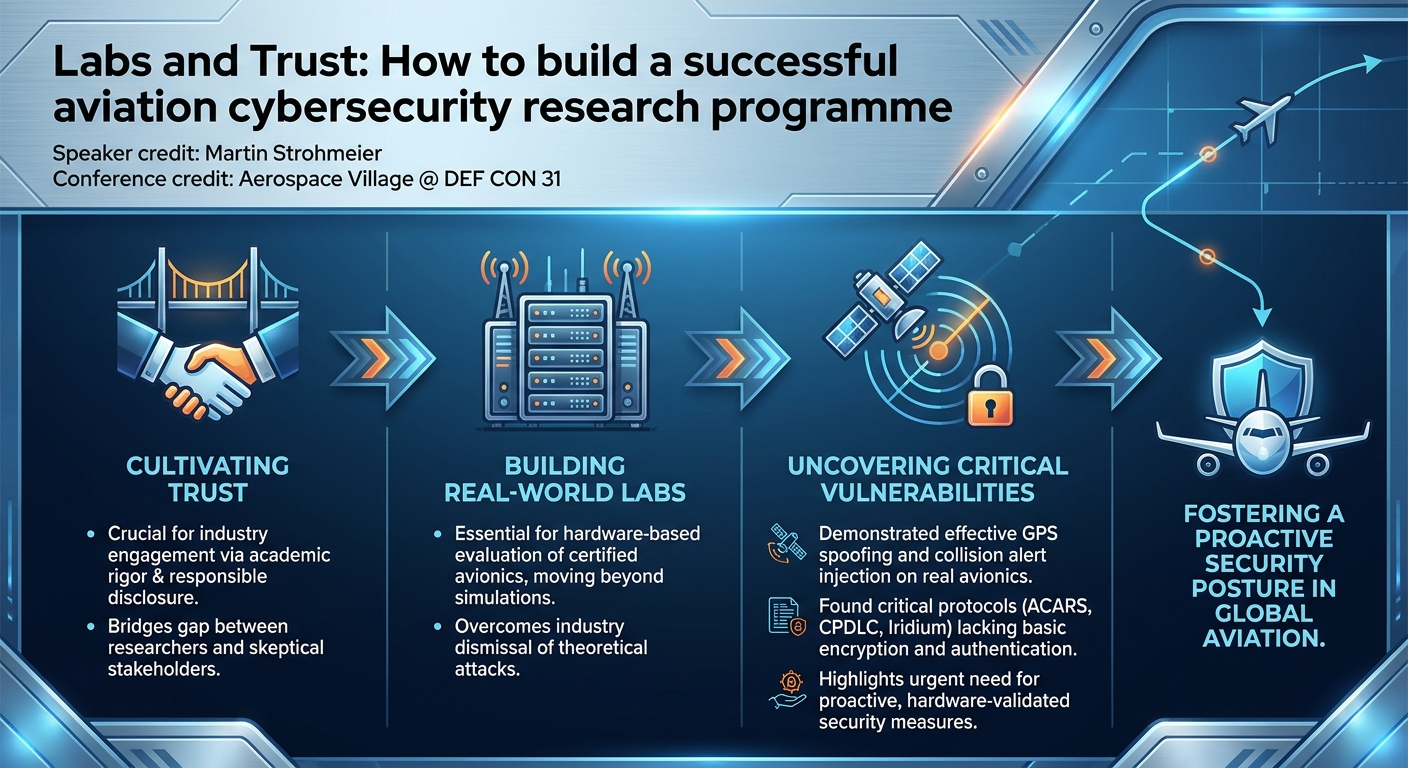
In an era where cybersecurity threats loom large over critical infrastructure, the aviation sector faces unique challenges in validating and addressing potential vulnerabilities. Martin Strohmeier, a Senior Scientist at the Swiss cyber defense campus (armasuisse Science + Technology), delivered a compelling talk at the Aerospace Village @ DEF CON 31, detailing his team's decade-long journey in establishing a successful aviation cybersecurity research program. The presentation, titled "Labs and Trust," meticulously outlines the strategic approach required to bridge the chasm between academic security research and the highly regulated, often skeptical, aviation industry.
Key moments
- 0:00 Introduction to aviation cybersecurity research program
- 4:00 Four steps for building trust in security research
- 10:00 Disclosure challenges: 'not encryption' example
- 13:00 Why real avionics hardware is essential for research
- 17:00 First avionics lab setup and architecture
- 19:00 Initial lab findings: GPS spoofing and collision attacks
- 21:00 Expanding the lab: CPDLC, SatCom, EFBs, MLAT
- 23:00 Key takeaways and call for collaboration
Labs and Trust: How to build a successful aviation cybersecurity research programme
Speakers: Martin Strohmeier, Senior Scientist, armasuisse Science + Technology
Conference: Aerospace Village @ DEF CON 31
YouTube: https://www.youtube.com/watch?v=jfPp_2QrEhI
Overview
In an era where cybersecurity threats loom large over critical infrastructure, the aviation sector faces unique challenges in validating and addressing potential vulnerabilities. Martin Strohmeier, a Senior Scientist at the Swiss cyber defense campus (armasuisse Science + Technology), delivered a compelling talk at the Aerospace Village @ DEF CON 31, detailing his team's decade-long journey in establishing a successful aviation cybersecurity research program. The presentation, titled "Labs and Trust," meticulously outlines the strategic approach required to bridge the chasm between academic security research and the highly regulated, often skeptical, aviation industry.
Strohmeier's core thesis revolves around two intertwined pillars: cultivating trust with industry stakeholders and building sophisticated labs capable of performing realistic, hardware-based evaluations. The talk transcends mere technical exploits, delving into the intricate political, social, and logistical hurdles faced by researchers aiming to improve aviation safety. By sharing both successes and frustrations, Strohmeier provides a roadmap for independent and government-affiliated entities seeking to conduct impactful, responsible cybersecurity research in an environment where the stakes are literally sky-high.
This article dissects Strohmeier's insights, emphasizing the methodologies for establishing credibility, navigating disclosure processes, and the indispensable role of physical testbeds equipped with certified avionics hardware. It highlights the critical need for moving beyond simulations to demonstrate the tangible impact of vulnerabilities, thereby fostering a proactive security posture within the global aviation ecosystem.
Background
▶ Watch: Introduction to aviation cybersecurity research program (0:00)
The landscape of aviation cybersecurity research has historically been fraught with tension. Early attempts by independent researchers to highlight vulnerabilities often resulted in sensationalized media headlines—"planes falling out of the sky"—which, while grabbing attention, alienated the very industry they sought to inform. As Strohmeier points out, the Federal Aviation Administration (FAA) and other aviation bodies typically dismiss such claims, either knowing them to be untrue or strongly disagreeing with their portrayal. Conversely, an equally problematic response from the industry has been the "nothing to see here" attitude, often asserting that systems are inherently safe due to redundancy, despite known vulnerabilities in underlying technologies. This dichotomy created a trust deficit, hindering genuine collaboration and progress.
Recognizing this challenge, Strohmeier and his team at armasuisse Science + Technology embarked on a mission over a decade ago to establish a research program grounded in academic rigor and responsible engagement. Their initial work focused on understanding the myriad of aircraft communication and wireless communication technologies across different flight phases, publishing over 60 papers with 50 co-authors from more than 20 institutions. This extensive background covered technologies like ADS-B, ACARS, Multi-lateration (MLAT), and various collision avoidance systems.
The core problem they encountered was the industry's skepticism towards simulated attacks. While academic papers and DEF CON talks could demonstrate theoretical vulnerabilities using Software-Defined Radios (SDRs), aviation experts frequently argued that these attacks "cannot be done in a real aircraft" due to unspecified "redundancy" or "black magic." This fundamental disconnect underscored the need for a new approach: one that could definitively prove the real-world impact of security flaws on certified avionics hardware. The journey to build this bridge involved a deliberate four-step strategy: adopting a rigorous academic approach to avoid sensationalism, engaging in responsible disclosure with industry partners, conducting thorough impact evaluations that consider the entire system, and crucially, performing real-world evaluations with actual hardware.
Key Findings
▶ Watch: Disclosure challenges: 'not encryption' example (10:00)
Strohmeier’s extensive research program has yielded several critical findings, both about specific technical vulnerabilities and the broader challenges of engaging the aviation industry on cybersecurity.
Firstly, a consistent overarching conclusion from their research is that, despite the prevalence of vulnerabilities, "no one's falling out of the sky" due to a single exploit. However, he quickly qualifies this by stating that "in very specific circumstances that can absolutely be relevant problems." This nuanced perspective is crucial for building trust, as it avoids alarmism while still highlighting legitimate risks. The key is to assess the holistic impact across the complex ecosystem of aviation systems, rather than focusing on isolated components.
The team's experience with responsible disclosure has revealed a mixed bag of responses. A positive example involved the discovery of ACARS (Aircraft Communications Addressing and Reporting System) data links transmitting credit card data in the clear. After reporting this to several airlines, it took "a few years" due to the slow pace of industry processes, but these vulnerabilities were eventually fixed. This demonstrated that, with persistence, positive change is possible.
Conversely, Strohmeier shared a frustrating negative example concerning a data link system where the manufacturer claimed to use "encryption," which was, in reality, a monoalphabetic substitution cipher—effectively just obfuscation. When confronted, the manufacturer's arguments included: "it's not encryption, it's just obfuscation," "there's no sensitive data on these data links," "no industry standards tell us to do security," and "everyone using this sort of encryption... knows it's not encryption." This highlights a significant industry mindset issue, where a lack of formal standards or a belief in "security by obscurity" can impede the adoption of robust cryptographic measures, even when the software interface explicitly states "encrypt downlink." This finding underscores a critical gap in understanding and implementation of fundamental security principles within parts of the aviation supply chain.
The most significant technical finding, and the driving force behind the "Labs" component of the talk, is the proven efficacy of radio frequency (RF) attacks against certified avionics hardware. Prior to their lab, the industry often dismissed such attacks as theoretical or impossible in a real-world scenario. However, Strohmeier's team demonstrated that:
- GPS spoofing is effective against common avionics systems like the Garmin GTM 750, GTX 3000, and GTS 8000. They could make an aircraft system believe it was flying at 10,000 feet or located in Scandinavia, using readily available SDRs and open-source software.
- ADS-B (Automatic Dependent Surveillance-Broadcast) and collision avoidance systems are vulnerable to out-of-the-box attacks, allowing the injection of false aircraft and collision alerts. While achieving a "full resolution advisory" from a Traffic Alert and Collision Avoidance System (TCAS) required further work, the initial impact was undeniable.
- CPDLC (Controller-Pilot Data Link Communication), a system being widely rolled out in Europe and the US, was found to be unencrypted and unauthenticated. This allows researchers to connect to real ground stations, capture data, and analyze the protocol for potential attack vectors.
- The Iridium Satcom system, offered by Garmin avionics for emails, SMS, and calls, was also found to be unencrypted, making it "quite trivial to find your own calls and your own SMS on this system."
These findings, rooted in real hardware testing, are instrumental in overcoming industry skepticism and demonstrating that theoretical vulnerabilities can indeed manifest as practical threats with significant implications for aviation safety and operations.
Technical Deep Dive
▶ Watch: First avionics lab setup and architecture (17:00)
The cornerstone of Strohmeier's presentation is the detailed exposition of how armasuisse Science + Technology constructed a pioneering aviation cybersecurity research lab focused on real-world hardware evaluations. The primary motivation was to move beyond simulations and SDR-based attacks to prove that RF vulnerabilities could impact certified avionics systems directly. Before this initiative, while there were isolated efforts like a US Department of Homeland Security program allowing access to real aircraft (which quietly ended), no public, extensible lab existed for independent researchers.
Building such a lab presented numerous challenges. It involved navigating "fairly uncharted ground," as most existing testbeds were internal to OEMs like Airbus or Pilatus, often under strict Non-Disclosure Agreements (NDAs). Avionics manufacturers were often reluctant to collaborate, especially with universities. A critical trade-off was managing cost versus realism versus complexity. Realistic systems can quickly escalate to "six figures" in cost, making it tempting to "just buy an aircraft." However, working on a full aircraft introduces immense complexity for debugging and isolated system testing, making a dedicated lab more practical.
The high-level concept for their lab centered on several key requirements:
- Certified/Certifiable Avionics Hardware: The systems needed to genuinely believe they were deployed in a real, flying aircraft.
- Full Radio Frequency (RF) Interfaces: The lab required numerous antennas to facilitate over-the-air communication, enabling spoofing, jamming, and fuzzing tests.
- Extensibility: The initial setup needed to be modular, allowing for the integration of more technologies in the future.
The first iteration of the lab featured hardware from Garmin: specifically, the GTM 750, GTX 3000 (transponder), and GTS 8000 (Traffic Advisory System/TCAS). These components were integrated by certified aviation integrators, ensuring they functioned as they would in an actual aircraft. The system was equipped with the correct antennas for various functions, including collision avoidance, transponder operations, and GNSS (Global Navigation Satellite System). A crucial simulation component involved feeding barometric altitude data via a PC, which was necessary to convince the avionics system that it was airborne at, for example, 10,000 feet, rather than stationary on the ground.
Safety was paramount for RF testing. The lab incorporated large Faraday cages and anechoic chambers, allowing researchers to transmit signals freely without interfering with external systems or bothering anyone. The entire setup was housed in a full rack, controllable via a touchscreen interface identical to what a pilot would use.
Initial testing confirmed several well-known theoretical attacks:
- GPS Spoofing: Using SDRs and openly available software, the team successfully demonstrated GPS spoofing against the Garmin avionics. The system could be made to believe it was located in Scandinavia or actively flying, despite being stationary in Switzerland. This directly countered the "it can't be done" argument.
- ADS-B and Collision Avoidance Systems: The lab proved that it was possible to send false aircraft and collision warnings. While achieving a "full resolution advisory" from the TCAS required more advanced techniques, the ability to inject misleading traffic information was clearly demonstrated.
The lab's design emphasized extensibility, leading to several significant additions:
- CPDLC (Controller-Pilot Data Link Communication): To research this increasingly vital system, the team acquired Universal Avionics hardware. They collaborated with their local ANSP (Air Navigation Service Provider) and Eurocontrol to establish a connection to a real ground station. This allowed them to log in, capture unencrypted and unauthenticated data, and perform in-depth protocol analysis to identify attack vectors.
- Iridium Satcom: Leveraging the Garmin system's capability, they added the Iridium Satcom system, which enables email, SMS, and voice calls via avionics hardware. Crucially, Iridium was found to be unencrypted, making it straightforward to intercept communications.
- Electronic Flight Bags (EFBs): Recognizing the growing integration of personal devices, the lab was extended to connect phones and iPads to the flight management computer via Bluetooth and Wi-Fi, creating new avenues for security research.
- MLAT (Multilateration) System: In a practical move for Swiss airspace, a local MLAT system was built. MLAT is often considered a backup for other systems like ADS-B, and its inclusion in the lab allows for security research into its robustness and potential vulnerabilities.
The ongoing research leverages this unique testbed, inviting collaborations from various companies and countries. The detailed, hardware-centric approach of this lab stands as a critical advancement in aviation cybersecurity, providing irrefutable evidence of vulnerabilities that were previously dismissed as theoretical.
Demo / Proof of Concept
▶ Watch: Initial lab findings: GPS spoofing and collision attacks (19:00)
While the talk itself was a presentation, Martin Strohmeier alluded to and presented visual evidence of several compelling demonstrations and proofs of concept conducted within their aviation cybersecurity lab. The most striking of these was the GPS spoofing demonstration. Using Software-Defined Radios (SDRs) and publicly available software, the team successfully tricked the certified Garmin avionics systems (GTM 750, GTX 3000, GTS 8000) into believing they were in a different geographical location entirely, such as Scandinavia, despite the physical lab being located in Switzerland. More impressively, they could make the system believe the aircraft was actively flying, illustrating a critical vulnerability that could disorient pilots or interfere with navigation systems.
Another key demonstration involved attacks on ADS-B (Automatic Dependent Surveillance-Broadcast) and collision avoidance systems. The lab setup allowed researchers to inject false aircraft signals and collision warnings directly into the avionics. While achieving a full "resolution advisory" from the TCAS (Traffic Alert and Collision Avoidance System) was noted as an ongoing area of research, the ability to generate misleading traffic information demonstrated a clear potential for operational disruption and safety hazards.
The integration of the CPDLC (Controller-Pilot Data Link Communication) system provided a proof of concept for real-world data interception and analysis. By connecting their Universal Avionics hardware to a live Eurocontrol ground station, the team could log in, capture the unencrypted and unauthenticated data, and analyze the protocol. This demonstrated the feasibility of understanding and potentially manipulating critical air traffic control communications. Similarly, the interception of unencrypted communications over the Iridium Satcom system served as a proof of concept for the ease with which private calls and SMS messages could be monitored when transmitted via the aircraft's avionics.
These demonstrations, conducted on certified, real-world avionics hardware within a controlled laboratory environment, provided undeniable evidence of the practical applicability and impact of previously theoretical cybersecurity vulnerabilities. They served as crucial validation points, helping to overcome the skepticism often encountered from the aviation industry regarding "simulated" attacks.
Defensive Implications
▶ Watch: Key takeaways and call for collaboration (23:00)
The detailed findings from Strohmeier's "Labs and Trust" initiative carry profound implications for cybersecurity defenders across the aviation ecosystem—from manufacturers and airlines to regulators and air traffic control. The central message is an urgent call for a paradigm shift: moving from skepticism and a reliance on "security by obscurity" or unverified redundancy, towards proactive, transparent, and hardware-validated security measures.
First and foremost, manufacturers must re-evaluate their approach to security. The example of the "monoalphabetic substitution cipher" being marketed as encryption is a stark reminder that fundamental security principles are sometimes overlooked. It highlights the need for robust, peer-reviewed cryptographic solutions and transparent communication about security capabilities, rather than relying on the absence of industry standards or the assumption that "everyone knows" a system is insecure. Manufacturers should actively collaborate with independent researchers and embrace responsible disclosure processes, viewing them as opportunities for improvement rather than threats.
Regulators and standards bodies (e.g., FAA, EASA, ICAO) must accelerate the development and enforcement of stringent cybersecurity standards for all critical avionics systems, particularly for widely deployed communication protocols. The proven vulnerabilities in ACARS, CPDLC, and Iridium Satcom—all found to be unencrypted and/or unauthenticated—underscore a systemic failure to implement basic security controls in systems vital for air-to-ground communication and navigation. Mandating strong encryption, authentication, and integrity checks should be a top priority.
For airlines and operators, the findings necessitate a greater awareness of the real-world attack surface. The demonstrated GPS spoofing capabilities against certified avionics mean that reliance solely on GPS for navigation without robust anti-spoofing or alternative navigation systems (like inertial navigation or enhanced MLAT) is a significant risk. Operators need to assess their operational procedures and pilot training to account for potential data link manipulation and the injection of false information. Investing in more secure communication alternatives and understanding the limitations of existing systems is crucial.
The success of the armasuisse lab also champions the importance of investment in realistic testbeds. Defenders cannot effectively secure systems without understanding how they fail in a real-world context. This means allocating resources for hardware-in-the-loop testing, establishing internal security labs, or actively collaborating with external research institutions that possess such capabilities. Validating defensive measures against actual attack vectors, rather than purely theoretical models, is essential for building true resilience.
Finally, the emphasis on building trust is a defensive strategy in itself. By fostering open communication and collaboration with the cybersecurity research community, the aviation industry can leverage external expertise to identify vulnerabilities before they are exploited maliciously. This collaborative approach, coupled with a commitment to transparent disclosure and timely remediation, forms the strongest defense against an evolving threat landscape. The goal is not just to fix specific flaws, but to cultivate a security culture that is proactive, adaptable, and deeply informed by real-world testing.
Key Takeaways
- Building Trust is Paramount: Establishing credibility with the aviation industry, regulators, and manufacturers through academic rigor, responsible disclosure, and holistic impact assessment is challenging but essential for effective cybersecurity research.
- Real-World Hardware Testing is Indispensable: Simulations and SDR-based attacks are valuable, but demonstrating vulnerabilities on certified, real-world avionics hardware is crucial to overcome industry skepticism and prove the tangible impact of security flaws.
- Critical Protocols Lack Basic Security: Many widely used aviation communication systems, including ACARS, CPDLC, and Iridium Satcom, are deployed without proper encryption or authentication, leaving them vulnerable to interception and manipulation.
- GPS Spoofing is a Demonstrated Threat: Attacks like GPS spoofing have been successfully demonstrated against certified avionics, capable of misleading aircraft navigation systems about location and flight status.
- Collaboration is Key to Progress: Fostering wide-ranging collaboration between independent researchers, government entities, universities, and industry stakeholders is vital for identifying and mitigating aviation cybersecurity risks effectively.
- Invest in Dedicated Research Labs: The development and utilization of specialized labs equipped with certified avionics and RF testing capabilities are critical for advancing the state of aviation cybersecurity research and validating defensive strategies.
About the Speaker(s)
Martin Strohmeier is a Senior Scientist at the Swiss cyber defense campus, part of armasuisse Science + Technology, located in Zurich. He also holds a position as a Visiting Fellow of Kellogg College. With over a decade of dedicated research in aviation cybersecurity, Strohmeier has been a prolific contributor to the field, co-authoring over 60 papers with collaborators from more than 20 institutions globally. His work focuses on open security research, particularly with real avionics hardware, and he is a strong advocate for working closely with industry and regulators to improve aviation safety. His expertise spans various aviation communication and navigation technologies, and he is a leading voice in advocating for transparent, hardware-validated security research.
Reviews
Dr. Zero (Offensive Security Researcher) — STRONG ACCEPT
Strohmeier spent a decade and God knows how much Swiss government money building a hardware-in-the-loop avionics lab just to prove aviation vendors are full of shit. This isn't theoretical SDR waving; it's spoofing a real Garmin GTM 750 to permanently kill the "it doesn't work on certified hardware" excuse. An absolute masterclass in forcing an arrogant industry to swallow its own vulnerabilities.
Heather Calloway (CISO) — MUST SEE
Martin Strohmeier’s briefing on aviation security isn’t just about spoofing avionics; it’s a playbook for breaking through institutional denial. By building a lab with certified hardware, his team removed the industry’s favorite excuse: that exploits only work in simulation. If you operate in a highly regulated, high-denial sector, this is required viewing.