Stories from the Trenches: Operating a Aeronautics Cyber Range
Christopher Ottesen (Senior Cyber Systems Security Engineer · Lockheed Martin)
Aerospace Village @ DEF CON 31 · Day 2 · Aerospace Village
Overview
In the highly specialized and safety-critical domain of aerospace, securing complex embedded avionics systems presents unique challenges that often diverge significantly from conventional IT security. Christopher Ottesen, an Embedded Avionics Penetration Tester and Senior Cyber Systems Security Engineer at Lockheed Martin, delivered a compelling talk at DEF CON 31's Aerospace Village, shedding light on the practical realities and hard-won lessons from operating an Aeronautics Cyber Range (ACR). His presentation, "Stories from the Trenches," offered a candid look at the roadblocks encountered and the solutions devised by Lockheed Martin's dedicated purple team in their mission to ensure the cyber survivability of critical weapon systems.
Key moments
- 1:50 Mission of the Aeronautics Cyber Range (ACR)
- 3:00 Five major roadblocks to running a cyber range
- 4:00 Lack of public threat intelligence for avionics
- 6:00 Challenges in locating accurate system documentation
- 10:50 Building trust with product teams for security
- 14:20 Prioritizing 'low-hanging fruit' over AI silver bullets
- 16:00 The critical importance of supply chain security
Stories from the Trenches: Operating an Aeronautics Cyber Range
Speakers: Christopher Ottesen, Senior Cyber Systems Security Engineer, Lockheed Martin
Conference: Aerospace Village @ DEF CON 31
YouTube: https://www.youtube.com/watch?v=6OMgfcNPMn4
Overview
In the highly specialized and safety-critical domain of aerospace, securing complex embedded avionics systems presents unique challenges that often diverge significantly from conventional IT security. Christopher Ottesen, an Embedded Avionics Penetration Tester and Senior Cyber Systems Security Engineer at Lockheed Martin, delivered a compelling talk at DEF CON 31's Aerospace Village, shedding light on the practical realities and hard-won lessons from operating an Aeronautics Cyber Range (ACR). His presentation, "Stories from the Trenches," offered a candid look at the roadblocks encountered and the solutions devised by Lockheed Martin's dedicated purple team in their mission to ensure the cyber survivability of critical weapon systems.
Ottesen's role within Lockheed Martin's Aeronautics business area involves a deep dive into embedded networking protocols, applications, and AR systems found in high-profile platforms like the F-35 and C-130. The ACR functions as a purple team, blending offensive and defensive security mindsets to proactively identify vulnerabilities and develop actionable mitigations throughout the product lifecycle. This talk is crucial for anyone involved in securing specialized, proprietary systems, as it highlights the necessity of bespoke approaches, the critical role of communication, and the dangers of over-reliance on generic security solutions in environments where public threat intelligence and off-the-shelf tools are scarce.
The talk underscores that while the underlying principles of cyber security remain constant, their application in aerospace demands a tailored methodology. Ottesen's insights reveal that the biggest hurdles often aren't purely technical, but rather revolve around information access, organizational dynamics, and fostering a culture of trust and continuous improvement. By sharing these "stories from the trenches," he provides a valuable roadmap for other organizations navigating the complexities of establishing and operating cyber ranges for unique, high-stakes environments.
Background
▶ Watch: Mission of the Aeronautics Cyber Range (ACR) (1:50)
Lockheed Martin's Aeronautics sector is responsible for some of the world's most advanced aircraft, including the F-16 Fighting Falcon, F-22 Raptor, F-35 Lightning II, C-130 Hercules, and the U-2 Dragon Lady. Securing these sophisticated platforms, which rely heavily on complex embedded avionics systems, is a paramount concern. This is where the Aeronautics Cyber Range (ACR) plays a critical role. Described as a purple team, the ACR's primary objective is to think like adversaries, develop tailored test objectives, conduct rigorous cyber testing, and deliver actionable mitigations to ensure the cyber survivability of Lockheed Martin's Aeronautics weapon systems throughout their entire lifecycle.
The ACR's methodology encompasses several core competencies: hardware, software, embedded networking, RF (Radio Frequency), and simulation and modeling. Ottesen's personal focus lies predominantly in software, involving extensive dynamic and static code analysis, debugging, decompiling, and exploit development. A recurring theme throughout the talk is the significant absence of publicly available tools and information relevant to the proprietary and highly specialized systems they work with. This necessitates the creation of "a crap ton of in-house tools"—a testament to the unique challenges of this domain.
The very nature of aviation's safety-critical aspects means that threat intelligence, vulnerabilities, and attack vectors are meticulously guarded, often classified, and rarely enter the public domain. This stands in stark contrast to traditional IT security, where an abundance of public data, platforms, and community knowledge exists. This scarcity of external resources forces the ACR team to adopt a highly self-reliant approach, emphasizing deep engineering analysis, internal collaboration, and a proactive mindset to anticipate and counter emerging threats. The problem isn't just about finding vulnerabilities; it's about pioneering the methods to find them in an environment where the usual signposts are absent.
Key Findings
▶ Watch: Lack of public threat intelligence for avionics (4:00)
Ottesen structured his talk around five major roadblocks and their corresponding solutions, providing a pragmatic framework for understanding the intricacies of operating a specialized cyber range. These findings highlight that many challenges are less about pure technical skill and more about information management, communication, and organizational culture.
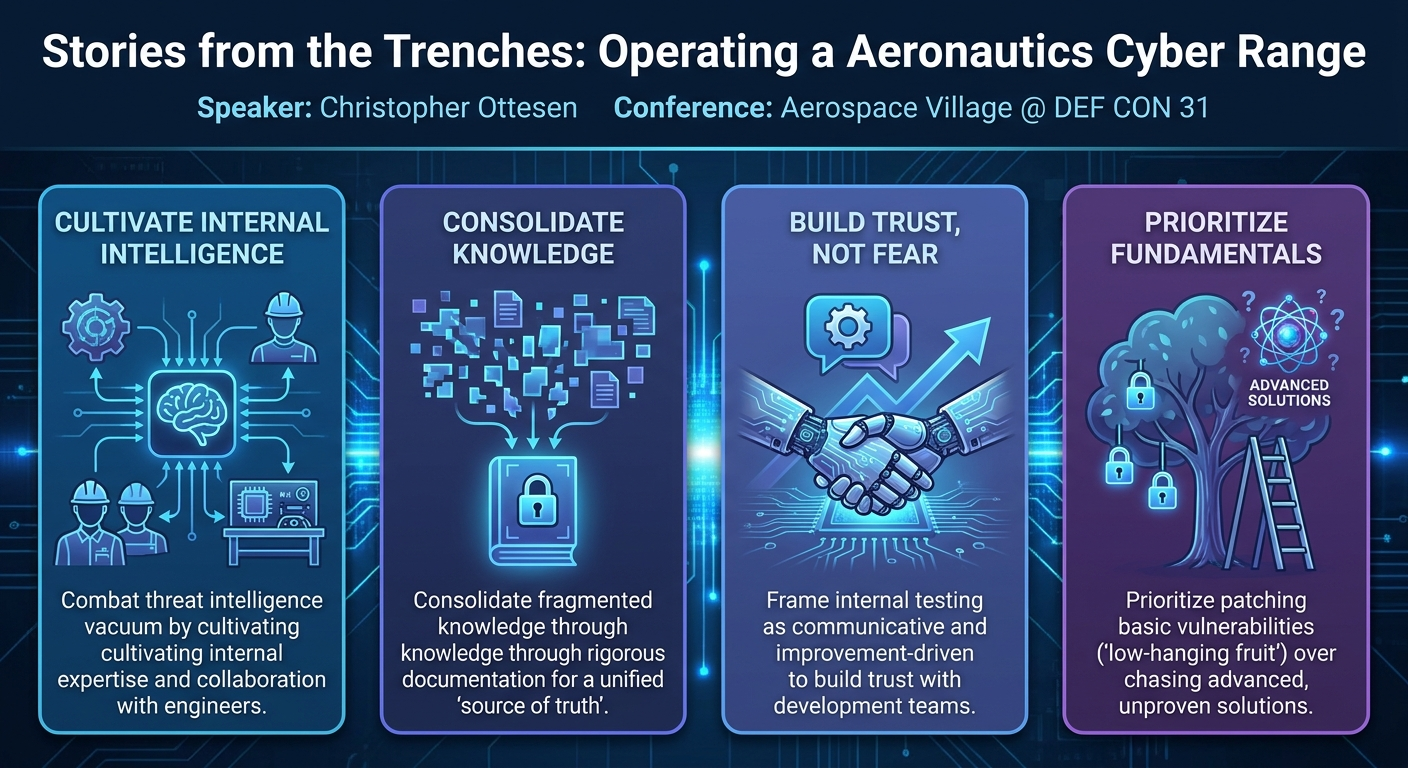
- The Threat Intelligence Vacuum:
- Barrier: Unlike traditional IT, there's a severe lack of public threat intelligence for embedded avionics and safety-critical aviation systems. Information is highly protected due to security and proprietary concerns. This makes it challenging to inform tests and understand the adversary landscape.
- Solution: The ACR team must act as its own threat intelligence source. This involves deep engineering analysis, actively thinking like the adversary, and asking "better questions." Crucially, they engage directly with product engineers and test teams—the individuals "most intimate with the system"—to gather invaluable insights into real-world operational contexts and potential weak points. This internal, collaborative approach compensates for the external data deficit.
- Locating the Truth (System Data):
- Barrier: Information about complex systems is often fragmented, siloed, and inconsistent. Data may reside on disparate network shares, SharePoint sites, printed documents, or, most problematically, solely in the minds of Subject Matter Experts (SMEs). This leads to "data scavenger hunts" where teams are bounced between different departments, and the departure of an SME can result in significant knowledge loss. Another issue is "unintentional developer gaslighting," where developers, due to their narrow focus, might provide an incomplete or simplified view of system functionality (e.g., device A talks directly to B, ignoring intermediate network hardware and software layers).
- Solution: Rigorous documentation is paramount. The ACR team makes it a core part of their job to capture and consolidate as much system information as possible, not just their test results. By combining disparate documents and observations from testing, they often build a more complete and accurate picture of the system than previously existed, effectively becoming a central SME for subsequent inquiries. This proactive documentation helps mitigate knowledge loss and provides a unified "source of truth."
- The Ostrich in the Room (Cyber is Scary):
- Barrier: The terms "cyber security" and "penetration testing" can evoke fear and defensiveness among product owners and engineers. Negative media portrayals of cybercrime contribute to a perception that cyber teams are looking to "break things" or "attack" their work. This resistance can hinder collaboration and make it difficult to gain access to systems.
- Solution: The ACR adopts a "communicative, improvement-driven pen test" philosophy. Instead of focusing on "wins" or "owning systems" (though internal celebrations are encouraged), the emphasis during debriefs and presentations is on product improvement and education. By framing findings as opportunities to make better, more secure products, the team builds trust with development teams. This approach fosters a positive, continuous feedback loop, leading to stronger relationships and the adoption of secure coding practices.
- Communication with Everybody Involved:
- Barrier: Programs and government customers may be unaware of the cyber range's existence or its capabilities, especially if the range operates across multiple programs and testing is internally driven rather than explicitly requested. When the cyber team suddenly appears, asking to test a system, it can lead to defensiveness and resistance.
- Solution: Proactive communication is vital. The ACR team conducts "Road Shows," inviting stakeholders to presentations that explain their mission, capabilities, and the value they provide. They actively "brag about themselves" to raise awareness and demonstrate how their testing aligns with broader program goals. When approaching a program for testing, it's crucial to bring them into the process, explain the "what" and "why" of the testing, and get everyone "on the same page" to overcome initial skepticism.
- Silver Bullets Don't Exist (Yet):
- Barrier: There's a common temptation to chase "silver bullet" solutions, such as investing heavily in advanced AI, while neglecting fundamental security practices. In the specialized realm of embedded avionics, this is exacerbated by the lack of public tools. Adversaries, however, will always seek the path of least resistance. If basic vulnerabilities (the "low-hanging fruit") are left unpatched while resources are poured into complex, unproven defenses, the system remains vulnerable.
- Solution: Adopt an iterative approach to security. The priority should always be to identify and patch the "low-hanging fruit" first. Adversaries will exploit the easiest weaknesses rather than attempting to bypass the most sophisticated defenses. After addressing the initial vulnerabilities, the team should re-evaluate the system from a different perspective, continuously going deeper to uncover more complex issues. Ottesen also stressed the critical importance of supply chain security, noting that even the most secure product can be compromised by an insecure supply chain, which acts as "a quick easy back door."
These findings collectively paint a picture of a challenging yet rewarding environment where success hinges on a blend of technical expertise, strategic communication, and an unwavering commitment to iterative improvement.
Technical Deep Dive
▶ Watch: Challenges in locating accurate system documentation (6:00)
The Aeronautics Cyber Range (ACR) at Lockheed Martin operates in a highly constrained and specialized technical environment, necessitating deep expertise across multiple domains. Ottesen's team focuses on embedded avionics systems, which are the computational brains of modern aircraft. These systems involve intricate embedded networking protocols, specialized applications, and increasingly, AR (Augmented Reality) systems. The technical work performed by the ACR is multi-faceted, encompassing both offensive and defensive security operations.
A significant portion of their effort is dedicated to software analysis. This includes rigorous dynamic code analysis, where software is executed and observed for vulnerabilities, and static code analysis, which involves examining source code or compiled binaries without execution to identify potential flaws. Debugging and decompiling are essential skills, particularly when dealing with proprietary systems for which source code may not be readily available or complete. The ultimate goal of this analysis is to uncover weaknesses that could lead to exploits, which they then develop to demonstrate impact and inform mitigation strategies.
The talk highlights a crucial technical reality: the profound lack of public tools and information. Unlike commercial software or traditional IT infrastructure, there are no off-the-shelf penetration testing tools specifically designed for many of the unique, proprietary protocols and architectures found in advanced avionics. This forces the ACR team to develop a significant number of in-house tools. These custom tools are not merely conveniences; they are fundamental enablers for their work, allowing them to parse obscure data formats, interact with non-standard interfaces, and develop targeted exploits that would otherwise be impossible.
One specific example Ottesen used to illustrate the complexity and potential for "unintentional developer gaslighting" involved the communication between two devices, Device A and Device B. A developer, from a software perspective, might state that "Device A talks directly to Device B." However, a comprehensive security analysis reveals a much more complex reality:
- Device A communicates with its network card.
- The network card, itself an embedded system, runs its own software.
- This communication then travels through a network switch, which also contains its own firmware and processing logic.
- Finally, the message reaches Device B, potentially through another network card and its associated software.
This illustrates that what appears to be a simple software interaction at a high level is, in reality, a multi-layered stack involving distinct hardware components, embedded software, and network infrastructure, each presenting its own attack surface. A truly effective technical deep dive requires understanding and analyzing all these layers, moving beyond a narrow, functional perspective to encompass the complete attack surface. This holistic view is what the ACR strives to achieve through its detailed analysis and documentation efforts.
Demo / Proof of Concept
▶ Watch: Prioritizing 'low-hanging fruit' over AI silver bullets (14:20)
While Christopher Ottesen's talk extensively covered the methodologies, challenges, and solutions involved in operating an Aeronautics Cyber Range, it did not include a live demonstration or a detailed proof of concept during the presentation itself. The speaker mentioned that the team develops "a crap ton of in-house tools" out of necessity due to the lack of public resources for their specialized domain. However, no specific tool or exploit was showcased or technically detailed as part of the talk.
Ottesen did refer to an ongoing CTF (Capture The Flag) event that the Aerospace Village was hosting during DEF CON 31, offering an F-35 model as a prize for the first solver. While this CTF represents a form of practical security challenge, it was separate from the core content of his presentation and not a direct demonstration of the ACR's internal testing or tools.
Defensive Implications
▶ Watch: The critical importance of supply chain security (16:00)
The insights shared by Christopher Ottesen offer crucial defensive implications for any organization dealing with specialized, safety-critical, or proprietary systems, particularly in aerospace. The ACR's "stories from the trenches" provide a roadmap for building robust cyber defenses by addressing not just technical vulnerabilities but also organizational and informational challenges.
- Cultivate Internal Threat Intelligence: Defenders cannot rely solely on external threat feeds for unique systems. It is imperative to develop an internal threat intelligence capability by actively engaging with product engineers and test teams. These individuals possess invaluable, intimate knowledge of system design, operational quirks, and potential weak points that external sources cannot provide. Fostering this communication channel is a primary defensive strategy.
- Prioritize Comprehensive Documentation and Knowledge Management: To combat data silos, tribal knowledge, and the impact of SME turnover, organizations must establish rigorous documentation processes. Every test, every system interaction, and every piece of discovered information should be meticulously recorded and consolidated. This transforms fragmented data into a unified "source of truth," making it easier for future teams to understand complex systems and reducing the risk of knowledge loss. Becoming the SME for combined knowledge is a powerful defensive stance.
- Adopt a Collaborative, Improvement-Driven Security Mindset: Traditional "red team vs. blue team" antagonism is counterproductive internally. Defenders should embrace a purple team philosophy, focusing on communicative, improvement-driven security assessments. By framing findings as opportunities for product enhancement and education, security teams can build trust with development teams. This fosters a positive feedback loop that leads to more secure coding practices, earlier vulnerability detection, and a stronger overall security posture.
- Proactive Stakeholder Engagement and Education: Security teams, especially those operating across multiple programs, must actively promote their value and capabilities. Conducting "Road Shows" and proactively engaging program managers and government customers helps demystify cyber security, explain the "why" behind internal testing, and ensure that security is integrated into the product lifecycle from the outset. This pre-emptive communication helps overcome resistance and builds a foundation for collaboration.
- Focus on Foundational Security and Iterative Improvement: The pursuit of "silver bullet" solutions, such as over-reliance on emerging technologies like AI, is a dangerous distraction if low-hanging fruit and basic security hygiene are neglected. Defenders must adopt an iterative approach: identify and patch the easiest vulnerabilities first, then continuously re-evaluate and go deeper. Adversaries will always target the path of least resistance. A robust defense starts with securing the fundamentals before investing in complex, often unproven, advanced solutions.
- Fortify the Supply Chain: Ottesen explicitly highlighted supply chain security as a critical defensive layer. No matter how secure a product is internally, an insecure supply chain provides "a quick easy back door" for adversaries. Organizations must extend their security scrutiny to their entire supply chain, ensuring that components, software, and services from third-party vendors meet stringent security standards.
In essence, the defensive implications from Ottesen's talk emphasize that effective cyber security in specialized domains is a holistic endeavor, requiring technical prowess, robust information management, strategic communication, and a continuous, collaborative approach to improvement across the entire organization and its ecosystem.
Key Takeaways
- Specialized Domain, Specialized Tools: Securing embedded avionics and other safety-critical, proprietary systems necessitates deep engineering analysis and the development of in-house tools due to the severe lack of public threat intelligence and off-the-shelf solutions.
- Information is Power (and Often Fragmented): Combatting data silos, inconsistent documentation, and reliance on tribal knowledge is critical. Rigorous documentation and proactive knowledge consolidation are essential to create a unified "source of truth" and prevent knowledge loss from SME turnover.
- Build Trust, Not Resentment: Internal penetration testing should be framed as a "communicative, improvement-driven" process focused on product enhancement and education, rather than "wins." This fosters trust with development teams and encourages secure coding practices.
- Proactive Communication is Non-Negotiable: Security teams must actively engage and educate all stakeholders, including program managers and customers, about their mission and value. "Road Shows" and clear explanations of testing objectives are vital for gaining buy-in and establishing collaboration.
- No Silver Bullets; Focus on Fundamentals: Avoid over-reliance on advanced, complex solutions (like AI) while neglecting basic security. Prioritize finding and patching "low-hanging fruit" through an iterative testing approach, as adversaries will always target the easiest path.
- Supply Chain as a Critical Attack Vector: Regardless of internal security, an insecure supply chain remains a significant and easily exploitable "back door." Robust supply chain security is a fundamental and non-negotiable defensive measure.
About the Speaker(s)
Christopher Ottesen is an Embedded Avionics Penetration Tester and Senior Cyber Systems Security Engineer at Lockheed Martin. He specializes in the security of embedded networking protocols, applications, and AR systems within the Aeronautics business area. Ottesen graduated in 2019. His career in embedded avionics security has spanned several years, including an internship for approximately five years and two years at another DOD contractor before joining Lockheed Martin. He describes himself as having a wide range of hobbies and is active on the internet, though he primarily uses Twitter for DEF CON-related engagement. His experience provides a unique perspective on the operational challenges and successes of running a specialized cyber range in a highly sensitive industry.
Reviews
Dr. Zero (Offensive Security Researcher) — WEAK
Lockheed Martin sends an engineer to DEF CON to reveal that communication is key and you should document your network topologies. It's a heavily sanitized corporate PowerPoint masquerading as a war story, completely devoid of real technical signal.
Heather Calloway (CISO) — SOLID
An exceptionally grounded playbook on how to build and integrate an internal security capability within a highly siloed, proprietary engineering environment. It is required reading for any security leader struggling to prove value to defensive product teams or fighting the institutional risk of tribal knowledge.