Space Pirates on the Loose! - Space-Based Threats to US Interests
Sage Meadows (Student · Cal Poly), Henry Danielson
Aerospace Village @ DEF CON 31 · Day 2 · Aerospace Village
Overview
In an era of unprecedented expansion into space, the talk "Space Pirates on the Loose!" delivered by Cal Poly student Sage Meadows, with an introduction by Henry Danielson of DEF CON and the Aerospace Village, casts a critical eye on the burgeoning cyber threats facing space technologies. Meadows' presentation, a culmination of her senior research project, highlights a stark disparity: while space technology is advancing at a breakneck pace, the accompanying legal frameworks and cybersecurity measures remain alarmingly underdeveloped. The research, which aims to inform the National Space Council, proposes a comprehensive taxonomy of cyber threats and analyzes the ethical, legal, and policy gaps that arise from various risk scenarios.
Key moments
- 2:00 Introduction to space cyber threats research
- 3:45 Explaining attack trees and persona non gratas
- 8:00 Persona: Bob, the alien-hunting data tamperer
- 10:30 Bob's social engineering attack on ground station
- 13:00 Persona: Eugene, the laser satellite hacker
- 14:45 Jamming Quantum Key Distribution with laser attack
- 18:00 Top mitigation: addressing human cybersecurity vulnerabilities
Space Pirates on the Loose! - Space-Based Threats to US Interests
Speakers: Sage Meadows, Cal Poly Student Researcher; Henry Danielson
Conference: Aerospace Village @ DEF CON 31
YouTube: https://www.youtube.com/watch?v=K_yAfMaJd3c
Overview
In an era of unprecedented expansion into space, the talk "Space Pirates on the Loose!" delivered by Cal Poly student Sage Meadows, with an introduction by Henry Danielson of DEF CON and the Aerospace Village, casts a critical eye on the burgeoning cyber threats facing space technologies. Meadows' presentation, a culmination of her senior research project, highlights a stark disparity: while space technology is advancing at a breakneck pace, the accompanying legal frameworks and cybersecurity measures remain alarmingly underdeveloped. The research, which aims to inform the National Space Council, proposes a comprehensive taxonomy of cyber threats and analyzes the ethical, legal, and policy gaps that arise from various risk scenarios.
The core of Meadows' work revolves around threat modeling, a systematic approach to identify, enumerate, and prioritize potential attacks on space assets. Utilizing attack trees and Persona non Gratas, the research explores a broad spectrum of hypothetical attack scenarios, ranging from state-sponsored espionage to the antics of a disgruntled alien enthusiast. The talk underscores a crucial finding: the human element consistently emerges as the primary security vulnerability across all analyzed attack vectors. By presenting these abstracted views of potential cyber warfare in space, Meadows provides a foundational understanding for policymakers and security professionals to proactively address vulnerabilities before they manifest as real-world catastrophes.
This detailed exploration of theoretical attacks serves as a critical wake-up call, emphasizing the urgent need for a robust cybersecurity posture in the space domain. With an estimated 57,000 satellites planned through 2029, the potential attack surface is expanding exponentially, making the insights from this research invaluable. The work not only identifies potential avenues for compromise but also suggests practical mitigations, urging a paradigm shift towards integrating cybersecurity into the very design and operation of space infrastructure, alongside a significant investment in human-centric security practices.
Background
▶ Watch: Introduction to space cyber threats research (2:00)
The rapid proliferation of space technology marks a new frontier for both innovation and potential conflict. As Sage Meadows articulates, the sheer volume of planned satellite launches—an astounding 57,000 by 2029—underscores a global race to capitalize on orbital capabilities. This expansion, however, has not been paralleled by commensurate advancements in space law and cybersecurity. The problem, as highlighted by Meadows' research, is a significant and growing gap between technological capability and defensive readiness. This imbalance creates a fertile ground for malicious actors, from nation-states to individual enthusiasts, to exploit vulnerabilities in critical space-based infrastructure.
Meadows' research, conducted as a student research assistant under professors at Cal Poly, builds upon the foundational understanding that public papers and talks offer a rich, albeit often fragmented, view of potential threats. Acknowledging that no direct attacks were performed on live systems, the methodology relied on synthesizing publicly available information to construct a comprehensive threat landscape. The project also benefited from the insights of key figures like Patrick Lynn, who facilitated Cal Poly's first-ever grant on space cybersecurity from the US National Science Foundation and serves on the National Space Council's User Advisory Group. This involvement underscores the critical policy relevance of the research.
Prior work in the field of cybersecurity, particularly the Lockheed Martin Cyber Kill Chain model, provided a conceptual framework for understanding the phases of a cyberattack. Meadows adapted this model to suit the unique context of space operations, recognizing that each attack is unique and may involve different combinations or sequences of phases. The identification of humans as the "number one security vulnerability" is not new in the broader cybersecurity landscape, but its specific application and demonstration within the context of space assets underscore a critical, often overlooked, aspect of space security. The lack of extensive public research papers on the security of newer space technologies, such as the DART mission or laser-equipped satellites, further emphasized the need for a systematic threat modeling approach to proactively identify potential attack vectors.
Key Findings
▶ Watch: Persona: Bob, the alien-hunting data tamperer (8:00)
Sage Meadows' research into space-based threats yielded several critical findings that illuminate the current state of space cybersecurity and point towards urgent areas for improvement.
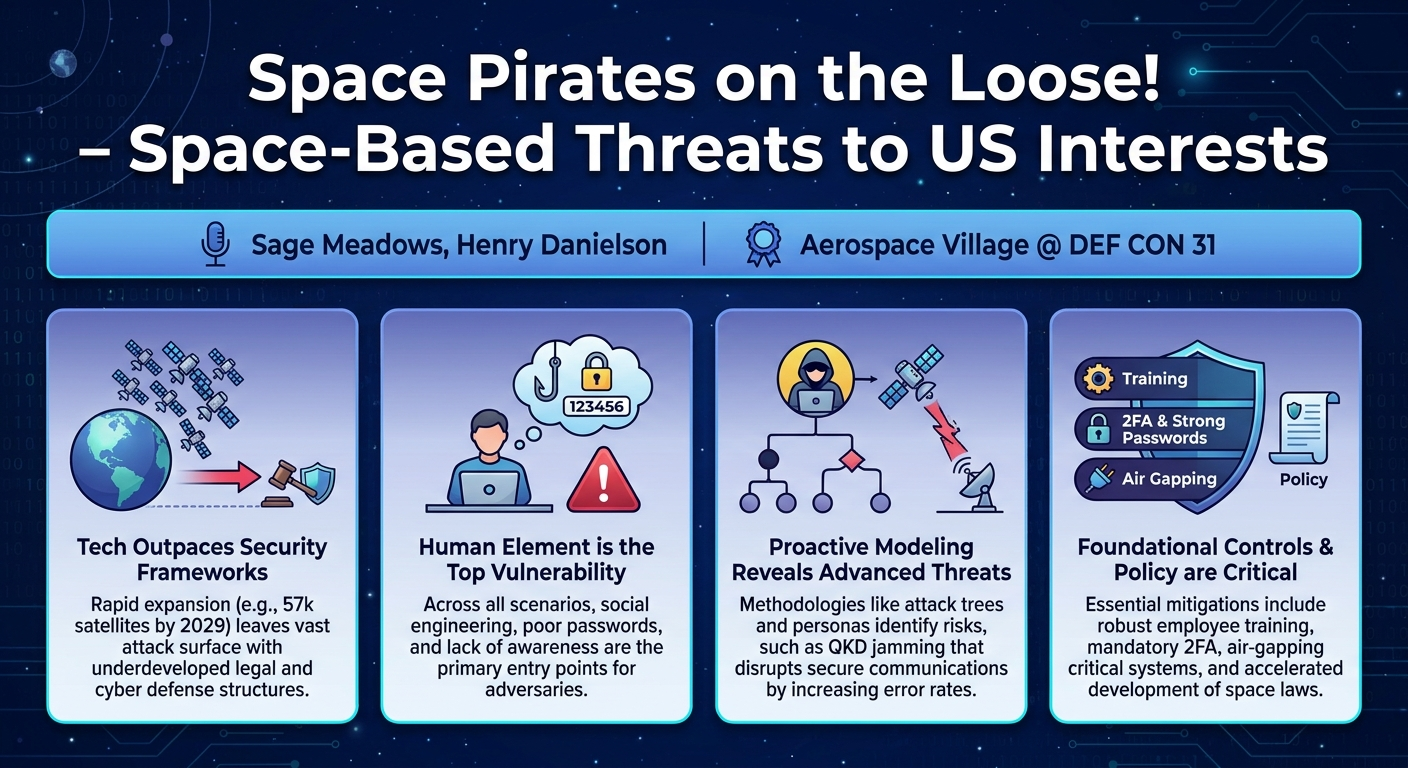
Firstly, the most overarching finding is the significant disparity between the rapid growth of space technology and the lagging development of space law and cybersecurity frameworks. With tens of thousands of new satellites slated for deployment in the coming years, the attack surface is expanding exponentially, while the regulatory and defensive mechanisms struggle to keep pace. This creates an environment ripe for exploitation by various threat actors.
Secondly, the research definitively identified the human element as the number one security vulnerability across all attack scenarios considered. Whether through social engineering, poor password hygiene, or lack of awareness, human actions or inactions consistently provided the most accessible entry points for adversaries. This finding underscores that even the most technically advanced space systems are only as secure as their human operators.
Thirdly, Meadows demonstrated the immense value of proactive threat modeling, utilizing attack trees and Persona non Gratas, as an effective methodology for identifying and brainstorming potential cyberattacks. This approach proved particularly useful in areas where specific cybersecurity research on new space technologies (like DART or laser satellites) is scarce. By systematically outlining attack paths and analyzing threat actor motivations and capabilities, the research generated a broad set of hypothetical scenarios that can inform defensive strategies.
Finally, the project provided an initial analysis of ethical, legal, and policy issues and gaps arising from these diverse risk scenarios. While not the primary focus of the presented talk, this aspect of the research highlights the need for a multi-faceted approach to space security that encompasses not just technical mitigations but also robust legal and policy frameworks to govern responsible behavior in orbit and on the ground.
Technical Deep Dive
▶ Watch: Bob's social engineering attack on ground station (10:30)
Meadows' research employs a structured, analytical approach to dissect potential cyber threats to space assets, primarily relying on threat modeling techniques. Threat modeling, in this context, is a method for systematically identifying, enumerating, and prioritizing potential threats to a system, along with their associated mitigations. The two primary tools utilized were attack trees and Persona non Gratas.
Attack trees are hierarchical diagrams that visually represent the various ways a threat actor can achieve a specific malicious goal. Each node in the tree represents a step or sub-goal, branching out into increasingly granular methods. Meadows found standard diagramming tools like Visio cumbersome and prone to crashes, leading her to adopt Deciduous, a web-based graph visualization tool. Deciduous streamlines the creation of attack trees by automatically formatting the diagram based on a simple text-based input language, allowing researchers to focus on the logic of the attack rather than the mechanics of diagramming.
The structure of these attack trees was often inspired by a modified version of the Lockheed Martin Cyber Kill Chain. The original kill chain outlines seven phases an adversary must complete to achieve their objective:
- Reconnaissance: Gathering information about the target.
- Weaponization: Preparing the attack (e.g., crafting a phishing email).
- Delivery: Transmitting the malicious payload to the target.
- Exploitation: Executing malicious code on the target system.
- Installation: Installing malware or backdoors for persistence.
- Command and Control (C2): Establishing a continuous remote communication channel.
- Actions on Objectives: Performing the final malicious acts (e.g., data exfiltration, system damage).
Meadows adapted this, often integrating the "installation" phase into "exploitation" and introducing a new mask phase. This mask phase addresses the adversary's efforts to hide their footprints, obscure the attack, or delay response times, reflecting a more complete understanding of sophisticated cyber operations.
Complementing the attack trees were Persona non Gratas, which are detailed profiles of hypothetical threat actors. These personas help analyze the motivations, skills, and resources of potential adversaries. Meadows' personas were inspired by "A Hybrid Threat Modeling Method" paper and featured AI-generated images from thispersondoesnotexist.com to enhance their realism.
To illustrate these concepts, Meadows walked through two distinct attack scenarios:
Scenario 1: Bob – The Alien Investigator
Bob, a 55-year-old retired computer engineer turned passionate alien investigator, represents a threat actor driven by emotional conviction and a desire to prove his radical theories. His goal: to falsify evidence of alien existence by tampering with SETI (Search for Extraterrestrial Intelligence) space data at the ground station level.
- Reconnaissance: Bob gathers information about the target company (assumed to have very poor security).
- Weaponization: He prepares malware on a USB drive.
- Delivery: Bob uses social engineering, physically walking into the company pretending to be an employee or inspector, leveraging his technical lingo.
- Exploitation: Once inside, he installs the USB, gains remote access to an employee's computer, and brute-forces a weak password (assumed to take less than 30 seconds) to access a database storing SETI data.
- Actions on Objectives: Bob alters the data by adding "anomalies" to trick scientists. When scientists discover the falsification but don't release it, Bob commits espionage by leaking the fabricated information to the public. This scenario highlights the vulnerability of ground stations and the human element in physical and cyber access.
Scenario 2: Eugene – The Teenage Prodigy Script Kiddie
Eugene, a 19-year-old physics major and self-proclaimed "teenage prodigy," embodies a more sophisticated, yet ego-driven, threat actor. His motivation: to cause chaos and destruction to impress his online Discord group of script kiddies, demonstrating his "elite" hacking skills. His target: a satellite equipped with lasers, specifically focusing on Quantum Key Distribution (QKD) systems.
- QKD Background: Quantum Key Distribution (QKD) is a cryptographic method that enables two parties (e.g., Alice and Bob) to share a random, secret bit stream for encryption and decryption. It relies on the principles of quantum mechanics, specifically the BB84 QKD security protocol. Keys are transmitted as photons, which are light particles, encoded with a random polarization basis (the direction of their oscillation). The security of QKD lies in the fact that any attempt by an eavesdropper (Eugene, in this case) to intercept or measure the photons will inevitably alter their quantum state, increasing the Quantum Bit Error Rate (QBER). If the QBER exceeds a certain threshold, no secret key can be reliably produced, alerting the legitimate parties to the presence of an eavesdropper.
- Eugene's Attack (Jamming): Having hypothetically gained access to a satellite's laser system through social engineering (bypassing earlier kill chain phases), Eugene, despite lacking deep quantum expertise, decides to "shoot lasers at things" for maximum chaos. His attack involves jamming the QKD transmission. By firing laser beams at the target satellite, the photons from Eugene's laser scatter off the satellite, introducing significant extra optical noise into the transmission. This noise interferes with the delicate quantum signal, drastically increasing the Quantum Bit Error Rate (QBER). When the QBER becomes sufficiently high, the QKD process fails, rendering the transmission ineffective and preventing the generation of a secure key. This demonstrates how a relatively unsophisticated technical understanding, combined with access to powerful tools, can cause significant disruption to advanced space communication systems.
These technical deep dives into specific attack paths illustrate the practical application of threat modeling and provide concrete examples of how diverse adversaries, with varying motivations and skill sets, could compromise critical space assets.
Demo / Proof of Concept
▶ Watch: Jamming Quantum Key Distribution with laser attack (14:45)
While Sage Meadows' research focused on theoretical attack scenarios and did not involve directly attacking or exploiting live technologies, the presentation itself served as a conceptual "proof of concept" for her methodology. The "demo" aspect was primarily the detailed walkthrough of the attack trees and Persona non Gratas for Bob and Eugene.
A notable part of this demonstration was the mention of Deciduous, the web application used to build the attack trees. Meadows highlighted how Deciduous simplified the complex task of diagramming these intricate attack paths, demonstrating a practical tool that aids in the threat modeling process. This indirectly showcased how such a tool can be leveraged by other researchers or security teams to visualize and analyze potential attack vectors for space technologies. The strength of the talk lay in its ability to articulate plausible, multi-stage attack scenarios, thereby proving the efficacy of her chosen research methodology in identifying vulnerabilities even for novel or less-researched space systems.
Defensive Implications
▶ Watch: Top mitigation: addressing human cybersecurity vulnerabilities (18:00)
The detailed threat modeling and scenario analysis presented by Sage Meadows offer critical insights for strengthening the cybersecurity posture of space assets. The defensive implications span technical mitigations, human-centric strategies, and broader policy considerations.
The most prominent defensive implication stems directly from the finding that humans are the number one security vulnerability. To counter this, organizations involved in space operations must prioritize robust employee training programs. These programs should educate staff on common social engineering tactics, the importance of data handling protocols, and the recognition of suspicious activities. Beyond training, enforcing strict security policies, such as mandatory two-factor authentication (2FA) for all critical systems and strong, unique password policies, is paramount. Eliminating default or easily guessable credentials for any system, from ground stations to satellite access portals, is a fundamental step.
Another crucial technical mitigation highlighted by Meadows' research is air gapping critical systems. Air gapping involves physically isolating a system or network from external networks, particularly the public internet. As demonstrated in the attack trees, many of the outlined scenarios, such as malware delivery or remote access, would be significantly more difficult, if not impossible, if the target systems were properly air-gapped. This applies especially to systems controlling sensitive data (like SETI data) or critical satellite functions (like laser controls). While not always feasible for all components, air gapping should be a primary consideration for the most sensitive operational technology (OT) and data storage systems.
Furthermore, the methodology itself offers a defensive strategy: proactive threat modeling using attack trees and Persona non Gratas. Security teams and engineers should regularly conduct such exercises to identify potential attack vectors for both existing and newly developed space technologies. This is particularly vital given the acknowledged scarcity of public cybersecurity research on cutting-edge systems like DART missions or advanced laser satellites. By thinking like an adversary and understanding their motivations, skills, and resources, defenders can anticipate attacks and implement controls before vulnerabilities are exploited.
Finally, the broader implication points to the urgent need for accelerated development of space law and cybersecurity policies. The current regulatory landscape is not keeping pace with technological advancement. Policymakers must work to establish clear international norms, responsibilities, and legal frameworks for cyber activities in space. This includes defining what constitutes a cyberattack in space, establishing mechanisms for attribution, and outlining appropriate responses to ensure the long-term stability and security of the space domain for all users. Integrating cybersecurity considerations from the initial design phase of space missions—a concept known as "security by design"—will be crucial to building resilient systems for the future.
Key Takeaways
- Rapid Space Technology Growth Outpaces Security: The exponential increase in satellite launches (57,000 by 2029) is far outstripping the development of robust cybersecurity measures and legal frameworks for space.
- Humans are the Primary Vulnerability: Across all attack scenarios, the human element—through social engineering, poor password hygiene, or lack of awareness—consistently provides the easiest entry point for adversaries.
- Proactive Threat Modeling is Essential: Methodologies like attack trees (aided by tools like Deciduous) and Persona non Gratas are highly effective for systematically identifying and brainstorming potential attack vectors, especially for emerging space technologies with limited existing security research.
- Implement Foundational Security Controls: Key mitigations include comprehensive employee training, strict enforcement of two-factor authentication and strong password policies, and judicious air gapping of critical systems to isolate them from external networks.
- Advanced Systems Face Unique Threats: Even highly specialized systems like Quantum Key Distribution (QKD) are vulnerable to jamming attacks that increase the Quantum Bit Error Rate (QBER), highlighting the need for specialized security research on new space capabilities.
- Policy and Legal Frameworks are Critical: There is an urgent need for the rapid development of international space law and cybersecurity policies to govern responsible behavior, define cyber warfare in space, and ensure the long-term security of orbital assets.
About the Speaker(s)
Sage Meadows is a student at Cal Poly, where she conducted this research as her senior project. Serving as a student research assistant, her work focuses on analyzing cyber threats to space technologies and exploring the ethical, legal, and policy issues arising from them. Her presentation at DEF CON 31's Aerospace Village showcased her significant contributions to this critical and rapidly evolving field.
Henry Danielson works with DEF CON and the Aerospace Village. He introduced Sage Meadows' talk, highlighting the importance of the research being presented and acknowledging key contributors to space cybersecurity initiatives, including Patrick Lynn, who has been instrumental in facilitating grants and advising the National Space Council on space cybersecurity.
Reviews
Dr. Zero (Offensive Security Researcher) — WEAK
This is a Cal Poly senior project doing paper threat modeling for space assets. The methodology is structured, but the grand conclusions are literally 'humans are the weakest link' and 'use 2FA'—findings that severely lack the technical teeth expected at DEF CON.
Heather Calloway (CISO) — WEAK
This is a student research project applying basic threat modeling frameworks to space infrastructure. While the visualization methodology is competent, the conclusions—that space law is lagging and humans are the weakest link—offer nothing new to security leaders. Skip this unless you are looking for entry-level examples of how to draw an attack tree.