Wingin' It - Pentesting a 737
Alexander Dodd (Attack Research)
Aerospace Village @ DEF CON 31 · Day 2 · Aerospace Village
Overview
In "Wingin' It - Pentesting a 737," Alexander Dodd of Attack Research shares a unique and eye-opening account of conducting a security assessment on a decommissioned Boeing 737 Next Generation (NG) aircraft. This talk serves a dual purpose: to illuminate the critical need for proactive, hands-on cybersecurity testing within the aerospace industry and to showcase the intriguing technical challenges and discoveries encountered by the security research community when confronted with such a complex target. Dodd, an Air Force veteran, emphasizes that while the aerospace sector inherently prioritizes safety, the digital components of modern aircraft present an evolving attack surface that demands rigorous, independent scrutiny beyond manufacturer assurances.
Key moments
- 0:00 Speaker introduction and talk objectives
- 2:00 The importance of hands-on aircraft security testing
- 4:00 Gaining access to a decommissioned 737 NG
- 6:00 Challenges: unfamiliarity with aircraft and limited information
- 16:00 Reverse-engineering proprietary Quadrax network cables
- 18:00 Initial network reconnaissance and finding unsecured systems
- 20:00 Accidentally crashing an outdated network switch
- 22:00 Analyzing the larger attack surface on newer 737 Max aircraft
Wingin' It - Pentesting a 737
Speakers: Alexander Dodd (Attack Research)
Conference: Aerospace Village @ DEF CON 31
YouTube: https://www.youtube.com/watch?v=VRb6br_n8dQ
Overview
In "Wingin' It - Pentesting a 737," Alexander Dodd of Attack Research shares a unique and eye-opening account of conducting a security assessment on a decommissioned Boeing 737 Next Generation (NG) aircraft. This talk serves a dual purpose: to illuminate the critical need for proactive, hands-on cybersecurity testing within the aerospace industry and to showcase the intriguing technical challenges and discoveries encountered by the security research community when confronted with such a complex target. Dodd, an Air Force veteran, emphasizes that while the aerospace sector inherently prioritizes safety, the digital components of modern aircraft present an evolving attack surface that demands rigorous, independent scrutiny beyond manufacturer assurances.
The presentation is a candid exploration of an unprecedented opportunity to "break things" on an actual airframe slated for decommissioning. Dodd meticulously details the methodologies, the unexpected hurdles, and the significant security vulnerabilities uncovered, all while adhering to strict responsible disclosure guidelines. The core message resonates deeply for both airline operators and cybersecurity professionals: trust, but verify. Even with robust certification processes, the operational reality of aircraft systems can diverge from theoretical security postures, necessitating real-world penetration testing to identify and mitigate risks that could otherwise remain undetected.
Background
▶ Watch: Speaker introduction and talk objectives (0:00)
The opportunity for this extraordinary engagement arose from Attack Research's existing relationships within the airline industry, stemming from prior work in areas like inflight entertainment and payment card industry (PCI) compliance. The client, an undisclosed airline, offered Attack Research access to a 737 NG that was being retired and prepared for "the squisher squasher," making it an ideal, low-risk environment for aggressive, hands-on testing. This context was crucial, as it allowed the team to physically dismantle panels and probe systems without concerns about invalidating an active airframe or causing operational disruptions.
The 737 NG, while a workhorse of the skies, represents an older generation of aircraft, with production ceasing in 2019. It has since been succeeded by newer platforms like the 737 MAX, 777, and 787. This distinction became a significant point of comparison during the assessment, revealing how the attack surface has evolved with newer designs. Despite the speaker's military background, he readily admitted to a lack of specific aerospace systems knowledge, highlighting the universal applicability of fundamental penetration testing methodologies even in highly specialized domains. The team effectively went in "blind," relying on their core hacking skills, on-site reconnaissance, and external research under challenging conditions.
The engagement was not without its constraints. Critical components such as engines, Line Replaceable Units (LRUs), and the landing gear were explicitly off-limits due to their high cost or potential for catastrophic damage if mishandled. Furthermore, the physical environment of a steel hanger presented its own challenges: zero cell signal or Wi-Fi inside the aircraft and poor connectivity within the building itself. This forced the team to conduct real-time research and problem-solving in a disconnected environment, often requiring them to step outside into inclement weather to consult external resources. The initial days were dedicated to extensive physical reconnaissance, systematically dismantling panels and searching for any accessible network interfaces, a process Dodd likened to "destruction" given the decommissioned status of the aircraft.
Key Findings
▶ Watch: Gaining access to a decommissioned 737 NG (4:00)
The penetration test yielded several critical findings that underscore the unique security challenges within the aerospace domain. One of the most significant discoveries was the pervasive use of non-standard networking protocols and cabling. While the team expected to find RJ45 Ethernet ports, they encountered a dearth of them. Instead, many internal systems communicated via ARINC (Aeronautical Radio, Incorporated) protocols, specifically ARINC 429 and ARINC 664 (AFDX), which utilize twisted pair wiring rather than standard Ethernet. The team also identified quadrax cables, a two-pair equivalent to Cat5, designed for durability and weight savings, but requiring specialized tools and pinouts. The initial lack of appropriate hardware to interface with these systems caused significant delays, forcing the team to improvise custom cables on-site.
A consistent and alarming vulnerability across various discovered network segments was the widespread use of default credentials. Dodd reported finding "admin/admin" or "admin/password" on "100% of the time," across cell modems, switches, and other critical infrastructure components. This glaring oversight in configuration provided immediate and unfettered access to internal systems once physical access was gained. Furthermore, the firmware on a key network switch (a Sixnet device) was found to be severely outdated, dating back to 2011. The vendor, Sixnet, had been acquired in 2012 and no longer supported the product, illustrating a critical security through obsolescence problem where essential components remain unpatched and vulnerable for over a decade.
The team successfully performed a denial-of-service (DoS) attack on the main network switch by attempting to mirror all traffic from every port back down a single port (Port 4), including Port 4 itself. This recursive configuration overwhelmed the switch, causing it to crash almost immediately. This demonstrated a critical fragility in the network infrastructure. Beyond the 737 NG, discussions with maintenance personnel revealed that newer aircraft, such as the 737 MAX, present an even broader attack surface. The MAX, for instance, can accept certain maintenance commands via text message, and many maintenance tasks that previously required direct physical connection can now be performed remotely. Crucially, the responsibility for software package signing (or "parts signing") for the MAX has shifted from the component manufacturers to the airlines themselves, introducing a new and significant attack vector related to certificate management and supply chain integrity for operators.
Technical Deep Dive
▶ Watch: Reverse-engineering proprietary Quadrax network cables (16:00)
The technical challenges began with the fundamental networking infrastructure of the 737 NG. The assumption of standard Ethernet networking proved largely incorrect. The team's initial reconnaissance involved physically removing panels throughout the aircraft – in the cockpit (though access was limited), maintenance bays, cargo bay, and cabin – searching for any accessible ports. They found only two RJ45 ports on the entire aircraft, a stark contrast to typical IT environments.
Instead, critical systems often utilized ARINC 429 and ARINC 664 (AFDX) protocols. ARINC 429 is a two-wire, point-to-point serial data bus, widely used for transferring short messages between avionics systems. ARINC 664 (AFDX), on the other hand, is a more modern, deterministic Ethernet-based network designed for critical avionics. Both are distinct from standard commercial Ethernet and require specialized hardware interfaces, which the team initially lacked. This highlighted a significant barrier to entry for conventional cybersecurity tools.
A more accessible, yet still non-standard, interface was the quadrax cable. These cables, described as effectively a two-pair Cat5 equivalent, connect to unique drum-shaped connectors. Dodd explained that these cables are preferred in aviation for their durability, lighter weight (less copper), and compact design, which saves space and avoids the fragility of standard RJ45 plastic tangs. The team had to resort to "sketchy websites" and assistance from maintenance personnel to determine the pinout for these cables and then manually fabricate custom adapters to convert them to RJ45 for their standard penetration testing equipment. This improvisation, involving cutting Cat5 cables, electrical tape, and pliers, consumed valuable time but was essential to gaining network access.
Once connected, the team discovered they were on a series of 10.x.x.x networks, indicating internal, segmented networks not directly exposed to passenger-facing systems. These networks hosted devices such as satellite modems and cellular modems, which provide connectivity to the aircraft's internal systems for various purposes, including maintenance and operational data. The ease of access to these internal networks was immediately amplified by the widespread use of default credentials (e.g., "admin/admin") on network switches and modems. This meant that once a physical connection was established, lateral movement within these critical operational networks was straightforward.
The most dramatic technical finding involved a Sixnet network switch, which was a central hub for many of the quadrax cables. The team attempted a common penetration testing technique: port mirroring all traffic to a specific output port (Port 4) to capture network communications. However, the switch's firmware, dating back to 2011, was unsophisticated. When instructed to mirror all ports, it included its own output port in the mirroring loop. This created a recursive loop where traffic was endlessly duplicated and sent back into the switch, rapidly overwhelming its processing capabilities and causing a complete crash. This demonstrated a fundamental flaw in the device's resilience and configuration management, exacerbated by the fact that Sixnet had been acquired in 2012, leaving the firmware unsupported and unpatched for over a decade. This "security through obsolescence" presented a significant risk, as such an unmanaged device could be trivially disrupted, impacting critical aircraft systems.
Demo / Proof of Concept
▶ Watch: Initial network reconnaissance and finding unsecured systems (18:00)
While the talk did not feature a live, real-time demonstration in the traditional sense, the speaker meticulously detailed several successful proof-of-concept activities and technical exploits performed during the engagement. These demonstrations were conducted on the decommissioned 737 NG, providing tangible evidence of vulnerabilities and potential attack paths.
The primary proof of concept involved the denial-of-service (DoS) attack against the central Sixnet network switch. Dodd described how the team, attempting to port mirror all network traffic for analysis, inadvertently triggered a recursive loop. By configuring the switch to mirror traffic from all ports, including the designated output port (Port 4), back down Port 4 itself, the switch rapidly overloaded and crashed. This demonstrated a critical vulnerability in the switch's firmware and configuration logic, highlighting how a seemingly innocuous diagnostic command could lead to system instability. The speaker emphasized that this was not a sophisticated exploit but rather a consequence of outdated and poorly designed firmware.
Another significant "proof of concept" was the successful physical access and identification of numerous components operating with default credentials like "admin/admin." This wasn't a single exploit but rather a pervasive finding across multiple devices, including cell modems and other network infrastructure. Each instance of a default credential represented a successful bypass of authentication, granting the team immediate administrative access to these systems.
Furthermore, the team's ability to physically access, identify, and then construct custom cables (the quadrax to RJ45 adapters) to interface with the aircraft's proprietary networking infrastructure served as a critical foundational proof of concept. This demonstrated that despite the specialized nature of avionics cabling, dedicated attackers could overcome these physical barriers to gain network access. The successful tampering with smoke detectors in the cargo bay also constituted a proof-of-concept for physical system manipulation, fulfilling a personal goal of the speaker to interact with components typically off-limits to passengers. Although the team couldn't trigger an alarm, the ability to physically interact with these safety-critical systems demonstrated a potential attack vector.
Defensive Implications
▶ Watch: Analyzing the larger attack surface on newer 737 Max aircraft (22:00)
The findings from this 737 NG penetration test carry profound defensive implications for airlines, aircraft manufacturers, and the broader aerospace industry. The most critical takeaway is the absolute necessity of hands-on, independent security testing on actual aircraft systems. Relying solely on manufacturer assurances or theoretical security models is insufficient. As Dodd articulated, "there's no substitute for actually getting some hands on your equipment." Airlines must advocate for and implement programs that allow security researchers to physically interact with and test their operational aircraft, even if initially on decommissioned airframes.
The prevalence of default credentials ("admin/admin") across multiple critical network devices (switches, modems) is a fundamental security failure. Defenders must implement rigorous configuration management policies that mandate changing all default passwords prior to deployment. This simple step would significantly raise the bar for attackers attempting to gain unauthorized access.
The discovery of outdated firmware (e.g., the Sixnet switch from 2011) highlights a severe lifecycle management problem. Airlines need robust processes for tracking the firmware versions of all installed components, assessing their security posture, and implementing patching strategies where possible. When components reach end-of-life and are no longer supported by manufacturers, airlines must develop mitigation strategies, such as enhanced network segmentation, intrusion detection, or planned replacement, to address the inherent vulnerabilities. The concept of "security through obsolescence" is not a valid defense.
The insights into newer platforms like the 737 MAX reveal an expanding attack surface. Features such as remote maintenance commands via text message and increased RJ45 ports, while offering operational efficiencies, also introduce new vectors for compromise. Defenders must secure the entire ecosystem surrounding these capabilities, including the mobile devices used for text commands and the maintenance laptops that can remotely interact with aircraft systems. The shift in responsibility for software package signing from OEMs to airlines on newer aircraft is particularly significant. Airlines must invest heavily in securing their internal Public Key Infrastructure (PKI) and code signing processes to prevent the introduction of malicious or tampered software updates into their fleet.
Finally, the unique networking challenges (e.g., ARINC protocols, quadrax cables) underscore the need for specialized tools and expertise within aviation cybersecurity teams. Defenders should understand the proprietary nature of these systems and train their personnel or engage external experts who possess the knowledge and equipment to operate within this specialized environment. Regulatory bodies and industry standards (e.g., advisory circulars) should evolve to actively encourage and facilitate penetration testing, rather than inadvertently creating barriers. Proactive engagement with the hacker community, as demonstrated by this talk, can provide invaluable intelligence to strengthen the defense of critical aerospace infrastructure.
Key Takeaways
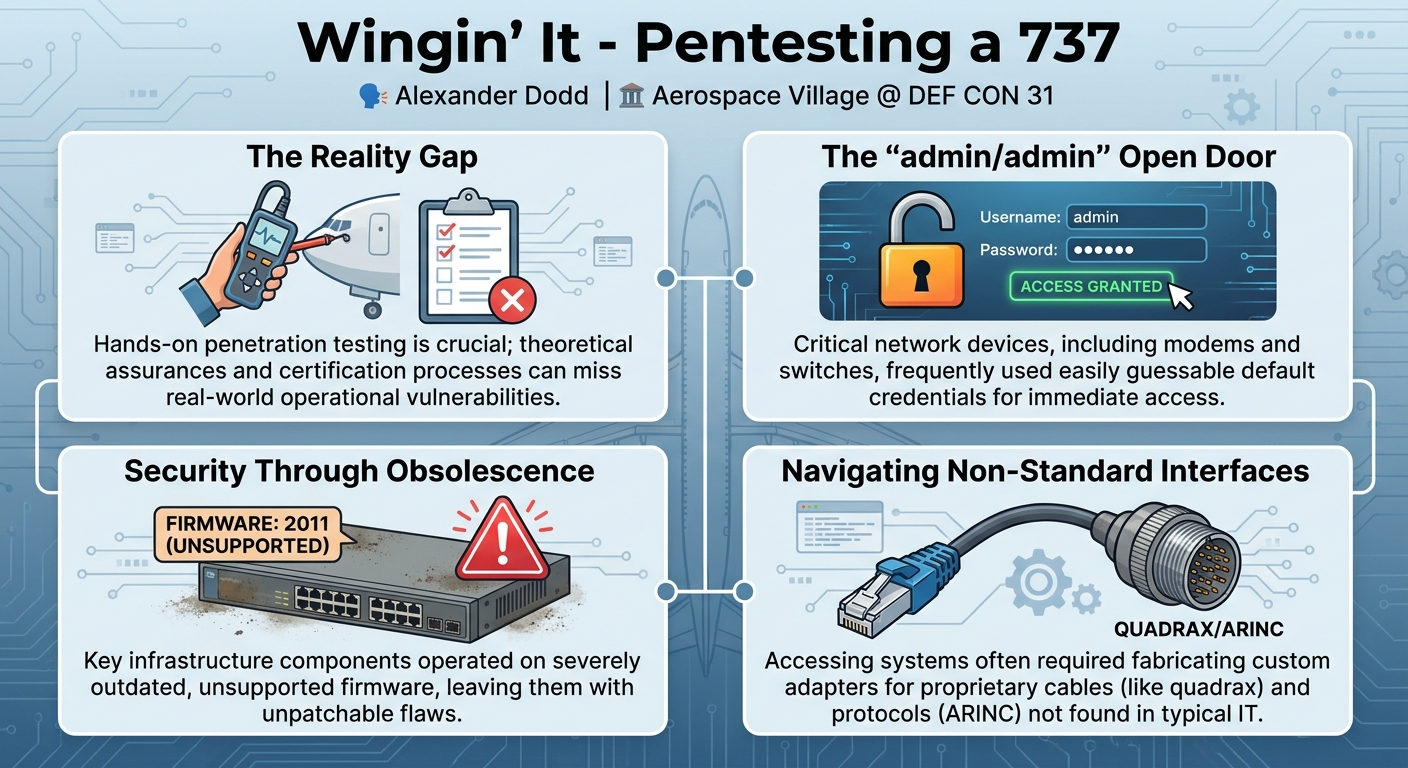
- Hands-on Penetration Testing is Crucial: There is no substitute for physically testing aircraft systems, even decommissioned ones, to uncover real-world vulnerabilities that theoretical assessments or manufacturer assurances might miss.
- Pervasive Default Credentials: Critical network devices throughout the aircraft were found to use easily guessable default credentials (e.g., "admin/admin"), providing attackers immediate administrative access upon gaining physical entry.
- Outdated and Unsupported Firmware: Key network infrastructure components operated on severely outdated and unsupported firmware (e.g., a Sixnet switch from 2011), creating significant and unpatchable vulnerabilities.
- Evolving Attack Surface on Newer Aircraft: Newer platforms like the 737 MAX introduce new attack vectors, including remote maintenance commands via text message, increased network connectivity, and shifting responsibility for software package signing to airlines, demanding expanded defensive strategies.
- Proprietary Networking Challenges: Aircraft utilize specialized cabling (e.g., quadrax cables) and protocols (ARINC) that require custom tooling and expertise to interface with, highlighting unique barriers and opportunities for both attackers and defenders.
- The Need for Comprehensive Lifecycle Management: Airlines must implement robust processes for tracking, patching, and securing all onboard components throughout their operational lifecycle, including managing end-of-life devices and their inherent vulnerabilities.
About the Speaker(s)
Alexander Dodd is a cybersecurity professional affiliated with Attack Research, a company based out of New Mexico. He is an Air Force veteran, having served eight years, though he humorously notes his experience was primarily "flying a desk" rather than actual aircraft. Dodd is passionate about hacking and exploring systems, and his enthusiasm for "breaking stuff" is evident throughout his presentation. He also co-hosts a podcast called "The Cyber Idiots" with fellow security enthusiasts. His work at Attack Research often involves specialized penetration testing, including engagements within the airline industry focusing on areas like inflight entertainment and payment systems.
Reviews
Dr. Zero (Offensive Security Researcher) — SOLID
Dodd got rare physical access to a decommissioned 737 NG and proved that behind the aviation safety theater, aircraft networks look exactly like an unpatched 2011 factory floor. It's a competent war story about splicing proprietary cables with pliers just to find default credentials. Not groundbreaking vulnerability research, but a sobering reality check for aviation defenders.
Heather Calloway (CISO) — MUST SEE
Dodd's teardown of a decommissioned 737 NG bridges the gap between aviation safety mythology and actual network reality. He proves that theoretical air-gaps do not survive maintenance requirements, and that operational cyber risk for newer fleets is shifting directly onto the airlines. A required briefing for any transportation or OT security leadership team.