A Fireside Chat with Chris Roberts and Pete Cooper
Chris Roberts (CISO · Boom Supersonic), Pete Cooper (Co-founder · Aerospace Village)
Aerospace Village @ DEF CON 31 · Day 2 · Aerospace Village
Overview
In a captivating fireside chat at DEF CON 31's Aerospace Village, Chris Roberts, CISO of Boom Supersonic, and Pete Cooper, founder of the Aerospace Village, delved into the unprecedented challenge and opportunity of securing the next generation of supersonic aircraft. The discussion centered on Boom Supersonic's ambitious Overture project – a modern successor to the Concorde, designed for sustainable, high-speed travel. This talk wasn't just about aviation; it was a masterclass in building security from the ground up, leveraging a "greenfield" environment to rethink traditional aerospace cybersecurity.
Key moments
- 1:30 Boom Supersonic's green field security approach
- 3:10 Identifying and securing core intellectual property and assets
- 5:20 Empowering people for human-centric supply chain security
- 7:05 Using 'how can I kill you?' for threat modeling
- 9:40 Building a self-healing airplane with AI and data
- 13:00 Leveraging digital twins for predictive maintenance and failure
- 16:00 Advice to younger self: communication and collaboration
A Fireside Chat with Chris Roberts and Pete Cooper
Speakers: Chris Roberts, CISO, Boom Supersonic; Pete Cooper, Co-founder, Aerospace Village
Conference: Aerospace Village @ DEF CON 31
YouTube: https://www.youtube.com/watch?v=q7Ivco9bq9Q
Overview
In a captivating fireside chat at DEF CON 31's Aerospace Village, Chris Roberts, CISO of Boom Supersonic, and Pete Cooper, founder of the Aerospace Village, delved into the unprecedented challenge and opportunity of securing the next generation of supersonic aircraft. The discussion centered on Boom Supersonic's ambitious Overture project – a modern successor to the Concorde, designed for sustainable, high-speed travel. This talk wasn't just about aviation; it was a masterclass in building security from the ground up, leveraging a "greenfield" environment to rethink traditional aerospace cybersecurity.
Roberts articulated Boom's unique advantage: the ability to design security into the very fabric of the aircraft and its operational ecosystem, rather than retrofitting it onto decades of legacy systems. This approach allows for a human-centric security philosophy, a robust data architecture supporting a "self-healing" airplane, and an open invitation to the hacker community for collaboration. The conversation highlighted the critical shift from adversarial security postures to cooperative engagement, emphasizing that the future of aerospace safety hinges on integrated security, advanced technology, and community trust.
The significance of this talk extends beyond aerospace, offering valuable insights for any industry grappling with complex supply chains, critical infrastructure, and the imperative to secure highly advanced, interconnected systems. Roberts' candid reflections on his journey from a prominent security researcher to a CISO responsible for an entire aircraft's security underscored the evolving nature of cybersecurity leadership – one that prioritizes communication, collaboration, and a deep understanding of both human and technical vulnerabilities.
Background
▶ Watch: Boom Supersonic's green field security approach (1:30)
The aerospace industry has historically grappled with a multifaceted security challenge, largely stemming from its long operational lifecycles and the inherent complexity of integrating diverse technologies over many decades. Traditional aircraft designs often precede modern cybersecurity paradigms, leading to systems that are difficult to update, patch, or secure against contemporary threats. The supply chain is notoriously vast and intricate, with a single major manufacturer potentially dealing with tens of thousands of suppliers, each presenting a potential attack surface. This fragmentation makes consistent security enforcement and visibility incredibly difficult, often resulting in reactive measures rather than proactive security-by-design.
Pete Cooper, as the founder of the Aerospace Village, highlighted the organization's mission to bridge the gap between hackers, researchers, and industry, fostering a collaborative environment to enhance space and aviation security. This initiative directly addresses the traditional disconnect where security researchers often operate in an adversarial role, discovering vulnerabilities that industry may be slow or resistant to acknowledge and fix. The problem, therefore, isn't just technical; it's cultural, rooted in a lack of trust and effective communication between those who build and those who scrutinize.
Boom Supersonic, with its Overture aircraft, finds itself in a unique position to bypass many of these legacy challenges. As a relatively new entrant in the commercial aviation space, Boom operates with a greenfield environment, meaning it is building its systems and processes from scratch. This allows Chris Roberts and his team to integrate security considerations from the initial design phase, rather than attempting to bolt them on later. This opportunity is revolutionary for aviation, where the typical response to security concerns often involves patching older systems or implementing costly, inefficient workarounds. Roberts' background as a well-known security researcher, often pushing boundaries with his "offensive" security work, provides a distinct perspective, allowing him to anticipate adversarial tactics and build robust defenses into the very core of Boom's operations and aircraft.
Key Findings
▶ Watch: Empowering people for human-centric supply chain security (5:20)
The fireside chat unveiled several key findings and strategic approaches that Boom Supersonic is employing to secure its next-generation aircraft:
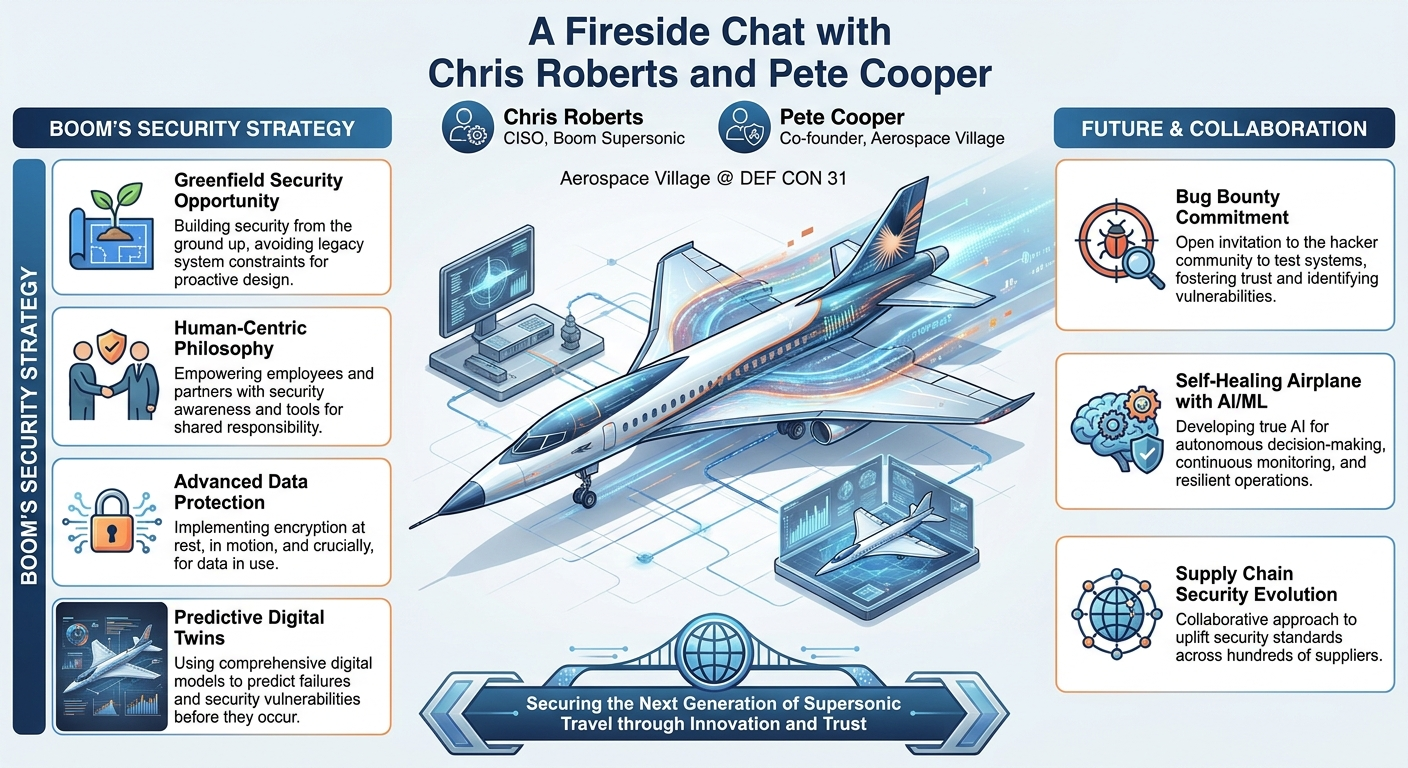
- Greenfield Security Opportunity: Boom Supersonic is leveraging its status as a new company to implement security from the ground up, avoiding the burden of legacy systems that plague established aerospace manufacturers. This allows for a proactive security-by-design approach across all facets of the aircraft and its operational ecosystem.
- Human-Centric Security Philosophy: Rather than relying solely on technical controls, Roberts emphasizes a human approach to security. This involves empowering employees and supply chain partners with awareness and tools to make informed decisions, fostering a culture where security is a shared responsibility rather than a punitive measure. The goal is to help people "ask a question or two before you click something."
- NIST Cyber Security Framework (CSF) Adoption: Boom uses the NIST CSF as its foundational framework for assessing cybersecurity maturity, identifying critical assets, and defining desired security postures. This structured approach helps in systematically addressing gaps and building a robust security program. Roberts begins by asking, "how can I kill you?" to identify core vulnerabilities and critical assets.
- Data-Centric Protection and Visibility: A primary focus is on understanding "where's the data and who has eyes on it." This involves meticulous classification of intellectual property, technical information, and operational data, ensuring its integrity, confidentiality, and availability throughout its lifecycle, including immutable records for FAA compliance.
- Strategic Outsourcing for Core Security Operations: Recognizing the resource constraints of a growing company, Boom has partnered with a Managed Security Provider (MSP) for its Security Operations Center (SOC) and Network Operations Center (NOC) needs. This allows Boom to leverage specialized expertise without building a large internal team immediately.
- Pioneering a "Self-Healing" Airplane with AI/ML: Boom is developing an advanced AI engine—not just "machine learning on steroids"—to create a truly self-healing airplane. This system will continuously monitor flight envelopes, platform performance, and ancillary elements, making autonomous decisions to maintain optimal and safe operation.
- Extensive Use of Digital Twins for Predictive Intelligence: The company is building comprehensive digital twins for the entire aircraft, including engines, wings, and fuselage. These multi-dimensional models simulate the physical asset's lifecycle, enduring stresses, heats, and operational cycles, enabling predictive maintenance and operational insights to anticipate failures before they occur.
- Commitment to Hacker Community Collaboration: In a groundbreaking move for a major manufacturer, Roberts publicly committed to rolling out a Boom Supersonic chassis for a bug bounty program at a future DEF CON event. This open invitation signifies a profound trust in and desire to collaborate with the hacker community to identify and remediate vulnerabilities.
- Innovation in Data-in-Use Encryption: Boom is actively working with partners like Tanium iO (specifically Artti Rahen) to implement encryption of data assets in use. This cutting-edge technology allows data to remain encrypted even while actively being processed, offering an unprecedented layer of protection for sensitive operational and diagnostic information.
- Supply Chain Security Evolution: With hundreds of suppliers (and growing), Boom is taking a proactive, human-centric approach to impart security knowledge and best practices, aiming to help suppliers evolve their security and safety standards rather than simply enforcing compliance.
Technical Deep Dive
▶ Watch: Using 'how can I kill you?' for threat modeling (7:05)
Boom Supersonic’s Overture aircraft represents a significant leap in aviation technology, designed to be faster, more efficient, and more sustainable than its predecessors like the Concorde. The technical architecture supporting this vision is equally advanced, with security woven into its core.
The Overture itself is an engineering marvel, utilizing advanced aerodynamics, fluid dynamics, metallurgy, and sustainable aviation fuel (SAF) to achieve speeds that cut typical flight times by one to two-thirds, operating at an altitude of 60,000 feet. Securing such a complex system starts with identifying and classifying assets across its distributed ecosystem. Roberts outlined three primary operational spheres: an experimental jet undergoing FAA certification in Moab, Utah; the full-scale iron bird in Colorado, where systems are integrated and tested; and the manufacturing factory in North Carolina. Each sphere presents unique security challenges, from protecting sensitive intellectual property (IP) and technical design data to ensuring the integrity and immutability of operational records required for regulatory compliance over decades.
Boom's approach to cybersecurity begins with a foundational understanding of its critical assets and potential vulnerabilities. Roberts employs a direct, "how can I kill you?" methodology to identify the most impactful attack vectors – whether it's sabotaging a 3D printer, disrupting the supply chain, or compromising network infrastructure. This brutal honesty informs the application of the NIST Cyber Security Framework (CSF), guiding the company in assessing its current maturity level against desired security goals. Early gaps identified included basic endpoint detection and response (EDR) efficacy and, crucially, a clear understanding of data location and ownership. To address the immediate operational security needs, Boom opted to partner with a Managed Security Provider (MSP), leveraging specialized expertise for 24/7 monitoring and response without the overhead of building a large internal Security Operations Center (SOC) and Network Operations Center (NOC) from scratch.
A cornerstone of Boom's technical vision is the development of a "self-healing airplane" powered by a bespoke AI engine. Roberts explicitly differentiates this from mere "machine learning on steroids," aiming for a system capable of making genuine, autonomous decisions. This AI platform will ingest a massive amount of data, including engine data, cockpit data, atmospheric conditions, and sensor readings from the aircraft's fiber wings and carbon fiber fuselage. By comparing observed flight envelopes and performance data against ideal operational parameters and historical trends, the AI will detect anomalies and proactively initiate corrective actions or alert ground crews. This continuous, real-time analysis aims to predict and mitigate issues before they escalate, enhancing both safety and operational efficiency.
The sheer volume of data generated by the Overture necessitates a robust data architecture capable of ingesting, securing, and processing information from myriad sources. Roberts describes this as "hoovering it all up," emphasizing the need for encryption at rest and encryption in motion. However, Boom is pushing the boundaries further by collaborating with experts like Artti Rahen from Tanium iO on data in use encryption. This advanced cryptographic technique allows data to remain encrypted even while it is actively being computed upon, offering unparalleled protection against memory scraping attacks and unauthorized access during processing – a critical innovation for highly sensitive flight and diagnostic data.
Perhaps one of the most compelling technical aspects is the extensive use of digital twins. This concept involves creating a comprehensive, multi-dimensional (3D, 4D) virtual model of the physical aircraft. These digital twins are continuously fed real-world data about the plane's operational life – including stresses, heat cycles, system performance, and geographical locations. This rich dataset allows for highly accurate predictive maintenance, akin to the marine industry's approach to engines. For example, if an engine is frequently used on a London-Sydney route, the digital twin can predict the likelihood of component failure before the aircraft even departs, enabling proactive part swaps or maintenance scheduling. Beyond maintenance, these digital twins, combined with an atmospheric engine that models weather and environmental conditions, allow for complex relational architectures for threat intelligence. By simulating how different operational environments affect specific components, Boom can predict potential failures or vulnerabilities with unprecedented accuracy, leveraging 60 to 70 million core hours of High-Performance Computing (HPC) for these simulations. This capability moves beyond traditional fatigue testing, where physical aircraft were subjected to rapid stress cycles, to a dynamic, data-driven predictive model.
Demo / Proof of Concept
▶ Watch: Leveraging digital twins for predictive maintenance and failure (13:00)
While the fireside chat itself did not feature a live technical demonstration, Chris Roberts made a significant announcement regarding a future Proof of Concept (PoC) that underscores Boom Supersonic's commitment to transparency and collaboration with the cybersecurity community.
Roberts explicitly stated, "when we get to a point where from a Boom standpoint that chassis is ready to be rolled somewhere, it's coming here. We're going to roll it out, open the doors, and go bug bounty. Have at it." This promise to bring an actual Boom Supersonic aircraft chassis to a future DEF CON event for a bug bounty program is a groundbreaking move in the aerospace industry. It represents an unprecedented level of trust and an active invitation for the hacker community to rigorously test the security of their systems. This future event will serve as the ultimate demonstration of Boom's confidence in its security-by-design approach and its willingness to engage openly with external researchers to identify and remediate vulnerabilities before the aircraft enters commercial service.
Defensive Implications
▶ Watch: Advice to younger self: communication and collaboration (16:00)
The strategies and philosophies articulated by Chris Roberts at Boom Supersonic offer crucial defensive implications for organizations across various sectors, particularly those involved in critical infrastructure, manufacturing, and complex supply chains.
- Embrace Greenfield Security Opportunities: For any new project, product, or organizational initiative, security must be integrated from the absolute beginning. Boom's success stems from its ability to design security into the Overture from day one, rather than attempting costly and often ineffective retrofits. This security-by-design principle should be a non-negotiable starting point.
- Prioritize Human-Centric Security: Technical controls are insufficient without an empowered workforce. Defenders should invest in security awareness programs that focus on education and empowerment rather than fear and blame. By helping employees understand why security matters (e.g., comparing company data to personal bank records) and providing easy-to-use secure tools (e.g., simple encryption for sensitive documents), organizations can transform employees into active participants in their defense. This extends to the supply chain, fostering a collaborative approach to uplift security standards.
- Implement a Data-Centric Security Strategy: Organizations must meticulously identify, classify, and protect their critical data assets. Understanding "where the data is and who has eyes on it" is fundamental. This includes data at rest, in motion, and crucially, data in use. Exploring advanced technologies like data in use encryption (as Boom is doing with Tanium iO) can provide a significant defensive advantage for highly sensitive information.
- Leverage Established Cybersecurity Frameworks: Frameworks like the NIST Cyber Security Framework (CSF) provide a structured approach to assess maturity, identify gaps, and prioritize security investments. Regularly asking "how can we be killed?" helps focus defensive efforts on the most impactful risks, moving beyond check-box compliance to genuine risk reduction.
- Strategic Use of Managed Security Services: For organizations with limited resources, partnering with a Managed Security Provider (MSP) for SOC/NOC functions can provide access to specialized expertise and 24/7 monitoring capabilities that would be cost-prohibitive to build internally. This allows internal teams to focus on strategic security initiatives.
- Invest in Predictive and Proactive Technologies (AI/ML & Digital Twins): The concept of a "self-healing airplane" powered by AI and comprehensive digital twins has broad applicability. Defenders should explore how AI/ML can be used for advanced anomaly detection, predictive threat intelligence, and even automated response in their own environments. Digital twins can be extended beyond physical assets to model IT infrastructure, network topologies, and even organizational processes, enabling predictive security posture management and resilience planning.
- Foster Open Collaboration with the Hacker Community: Boom's commitment to a public bug bounty program on an actual aircraft chassis sets a new standard. Organizations should actively engage with the hacker community through bug bounties, responsible disclosure programs, and participation in conferences like DEF CON. This open dialogue and external validation are invaluable for identifying vulnerabilities that internal teams might miss.
- Strengthen Supply Chain Security Through Collaboration: Instead of merely imposing security requirements, engage with suppliers to help them improve their security posture. Providing guidance, tools, and shared knowledge can build a more resilient collective defense against sophisticated supply chain attacks.
Key Takeaways
- Greenfield Advantage: Building security from the ground up offers an unparalleled opportunity to integrate robust defenses by design, avoiding the complexities of legacy system retrofitting.
- Human-Centric Security: Empowering employees and supply chain partners with security awareness and user-friendly tools is as crucial as technical controls for fostering a resilient security culture.
- Predictive Power of Digital Twins: Leveraging multi-dimensional digital twins and HPC allows for proactive identification of potential failures and security vulnerabilities, moving from reactive to predictive defense.
- Advanced Data Protection: Implementing encryption for data at rest, in motion, and especially data in use provides a critical layer of protection for sensitive information throughout its lifecycle.
- Open Collaboration with Hackers: Engaging the cybersecurity community through bug bounties and transparent communication is a powerful way to identify and mitigate vulnerabilities, building trust and enhancing overall security.
- AI for Autonomous Defense: Developing true AI capabilities for continuous monitoring and autonomous decision-making can pave the way for "self-healing" systems that enhance safety and operational resilience.
About the Speaker(s)
Chris Roberts is the CISO of Boom Supersonic, where he is tasked with securing the next generation of supersonic commercial aircraft, the Overture. With a distinguished career in cybersecurity, Roberts is widely recognized for his extensive experience in aerospace security and for pushing the boundaries of security research. He has a history of engaging with systems from an "offensive" perspective, using that deep understanding to build robust defenses. His current role at Boom Supersonic allows him to apply this expertise in a unique greenfield environment, focusing on building security from the ground up, fostering collaboration, and championing a human-centric approach to cybersecurity.
Pete Cooper is a founder of the Aerospace Village, an initiative dedicated to bringing together diverse voices from the hacker community, researchers, and industry to collaborate on enhancing the safety and security of the space and aviation sectors. Cooper is a passionate advocate for open dialogue, trust-building, and coordinated efforts to address the complex cybersecurity challenges facing aerospace. His work with the Aerospace Village aims to bridge traditional divides and foster a collective approach to securing critical infrastructure.
Reviews
Dr. Zero (Offensive Security Researcher) — SOLID
A standard CISO fireside chat rescued from mediocrity by one massive promise. You have to wade through a lot of board-level boilerplate and AI marketing fluff, but Roberts committing to bringing a physical aircraft chassis to DEF CON for live hacking is a genuine flex.
Heather Calloway (CISO) — SOLID
Roberts outlines the rare opportunity to build a product security program from scratch for a commercial jet. While the 'self-healing AI' discussions border on marketing hype, the core focus on supply chain risk, FAA compliance, and a radical public commitment to a physical bug bounty makes this worth a leadership team's time. It is a blueprint for shifting an adversarial culture into a cooperative risk model.