Hacking Satellites: Houston, We Have a Problem
Jacob Oakley
Aerospace Village @ DEF CON 31 · Day 3 · Aerospace Village
Overview
Jacob Oakley’s compelling talk, "Hacking Satellites: Houston, We Have a Problem," delivered at Aerospace Village @ DEF CON 31, peels back the curtain on the often-misunderstood cybersecurity landscape of space systems. Oakley, a seasoned professional with nearly two decades of experience in offensive cyber operations and space system security, meticulously articulates the alarming convergence of traditional IT vulnerabilities with the unique complexities of the orbital domain. The presentation serves as a critical bridge between cybersecurity experts and aerospace engineers, highlighting how assets once perceived as air-gapped fortresses are, in reality, increasingly susceptible to the same attack vectors plaguing terrestrial networks.
Key moments
- 0:00 Introduction to Space Systems Cybersecurity
- 1:40 Realization: Space Systems are Vulnerable Computers
- 6:00 Redundancy vs. Security: Watchdog Scripts
- 8:00 Motivations for Hacking a Satellite Mission
- 13:20 The TRX Framework for Targeting Space Systems
- 13:40 How a Single Satellite Compromise Spreads
- 15:40 Foundational Problems in Space Cybersecurity
- 20:10 The Critical Space Cybersecurity Disclosure Problem
Hacking Satellites: Houston, We Have a Problem
Speakers: Jacob Oakley
Conference: Aerospace Village @ DEF CON 31
YouTube: https://www.youtube.com/watch?v=bHsGfX18DQs
Overview
Jacob Oakley’s compelling talk, "Hacking Satellites: Houston, We Have a Problem," delivered at Aerospace Village @ DEF CON 31, peels back the curtain on the often-misunderstood cybersecurity landscape of space systems. Oakley, a seasoned professional with nearly two decades of experience in offensive cyber operations and space system security, meticulously articulates the alarming convergence of traditional IT vulnerabilities with the unique complexities of the orbital domain. The presentation serves as a critical bridge between cybersecurity experts and aerospace engineers, highlighting how assets once perceived as air-gapped fortresses are, in reality, increasingly susceptible to the same attack vectors plaguing terrestrial networks.
This talk is particularly significant given the accelerating pace of space commercialization and the growing reliance on satellite infrastructure for everything from global communications and navigation to military intelligence. Oakley shatters the illusion of inherent space system security, revealing that these multi-million and multi-billion dollar assets often lack fundamental cybersecurity protections, relying instead on redundancy measures that offer no defense against malicious actors. His insights are crucial for understanding the evolving threat landscape and for galvanizing both industries to address these pressing vulnerabilities before catastrophic compromises occur.
By detailing the anatomy of a satellite system, the motivations of attackers, and the systemic challenges hindering robust security, Oakley provides a stark warning and a call to action. He demonstrates that the "final frontier" is anything but secure, presenting a clear roadmap for how nation-states and sophisticated adversaries (APTs) could exploit these systems, with far-reaching implications for global stability and economic function.
Background
▶ Watch: Introduction to Space Systems Cybersecurity (0:00)
Traditionally, space systems were viewed by many, including seasoned cybersecurity professionals, as isolated, highly specialized machines floating in orbit, communicating via esoteric protocols and protected by their sheer inaccessibility. Jacob Oakley candidly admits to holding this perception himself, initially envisioning a space system as "something floatin' in space and then there's some dishes on the ground that point and talk to it." However, his deep dive into the industry revealed a "terrifying" truth: modern space systems, particularly Low Earth Orbit (LEO) satellites, bear a striking resemblance to conventional, often weakly secured, network architectures.
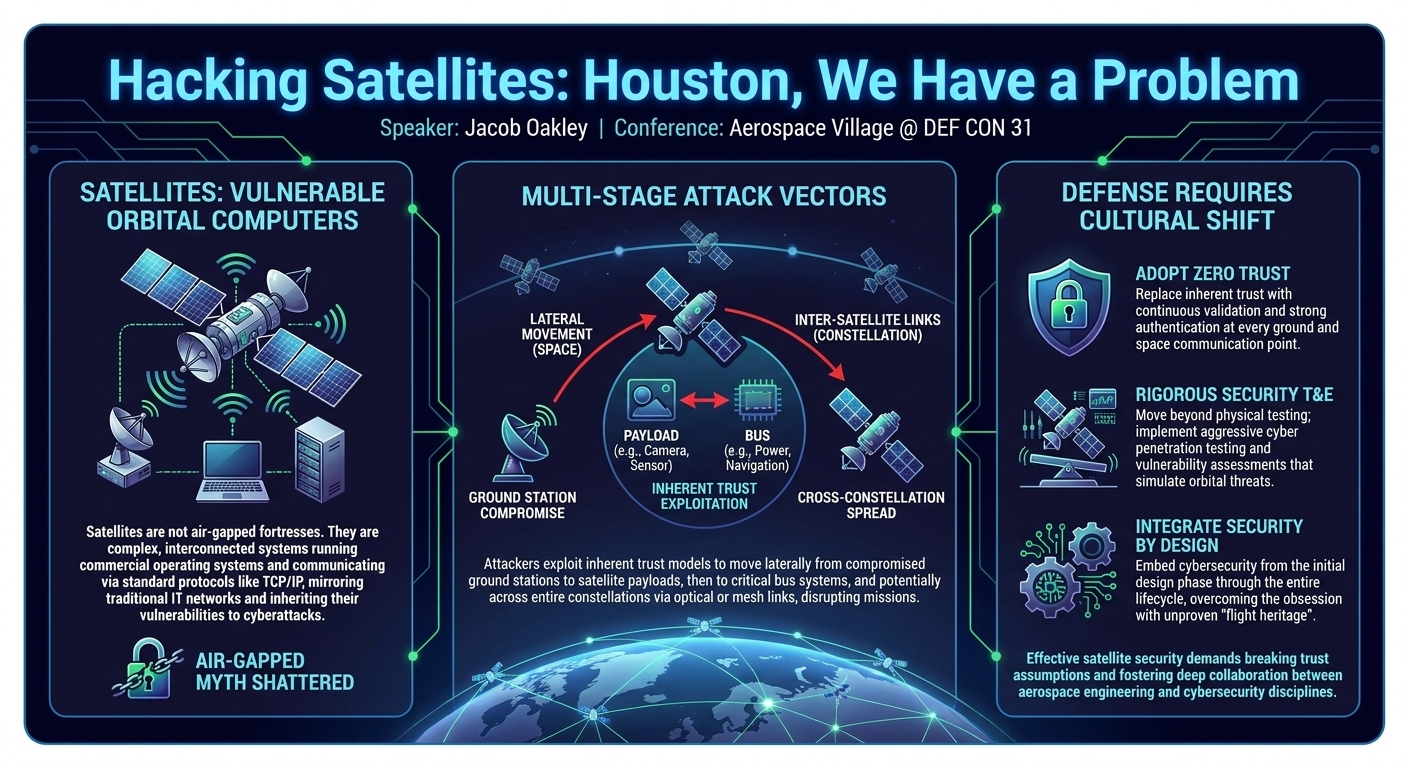
A typical satellite comprises two primary segments: the bus and the payload. The bus is the foundational platform, responsible for core operational functions such as propulsion, power generation and storage, and Position, Navigation, and Timing (PNT). PNT is achieved through technologies like GPS, Star trackers (which map celestial bodies), and Sun sensors. The payload, conversely, is the mission-specific component—a camera for imagery, antennas for communication (like Sirius XM Radio), or scientific instruments. Oakley emphasizes that these components are, at their core, computers, frequently communicating via TCP/IP and often employing Software Defined Radios (SDRs). This architectural similarity means that if an attacker compromises a ground station, they could potentially send malicious traffic to the satellite without needing complex protocol alterations, exploiting an "inherent trust" within these systems.
The operational life of a satellite presents unique environmental challenges that often overshadow cyber considerations. Space vehicles must withstand extreme radiation, temperature fluctuations from direct sunlight to complete darkness, the vacuum of space, and the constant threat of collision with other space objects. Consequently, significant engineering effort goes into hardening components against these physical threats. Before launch, satellites undergo rigorous physical testing—shaking tables to simulate launch forces, vacuum chambers, and thermal ovens. Once deployed, they must stabilize, generate power, and maintain communication. While these operational constraints drive robust redundancy measures—such as backups, gold images, and Watchdog scripts that trigger predetermined actions to protect the asset—Oakley critically points out that "none of those are security focused." An attacker with code execution could easily disable these redundancies, turning protective measures into vectors for mission disruption.
Key Findings
▶ Watch: Redundancy vs. Security: Watchdog Scripts (6:00)
Jacob Oakley's presentation articulates several critical findings that collectively paint a concerning picture of satellite cybersecurity. Foremost among these is the revelation that space systems are not the impenetrable, air-gapped entities many perceive them to be. Instead, they are increasingly interconnected, software-defined systems that mirror traditional IT networks, making them vulnerable to common attack methodologies. The proliferation of real-time operating systems and stripped-down Linux distributions on satellites, while simplifying development, has significantly broadened the attack surface and lowered the barrier to entry for adversaries.
A central finding is the distinction between redundancy and security. While space organizations excel at building resilient systems with multiple fail-safes to ensure operational continuity, these measures are not designed to withstand malicious, adaptive attacks. An attacker with code execution can subvert Watchdog scripts or manipulate power management, turning intended safeguards into tools for disruption.
Oakley introduces a structured approach to understanding adversarial targeting, categorizing missions into sensing, emitting, and transiting. Attackers select targets based on opportunity, ownership, specific satellite function, or mission type (e.g., all navigation satellites). Their motivations typically fall into five categories: collecting data, redirecting malicious activity, subverting the mission, ransoming the asset, or simply disabling it.
The talk further delineates attack vectors into pre-operational and operational phases. Pre-operational vectors encompass the entire supply chain, from design, development, testing, transportation, and storage in warehouses awaiting launch. Operational vectors involve attacks once the satellite is in space, including ground-to-space, space-to-ground, inner-vehicle (pivoting between the bus and payload or hosted payloads), and space-to-space (traversing constellations via optical links or mesh networks). Oakley highlights that exploitation is often tied to the mission and motivation; for example, ransoming might target the entire satellite (bus), while intelligence collection might focus on the payload.
Finally, Oakley identifies a series of systemic, foundational problems that impede effective cybersecurity for space systems. These include the perennial cost problem (cybersecurity seen as an overhead), the industry's obsession with flight heritage (reluctance to use unproven security solutions in space), the unique suitability of satellites for cyber warfare (silent "kills"), a significant test and evaluation problem (lack of rigorous security testing beyond compliance), the adaptation problem (cyber threats constantly evolve), a profound defense-in-depth problem (inherent trust architectures), the modernization problem (increased attack surface from open OS), a failure analysis problem (cyber rarely considered in post-mortems), and a severe disclosure problem (lack of public examples due to government/corporate ownership hindering momentum for change).
Technical Deep Dive
▶ Watch: The TRX Framework for Targeting Space Systems (13:20)
The technical vulnerabilities of space systems, as detailed by Jacob Oakley, stem from their increasingly complex and interconnected architecture, which paradoxically mirrors terrestrial IT networks while lacking comparable security maturity. At the heart of a satellite system are the bus and payload subsystems, each presenting distinct yet interconnected attack surfaces.
The bus, responsible for the satellite's core operational functions, offers multiple points of compromise. Its Position, Navigation, and Timing (PNT) systems, which rely on GPS, Star trackers, and Sun sensors, are critical. Disrupting PNT can prevent the satellite from accurately pointing its antennas to ground stations, closing communication links, or performing encryption handshakes. An attacker could spoof GPS signals or manipulate the star tracker's data, causing the satellite to lose its orientation. Flight control mechanisms, such as flywheels and reaction wheels (which generate inertia for movement), are also potential targets. Compromising these could lead to uncontrolled tumbling or orbital decay. More fundamentally, the bus manages power generation, distribution, and storage, a unique attack surface whose disruption could effectively "kill" the satellite.
The payload, tailored to the satellite's specific mission, offers its own set of vulnerabilities. For instance, a camera payload's GPS could be manipulated to misreport imagery locations, or a communications payload could be hijacked to redirect data. Oakley emphasizes that many payloads are "hosted," meaning one company owns and flies the bus, while another owns and operates the payload. This multi-tenant environment creates a potential lateral movement vector: a compromise of one payload could spread to the bus, and then potentially to other hosted payloads.
Communication between ground stations and satellites, and even between components within a satellite, often relies on TCP/IP over modulated, encrypted signals via Software Defined Radios (SDRs). While encryption is present, the underlying trust model is weak. If an attacker gains access to a ground station, they can leverage this inherent trust to send malicious commands directly to the satellite. Crucially, the speaker highlights that gaining code execution on a satellite's operating system (often a stripped-down Linux variant) grants significant power. This allows for manipulation of crypto keys, effectively locking out legitimate operators, or subverting redundancy protocols like Watchdog scripts. By altering Watchdog parameters (e.g., setting a power usage threshold to zero), an attacker can force the satellite to repeatedly shut down as a "protective measure," rendering it inoperable.
Oakley illustrates a multi-stage exploitation scenario. An initial compromise might occur via a "personal computer" connected to a "cell phone," which then connects to a "server that hosts the ground station VM." From the ground station, an attacker could pivot to the payload computer due to "inherent trust." Once on the payload, the attacker could move to the data handling system for the bus, then to the SDR, ultimately taking control of communications or completely severing them. In mesh networks and constellations, like those envisioned by Starlink, a compromise on one satellite could leverage optical links or other inter-satellite communication channels to proliferate across the entire network, compromising multiple satellites and their associated ground stations. The fundamental issue is a pervasive lack of defense-in-depth and validation, where "satellites have no reason to not trust the ground," and ground stations often don't validate traffic from satellites, assuming it's benign. This architectural trust, while simplifying operations, creates a wide-open avenue for sophisticated lateral movement and widespread compromise.
Demo / Proof of Concept
▶ Watch: How a Single Satellite Compromise Spreads (13:40)
While Jacob Oakley's talk does not feature a live, in-depth demonstration of hacking a satellite, he powerfully illustrates the theoretical and practical feasibility of such attacks through vivid hypothetical scenarios and references to existing competitions. He alludes to the "finals of a competition where they're doing that" – likely referring to Hack-A-Sat, a well-known hacking competition focused on space systems, which underscores the reality of these vulnerabilities.
Oakley further uses a relatable, step-by-step narrative to convince skeptical engineers that even "air-gapped" systems can be compromised. He walks through a plausible chain of events: from a personal computer used to charge a cell phone, to that same cell phone being connected to a lab server hosting a ground station VM. He then details how malware and tools could bridge these seemingly disparate environments, ultimately gaining access to the ground station. From there, the "inherent trust" between the ground station and the satellite's payload computer, and then between the payload and the bus, allows for lateral movement and full compromise, demonstrating a clear proof-of-concept for how a malicious actor would gain control. The scenarios presented, while not a live demo, serve as a potent conceptual proof of concept, highlighting the architectural weaknesses and trust assumptions that adversaries would exploit.
Defensive Implications
▶ Watch: The Critical Space Cybersecurity Disclosure Problem (20:10)
The defensive implications arising from Jacob Oakley's analysis are profound and necessitate a fundamental paradigm shift in how the space industry approaches cybersecurity. The most immediate challenge is overcoming the cost problem: cybersecurity is frequently viewed as an expenditure rather than an integral investment, particularly when competing with the immense costs of space launch and operations. This economic hurdle is compounded by the flight heritage obsession, where the space community is highly reluctant to deploy unproven technologies in orbit. Novel cybersecurity tools, lacking a track record in space, face significant resistance, leaving systems vulnerable to known exploits. Defenders must advocate for dedicated budgets and foster innovation in space-qualified security solutions, potentially through ground-based testing that rigorously simulates orbital conditions.
A critical area for improvement is Test and Evaluation (T&E). Current T&E focuses heavily on physical resilience (e.g., vacuum, radiation, vibration), but "there isn't an exercising of the security apparatus for these assets." While compliance checks like the Risk Management Framework (RMF) exist, they are insufficient. The industry needs to adopt a "shake-table" equivalent for cybersecurity, conducting aggressive penetration testing, red teaming, and vulnerability assessments that go beyond mere compliance to truly validate the security posture of space systems. This includes testing against the adaptation problem, recognizing that cyber adversaries constantly evolve their tactics, unlike static environmental challenges.
The pervasive defense-in-depth problem demands a radical rethinking of trust architectures. The "inherent trust" between ground stations, satellites, and inter-satellite components must be replaced with a Zero Trust model. This involves implementing rigorous authentication, authorization, and continuous validation at every communication point, both on the ground and in space. Micro-segmentation within satellites, strong cryptographic separation between bus and payload, and robust integrity checks for all data exchanged are essential. Operators must overcome their "nervousness" about security measures potentially disrupting satellite operations, recognizing that a compromise is far more disruptive.
The modernization problem highlights that the move to open operating systems and software-defined components, while beneficial for development, inadvertently expands the attack surface. Defenders must proactively secure these new architectures, applying best practices from enterprise IT security, including secure coding, patch management (despite the challenges of uploading patches to space), and robust configuration management.
Finally, addressing the failure analysis problem and the disclosure problem requires a cultural shift. Cybersecurity must be systematically integrated into every post-mortem investigation for satellite anomalies, acknowledging that a cyberattack can mimic environmental or hardware failures. Furthermore, the industry needs mechanisms for responsible disclosure of vulnerabilities and, ideally, public examples of compromises (akin to Stuxnet or SolarWinds for terrestrial systems) to build momentum for change. Without these "hammers," as Oakley describes them, it's challenging to convince stakeholders to invest in fixing problems they believe "haven't happened yet." Ultimately, a stronger "interchange" between the space and cybersecurity industries is vital for building a prepared and resilient space infrastructure.
Key Takeaways
- Satellites are Vulnerable IT Systems: Modern space systems, particularly LEO satellites, are not air-gapped but are increasingly complex, interconnected computers running open operating systems and communicating via TCP/IP, making them susceptible to traditional cyberattack vectors.
- Redundancy is Not Security: Existing operational safeguards like backups, gold images, and Watchdog scripts are designed for resilience against physical failures, not for defense against malicious, adaptive attackers who can subvert these measures.
- Targeting is Mission and Motivation-Driven: Adversaries strategically select targets based on mission type (sensing, emitting, transiting) and are motivated by objectives such as data collection, mission subversion, ransomware, or outright disablement of the asset.
- Multi-Stage Attack Vectors Exist: Attacks can originate from pre-operational phases (supply chain compromise) or operational phases, with potential for lateral movement from ground to space, within a satellite (payload to bus), and across entire constellations via inter-satellite links.
- Systemic Challenges Hinder Defense: Deep-rooted issues like the high cost of space operations, obsession with "flight heritage," inadequate security testing, inherent trust models, and a lack of public disclosure prevent the adoption of robust cybersecurity measures.
- Urgent Cultural Shift Required: Effective satellite cybersecurity demands a fundamental shift in industry mindset, integrating security into every design stage, embracing rigorous cyber T&E, breaking inherent trust assumptions, and fostering greater collaboration between space and cybersecurity professionals.
About the Speaker(s)
Jacob Oakley is a distinguished cybersecurity professional and author with close to two decades of experience. His expertise spans offensive cyber operations and security for Space Systems, where he has developed a deep understanding of the unique challenges and vulnerabilities of this critical domain. Oakley advises on the strategic mitigation of risks and threats to globally distributed, multi-domain network architectures, making him a leading voice at the intersection of space and cybersecurity. His work aims to bridge the knowledge gap between these two complex fields, advocating for proactive security measures in the rapidly expanding space industry.
Reviews
Dr. Zero (Offensive Security Researcher) — WEAK
Jacob Oakley spends a session explaining to a DEF CON audience that satellites are just Linux boxes floating in space that use TCP/IP. It's a fundamental awareness briefing that drops zero CVEs, shows zero actual exploits, and relies on 'if you get code execution' hand-waving instead of demonstrating how to get it.
Heather Calloway (CISO) — MUST SEE
Oakley strips away the exceptionalism around space systems, proving that multi-million dollar LEO satellites are essentially just poorly segmented Linux boxes in orbit. For CISOs in defense, telecom, or critical infrastructure, this is required viewing. It translates orbital architecture directly into third-party and OT risk.