Attribution, Partnerships, and Incident Response
Cynthia Kaiser (Deputy Assistant Director, Cyber Division · FBI)
Black Hat Middle East & Africa 2023 (Executive Summit) · Day 1 · Executive Summit
Overview
In a compelling presentation at Black Hat MEA, Cynthia Kaiser, Deputy Assistant Director of the FBI's Cyber Division, illuminated the complex interplay between attribution, partnerships, and incident response in the global fight against cyber threats. Drawing from her extensive experience as an intelligence analyst and her current executive role, Kaiser posited that cybersecurity represents "the National Security challenge of our lifetime," impacting citizens, jobs, and fundamental ways of life. Her talk underscored the FBI's evolving strategy to counter sophisticated adversaries, emphasizing a critical shift from traditional, linear incident response models to a more integrated, collaborative, and dynamic approach.
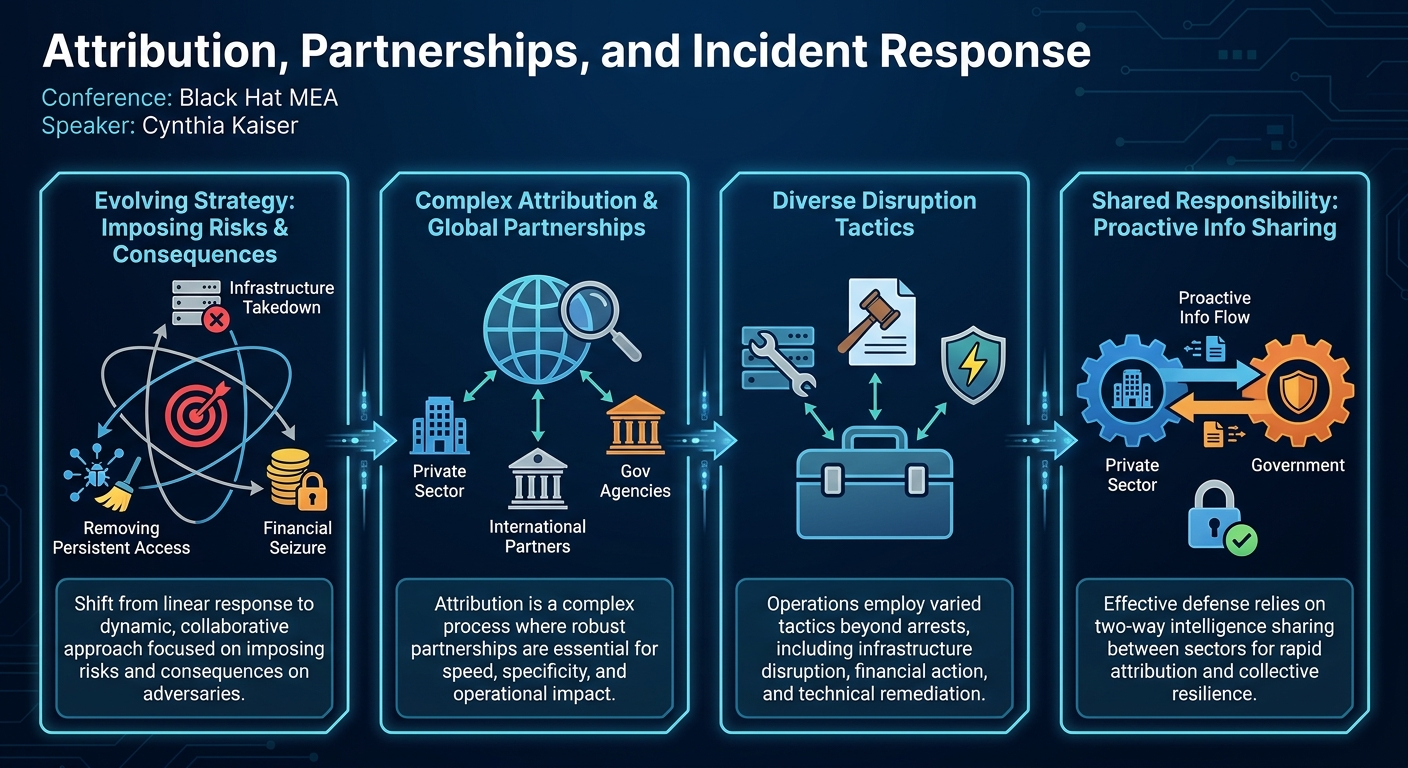
Key moments
- 0:00 Introduction and FBI's Cyber Strategy
- 3:35 The Evolving Complexity of Cyber Attribution
- 5:36 Global Partnerships are Essential for Cyber Defense
- 9:10 Albania Attack: International Cooperation and Geopolitical Impact
- 11:08 Quakbot Takedown: Multinational Disruption of a Botnet
- 14:40 Beyond Arrests: Diverse Law Enforcement Disruption Tactics
- 16:30 Call to Action: Private Sector's Role in Information Sharing
Attribution, Partnerships, and Incident Response
Speakers: Cynthia Kaiser, Deputy Assistant Director, Cyber Division, FBI
Conference: Black Hat MEA
YouTube: https://www.youtube.com/watch?v=DT4PZp9xYX0
Overview
In a compelling presentation at Black Hat MEA, Cynthia Kaiser, Deputy Assistant Director of the FBI's Cyber Division, illuminated the complex interplay between attribution, partnerships, and incident response in the global fight against cyber threats. Drawing from her extensive experience as an intelligence analyst and her current executive role, Kaiser posited that cybersecurity represents "the National Security challenge of our lifetime," impacting citizens, jobs, and fundamental ways of life. Her talk underscored the FBI's evolving strategy to counter sophisticated adversaries, emphasizing a critical shift from traditional, linear incident response models to a more integrated, collaborative, and dynamic approach.
The core of Kaiser's message revolved around the FBI's 2020 cyber strategy, which focuses on imposing risks and consequences on cyber adversaries. This strategy is built on three pillars: robust partnerships, proactive disruptions, and a shared responsibility across government and the private sector. The ultimate goal is to dismantle the anonymity that often shields malicious actors, making it significantly harder and more costly for them to succeed. Kaiser detailed how the FBI navigates the increasingly intricate landscape of cyber attribution, grappling with questions of speed, specificity, and the ultimate success of operational responses, all while highlighting the indispensable role of international and private sector collaboration.
Background
▶ Watch: Introduction and FBI's Cyber Strategy (0:00)
The landscape of cyber threats has undergone a profound transformation, moving far beyond the early days of personal computing. As Cynthia Kaiser reflected, the simplicity of storing data on floppy disks has given way to a world where everything is interconnected and saved on the cloud, presenting adversaries with unprecedented opportunities to steal, disrupt, and attack. This technological evolution has necessitated a rapid re-evaluation of how defenders counter malicious exploitation. The FBI, at the forefront of this battle, recognizes that traditional methods for attribution—the process of identifying the perpetrator of a cyberattack—are no longer sufficient.
Historically, attribution felt more straightforward: respond to an incident, collect data, analyze technical artifacts and Indicators of Compromise (IOCs), compare them with known adversary Tactics, Techniques, and Procedures (TTPs), and then decide on the level of public disclosure. However, today, these steps are no longer sequential but often occur simultaneously and with far greater complexity. Kaiser identified several factors driving this change: rapid advancements in technology, a shifting global geopolitical landscape, escalating public expectations, evolving network defense needs, and the sheer growth and sophistication of the cybercriminal ecosystem. These factors have complicated established processes, forcing the FBI to rethink how to most effectively approach evolving threats.
The FBI's re-evaluation crystallizes around three critical questions:
- Speed: How quickly should attribution be made, especially publicly?
- Specificity: How granular can or should attribution be, particularly when linking enabling services, cybercriminal groups, proxies, and nation-state actors?
- Success: How can operational options be developed to achieve the greatest impact against adversaries?
As a nexus between the law enforcement and intelligence communities, the FBI's century-long mission to identify and bring harm-doers to justice now heavily relies on navigating these complexities in cyberspace. Recognizing that no single entity can tackle the global, borderless nature of cybercrime, the FBI has become "more reliant than ever on partners" across the private sector, government agencies, and international jurisdictions. This foundational belief in collaboration underpins the FBI's contemporary approach to incident response and disruption operations.
Key Findings
▶ Watch: Global Partnerships are Essential for Cyber Defense (5:36)
The central finding presented by Cynthia Kaiser is the FBI's imperative to evolve its approach to cyber attribution from a linear, post-incident analysis to a dynamic, collaborative, and strategically varied process. This evolution is driven by the recognition that partnerships—spanning the private sector, other government agencies, and international counterparts—are not merely beneficial but absolutely essential for achieving meaningful disruption and deterrence against sophisticated cyber adversaries. The FBI's strategy is now characterized by a flexible, impact-driven decision-making framework concerning the speed, specificity, and desired outcomes of attribution.
Kaiser highlighted that the FBI often identifies overlaps between criminal and national security cases that are not immediately apparent, underscoring the critical need for broad intelligence gathering and analysis. To facilitate this, the FBI Cyber Division is significantly expanding its international footprint, with 16 (and soon 22) Cyber Assistant Legal Attaches deployed globally to foster relationships and cooperate on cross-border cyber cases. Furthermore, the deployment of FBI Cyber Action Teams (CAT teams), which have been dispatched internationally over eight times in the last 24 months, represents a proactive, on-the-ground capability to assist foreign partners and provide training.
The talk presented three distinct case studies to illustrate the FBI's varied and successful application of this evolved strategy:
- WhisperGate (January 2022): An example where rapid, country-level attribution to Russia was deemed sufficient and impactful, especially at the onset of hostilities in Ukraine, to enable quick information sharing and network defense. This success was built on years of prior collaboration with Ukraine, including responses to the 2015 BlackEnergy attacks and the 2017 NotPetya attacks.
- Albanian Government Attack (July 2022): A prime instance of deep international partnership, resulting in precise attribution to Iran, significant geopolitical consequences (Albania closing the Iranian Embassy), and the release of detailed technical advisories for global defenders. This operation leveraged both national security and law enforcement authorities, allowing for unclassified information sharing.
- Qakbot Botnet Takedown (August 2022): The largest-ever US government-led takedown of botnet infrastructure, demonstrating a strategy of slow, highly specific attribution executed through a multinational operation. This targeted all aspects of the cybercriminal enterprise—malware, infrastructure, communications, and finances—for maximum long-term impact.
These examples collectively demonstrate that there is no "one-size-fits-all" approach to attribution. Instead, the optimal strategy depends on the specific threat, the operational objectives, and the available partnership opportunities, always aiming to impose the greatest possible consequences on malicious actors.
Technical Deep Dive
▶ Watch: Albania Attack: International Cooperation and Geopolitical Impact (9:10)
The FBI's operational successes in countering global cyber threats are deeply rooted in sophisticated technical analysis, strategic infrastructure disruption, and the leveraging of unique legal authorities. Cynthia Kaiser provided several compelling examples that showcase the technical depth of these operations.
The WhisperGate attack in January 2022, targeting Ukrainian government services, highlighted the FBI's rapid response capabilities. Within two days of learning about the wiper malware attack, the FBI, in collaboration with private sector and US government counterparts, was able to identify connections to known malicious actor TTPs and IOCs. This swift analysis enabled an initial attribution to Russia. This rapid success was not an isolated event but built upon years of joint efforts with Ukrainian partners to counter destructive cyber effects, notably including the 2015 BlackEnergy attacks against the Ukrainian energy sector and the globally disruptive 2017 NotPetya attacks. These previous incidents provided a rich repository of adversary intelligence and established relationships crucial for quick, albeit country-level, attribution when speed was paramount for defending critical infrastructure.
In July 2022, the Albanian government suffered a devastating cyberattack that destroyed government data and crippled all online services. The FBI's response involved immediately deploying a CAT team to the ground. Leveraging both national security and law enforcement authorities, the CAT team was able to review highly relevant technical information. Crucially, all collected information was kept unclassified, facilitating swift and free sharing with Albanian government partners and Microsoft teams on the ground. This joint technical work ultimately led to the attribution of these attacks to Iran. Following this, the FBI released a public advisory providing "new technical details" to network defenders worldwide, enabling them to protect their systems against similar TTPs. The ability to collect and disseminate actionable, unclassified technical intelligence was key to both attribution and broader defensive impact.
Perhaps the most technically intricate operation discussed was the August 2022 multinational effort to disrupt and dismantle Qakbot. Qakbot was a highly evasive and globally distributed botnet infrastructure that infected hundreds of thousands of computers across various industries, from financial institutions to medical device manufacturers and government agencies. Victims were typically compromised through spam emails containing malicious links, which, when clicked, allowed Qakbot to deliver various ransomware families (Kaiser noted "pretty much any ransomware family that you can think of at one point had used Qakbot"). The infected computers became part of the botnet, controlled remotely by cybercriminals to launch further attacks.
The technical challenge of disrupting Qakbot was immense due to its globally distributed nature and its operators' constant efforts to change their Command and Control (C2) infrastructure to evade detection. The FBI's operation, conducted with six international partners (France, Germany, Netherlands, Romania, Lithuania, and the UK), involved gaining lawful access to Qakbot's infrastructure. This access enabled the FBI to identify over 700,000 infected computers worldwide. A critical technical maneuver involved redirecting Qakbot traffic to FBI-controlled servers. These servers were then used to instruct the infected computers to actually remove the Qakbot malware, effectively disarming the botnet from within. Beyond infrastructure disruption, the operation also targeted the adversary's financial gains, seizing $9 million from the cybercriminals, which was made available to victims. This operation demonstrated a deep understanding of the botnet's technical architecture and the ability to surgically intervene at a global scale.
Kaiser also briefly mentioned the 2021 Hafnium operation, where the FBI "removed Chinese webshell from thousands of computers across the US." This highlights another facet of their technical operations: proactively eliminating persistent access mechanisms that adversaries implant on victim networks. These examples collectively underscore the FBI's multifaceted technical capabilities, ranging from rapid forensic analysis and intelligence dissemination to complex, multi-jurisdictional infrastructure takedowns and the direct remediation of compromised systems.
Demo / Proof of Concept
▶ Watch: Beyond Arrests: Diverse Law Enforcement Disruption Tactics (14:40)
While Cynthia Kaiser's talk extensively detailed real-world operations and the technical mechanisms behind successful disruptions, it did not include a live demonstration or a proof of concept of a specific exploit or defensive tool. Instead, the examples provided, such as the Qakbot takedown, served as retrospective case studies illustrating the FBI's operational capabilities and the methodologies employed in large-scale cyber interventions.
Defensive Implications
▶ Watch: Call to Action: Private Sector's Role in Information Sharing (16:30)
The insights shared by Cynthia Kaiser offer critical guidance for network defenders across all sectors, emphasizing the proactive steps necessary to build resilience against evolving cyber threats. The overarching message is that cyber defense is a shared responsibility, requiring a constant, two-way flow of information between the private sector and government agencies.
First and foremost, defenders must recognize the critical role they play in the broader ecosystem of cyber defense. By proactively sharing substantive intelligence and relevant technical information, companies can significantly contribute to quicker attribution efforts by the FBI and its partners. This information, including IOCs, TTPs, and contextual data from unique cyber incidents on their networks, is vital for identifying, deterring, and disrupting threats to industry and critical infrastructure. The speed and granularity of this sharing directly influence the government's ability to make informed policy decisions and launch effective response operations.
A fundamental defensive measure highlighted is the imperative to maintain an up-to-date and comprehensive incident response plan. This plan should not merely exist on paper but must be practiced often to ensure that all stakeholders know "who to call when an incident occurs" and how to execute their roles efficiently under pressure. A well-rehearsed IR plan minimizes response times and maximizes the chances of successful containment and recovery.
Furthermore, defenders should be aware of the FBI's diverse range of disruption tactics, which extend beyond traditional arrests. These include:
- Seizing domain names, money, and infrastructure: Directly impacting the adversary's operational capabilities and financial incentives.
- Shutting backdoors: Removing persistent access mechanisms, such as the Chinese webshells removed in the Hafnium operation, that adversaries implant on networks.
- De-cybercriminalizing: Driving a wedge between adversaries, limiting their travel, making private sector jobs less accessible, and establishing clear lines of acceptable conduct in cyberspace, even if an arrest isn't immediately possible.
Understanding these varied approaches can help organizations contextualize government actions and appreciate the broader impact of their intelligence sharing. Ultimately, the FBI and the US government aim to be "in lock step" with international and private sector partners, making joint decisions to protect collective interests. This collaborative spirit means that defenders are not alone in facing these threats, but their active participation in information sharing and robust internal preparedness are indispensable components of global cybersecurity.
Key Takeaways
- Cybersecurity is a National Security Imperative: Modern cyber threats pose the "National Security challenge of our lifetime," impacting all aspects of society, necessitating a unified and proactive defense.
- Attribution is Complex and Strategic: The process of identifying cyber adversaries has evolved beyond simple technical analysis, requiring a flexible approach that balances speed, specificity, and desired impact based on operational objectives.
- Partnerships are Non-Negotiable: Effective cyber defense and disruption are impossible without robust collaboration across the private sector, government agencies, and international partners, facilitating critical information sharing and joint operations.
- FBI Employs Diverse Disruption Tactics: Beyond arrests, the FBI targets all aspects of cybercriminal enterprises, including infrastructure takedowns (e.g., Qakbot), financial seizures, removal of persistent access (e.g., Hafnium), and geopolitical consequences, to impose maximum risk and cost on adversaries.
- Information Sharing is Crucial for Collective Defense: A proactive, two-way flow of substantive intelligence and technical details between the private sector and government is vital for rapid attribution, threat deterrence, and the development of effective defensive strategies.
- Proactive Incident Response is Essential: Organizations must develop and regularly practice comprehensive incident response plans to ensure swift, coordinated action, enabling quick engagement with law enforcement and minimizing the impact of cyber incidents.
About the Speaker(s)
Cynthia Kaiser serves as a Deputy Assistant Director within the FBI's Cyber Division, a role that places her at the forefront of the United States' efforts to counter global cyber threats. Her career journey into cybersecurity began as an intelligence analyst, where she gained invaluable experience briefing senior levels of the US government on critical national security threats, including pivotal cyber incidents. This background allowed her to witness firsthand the US government's strategic positioning against global cyber challenges. Kaiser's passion for countering cyber threats has only intensified in her executive role, driven by a personal commitment to protecting her friends, family, and community. She humorously recounted an early, albeit misguided, interaction with technology as a child, attempting to use an early IBM PC as a piggy bank, highlighting her journey from a technology novice to a leading expert in cyber defense. Her insights are shaped by a deep understanding of both intelligence analysis and law enforcement operations in the cyber domain.
Reviews
Dr. Zero (Offensive Security Researcher) — SOLID
Another Fed keynote preaching the gospel of public-private partnerships, but Kaiser actually brings a few receipts. She skips the usual buzzword bingo to outline a fundamental, aggressive shift in how the Bureau physically interacts with compromised victim networks.
Heather Calloway (CISO) — SOLID
This is the FBI's current playbook on attribution and active disruption. Kaiser outlines how the Bureau is moving past post-mortem forensics into active infrastructure takedowns and unclassified intelligence sharing. It sets the baseline for how your incident response team should engage law enforcement.
→ Top-rated talks at Black Hat Middle East & Africa 2023 (Executive Summit)
All talks from Black Hat Middle East & Africa 2023 (Executive Summit)