Privacy in the Age of AI: Navigating Data Challenges & Safeguarding Personal Information
David Cross (SVP & CISO · Oracle SaaS Cloud), Jim Higgins (CISO · Snap Inc.), Latha Maripuri (CISO · Uber), Vitaly Gudanets (CISO · Netflix)
Black Hat Middle East & Africa 2023 (Executive Summit) · Day 1 · Executive Summit
Overview
In an era defined by the rapid ascent of artificial intelligence (AI) and large language models (LLMs), the imperative to balance technological innovation with robust privacy and security safeguards has become paramount. This panel discussion at Black Hat MEA brought together a distinguished group of Chief Information Security Officers (CISOs) from leading global technology companies—Oracle, Snap Inc., Uber, and Netflix—to dissect the multifaceted challenges and opportunities presented by AI. The conversation, moderated by David Cross, delved into the inherent risks, strategic defensive measures, and the evolving landscape of AI adoption across enterprise and consumer domains.
Key moments
- 0:45 Initial risks of AI and LLMs
- 2:05 Uber's AI use cases and paradigm shift
- 5:30 AI's dual role: safety and scaled attacks
- 11:45 Legal and IP challenges of AI-generated content
- 18:40 Key advice for organizations adopting generative AI
- 22:00 AI red teaming and regulatory implications
- 29:20 Architecting AI for data deletion and ownership
- 37:00 Future of CISOs in the age of AI
Privacy in the Age of AI: Navigating Data Challenges & Safeguarding Personal Information
Speakers: David Cross (SVP & CISO, Oracle SaaS Cloud), Jim Higgins (CISO, Snap Inc.), Latha Maripuri (CISO, Uber), Vitaly Gudanets (CISO, Netflix)
Conference: Black Hat MEA
YouTube: https://www.youtube.com/watch?v=Pw0UUhWOGgo
Overview
In an era defined by the rapid ascent of artificial intelligence (AI) and large language models (LLMs), the imperative to balance technological innovation with robust privacy and security safeguards has become paramount. This panel discussion at Black Hat MEA brought together a distinguished group of Chief Information Security Officers (CISOs) from leading global technology companies—Oracle, Snap Inc., Uber, and Netflix—to dissect the multifaceted challenges and opportunities presented by AI. The conversation, moderated by David Cross, delved into the inherent risks, strategic defensive measures, and the evolving landscape of AI adoption across enterprise and consumer domains.
The panelists offered a pragmatic perspective, drawing parallels between the current AI revolution and the earlier shift to cloud computing, emphasizing that while the technology is novel, many underlying security and privacy principles remain relevant. However, the unprecedented velocity of AI innovation introduces new complexities, demanding proactive governance, education, and adaptive security frameworks. This article synthesizes their collective insights, providing a comprehensive analysis of the critical considerations for organizations navigating the privacy and security implications of AI.
Background
▶ Watch: Initial risks of AI and LLMs (0:45)
The advent of AI and LLMs marks a paradigm shift comparable to the widespread adoption of cloud computing, as noted by Latha Maripuri. This analogy underscores a critical theme: while the technology itself is new, the fundamental security and privacy questions—such as vendor risk, access control, data anonymization, and model integrity—echo concerns previously encountered with cloud infrastructure. However, the unique challenge posed by AI is its unprecedented velocity of innovation. Vitaly Gudanets highlighted that "every single week we feel there's a new large model being introduced," making it difficult for security and privacy practitioners to keep pace with advancements and emerging risks.
Before the recent surge in generative AI, many companies were already grappling with foundational data governance issues. These included understanding where data is stored, managing consent, executing deletion requests (e.g., under GDPR), categorizing data, and implementing effective encryption. The introduction of generative AI, with its pervasive data consumption and output generation capabilities, exacerbates these existing struggles, elevating them "to a whole other level."
Furthermore, attackers are quick to follow trends, leveraging new technologies for malicious purposes. Jim Higgins and Latha Maripuri both observed that attackers are already scaling their efforts, using AI to enhance phishing and spear phishing campaigns, craft more sophisticated malware, and simulate various attack vectors. This proactive weaponization of AI by threat actors necessitates an equally proactive defensive posture from organizations. The panel collectively acknowledged that AI is no longer a niche technology; virtually every organization is now either using or exploring AI, making its security implications a universal concern.
Key Findings
▶ Watch: AI's dual role: safety and scaled attacks (5:30)
The discussion revealed several key findings regarding AI's impact on privacy and security:
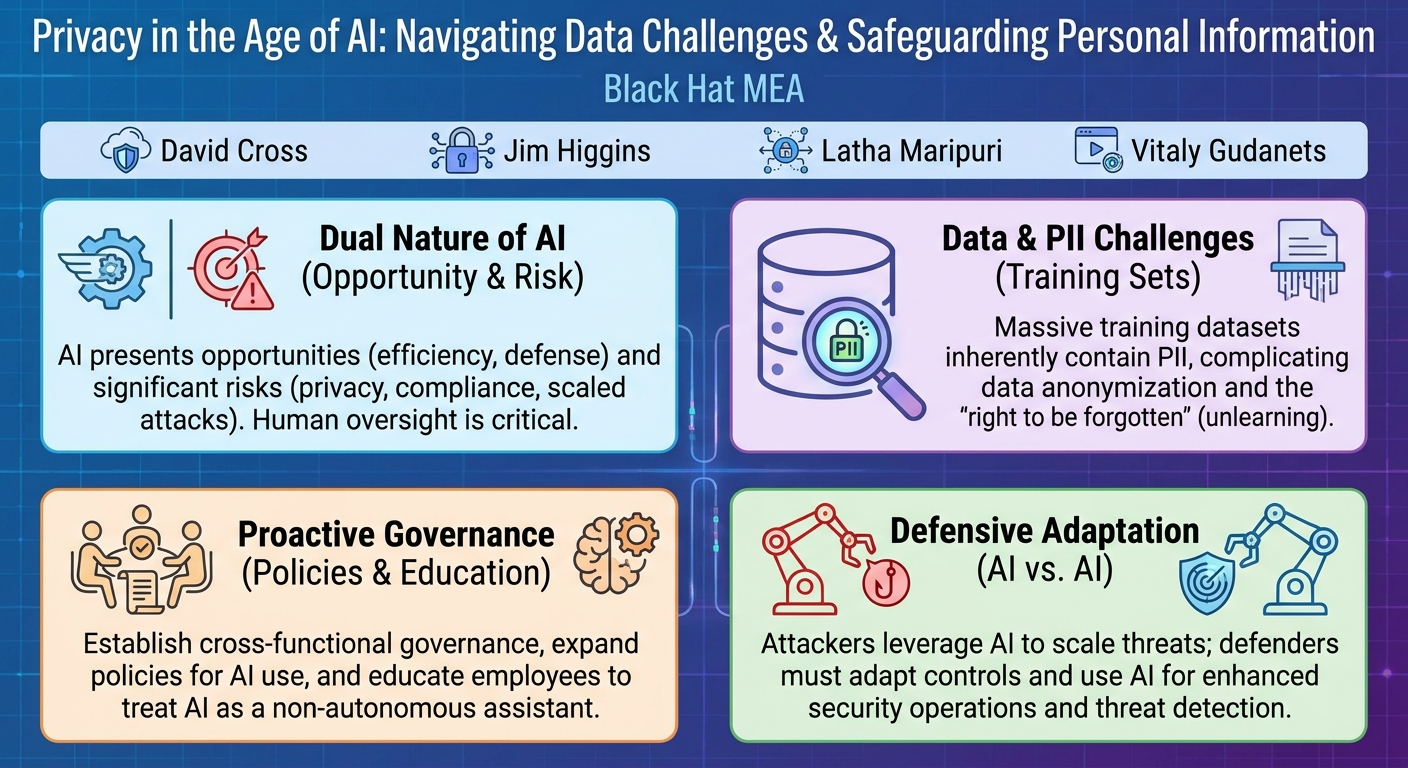
- Dual Nature of AI: AI presents both significant opportunities and profound risks. On the positive side, Uber leveraged generative AI for hackathons, identifying use cases in customer support, employee productivity, and software engineering automation, including code creation and test case generation. Snap Inc. utilizes AI for platform safety, detecting and preventing inappropriate content faster. Security teams themselves can harness AI for data analysis, visibility, and improving security operations, as highlighted by Latha Maripuri and Vitaly Gudanets. Conversely, AI introduces risks related to data regulation, compliance, privacy, and product security, including "unknown and non vulnerabilities."
- PII and Training Data Challenges: A core privacy concern is the reliance of AI models on large training data sets, which often contain personally identifiable information (PII). Jim Higgins emphasized the risk of this sensitive data appearing as output from the model. The challenge lies in managing and safeguarding this PII within vast, complex data sets used for training, especially when quick and responsive models are desired.
- Legal and Intellectual Property (IP) Complexities: The legal landscape surrounding AI is fraught with uncertainty. Panelists raised concerns about copyright ownership for AI-generated code (e.g., from tools like GitHub Co-pilot) and the potential for third-party licensing issues. A significant risk involves the protection of an organization's own intellectual property; if employees input confidential documents or proprietary code into public AI platforms, there's a substantial risk of that IP being leaked and used to train new, publicly accessible models. The irreversibility of this data leakage once ingested by a model makes it a critical concern.
- Trust and Accuracy Limitations: Despite the excitement, current AI models are not 100% reliable. Latha Maripuri stressed that AI should primarily serve as an assistant, not an autonomous decision-maker, especially for critical tasks like generating production code. She noted that current accuracy rates range from the "low 70s to low 90s," far from the desired 100%. This necessitates human oversight and a feedback loop mechanism to continually evaluate quality, time savings, and confidence thresholds. The challenge of "who will watch the AI" remains a pertinent question.
- Enterprise vs. Consumer AI Risk Profiles: Jim Higgins differentiated the risk profiles of AI in enterprise versus consumer contexts. He suggested that AI used in enterprise settings (e.g., for EDR or internal security) is generally more manageable due to controlled environments. However, consumer-facing AI, which directly handles individuals' private information, demands significantly higher levels of protection, discipline, and awareness due to the direct impact of model outputs on user decisions and data privacy.
- Bias Mitigation: Latha Maripuri identified bias mitigation as a significant, often overlooked gap. She stressed the importance of developers and engineers working with AI solutions to actively identify and address biases in models and outputs, using feedback loops to continuously improve solutions.
Technical Deep Dive
▶ Watch: Key advice for organizations adopting generative AI (18:40)
The technical implications of AI, particularly concerning data management and model integrity, were a central theme. The panelists highlighted that the very nature of AI, especially LLMs, introduces unique technical hurdles for privacy and security.
One fundamental technical challenge revolves around data handling. For AI models to be effective, they require massive datasets for training. As Jim Higgins pointed out, these datasets often contain Personally Identifiable Information (PII), which creates a direct risk of sensitive data being inadvertently exposed or reproduced in model outputs. The technical complexity lies in effectively implementing data anonymization and masking techniques across these vast and diverse datasets. Latha Maripuri emphasized that this should almost become a prerequisite for AI adoption, ensuring that sensitive data is truly masked to prevent re-identification, especially given the unknown downstream effects of where the data might travel.
The concept of data deletion and the "right to be forgotten," which is a cornerstone of regulations like GDPR, becomes technically arduous with LLMs. Jim Higgins elaborated on the difficulty of removing specific data points once they have been ingested and used to train a complex model. Unlike traditional databases where records can be precisely deleted, LLMs learn patterns and relationships from data, making it challenging to "unlearn" or selectively remove the influence of a particular piece of information without retraining the entire model, which is often impractical. This necessitates a proactive architectural approach, where the ability to manage data deletion and retention policies is considered upfront in the design of AI systems, rather than as an afterthought.
Access control for AI models and their underlying data sets is another critical technical area. Latha Maripuri stressed the need to think about how access controls, typically applied in traditional IT environments, translate to generative AI architectures. This includes not only who can access the models but also who can input data, what data they can input, and how the models' outputs are governed. This extends to the supply chain ripple effect, where AI service providers themselves may rely on other third-party services, creating a complex web of data flows and potential vulnerabilities that require diligent technical assessment.
From a development perspective, the use of AI tools like GitHub Co-pilot for code generation introduces technical risks. While beneficial for productivity, Jim Higgins noted that any AI-generated code requires significant testing and verification before deployment, especially for systems affecting large user bases. This implies the need for robust static application security testing (SAST), dynamic application security testing (DAST), and comprehensive code reviews that account for the potential inaccuracies, vulnerabilities, or unintended biases introduced by AI.
Finally, the panel touched upon the internal workings of AI itself. Latha Maripuri mentioned the need for prompt engineering and the expertise required to build models. This underscores the technical skill gap that organizations might face, needing professionals who understand not just how to use AI, but how to securely develop and deploy it, including understanding how to mitigate bias within the algorithms and training data. The technical challenge of achieving high accuracy (currently 70-90%) also points to inherent limitations that require careful consideration in deployment strategies.
Demo / Proof of Concept
▶ Watch: AI red teaming and regulatory implications (22:00)
This discussion was a panel talk focusing on strategic and policy-level insights regarding AI, privacy, and security. As such, no live demonstration or proof of concept was presented during the session.
Defensive Implications
▶ Watch: Future of CISOs in the age of AI (37:00)
The collective wisdom of the CISOs provided a robust framework for organizations to bolster their defenses against AI-related risks and leverage its benefits securely. The emphasis was on proactive, adaptive, and comprehensive strategies:
- Establish Robust Governance and Policies:
- Cross-Functional AI Governance Team: Uber's approach of setting up a central, cross-functional AI governance team is a critical first step. This team vets all generative AI solutions before adoption, ensuring consistent controls and visibility across the organization.
- Expand Existing Policies: Organizations must expand their current security and privacy policies to explicitly cover AI use cases. This includes clear guidelines on what data can and cannot be inputted into AI platforms, especially third-party services.
- Data Classification and Retention: Reinforce and adapt existing data classification policies to AI environments. Define retention policies for AI-generated data and user interactions with AI, considering future data deletion requests.
- Prioritize Education and Awareness:
- Internal User Education: Educate all employees—from developers and engineers to finance, legal, and HR teams—on the proper and improper use of AI tools. This training should cover risks such as IP leakage, PII exposure, and copyright issues.
- AI as an Assistant: Instill the understanding that AI should currently be treated as an assistant tool, not a fully autonomous one, especially for critical tasks. Emphasize the need for human review and verification of AI outputs.
- Implement Rigorous Vendor Risk Management:
- Thorough Vendor Assessment: Conduct deep risk assessments for all AI service providers. This must go beyond standard security checks to specifically evaluate their data handling practices, retention policies, control over data sets, and their own supply chain dependencies. Many vendors in this space are still early in their thinking regarding these aspects.
- Adapt and Enhance Security Controls:
- Shift Existing Controls: Review and adapt existing security and privacy controls—such as monitoring, access control, and incident response—to the new generative AI landscape. This involves understanding how data flows into, through, and out of AI systems.
- Data Anonymization as Prerequisite: Implement robust data anonymization and masking as a prerequisite for using sensitive data with AI models, particularly when interacting with external services. This minimizes the risk of re-identification and data leakage.
- Testing and Validation: For AI-generated code (e.g., from GitHub Co-pilot), mandate significant testing and verification. This includes security testing to catch vulnerabilities or errors introduced by the AI.
- Proactive Red Teaming and Architectural Design:
- Dedicated AI Red Teams: As suggested by the US Executive Order for AI, organizations should consider specialized AI red teams or integrate AI-specific testing into existing red team operations. The goal is to validate model security, access controls, and output integrity, ensuring AI cannot be prompted to reveal sensitive internal information.
- Architect for Data Deletion: Design AI systems from the outset with the ability to manage data deletion and the "right to be forgotten." This proactive architectural decision is crucial given the technical difficulty of removing data from trained LLMs retrospectively.
- Address Bias Mitigation:
- Feedback Loops for Bias: Implement continuous feedback loops to identify and mitigate biases in AI solutions. Developers and engineers must be trained to recognize and address biased outputs or underlying data, driving ongoing improvement in model fairness and accuracy.
By adopting these comprehensive defensive implications, organizations can navigate the complexities of AI, harnessing its transformative potential while effectively safeguarding privacy and security.
Key Takeaways
- AI is a Paradigm Shift, but Core Principles Remain: While AI introduces novel challenges, many security and privacy principles from cloud adoption (e.g., vendor risk, access control, data governance) are still highly relevant but require adaptation to the velocity of AI innovation.
- Proactive Governance and Education are Crucial: Establish cross-functional AI governance teams and expand policies to cover AI use cases. Educate all employees on proper AI usage, IP protection, and privacy risks, treating AI as an assistant rather than an autonomous tool.
- Data Management is Paramount: Large AI training datasets inherently contain PII, necessitating robust data anonymization, masking, and meticulous vendor risk assessments. Architect AI systems with data deletion and retention policies designed upfront, not as an afterthought.
- Attackers Leverage AI, so Must Defenders: Threat actors are using AI to scale phishing and malware attacks. Security teams should also leverage AI for data analysis, threat detection, and improving security operations, adapting existing controls for monitoring and access management.
- Rigorous Testing and Bias Mitigation: AI-generated content and code require significant human review, testing, and verification due to current accuracy limitations (70-90%). Actively work to identify and mitigate biases within AI models and outputs through continuous feedback loops.
About the Speaker(s)
The panel comprised four distinguished Chief Information Security Officers, each bringing a wealth of experience from leading technology companies:
- David Cross is the SVP & CISO for Oracle SaaS Cloud and a Venture Partner with Rain Capital. He moderated the discussion, drawing on his extensive background in cloud security.
- Jim Higgins serves as the Chief Information Security Officer for Snap Inc. Prior to his role at Snapchat, he spent 11 years at Google in product security, offering a deep understanding of consumer-facing technology and its security challenges.
- Latha Maripuri is the Chief Information Security Officer for Uber, where she oversees security and privacy engineering globally. Her insights often focused on the practical implementation of AI in large-scale enterprise environments and data governance.
- Vitaly Gudanets is the Chief Information Security Officer at Netflix, responsible for security and privacy engineering. His contributions highlighted the rapid pace of technological change and the need for adaptive security strategies in a fast-evolving media landscape.
Reviews
Dr. Zero (Offensive Security Researcher) — WEAK
Four Fortune 500 CISOs got on a stage to tell us that AI is like the cloud, attackers might use it for phishing, and you shouldn't paste proprietary code into ChatGPT. A complete waste of a heavy-hitting panel that traded actual operational insight for sanitized, PR-approved LinkedIn platitudes.
Heather Calloway (CISO) — SOLID
This is a competent, high-level panel of top-tier CISOs agreeing on the foundational realities of enterprise AI risk. It serves as a solid baseline for what a board expects to hear about AI governance, but it won't teach a mature security leadership team anything they haven't already operationalized.
→ Top-rated talks at Black Hat Middle East & Africa 2023 (Executive Summit)
All talks from Black Hat Middle East & Africa 2023 (Executive Summit)