Fireside Chat with Camille Vasquez: Privacy and Security Lessons from the Depp v. Heard Trial
Camille Vasquez (Partner · Brown Rudnick)
Black Hat Middle East & Africa 2023 (Executive Summit) · Day 1 · Executive Summit
Overview
In an unexpected but highly insightful fireside chat at Black Hat MEA, renowned attorney Camille Vasquez, best known for her pivotal role in representing Johnny Depp during his highly publicized defamation trial against Amber Heard, offered a unique perspective on privacy, security, and crisis management. While traditionally a legal expert, Vasquez found herself, and her firm, directly confronting significant cybersecurity and physical security challenges as the trial unfolded under intense global scrutiny. This talk transcended typical legal discourse, illustrating how the principles of legal defense, brand management, and public relations critically intersect with the practicalities of digital and personal security in an era of hyper-connectivity and pervasive media.
Key moments
- 0:00 Unexpected media spotlight and personal privacy
- 2:30 Outsourcing security and attempted trial hacks
- 4:15 Corporate crisis preparation and brand protection
- 8:15 Communicating security risks to high-profile clients
- 10:10 Strategies for composure and witness preparation
- 16:30 Fostering team collaboration and accountability
- 20:45 Unexpected physical security threats and planning
Fireside Chat with Camille Vasquez: Privacy and Security Lessons from the Depp v. Heard Trial
Speakers: Camille Vasquez, Partner, Brown Rudnick
Conference: Black Hat MEA
YouTube: https://www.youtube.com/watch?v=3X7V937Hi-Y
Overview
In an unexpected but highly insightful fireside chat at Black Hat MEA, renowned attorney Camille Vasquez, best known for her pivotal role in representing Johnny Depp during his highly publicized defamation trial against Amber Heard, offered a unique perspective on privacy, security, and crisis management. While traditionally a legal expert, Vasquez found herself, and her firm, directly confronting significant cybersecurity and physical security challenges as the trial unfolded under intense global scrutiny. This talk transcended typical legal discourse, illustrating how the principles of legal defense, brand management, and public relations critically intersect with the practicalities of digital and personal security in an era of hyper-connectivity and pervasive media.
The discussion, moderated by Graham Cluley, revealed that the unprecedented media attention on the trial, and on Vasquez herself, necessitated immediate and robust security protocols. From attempted hacks on her devices to personal security threats, Vasquez shared firsthand experiences that underscored the vulnerability even of those not directly involved in the technology sector. Her insights provide invaluable lessons for individuals, corporate clients, and security professionals alike, highlighting the importance of proactive preparation, effective communication, and understanding the intricate relationship between cyber security, public opinion, and an organization's or individual's brand integrity.
Background
▶ Watch: Unexpected media spotlight and personal privacy (0:00)
The backdrop for this discussion was the sensational Johnny Depp v. Amber Heard defamation trial, a legal battle that captivated global audiences and generated unprecedented public engagement. What began as a high-profile celebrity lawsuit quickly evolved into a cultural phenomenon, fueled by social media platforms like TikTok, where hashtags related to Camille Vasquez alone reportedly garnered over 900 million views. This intense public interest transformed the trial into a live, global spectacle, creating an environment ripe for both digital scrutiny and real-world threats.
Vasquez, a legal expert specializing in high-net-worth and celebrity clients, found herself unexpectedly thrust into the spotlight, becoming an "overnight celebrity" in her own right. This sudden propulsion into public consciousness brought with it significant privacy and security implications that her firm, Brown Rudnick, had to address immediately. The case illustrated a stark division in public opinion, often characterized as "Team Johnny" versus "Team Amber," creating an almost vigilante-like atmosphere where individuals on both sides sought to influence the narrative. This environment underscored a critical problem: in an age where public opinion can be as influential as legal precedent, managing one's digital footprint and physical safety becomes paramount, not just for celebrities, but for any individual or organization caught in a contentious public spotlight. The talk also touched upon the historical context of media hacking, particularly in the UK, drawing parallels to the attempted breaches experienced by Vasquez's team. This context sets the stage for understanding why proactive crisis management and robust cybersecurity measures are no longer optional, but essential components of modern legal and corporate strategy.
Key Findings
▶ Watch: Corporate crisis preparation and brand protection (4:15)
Camille Vasquez's experiences during the Depp v. Heard trial unveiled several critical findings regarding privacy, security, and crisis management in the modern era. Foremost among these was the absolute necessity of proactive preparation for unforeseen security challenges. Despite not seeking public attention, Vasquez and her legal team faced immediate and severe threats, including attempted hacks on their devices and physical security threats directed at Vasquez herself. This highlighted that security vulnerabilities can emerge rapidly and unexpectedly, even for those whose primary profession is not in the technology sector.
Another key finding was the symbiotic relationship between cybersecurity and brand reputation. Vasquez emphasized that losing in the "court of public opinion" can be as damaging, if not more so, than losing in a legal courtroom. Therefore, any security incident, such as a data breach or a cyberattack, must be managed not just from a technical perspective, but also as a critical component of brand protection and public trust. The discussion underscored the importance of a well-defined crisis response plan that dictates how an organization communicates with all stakeholders—government, customers, employees, and the general public—to maintain transparency and engender trust.
Furthermore, the talk revealed the crucial role of specialized expertise and effective communication within a crisis team. Vasquez's firm outsourced device security to a dedicated security company, acknowledging the need for external experts when internal capabilities are insufficient. She also stressed the importance of legal advisors who can act as a "Rosetta Stone," translating complex legal requirements into actionable technical protocols and effectively communicating risks to high-profile clients or CEOs who might otherwise dismiss security advice. The phenomenon of public engagement, including "armchair detectives" on platforms like Reddit and 4chan, was also a significant finding, demonstrating how crowdsourced information can both aid (as it often did for Mr. Depp's team) and complicate a public narrative.
Technical Deep Dive
▶ Watch: Communicating security risks to high-profile clients (8:15)
While the talk was a fireside chat rather than a technical presentation on specific exploits or vulnerabilities, it provided a profound "technical deep dive" into the processes, protocols, and strategic architectures necessary for robust security and crisis management in a high-stakes, high-visibility environment. Vasquez's experiences illustrate an operational framework for how legal teams and organizations should integrate security into their core functions.
A primary technical protocol implemented by her firm involved outsourcing security for their mobile devices. Following multiple attempted hacks during the trial, Vasquez's devices were turned over to a specialized security company for hardening and protection. This decision highlights a crucial technical strategy: recognizing when to leverage external, specialized expertise for critical security functions, especially when internal IT teams may not possess the specific skills or resources required for advanced threat protection against state-sponsored or highly motivated attackers. The firm also established a broader data protection protocol to safeguard Vasquez's personal and family information amidst the surge of public interest, demonstrating a proactive approach to personal data privacy beyond just corporate assets.
From a crisis management perspective, Vasquez detailed the "technical" architecture of an effective response team. This involves:
- Preparation and Planning: Establishing a comprehensive crisis team and a detailed triage response plan before any incident occurs. This plan must cover disclosure obligations to government entities, customers, and employees, ensuring a coordinated and legally compliant response.
- Legal-Technical Translation: Acknowledging the gap between legal requirements and technical implementation, Vasquez emphasized the need for legal advisors who can act as a "Rosetta Stone." These advisors must understand the technical implications of legal statutes and translate complex legal advice into practical, actionable security protocols and technical requirements for clients. This interdisciplinary approach is a critical "technical" bridge.
- Leadership Engagement and Risk Communication: Acknowledging the challenge of convincing high-profile individuals or CEOs to take security seriously, Vasquez highlighted the "technical" skill of risk communication. Lawyers, as "bad guys" if necessary, must effectively communicate the security risks and consequences of not adhering to recommended protocols. This involves a "deep bench" of team members capable of communicating with diverse personality types, ensuring that security advice penetrates all levels of an organization.
- Coordinated Messaging Architecture: In the event of a breach or crisis, the communication strategy itself becomes a technical architecture. Every message, from social media posts and press releases to formal disclosure statements, must be "on brand" and consistent. This requires careful coordination among legal, PR, and technical teams to ensure messaging aligns with the company's values and legal obligations. Vasquez stressed the importance of educating the media rather than attempting to trick them, positioning transparency as a cornerstone of the communication strategy.
- Team Accountability and Ownership: The internal "architecture" of a crisis response team involves clearly identified key leaders and a distribution of accountability and ownership. Every team member, regardless of seniority, must understand their specific role and responsibility within the response, from contributing to press releases to managing information flows. This prevents unscripted, potentially damaging communications, such as a support desk employee "riffing off" answers during a breach.
- Physical Security Protocols: Beyond digital threats, the talk touched on the swift implementation of physical security measures. Vasquez, who had never anticipated needing personal security, found herself receiving details, some generously provided by Mr. Depp's team, due to specific threats made during the trial. This illustrates the holistic nature of security: digital and physical protections are often interconnected, especially for high-profile individuals.
Finally, the discussion implicitly highlighted the role of Open Source Intelligence (OSINT) and crowdsourcing. The public's intense interest led to "armchair detectives" on platforms like Reddit and 4chan digging for information. While not always legally admissible, some of this crowdsourced data proved "very helpful" to the legal team, demonstrating how public scrutiny can inadvertently contribute to intelligence gathering, a form of "technical" data collection in a broader sense. This calls for organizations to monitor public channels and understand how such information can impact their case or brand.
Demo / Proof of Concept
▶ Watch: Fostering team collaboration and accountability (16:30)
This fireside chat did not include a technical demonstration or a proof of concept in the traditional sense of a security conference presentation. As a discussion focused on legal and strategic insights, there were no live exploits, code walkthroughs, or demonstrations of security tools. The "proof" of the concepts discussed came from Camille Vasquez's real-world experiences during the high-profile trial.
Defensive Implications
▶ Watch: Unexpected physical security threats and planning (20:45)
The insights shared by Camille Vasquez offer critical defensive implications for individuals and organizations grappling with privacy, security, and reputational risks in a hyper-connected world. These lessons extend far beyond the courtroom, providing a framework for robust cybersecurity and crisis management strategies.
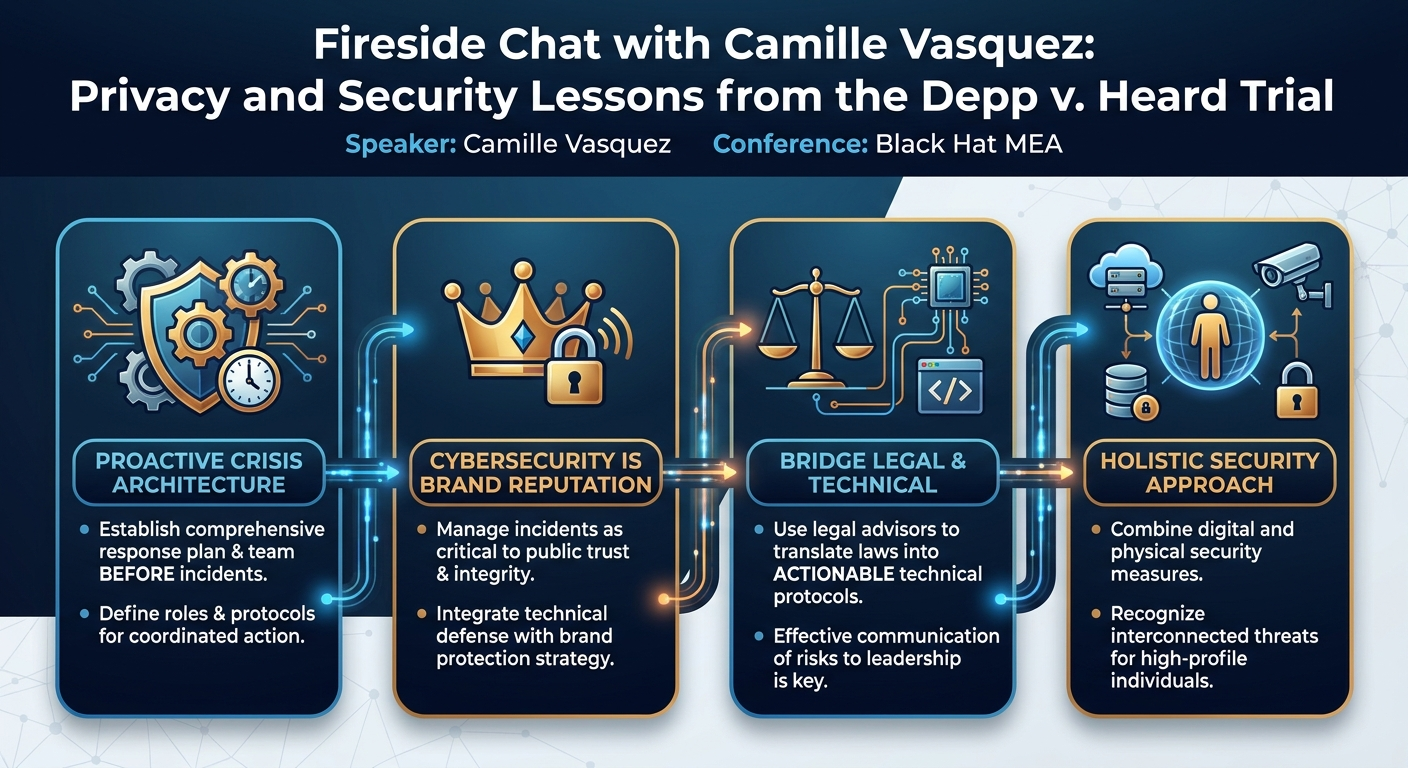
- Proactive Crisis Planning is Non-Negotiable: The most significant defensive implication is the absolute necessity of developing a comprehensive crisis response plan before any incident occurs. Vasquez emphasized that organizations must anticipate breaches and prepare for them, rather than reacting in panic mode. This plan should clearly define roles, responsibilities, communication protocols, and disclosure obligations to various stakeholders, including government, customers, and employees. This proactive stance is the first line of defense against reputational and financial damage.
- Integrate Cybersecurity with Brand Reputation Management: Defenders must understand that cybersecurity incidents are not merely technical problems; they are brand reputation crises. A hack or data breach can severely erode public trust and damage an organization's image. Therefore, cybersecurity strategies must be seamlessly integrated with brand protection efforts. Legal, PR, and security teams must collaborate to craft consistent, transparent messaging that reinforces the brand's values and commitment to security, even in the face of adversity.
- Leverage Specialized External Expertise: When faced with sophisticated threats, organizations should not hesitate to outsource security functions to specialized firms. Vasquez's experience with attempted hacks on her devices led her firm to engage external security experts. This highlights that internal IT teams, while competent, may not possess the niche skills required to counter advanced persistent threats or protect high-profile individuals from targeted attacks. Recognizing this capability gap and seeking specialized help is a vital defensive strategy.
- Bridge the Legal-Technical Divide: Security professionals and legal counsel must learn to speak each other's language. Organizations need legal advisors who can act as a "Rosetta Stone," translating complex legal requirements and disclosure obligations into actionable technical protocols and vice versa. This ensures that security measures are compliant with regulations and that legal advice is grounded in technical realities, preventing misinterpretations that could lead to non-compliance or inadequate protection.
- Cultivate a Culture of Security from the Top Down: Leaders, including CEOs and high-profile individuals, must take security advice seriously. Defenders need strategies to effectively communicate security risks and the consequences of non-compliance to senior management. This might involve legal counsel delivering "hard truths" about potential liabilities. A strong security posture requires buy-in and active participation from the highest levels of an organization.
- Establish Clear Communication Protocols for All Stakeholders: During a crisis, every message matters. Organizations must establish clear, coordinated communication channels and messaging for all internal and external stakeholders. This includes ensuring that customer support teams are equipped with approved scripts and that all public statements, from social media to press releases, are consistent and "on brand." This prevents contradictory information from being disseminated, which can further erode trust and complicate recovery efforts.
- Do Not Neglect Physical Security: While often overshadowed by cyber threats, physical security remains a critical defensive layer, especially for high-profile individuals or during contentious public events. Vasquez's personal experience with needing security details underscores that digital fame can translate into real-world threats. Organizations must assess physical security risks for their key personnel and implement appropriate protective measures.
- Monitor Open Source Intelligence (OSINT) and Public Sentiment: The case demonstrated how public interest, fueled by platforms like Reddit and 4chan, can generate vast amounts of information, some of which may be useful (or detrimental) to a case or brand. Defenders should integrate OSINT monitoring into their threat intelligence and crisis management strategies to understand public sentiment, identify emerging narratives, and potentially uncover relevant information that could impact their security posture or legal standing.
Key Takeaways
- Proactive Planning is Paramount: Develop a comprehensive crisis response plan and security protocols well before any incident occurs, covering both cyber and physical threats.
- Cybersecurity is Brand Protection: Recognize that cybersecurity is inextricably linked to brand reputation; how an organization responds to a breach dictates public trust.
- Bridge Legal and Technical Expertise: Ensure legal advisors can translate legal requirements into actionable technical security measures and effectively communicate risks to leadership.
- Coordinated Communication is Crucial: Establish consistent, transparent messaging across all channels and for all stakeholders during a crisis to maintain public and internal confidence.
- Empower a Dedicated Crisis Team: Identify key leaders, define clear roles and responsibilities, and foster accountability within the crisis management team to ensure a unified and effective response.
- Holistic Security Mindset: Don't overlook physical security for key personnel, as digital visibility can quickly translate into real-world threats.
About the Speaker(s)
Camille Vasquez is a distinguished Partner at Brown Rudnick, a global law firm. She gained international prominence for her leading role as part of Johnny Depp's legal team in his highly publicized defamation trial against Amber Heard. Vasquez specializes in brand reputation management, media law, and representing high-net-worth and celebrity clients. Known for her remarkable composure under pressure and meticulous preparation, she effectively navigates complex legal challenges that often intersect with intense public scrutiny. Her experience extends to advising multinational corporations on data breaches, privacy issues, and crisis response, making her a unique voice at the intersection of law, security, and public relations.
Reviews
Dr. Zero (Offensive Security Researcher) — WEAK
A Black Hat keynote slot burned on a Hollywood defamation trial. Vasquez's groundbreaking security insight? When millions of TikTokers try to dox you, hand your iPhone to an MSSP and draft a PR plan. This is a celebrity war story, not a security briefing.
Heather Calloway (CISO) — SOLID
Camille Vasquez uses the Depp v. Heard trial to illustrate what happens when high-profile litigation triggers rapid, asymmetrical cyber and physical threats against a legal team. It’s a vivid case study in Executive Protection (EP) and crisis communications, though the security takeaways themselves are foundational. Worth a look to understand how quickly outside counsel can become your primary attack surface during a corporate crisis.
→ Top-rated talks at Black Hat Middle East & Africa 2023 (Executive Summit)
All talks from Black Hat Middle East & Africa 2023 (Executive Summit)