Bridging the Supply Chain Cyber Maturity Rivers
Stephane Lenco (CISO · Thales Group)
Black Hat Middle East & Africa 2023 (Executive Summit) · Day 1 · Executive Summit
Overview
In his Black Hat MEA talk, "Bridging the Supply Chain Cyber Maturity Rivers," Stephane Lenco, CISO of Thales Group, delivered a compelling and candid account of his journey in tackling the pervasive and complex challenge of supply chain cybersecurity. Drawing on over two decades of experience in the field, Lenco articulates the critical need for a pragmatic, scalable, and risk-adjusted approach to securing an organization's extended ecosystem. The talk underscores that while supply chain security is universally recognized as a top concern—highlighted by entities like ENISA and the World Economic Forum, and reinforced by regulations like NIS2—current industry practices remain alarmingly insufficient.
Key moments
- 0:40 Why Supply Chain Cyber Security is a Top Concern
- 4:40 Why Traditional Security Appendices Fail to Scale
- 7:00 Developing Scalable and Tailored Questionnaires
- 9:00 The Challenge with Market Security Ratings
- 11:00 Tailoring Assessments Based on Supplier Risk and Type
- 13:30 Open-Sourcing and Collaborative Industry Standards
- 16:40 Three Essential Questions to Ask Any Supplier
Bridging the Supply Chain Cyber Maturity Rivers
Speakers: Stephane Lenco, CISO, Thales Group
Conference: Black Hat MEA
YouTube: https://www.youtube.com/watch?v=lAHZUzO6834
Overview
In his Black Hat MEA talk, "Bridging the Supply Chain Cyber Maturity Rivers," Stephane Lenco, CISO of Thales Group, delivered a compelling and candid account of his journey in tackling the pervasive and complex challenge of supply chain cybersecurity. Drawing on over two decades of experience in the field, Lenco articulates the critical need for a pragmatic, scalable, and risk-adjusted approach to securing an organization's extended ecosystem. The talk underscores that while supply chain security is universally recognized as a top concern—highlighted by entities like ENISA and the World Economic Forum, and reinforced by regulations like NIS2—current industry practices remain alarmingly insufficient.
Lenco frames the CISO's role as that of a "bridge builder," connecting the intricate technicalities of cyber threats with executive understanding and public resilience. He recounts the trials and errors of implementing various supply chain security strategies, from rigid contractual clauses to market-based ratings, ultimately advocating for a tailored methodology that respects the diverse capabilities and business contexts of suppliers. His insights are particularly relevant in an era marked by high-profile incidents like SolarWinds, demonstrating that effective supply chain security is not about achieving an unattainable perfection, but rather about intelligent risk management, continuous adaptation, and fostering collaborative maturity across the entire value chain.
The talk is a direct response to the "unstable situation" in supply chain security, where a mere 61% of companies ask for basic security certifications, less than half use security rating services (43%), and only about a third conduct due diligence, with a concerning 10% doing nothing at all. Lenco's narrative serves as a practical guide for organizations grappling with the daunting task of securing thousands of diverse suppliers, emphasizing that a one-size-fits-all approach is destined for failure and that true resilience comes from understanding, adapting, and partnering.
Background
▶ Watch: Why Supply Chain Cyber Security is a Top Concern (0:40)
The genesis of the supply chain cybersecurity problem, as articulated by Lenco, lies in its dual nature: it is an acknowledged top concern by leading cybersecurity agencies and forums, yet widely mismanaged in practice. The European Cyber Security Agency (ENISA) consistently rates supply chain cybersecurity as a paramount issue, a sentiment echoed globally. Regulatory frameworks, such as the updated Network and Information Security (NIS2) directive in Europe, now explicitly mandate critical national infrastructures to prioritize supply chain security, a direct lesson learned from incidents like SolarWinds. Despite this recognition, the industry's response remains fragmented and often ineffective, characterized by rudimentary checks and a significant percentage of organizations failing to implement any meaningful security controls for their suppliers.
Lenco, an engineer by training, approached this problem with a methodical yet adaptive mindset, likening the CISO's role to that of a bridge builder—connecting an organization with its diverse ecosystem of suppliers. His initial "by the book" strategy involved drafting comprehensive security appendices for contracts and conducting audits to verify compliance. This approach, while theoretically sound, proved to be an abject failure in practice. It simply did not scale. With an organization like Thales managing approximately 25,000 suppliers, demanding a complex security annex from a 10-person SME was impractical, if not impossible. Conversely, large corporations with established, standardized security practices found bespoke annexes cumbersome and disruptive, leading to lengthy legal negotiations. This traditional method was excessively time-consuming and prohibitively expensive, making comprehensive coverage of the supply chain economically unfeasible.
Learning from this initial setback, Lenco's team embarked on a second attempt, driven by an urgent executive mandate to vet 150 suppliers for a digital transformation project within 15 days. This real-world pressure forced an adaptation: the creation of scalable questionnaires. Recognizing that "one size doesn't fit all," they developed lighter, trimmed-down questionnaires for smaller companies (startups) and progressively more comprehensive versions for medium and large corporations, which could better afford and demonstrate compliance with advanced certifications. This tiered approach proved successful for the immediate challenge, demonstrating that customization was key to efficiency and speed.
However, the journey was not without further missteps. Encouraged by the initial success of scalability, the team explored the use of market security rating services, hoping to industrialize and accelerate the process further. These services, employing techniques like internet scanning and dark web intelligence, promised to provide security insights at scale. The outcome, however, was a significant misalignment: 87% of their suppliers received a "low rating." Such a high percentage was unmanageable, as it was neither feasible to dismiss nearly 90% of the supplier base nor to individually remediate such a vast number of issues. This experience plunged Lenco into a "valley of despair," highlighting that while market ratings could offer a tone or an opportunity for engagement, they could not be taken as absolute truth or a standalone solution for comprehensive risk management. This series of failures and partial successes ultimately underscored the necessity of a truly custom-made, risk-driven approach that aligns security measures with the specific context and impact of each supplier relationship.
Key Findings
▶ Watch: Developing Scalable and Tailored Questionnaires (7:00)
Stephane Lenco's extensive journey in securing the supply chain yielded several critical findings that challenge conventional wisdom and offer a more effective path forward:
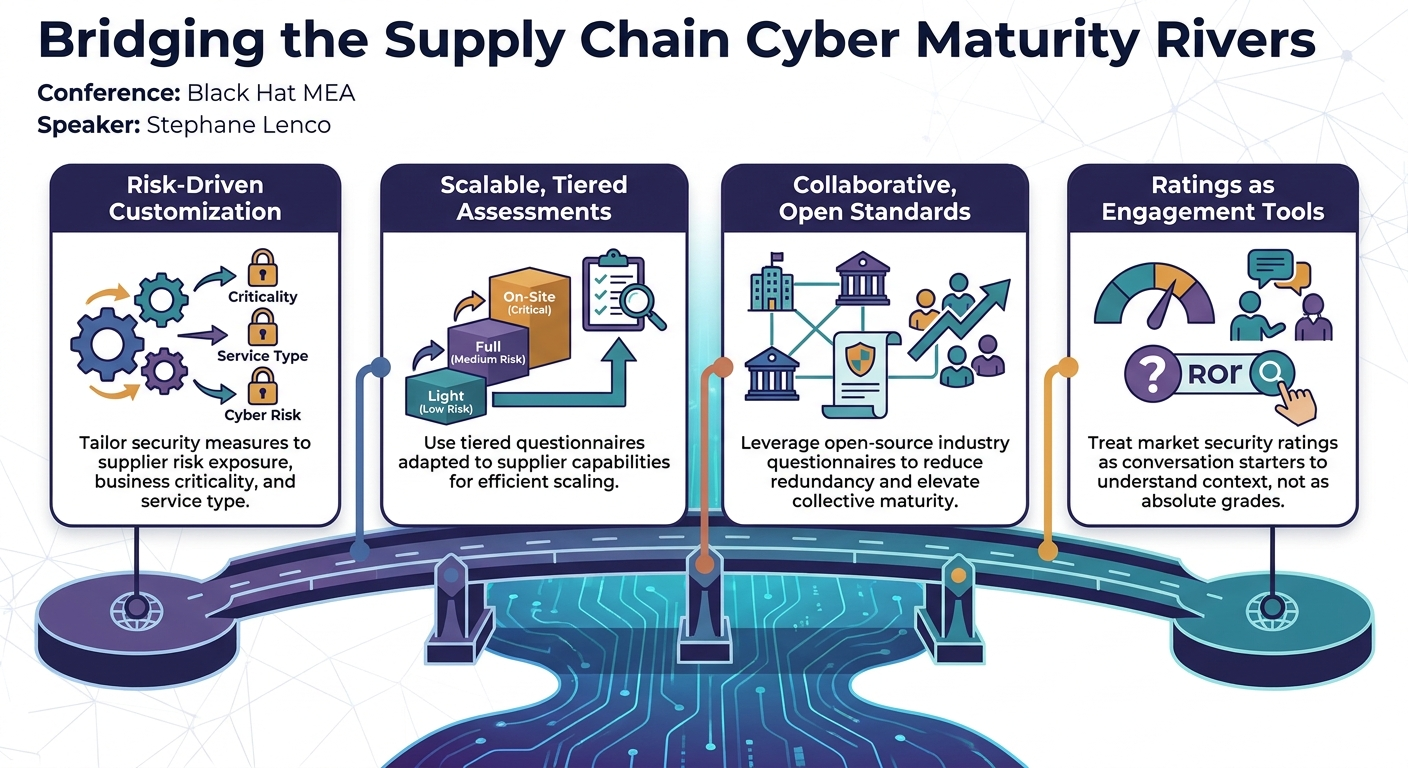
- Risk-Driven Customization is Paramount: The most significant finding is that a one-size-fits-all approach to supply chain security is fundamentally flawed and unsustainable. Instead, organizations must adopt a risk-driven methodology where security measures, assessment depth, and evidence requirements are meticulously tailored to the specific cyber risk exposure of the supplier, the business criticality of the service or product they provide, and their organizational size and type. This means a supplier providing metal sheets (focus on business continuity) requires a different assessment than a software provider (focus on CI/CD, SDLC).
- Scalability Through Tiered Assessments: True scalability in managing a vast supplier base is achieved not by simplification to the lowest common denominator, but by intelligent segmentation and tiered assessment strategies. Lenco demonstrated this through the evolution of questionnaires: a light questionnaire (approx. 50 questions) for lower-risk engagements, a full questionnaire (approx. 200+ questions) for higher-risk scenarios, and in some cases, a full questionnaire complemented by on-site evidence verification. This allows for efficient allocation of resources where they matter most.
- Collaboration and Open Standards Drive Collective Maturity: A powerful finding is the immense benefit of industry collaboration and open-sourcing security frameworks. By partnering with other aviation companies through initiatives like the Aviation Cyber Program, Lenco's team developed a jointly recognized, open-source questionnaire. This approach reduces redundant assessment burdens on suppliers (who only need to complete one recognized questionnaire for multiple clients) and elevates the overall security posture of an entire sector by promoting a shared, high standard.
- Market Ratings are Diagnostic Tools, Not Definitive Grades: While initially leading to despair, Lenco concluded that market security ratings should not be dismissed entirely. Their value lies not in their absolute scores (e.g., 87% low ratings), but in their ability to provide an initial tone and, crucially, to initiate engagement. They serve as a conversation starter, prompting organizations to understand the context behind a rating and providing an opportunity to offer guidance rather than simply rejecting a supplier.
- Focus on Fundamental Security Posture Indicators: For quick, effective assessment, Lenco identified three fundamental questions that reveal much about a supplier's security maturity:
- Do you have a CISO or someone capable of answering security questions? This indicates a dedicated security ownership.
- Who do we call if there is a cyber incident? This points to an established incident response mechanism.
- Did you survive a cyber incident? Experience with actual incidents often correlates with higher maturity due to lessons learned and implemented improvements.
Technical Deep Dive
▶ Watch: The Challenge with Market Security Ratings (9:00)
Stephane Lenco's journey into supply chain security is a masterclass in iterative problem-solving, moving from flawed, theoretical models to a sophisticated, risk-adaptive framework. The core of his technical deep dive revolves around the "bridge builder" metaphor, where the CISO constructs secure connections between the organization and its diverse supplier ecosystem.
The initial technical approach, driven by a "buy the book" engineering mindset, centered on security appendices within contracts and subsequent audits. These appendices were typically comprehensive documents, often incorporating best practices from standards like ISO. However, this approach faced significant technical and operational hurdles. For small and medium-sized enterprises (SMEs), these dense legal and technical documents were overwhelming, often exceeding their capacity to understand, implement, or even find a designated CISO to discuss. For large corporations, the bespoke nature of these appendices conflicted with their own highly standardized security practices, leading to protracted legal and technical reviews to ensure compliance and avoid conflicting requirements. Operationally, auditing 25,000 suppliers, as is the case for Thales, was an insurmountable task due to the sheer time, cost, and human resource requirements. This traditional method, while conceptually sound for a handful of critical suppliers, was technically and economically unscalable.
Recognizing the failure of a static, universal approach, Lenco's team pivoted towards dynamic, scalable questionnaires. The catalyst was an urgent digital transformation project requiring the rapid vetting of 150 startup suppliers. Here, the technical challenge was to design an assessment that was both quick and effective. The solution involved trimming down the initial, overly complex security appendix into a light questionnaire suitable for nascent organizations. This initial success, however, highlighted a new technical consideration: different supplier types require different depths of inquiry. A small startup cannot be expected to meet the same stringent controls as a multinational corporation.
This led to the development of tailored questionnaires, a cornerstone of Lenco's refined methodology. The tailoring was driven by two primary factors: the cyber risk exposure of the company and the nature of the service they provide. For instance, a cloud operator would not be asked about physical server enclosure security (as that’s their responsibility, not the client’s concern for their SaaS offering), whereas an IoT/OT provider would have different, specialized questions. The technical content of the questionnaire would adapt based on the supplier's role:
- For a provider of metal sheets, the focus would be on business continuity and operational resilience—their ability to continue delivery irrespective of cyber incidents.
- For a software provider (e.g., like SolarWinds), the questionnaire would delve into their secure software development life cycle (SDLC), CI/CD pipeline security, security of coding practices, and secure delivery mechanisms.
This multi-faceted risk assessment process involved:
- Cyber Risk Exposure Analysis: Understanding the inherent risk associated with the supplier and their services.
- Integration into Bidding Process: Embedding cybersecurity as a clear, non-binary criterion (not just pass/fail, but maturity assessment) in procurement.
- Tiered Questionnaires:
- Light Questionnaire: Approximately 50 questions, suitable for lower-risk suppliers or initial vetting.
- Full Questionnaire: Over 200 questions, for high-risk or critical suppliers.
- Full Questionnaire with On-site Evidence: The most stringent level, requiring physical verification for the highest criticality.
Crucially, the outcome of these assessments was not merely a score, but an action plan provided to the supplier, guiding them towards improved maturity. This fostered a collaborative rather than adversarial relationship. The criteria for selecting the appropriate tier included business criticality, partnership history, and company size, allowing for a nuanced approach to evidence requirements and assessment rigor.
Beyond internal process refinement, Lenco championed open-sourcing and industry collaboration as a technical scaling mechanism. Through the Aviation Cyber Program, he collaborated with other aviation companies to refine and standardize a common questionnaire. This initiative then expanded to the Global Aviation Supply Chain (including airports, catering, etc.), leading to a widely recognized standard. The technical benefit is profound: a supplier completing this open-source, industry-recognized questionnaire with adequate evidence gains acceptance across multiple clients, significantly reducing redundant efforts and promoting a baseline security standard across an entire sector. This approach also extended to automation and industrialization, shaping audit packages and improvement processes to run faster and more effectively.
The ultimate goal of this technical evolution is to manage residual risk consciously. Lenco acknowledges that perfect security is unattainable, and the framework allows for informed decisions on what risks are acceptable, based on the tailored assessments and continuous improvement plans.
Demo / Proof of Concept
▶ Watch: Open-Sourcing and Collaborative Industry Standards (13:30)
While Stephane Lenco's presentation did not feature a live technical demonstration or a specific software proof of concept, his talk effectively served as a conceptual proof of concept through the detailed recounting of his iterative journey and the real-world results achieved. He described the practical implementation of his evolving methodologies within Thales Group, demonstrating how different strategies—from initial contractual annexes to tailored, risk-based questionnaires and industry collaboration—were tested, refined, and deployed against a vast and diverse supplier base. The narrative itself, complete with specific challenges (e.g., vetting 150 suppliers in 15 days, 87% low market ratings) and their respective outcomes, functions as empirical evidence for the efficacy and challenges of various supply chain security approaches.
Defensive Implications
▶ Watch: Three Essential Questions to Ask Any Supplier (16:40)
Stephane Lenco's insights provide a robust framework for defenders seeking to fortify their supply chain security posture, moving beyond superficial compliance to genuine resilience.
- Adopt a Risk-Driven, Tiered Assessment Program: The foremost implication is to abandon the "one-size-fits-all" approach. Defenders must implement a tiered assessment methodology that categorizes suppliers based on their business criticality, the type of service or product they provide, and their inherent cyber risk exposure. This dictates the depth of inquiry, from a light questionnaire (approx. 50 questions) for low-risk engagements to a full questionnaire (200+ questions) for critical suppliers, potentially supplemented by on-site evidence verification. This allows for efficient resource allocation and targeted security efforts.
- Tailor Assessment Content to Supplier Function: Beyond just the depth, the content of security assessments must be specific to the supplier's role. For instance, questions for a cloud service provider should focus on their operational security, data privacy, and incident response, rather than physical server security. Conversely, a software developer should be assessed on their Secure Development Life Cycle (SDLC), CI/CD pipeline security, and code integrity. A manufacturing partner might require scrutiny of their Operational Technology (OT) security and business continuity plans.
- Prioritize Fundamental Security Capabilities: Defenders should focus on three critical indicators of supplier maturity, even for quick assessments:
- Designated Security Contact: Does the supplier have a CISO, CIO, or a clear point person responsible for security questions? This signifies ownership and accountability.
- Clear Incident Response (IR) Mechanism: Can the supplier articulate who to call in the event of a cyber incident, and do they have a defined process for reporting vulnerabilities or breaches? A well-defined Computer Emergency Response Team (CERT) contact (e.g.,
[email protected]as mentioned by Lenco) is crucial for rapid response and containment. - Experience with Cyber Incidents: Has the supplier survived a cyber incident? Lenco posits that organizations that have weathered a breach are often more mature post-incident, having learned crucial lessons and implemented improvements. This experience builds resilience.
- Leverage Industry Collaboration and Open Standards: To reduce the burden on both client and supplier, defenders should actively participate in or adopt open-source, industry-recognized questionnaires and security frameworks (e.g., like the Aviation Cyber Program). This fosters a shared baseline of security, streamlines assessment processes, and elevates collective supply chain maturity across a sector.
- Use Market Security Ratings as Engagement Tools, Not Absolute Verdicts: Security ratings services can provide an initial "tone" or starting point for engagement. However, defenders should not treat their grades as definitive pass/fail criteria. Instead, use them to initiate dialogue with suppliers, understand the context behind low ratings, and offer guidance for improvement. The goal is to build a more secure ecosystem, not to arbitrarily cut off partners.
- Provide Actionable Feedback and Foster Partnership: After assessments, provide suppliers with clear, actionable action plans for improvement. This transforms the assessment process into a collaborative effort to enhance security, positioning the client as a partner in the supplier's security journey rather than just an auditor.
- Consciously Manage and Accept Residual Risk: Defenders must recognize that achieving 100% security is impossible. The goal is to implement a robust risk management framework that allows for informed, conscious decisions about residual risk. This involves understanding where risks lie, mitigating them where feasible, and accepting certain levels of risk based on business context and cost-benefit analysis.
Key Takeaways
- Risk-Driven Customization is Essential: A rigid, one-size-fits-all approach to supply chain cybersecurity is destined to fail. Organizations must adopt a risk-driven methodology, tailoring assessment depth and content based on supplier criticality, service type, and inherent cyber risk.
- Scalability Through Tiered Assessments: Effective supply chain security for a large ecosystem demands tiered questionnaires (e.g., light 50-question, full 200+ question, or full with on-site evidence) that adapt to the supplier's size, capabilities, and the specific cyber risks associated with their offerings.
- Collaboration and Open Standards Boost Collective Security: Engaging in industry-wide collaboration and developing open-source, recognized questionnaires (like the Aviation Cyber Program) significantly reduces the assessment burden on suppliers and elevates the overall security posture of an entire sector.
- Market Security Ratings are Engagement Catalysts: While useful for an initial overview, market security ratings should not be taken as absolute truths. Their primary value lies in providing an opportunity to engage with suppliers, understand the context of their ratings, and guide them toward improvement.
- Prioritize Three Fundamental Security Questions: For a quick yet impactful assessment, always ask suppliers: 1) Do you have a CISO or dedicated security contact? 2) Who do we call during a cyber incident? 3) Have you survived a cyber incident? These reveal critical aspects of their security maturity and resilience.
- Embrace Iteration and Learn from Failures: The journey to robust supply chain security is iterative. Organizations must be prepared to learn from failures, adapt their strategies, and continuously refine their approach, recognizing that perfection is an unattainable ideal.
About the Speaker(s)
Stephane Lenco is the Chief Information Security Officer (CISO) for Thales Group, a global technology leader in the aerospace, transport, defense, and security markets. With over two decades of experience in cybersecurity, Lenco has a profound understanding of the challenges organizations face in securing their digital ecosystems. His career began with programming AI, which eventually led him into the cybersecurity domain. An engineer by training, he approaches complex problems with a methodical yet pragmatic mindset, evident in his iterative journey to secure Thales's extensive supply chain. Lenco is also an advisor to ENISA, the European Cyber Security Agency, highlighting his influence and expertise in shaping cybersecurity policy and best practices at a broader level. His involvement in initiatives like the Aviation Cyber Program further underscores his commitment to collaborative security within critical industries.
Reviews
Dr. Zero (Offensive Security Researcher) — SOLID
CISO war stories are usually sanitized PR garbage, but Lenco actually tells the truth. He admits his massive compliance program failed and calls out automated rating vendors for generating unmanageable noise. It doesn't drop zero-days, but it's a rare, sobering look at how enterprise risk actually works at scale.
Heather Calloway (CISO) — STRONG ACCEPT
Stephane Lenco's postmortem of Thales's third-party risk program is required viewing for any security leader drowning in vendor questionnaires. He bypasses the usual compliance theater to explain how a massive enterprise actually scales supply chain security: by tiering risk, dropping rigid contract annexes, and treating external security ratings as conversation starters rather than absolute verdicts.
→ Top-rated talks at Black Hat Middle East & Africa 2023 (Executive Summit)
All talks from Black Hat Middle East & Africa 2023 (Executive Summit)