An AI Governance Model on One Slide
Matthias Muhlert (Group CISO · Dr. Oetker Group)
Black Hat Middle East & Africa 2023 (Executive Summit) · Day 1 · Executive Summit
Overview
In an era where Artificial Intelligence (AI) rapidly integrates into every facet of business and society, effective governance remains a significant challenge. Matthias Muhlert, Group CISO at Dr. Oetker Group, tackled this complexity head-on in his Black Hat MEA talk, "An AI Governance Model on One Slide." The presentation introduces a deceptively simple yet profoundly comprehensive framework designed to demystify AI governance for a broad spectrum of stakeholders. Muhlert's core premise is that AI's pervasive nature demands inclusive decision-making, yet not all stakeholders can be expected to be AI experts. His one-slide model aims to bridge this knowledge gap, providing a clear, actionable path for organizations to evaluate, implement, and govern AI initiatives responsibly.
Key moments
- 0:00 Introducing the one-slide AI governance model
- 2:00 Core components: Application, Goal, Data
- 6:00 Categorizing algorithms and vendor questioning strategies
- 10:00 Understanding training types and human bias
- 14:00 The "Decision" point: When humans intervene
- 17:00 Using the model for AI risk analysis
- 22:00 AI governance: Societal, organizational, individual responsibilities
An AI Governance Model on One Slide
Speakers: Matthias Muhlert, Group CISO, Dr. Oetker Group
Conference: Black Hat MEA
YouTube: https://www.youtube.com/watch?v=zqFdn_fGCbw
Overview
In an era where Artificial Intelligence (AI) rapidly integrates into every facet of business and society, effective governance remains a significant challenge. Matthias Muhlert, Group CISO at Dr. Oetker Group, tackled this complexity head-on in his Black Hat MEA talk, "An AI Governance Model on One Slide." The presentation introduces a deceptively simple yet profoundly comprehensive framework designed to demystify AI governance for a broad spectrum of stakeholders. Muhlert's core premise is that AI's pervasive nature demands inclusive decision-making, yet not all stakeholders can be expected to be AI experts. His one-slide model aims to bridge this knowledge gap, providing a clear, actionable path for organizations to evaluate, implement, and govern AI initiatives responsibly.
The talk emphasizes the critical need for a structured approach to AI adoption, moving beyond mere technological excitement to address the profound implications for legal, ethical, and operational aspects. Muhlert's model offers a practical tool for diverse teams—from compliance and legal departments to data privacy officers and workers' councils—to engage meaningfully in AI strategy. By distilling complex AI concepts into a series of logical decision points, the framework enables organizations to determine which AI applications align with their values, objectives, and regulatory requirements, fostering confidence and transparency in AI deployment.
Ultimately, Muhlert's "one-slide" model serves as a foundational blueprint for establishing robust AI governance. It provides a common language and a shared understanding, empowering non-technical stakeholders to ask pertinent questions and contribute to informed decisions. Beyond mere adoption, the model also hints at its utility in identifying potential security risks and attack vectors, making it a valuable asset for both strategic planning and defensive posture in the evolving AI landscape.
Background
▶ Watch: Introducing the one-slide AI governance model (0:00)
The rapid proliferation of AI technologies, from predictive analytics to generative models, has created an urgent need for robust governance frameworks. However, the inherent complexity of AI—encompassing intricate algorithms, vast datasets, and diverse training methodologies—often intimidates non-technical stakeholders. Traditional governance models, often verbose and highly technical, struggle to engage the multi-disciplinary teams (legal, compliance, ethics, business operations, human resources) necessary for holistic AI oversight. This disconnect can lead to AI adoption without adequate consideration of legal ramifications, ethical dilemmas, or potential societal impacts.
The challenge, as identified by Matthias Muhlert, is to create a governance model that is both comprehensive enough to cover the critical aspects of AI and simple enough to be understood and utilized by individuals without deep AI expertise. His motivation stemmed from the observation that stakeholders need to be included in AI strategy and decision-making, but expecting everyone to become an AI expert is unrealistic. This gap often results in either a lack of oversight or an overly cautious approach that stifles innovation.
Prior work in AI governance has typically focused on high-level principles (e.g., fairness, transparency, accountability) or detailed technical specifications. While valuable, these approaches often lack a practical, accessible framework for day-to-day decision-making within an organization. Muhlert's model seeks to fill this void by providing a visual, step-by-step guide that translates abstract principles into concrete questions and decision points, enabling organizations to navigate the complexities of AI with greater clarity and confidence. It addresses the fundamental question: how can an organization decide which AI to use and which not to, ensuring alignment with its strategic goals and ethical responsibilities, all while being easily communicable across departments?
Key Findings
▶ Watch: Categorizing algorithms and vendor questioning strategies (6:00)
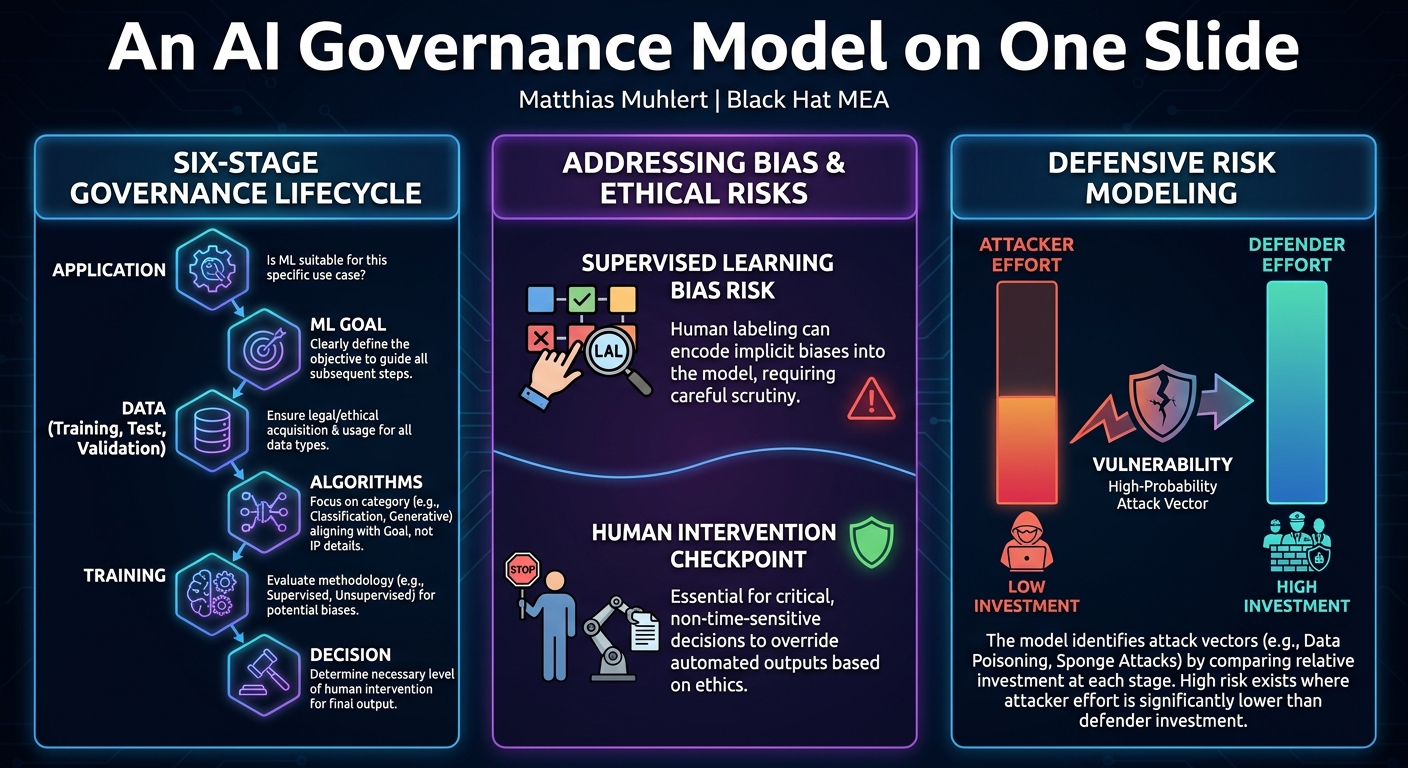
Matthias Muhlert's central contribution is a one-slide AI governance model designed for universal applicability and ease of understanding. The model systematically breaks down the AI lifecycle into six interconnected decision points: Application, Machine Learning Goal, Data, Algorithms, Training, and Decision. Each point represents a critical juncture where stakeholders, regardless of their AI expertise, can ask targeted questions and identify potential "red flags" that might preclude or modify the adoption of a specific AI solution.
The core finding is that by following this structured path, organizations can achieve a comprehensive yet simplified assessment of any AI initiative. The model emphasizes the importance of explicitly defining the goal of the machine learning algorithm, as this goal dictates the suitability of data, algorithms, and training methods. It categorizes data into training, test, and validation data, highlighting legal and ethical considerations from the outset. Furthermore, it simplifies the understanding of complex algorithms by focusing on their functional categories (e.g., classification, regression, generative AI) rather than proprietary intellectual property, making technical discussions more accessible.
Another key finding is the model's utility in evaluating the ethical implications of different training methodologies (reinforced, supervised, unsupervised, semi-supervised), particularly concerning the introduction of human bias. Finally, it introduces a crucial decision point regarding human intervention, prompting organizations to consider when automated decisions are appropriate and when human oversight is indispensable, especially in time-critical scenarios. Muhlert also demonstrated that this governance model can be extended to serve as a basic risk model, identifying potential attack vectors based on the relative investment required by attackers versus defenders at each stage (data, algorithms, training), thereby providing a proactive security lens.
Technical Deep Dive
▶ Watch: Understanding training types and human bias (10:00)
Muhlert’s AI governance model, while designed for accessibility, is underpinned by a solid understanding of core machine learning principles. It starts with the Application layer, which is the first decision point. Here, organizations must decide whether a specific application should even be attached to a machine learning algorithm. This initial gate ensures that AI is applied purposefully and not merely for its novelty. The application, in turn, feeds input information towards the machine learning algorithm, requiring a second decision point: whether that input data should be fed into the system.
At the heart of the model lies the Machine Learning Goal. Muhlert stresses that every algorithm must have a clearly defined and verbalized goal. Without a precise objective, effective governance and evaluation become impossible. This goal is intrinsically linked to the Data component. Data is categorized into three crucial types: training data, test data, and validation data. The acquisition and usage of training data must be legally and ethically sound. Test data, similar to training data, evaluates the algorithm's performance, while validation data provides a true/false or definitive result to gauge accuracy. The relationship between the goal and the data is paramount; the goal dictates whether specific data can and should be used.
The model then progresses to Algorithms. Recognizing that proprietary algorithms are often opaque, Muhlert suggests focusing on algorithm categories rather than demanding intellectual property details. He outlines common categories:
- Classification: Distinguishing between categories (e.g., spam/not spam).
- Clustering: Grouping similar data points.
- Recommendation: Suggesting items based on past behavior (e.g., e-commerce).
- Regression: Predicting continuous values (e.g., stock market developments).
- Dimension Reduction: Simplifying complex data by reducing variables (e.g., analyzing facial or micro-expressions in hiring).
- Generative AI: Creating new content (e.g., text, images), a category of increasing contemporary relevance.
Understanding the category helps assess if the chosen algorithm logically aligns with the defined goal. For instance, using a classification algorithm for stock market prediction (a regression problem) would be illogical. Furthermore, the choice of algorithm category has direct implications for the technological stack and infrastructure requirements.
Following algorithms, the model addresses Training methodologies, which are crucial for understanding how AI models learn and their potential biases. Muhlert identifies four primary types:
- Reinforced Learning: Involves trial and error, where an agent learns through rewards and penalties (e.g., a driverless car learning to navigate). Ethical considerations often arise concerning the goal of the reinforcement.
- Supervised Learning: A human explicitly labels data, guiding the machine learning algorithm. While effective, this method is highly susceptible to introducing human bias into the algorithm, as the human's judgments are encoded.
- Unsupervised Learning: The machine identifies patterns and structures in unlabeled data on its own, without human guidance. This method minimizes human bias and can lead to novel discoveries, particularly in fields like medicine where algorithms might find correlations humans overlook.
- Semi-supervised Learning: A hybrid approach where a portion of the data is labeled by humans, and the rest is processed unsupervised, offering a balance between accuracy and time efficiency.
Organizations must critically evaluate the ethical implications and potential for bias inherent in their chosen training method.
The final component is the Decision point, which determines the level of human intervention required in the AI's output. This is a crucial ethical and operational consideration. Muhlert differentiates between time-critical and less time-critical decisions. In time-critical scenarios, decisions are often automated by the machine. However, for less time-critical situations, there is greater opportunity for human review and override. An example highlighted is an AI used in hiring: while the machine might use dimension reduction or recommendation algorithms to analyze candidates' expressions and data, the ultimate decision to hire or reject should involve human intervention, allowing for ethical considerations beyond algorithmic output. This full path, from application to final decision, allows stakeholders to identify "red flags" at any stage, ensuring a robust and responsible AI deployment.
Demo / Proof of Concept
▶ Watch: Using the model for AI risk analysis (17:00)
The talk itself serves as a conceptual demonstration of the "one-slide" AI governance model. Matthias Muhlert did not present a traditional software or hardware demonstration but rather walked the audience through the logical flow and practical application of his visual framework. The single PowerPoint slide, dense with interconnected components and decision paths, is the "proof of concept" for his idea that complex AI governance can be distilled into an easily digestible format.
Muhlert's "demo" involved illustrating how an organization would navigate the model's various stages—from initial application to final decision—using real-world examples like a company hiring process or stock market prediction. He showed how each decision point (Application, Machine Learning Goal, Data, Algorithms, Training, Decision) prompts specific questions and considerations, allowing stakeholders to identify potential issues or "red flags" along the way. The effectiveness of the model is demonstrated through its ability to facilitate informed discussions among diverse, non-expert stakeholders, enabling them to collectively assess the legal, ethical, and technical viability of an AI initiative before it goes live. While not a runnable demo, the presentation effectively showcased the model's structure and its intended utility as a collaborative decision-making tool.
Defensive Implications
▶ Watch: AI governance: Societal, organizational, individual responsibilities (22:00)
Beyond its primary role in governance, Muhlert's model offers significant defensive implications, particularly in risk modeling and identifying potential attack vectors against AI systems. He proposes that the governance framework can be extended to assess where an attacker might most effectively target an organization's AI. This is achieved by comparing the attacker's potential investment (effort, resources) against the defender's existing investment at various stages of the AI lifecycle.
Muhlert illustrates this with specific examples:
- Data Attacks: If an attacker needs to invest significantly less effort than the defending organization to acquire or manipulate data, then the data layer becomes a high-probability attack vector. This could involve data poisoning or exploiting vulnerabilities in data acquisition processes.
- Algorithm Attacks: The model highlights the algorithm as another potential target. Muhlert specifically mentions Sponge Attacks, a type of attack where an attacker introduces a small piece of malicious algorithm or input that consumes disproportionately large amounts of the target algorithm's computational power, effectively causing a denial-of-service or severe performance degradation. The key indicator for this risk is when the attacker's effort to create such an attack is low, while the defender's effort to mitigate it (e.g., through robust algorithm design or monitoring) is high.
- Training Attacks: The training phase is also vulnerable. If an attacker can disturb or manipulate an AI model with a relatively short amount of additional training time or minimal data injection, compared to the defender's substantial investment in extensive training and validation, then the training process presents a high-risk attack surface. This could lead to model inversion attacks, evasion attacks, or the introduction of backdoors.
The model, therefore, provides a structured way to think about the likelihood of an attack at different points in the AI system. While Muhlert acknowledges it's not a complete risk model (as it primarily focuses on likelihood rather than impact), it serves as a powerful diagnostic tool for security professionals. By systematically asking questions at each stage of the governance model, organizations can proactively identify weaknesses and develop targeted defenses. This proactive stance is crucial for securing AI systems, moving beyond reactive incident response to integrate security considerations into the initial design and deployment phases. Furthermore, the model empowers individuals, even those merely "subject of AI" (e.g., job applicants), to ask critical questions about data acquisition, algorithms, and decision-making, fostering a more secure and accountable AI ecosystem.
Key Takeaways
- Simplified AI Governance: Complex AI governance can be distilled into a single, accessible visual model, enabling diverse stakeholders (technical and non-technical) to understand and contribute to decision-making.
- Structured Decision Path: The model provides a clear, step-by-step framework through application, goal definition, data handling, algorithm selection, training methodology, and final decision points, allowing for systematic evaluation and identification of "red flags."
- Ethical and Bias Considerations: It emphasizes critical evaluation of data acquisition legalities, ethical implications of AI goals, and the potential for human bias introduced through supervised learning and the need for human intervention in critical decisions.
- Risk Identification and Defensive Strategy: The governance model can be leveraged as a basic risk model to identify potential attack vectors (e.g., Sponge Attacks on algorithms, data poisoning, training manipulation) by comparing attacker effort versus defender investment.
- Empowered Stakeholders: The framework equips all stakeholders, including individuals subject to AI decisions, to ask pertinent questions about how AI is built, trained, and used, promoting transparency and accountability.
- Focus on Categories, Not IP: For algorithms, the model suggests focusing on functional categories (e.g., classification, regression, generative AI) rather than proprietary details, making technical discussions more manageable for non-experts.
About the Speaker(s)
Matthias Muhlert is the Group CISO at Dr. Oetker Group, a prominent international food company. His professional focus lies in securing complex digital landscapes and developing strategic approaches to emerging technologies like Artificial Intelligence. Muhlert is known for his ability to simplify intricate security and governance challenges into actionable frameworks, as demonstrated by his "An AI Governance Model on One Slide." Beyond AI governance, he is also exploring new paradigms in cybersecurity, having introduced a concept he calls "Cyber Fantastic," which he encourages the security community to engage with. His work reflects a commitment to fostering accessible understanding and robust security practices within the rapidly evolving technological landscape.
Reviews
Dr. Zero (Offensive Security Researcher) — WEAK
Matthias Muhlert took an AI 101 syllabus, crammed it into a flowchart, and brought it to Black Hat. This is a boardroom compliance presentation masquerading as a security talk. If your enterprise needs a one-slide crutch to figure out the difference between supervised and unsupervised learning, you're already dead in the water.
Heather Calloway (CISO) — STRONG ACCEPT
Muhlert delivers a pragmatic, single-slide framework that forces the business, legal, and engineering to speak the same language about AI adoption. It strips away the technical mystique and replaces it with concrete decision gates around data provenance, algorithmic goals, and human oversight. This is exactly the artifact you need to hand your AI steering committee so you can stop philosophizing and start making risk decisions.
→ Top-rated talks at Black Hat Middle East & Africa 2023 (Executive Summit)
All talks from Black Hat Middle East & Africa 2023 (Executive Summit)