Pushing Limits: How AI Is Helping Security Teams
Chris Meenan (VP, Product Management · IBM Security)
Black Hat Middle East & Africa 2023 (Executive Summit) · Day 1 · Executive Summit
Overview
In this insightful Black Hat MEA talk, Chris Meenan, VP of Product Management at IBM Security, explores how artificial intelligence (AI) is becoming an indispensable ally for cybersecurity teams grappling with an ever-expanding attack surface and an overwhelming volume of data. Titled "Pushing Limits," the presentation draws a compelling analogy between personal endurance, such as marathon running, and the relentless demands placed on security operations center (SOC) analysts. Meenan highlights the pervasive issue of analyst burnout and the inherent limitations of human capacity in the face of exponentially growing threats and data points.
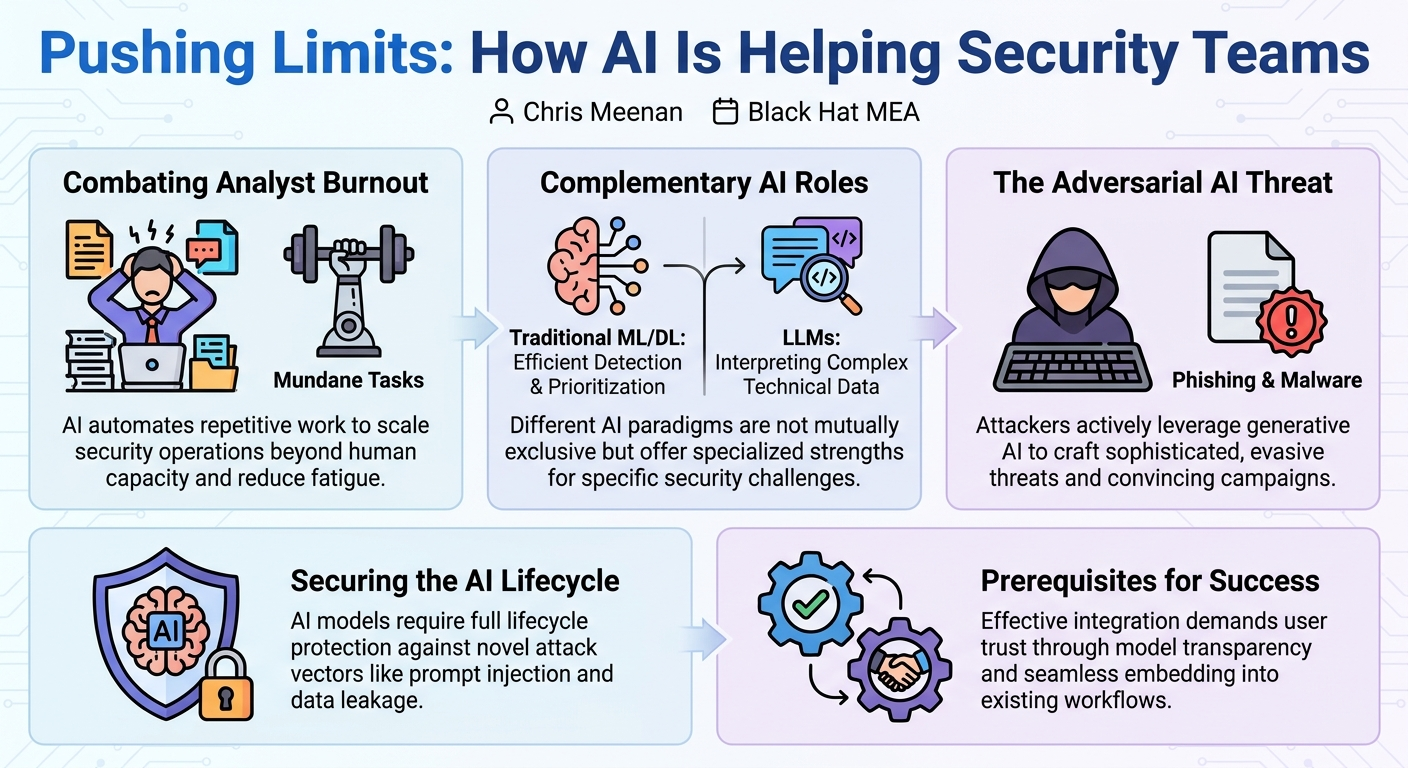
Key moments
- 0:30 Security teams are operating at their limit
- 2:30 Technology advancements increase attack surface
- 4:15 AI's two main outcomes: automate mundane, upskill teams
- 6:15 Successful AI requires trust and workflow integration
- 9:45 LLMs: interpreting complex security data for humans
- 12:20 Attackers are leveraging AI, especially for phishing
- 13:20 Key concern: Preventing data leakage from LLMs
- 14:30 Securing AI models across the entire lifecycle
Pushing Limits: How AI Is Helping Security Teams
Speakers: Chris Meenan, VP, Product Management, IBM Security
Conference: Black Hat MEA
YouTube: https://www.youtube.com/watch?v=UbBQDDbrW5c
Overview
In this insightful Black Hat MEA talk, Chris Meenan, VP of Product Management at IBM Security, explores how artificial intelligence (AI) is becoming an indispensable ally for cybersecurity teams grappling with an ever-expanding attack surface and an overwhelming volume of data. Titled "Pushing Limits," the presentation draws a compelling analogy between personal endurance, such as marathon running, and the relentless demands placed on security operations center (SOC) analysts. Meenan highlights the pervasive issue of analyst burnout and the inherent limitations of human capacity in the face of exponentially growing threats and data points.
The core of Meenan's argument is that AI, in its various forms—from traditional machine learning (ML) and deep learning to the nascent power of Large Language Models (LLMs)—offers a critical pathway to extend human capabilities, automate mundane tasks, and elevate the skill sets of security professionals. He details how different AI paradigms are not mutually exclusive but rather complementary, each addressing specific challenges within the security lifecycle. However, the talk also critically examines the dual-edged nature of AI, acknowledging that attackers are rapidly adopting these same technologies, thereby introducing new vulnerabilities and attack vectors that defenders must now contend with.
This talk is particularly relevant in today's cybersecurity landscape, where the shortage of skilled personnel and the sheer scale of digital transformation continue to strain security resources. Meenan provides a pragmatic roadmap for integrating AI effectively, emphasizing the critical need for trust and seamless workflow integration for AI outputs to be truly beneficial. Furthermore, he outlines a comprehensive approach to securing AI systems themselves, recognizing that AI models are not immune to compromise and represent a new frontier for defensive strategies.
Background
▶ Watch: Security teams are operating at their limit (0:30)
The cybersecurity industry, particularly the Security Operations Center (SOC), is operating at its absolute limit. Chris Meenan vividly illustrates this through the widespread issue of analyst burnout, attributing it to an "unhealthy" volume of work, an inundation of emails, threat intelligence, incidents, alerts, regulatory updates, compliance reports, and an ever-increasing stream of data. While humans possess remarkable cognitive abilities—capable of absorbing approximately 2.5 petabytes of data, staying awake for 11 hours, and even, theoretically, running at 40 miles per hour—these limits are being consistently tested and breached in the demanding environment of modern security.
Meenan traces the evolution of technology through eras: from the Mainframe to the PC, and then to Web and Cloud computing. Each of these advancements, while undoubtedly boosting organizational productivity and extending human capabilities, simultaneously introduced new opportunities for attackers. The attack surface of organizations expanded exponentially with each new technological paradigm, leading to more data to collect, new types of threats, more vulnerabilities, and a greater diversity of underlying security telemetry to monitor. This continuous expansion has made the job of security teams progressively more challenging, pushing them "into the red."
The current era is defined by the rise of AI, which Meenan posits is uniquely positioned to "really help us push the limits in terms of the amount of data that can be analyzed and made actionable by a human." He notes that AI has been on a long journey, evolving from early forms of machine learning (ML), through deep learning (DL), and now into the transformative age of Large Language Models (LLMs). Crucially, Meenan stresses that these different AI types are "very complimentary, not one replacing the other," and all are poised to deliver meaningful security outcomes. IBM, for instance, has been embedding AI across its product portfolio for several years, learning valuable lessons about successful AI adoption. The key prerequisites for effective AI integration, according to Meenan, are ensuring user trust in AI outputs—requiring transparency and the ability to understand the underlying data and reasoning—and seamless integration into existing workflows, ensuring AI acts as a helpful complement rather than a disruptive sideline. Without these fundamental elements, AI can become a "headwind" rather than a tailwind, paradoxically consuming more time than it saves.
Key Findings
▶ Watch: AI's two main outcomes: automate mundane, upskill teams (4:15)
Meenan identifies two fundamental outcomes that AI delivers in the realm of cybersecurity: automating the mundane and upleveling teams and individuals. These twin objectives are critical for alleviating analyst burnout and enhancing the overall efficacy of security operations.
The talk distinguishes between the strengths of different AI paradigms:
- Traditional AI (Machine Learning and Deep Learning): These are highly effective at tasks requiring classification and behavioral analysis. Examples include building profiles of normal user or system behavior and then detecting malicious deviations. They are also adept at alert prioritization, helping SOC analysts cut through the noise of an expanded attack surface to focus on the most critical incidents. However, Meenan underscores that traditional AI's recommendations must be infused with human context, such as threat intelligence and business context (e.g., asset databases), rather than operating in isolation.
- Large Language Models (LLMs): This new generation of AI excels at interpreting highly technical and complex security data (like log data) and presenting it in a "very human-readable form." This capability significantly reduces the time and specialized skill required for junior analysts to understand security events and enables quicker, clearer explanations to broader organizational stakeholders. Meenan explicitly states that while LLMs can perform detection and classification, they are "very inefficient and very expensive" for these tasks compared to traditional ML/DL, which remain superior for those specific use cases.
A significant finding is the increasing adoption of AI by attackers. Meenan notes that adversaries are leveraging LLMs and other AI techniques for their own benefit, including generating and modifying malware to evade detection. A particularly concerning area is phishing campaigns, where generative AI is being used to craft more sophisticated and convincing attacks. While current studies from the past 12 months suggest AI-generated phishing isn't "quite as effective as humans yet," Meenan warns that it "no doubt will get better" and "uplevel the attackers as well."
Perhaps the most pressing concern for security leaders regarding AI adoption is data leakage from LLMs. Meenan explains that LLMs, by their nature, treat ingested data as "one big blob of data with interconnections," fundamentally different from structured relational databases with granular access controls. This architecture makes it challenging to prevent sensitive information from being inadvertently or maliciously extracted. This concern is not theoretical, with "some evidence of that actually happening now out in the community." This introduces new attack vectors, such as prompt injection, where attackers craft specific prompts—potentially machine-generated with their own "pseudo code"—to influence model outputs or extract confidential data, akin to SQL injection or cross-site scripting attacks on web applications.
Technical Deep Dive
▶ Watch: LLMs: interpreting complex security data for humans (9:45)
The technical core of Meenan's talk delineates the distinct, yet complementary, roles of different AI technologies in cybersecurity. The journey of AI has progressed from foundational machine learning (ML), which is adept at pattern recognition and classification, through deep learning (DL), capable of processing more complex data representations, to the current frontier of Large Language Models (LLMs). Meenan emphasizes that each iteration builds upon the last, and they are not replacements but specialized tools for different challenges.
Traditional AI (ML/DL) in Security:
These technologies have been extensively applied in the detection and investigation phases of the threat management lifecycle.
- Behavioral Profiling and Anomaly Detection: ML models excel at establishing baselines of "normal" behavior for users, systems, and networks. By continuously monitoring activity, they can identify deviations from these profiles, flagging potential anomalies as malicious or suspicious. Meenan uses the simple analogy of classifying "a picture of a dog or a cat" to illustrate this binary assessment of good versus bad behavior.
- Alert Prioritization: With the expanded attack surface and increased telemetry from cloud environments and IT processes, SOCs are inundated with alerts. Traditional AI helps filter this noise by assessing the priority of alerts and incidents. However, Meenan critically points out that AI's assessment must be integrated with other crucial context: threat intelligence feeds and an organization's specific business context (e.g., the criticality of affected assets from a database). This fusion within the user experience allows analysts to make informed decisions rather than blindly trusting an AI score.
Large Language Models (LLMs) and Their Unique Contributions:
LLMs introduce a paradigm shift, particularly in how security data is interpreted and communicated.
- Technical Data Interpretation: Security data, such as log files, network traffic captures, and alert descriptions, is often "really complex" and akin to a "completely different language." It takes years for analysts to develop the expertise to instantaneously interpret this data and understand its implications. LLMs are uniquely capable of taking this highly technical information and translating it into "a very human readable form." This dramatically lowers the bar for new analysts and significantly accelerates the decision-making process for seasoned professionals.
- Stakeholder Communication: Beyond internal interpretation, LLMs empower security teams to "more easily and more quickly explain what's happening to their wider organization and their different stakeholders." This improves communication with non-technical audiences, fostering better understanding and support for security initiatives.
- Inefficiency for Classification: Meenan explicitly notes that while IBM has experimented with using LLMs for detection and classification, they found it "very inefficient and very expensive." Traditional deep learning and machine learning models are "much more effective" for these specific tasks, reinforcing the idea of complementary AI roles.
The Adversarial AI Landscape:
Meenan underscores that attackers are not passive observers in the AI revolution. They are actively leveraging these technologies:
- Malware Generation and Evasion: AI can assist in the rapid generation of novel malware variants or the modification of existing ones to evade traditional signature-based and even some behavioral detection techniques.
- Advanced Phishing: Generative AI is being employed to craft highly convincing and personalized phishing emails, social engineering messages, and even deepfake voice/video content. Meenan cites "different studies... in the last 12 months" showing the evidence of generative AI in phishing campaigns, acknowledging that while it's not yet as effective as human-crafted attacks, its capabilities are rapidly advancing.
Securing AI Models: A Full Lifecycle Approach:
The most critical new technical challenge posed by AI, particularly LLMs, is securing the models themselves. Meenan highlights the fundamental architectural difference: LLMs are "one big blob of data with interconnections," lacking the structured, permission-controlled nature of relational databases. This makes data leakage a significant concern, with evidence already emerging in the community.
IBM's approach to securing AI models, applicable to both traditional AI and LLMs, mirrors a comprehensive application security lifecycle:
- Secure the Data: Focus on who is accessing the data, its provenance, and ensuring its integrity before ingestion into models.
- Secure the Model Itself: Ensure that only appropriate and authorized applications are accessing and interacting with the AI model.
- Secure the Usage: This is particularly critical for LLMs. Meenan shares an example of a CISO creating "smaller models" with restricted use for sensitive data (e.g., PII). This involves tightly controlling who can use specific models, meticulous monitoring of model interactions, and collecting comprehensive audit logs to track potential abuse.
- Secure the Underlying Infrastructure: Standard security practices for the compute, storage, and networking infrastructure supporting AI models are paramount.
- AI Governance Layer: An overarching governance framework is essential to manage the full lifecycle, from the provenance of the training data through to the ethical and secure use of the deployed AI models. This layer ensures end-to-end accountability and compliance.
A specific attack vector highlighted is prompt injection. Similar to how SQL injection exploits vulnerabilities in database queries, prompt injection involves crafting malicious inputs (prompts) to manipulate an LLM's behavior, extract sensitive data, or generate unintended outputs. Meenan notes that prompts can be surprisingly sophisticated, sometimes resembling "pseudo code," allowing attackers to target very specific information extraction. This necessitates robust input validation, output filtering, and continuous monitoring of LLM interactions.
Demo / Proof of Concept
▶ Watch: Attackers are leveraging AI, especially for phishing (12:20)
While Chris Meenan's talk provided a comprehensive and detailed exploration of how AI is being leveraged in cybersecurity, it did not feature a live demonstration or a specific proof-of-concept tool. Instead, the presentation focused on articulating the theoretical frameworks, practical applications, and strategic implications of AI across various security functions and the evolving threat landscape. Meenan described numerous use cases and IBM's approach to integrating and securing AI, using real-world scenarios and challenges faced by SOC teams to illustrate his points rather than showcasing a specific product or exploit in action.
Defensive Implications
▶ Watch: Securing AI models across the entire lifecycle (14:30)
The insights shared by Chris Meenan offer several critical directives for security defenders navigating the AI era:
- Embrace AI for Operational Efficiency: Defenders must strategically adopt AI, particularly traditional machine learning, to automate mundane tasks and enhance detection capabilities. This includes leveraging AI for behavioral profiling, anomaly detection, and critically, alert prioritization. By reducing the volume of false positives and highlighting high-priority threats, AI can significantly mitigate analyst burnout and improve SOC efficiency.
- Uplevel Teams with LLMs: Integrate Large Language Models to empower security teams, especially junior analysts, to interpret complex technical data more rapidly and accurately. This includes translating raw log data, security alerts, and threat intelligence into human-readable narratives. Furthermore, LLMs can facilitate clearer and quicker communication of security incidents to non-technical stakeholders, improving organizational response and understanding.
- Prioritize Trust and Workflow Integration: For AI to be truly effective, security teams must trust its outputs. This necessitates transparency in AI models, allowing analysts to understand why a particular recommendation or classification was made. Crucially, AI must be seamlessly integrated into existing security workflows, complementing rather than disrupting human analysis. AI outputs should be presented alongside other critical context, such as threat intelligence and business context, to provide a holistic view.
- Prepare for AI-Powered Attacks: Defenders must acknowledge and prepare for the inevitable rise of AI-powered attacks. This means anticipating more sophisticated and evasive malware generation, highly personalized and effective phishing campaigns, and novel forms of social engineering. This requires investing in AI-driven defensive tools that can counter these advanced threats.
- Secure AI Models as Critical Assets: AI models themselves represent a new and potentially lucrative target for attackers. Defenders must implement a robust, full lifecycle security approach for all AI systems, treating them with the same rigor as any other critical application or data store. This involves:
- Data Security: Implementing stringent access controls and ensuring the provenance and integrity of data used for training and inference.
- Model Security: Protecting the AI models from unauthorized access, tampering, and ensuring only approved applications interact with them.
- Usage Security: Establishing granular access controls for who can use specific models, particularly for sensitive data. This may involve creating smaller, specialized models with tight usage restrictions, as demonstrated by IBM's CISO example.
- Monitoring and Auditing: Implementing continuous monitoring and comprehensive audit logging of all model interactions to detect and respond to potential misuse or compromise, including prompt injection attempts.
- Infrastructure Security: Securing the underlying compute, storage, and network infrastructure that supports AI operations.
- AI Governance: Establishing an overarching governance framework to manage the entire AI lifecycle, from data acquisition to model deployment and retirement, ensuring ethical use and compliance.
- Continuously Evaluate and Govern AI: The effectiveness of AI in "pushing limits" must be continually assessed. Defenders need to monitor whether AI is genuinely raising team capabilities or merely shifting burdens. Furthermore, organizations must proactively establish limits and guardrails around AI to ensure its security and prevent it from inadvertently introducing an even larger attack surface than it was intended to defend. Meenan references the "IBM CIO's guide on cybersecurity" as a resource for this.
Key Takeaways
- Security Teams are Overwhelmed; AI Offers a Scalable Solution: Modern security operations are at their human limits due to exponential data growth, increasing threats, and analyst burnout. AI provides a critical path to automate mundane tasks and scale security capabilities beyond human capacity.
- AI Evolution is Complementary, Not Exclusive: Different AI paradigms—traditional Machine Learning, Deep Learning, and Large Language Models—are not replacements for each other but offer complementary strengths. Each is best suited for specific challenges within the security lifecycle.
- LLMs Excel at Interpretation and Explanation: While traditional AI handles detection and classification efficiently, LLMs are uniquely powerful for interpreting complex technical security data into human-readable formats and facilitating quicker, clearer explanations to diverse stakeholders.
- Attackers Are Adopting AI, Demanding Proactive Defense: Adversaries are actively leveraging AI for more sophisticated malware generation, evasion techniques, and highly effective phishing campaigns. Defenders must anticipate and prepare for these AI-powered attacks.
- Securing AI Models Themselves is a New Critical Frontier: AI models, especially LLMs, present new security challenges like data leakage due to their unstructured nature and novel attack vectors such as prompt injection. A full lifecycle security approach, encompassing data, model, usage, infrastructure, and governance, is essential.
- Trust and Workflow Integration are Paramount for AI Success: For AI to truly enhance security, its outputs must be transparent and trustworthy, and it must be seamlessly integrated into existing security workflows, complementing human analysis with additional context like threat intelligence and business priorities.
About the Speaker(s)
Chris Meenan is the Vice President of Product Management at IBM Security. With extensive experience in the cybersecurity domain, Meenan is a key figure in driving the integration of advanced technologies like AI into IBM's security portfolio. His background as a product manager has given him a deep understanding of how to embed AI effectively into security solutions, focusing on practical outcomes and user experience. Beyond his professional endeavors, Meenan is also an aspiring marathon runner, highlighting his personal drive to "push limits," a theme he skillfully wove into his Black Hat MEA presentation to underscore the similar challenges faced by security teams.
Reviews
Dr. Zero (Offensive Security Researcher) — HARD PASS
Chris Meenan flew to Black Hat to tell us that SOC analysts are tired and LLMs can summarize alerts. This is an IBM product roadmap disguised as a keynote. If you've read a single vendor whitepaper in the last eighteen months, you already know every word of this talk.
Heather Calloway (CISO) — WEAK
This is a product management pitch dressed up as a Black Hat briefing. It correctly categorizes the operational split between ML for detection and LLMs for translation, but offers no new research, no operational telemetry, and no real-world proof of concept.
→ Top-rated talks at Black Hat Middle East & Africa 2023 (Executive Summit)
All talks from Black Hat Middle East & Africa 2023 (Executive Summit)