Developer-Centric Security
Dr. Chenxi Wang (Founder & General Partner · Rain Capital)
Black Hat Middle East & Africa 2023 (Executive Summit) · Day 1 · Executive Summit
Overview
Dr. Chenxi Wang's talk, "Developer-Centric Security," delivered at Black Hat MEA, presents a compelling vision for the evolution of cybersecurity, urging a fundamental shift from traditional operational models to an engineering-focused, developer-centric approach. Wang, a prominent investor and former technologist, argues that security must integrate deeply into the development pipeline, becoming a native capability rather than an afterthought. This transformation, she contends, is not merely an improvement but an existential necessity in an era defined by rapid technological advancement and escalating threats.
Key moments
- 1:40 Why now is a great time for cybersecurity
- 4:00 Defining developer-centric security and its importance
- 6:00 Shifting security roles to engineers building pipelines
- 7:40 AI engineering will subsume traditional software engineering
- 11:00 Future 'data broker economy' enabling AI-powered attacks
- 16:00 How software security evolves into model security
Developer-Centric Security
Speakers: Dr. Chenxi Wang, Founder & General Partner, Rain Capital
Conference: Black Hat MEA
YouTube: https://www.youtube.com/watch?v=fvA_6iAsEpY
Overview
Dr. Chenxi Wang's talk, "Developer-Centric Security," delivered at Black Hat MEA, presents a compelling vision for the evolution of cybersecurity, urging a fundamental shift from traditional operational models to an engineering-focused, developer-centric approach. Wang, a prominent investor and former technologist, argues that security must integrate deeply into the development pipeline, becoming a native capability rather than an afterthought. This transformation, she contends, is not merely an improvement but an existential necessity in an era defined by rapid technological advancement and escalating threats.
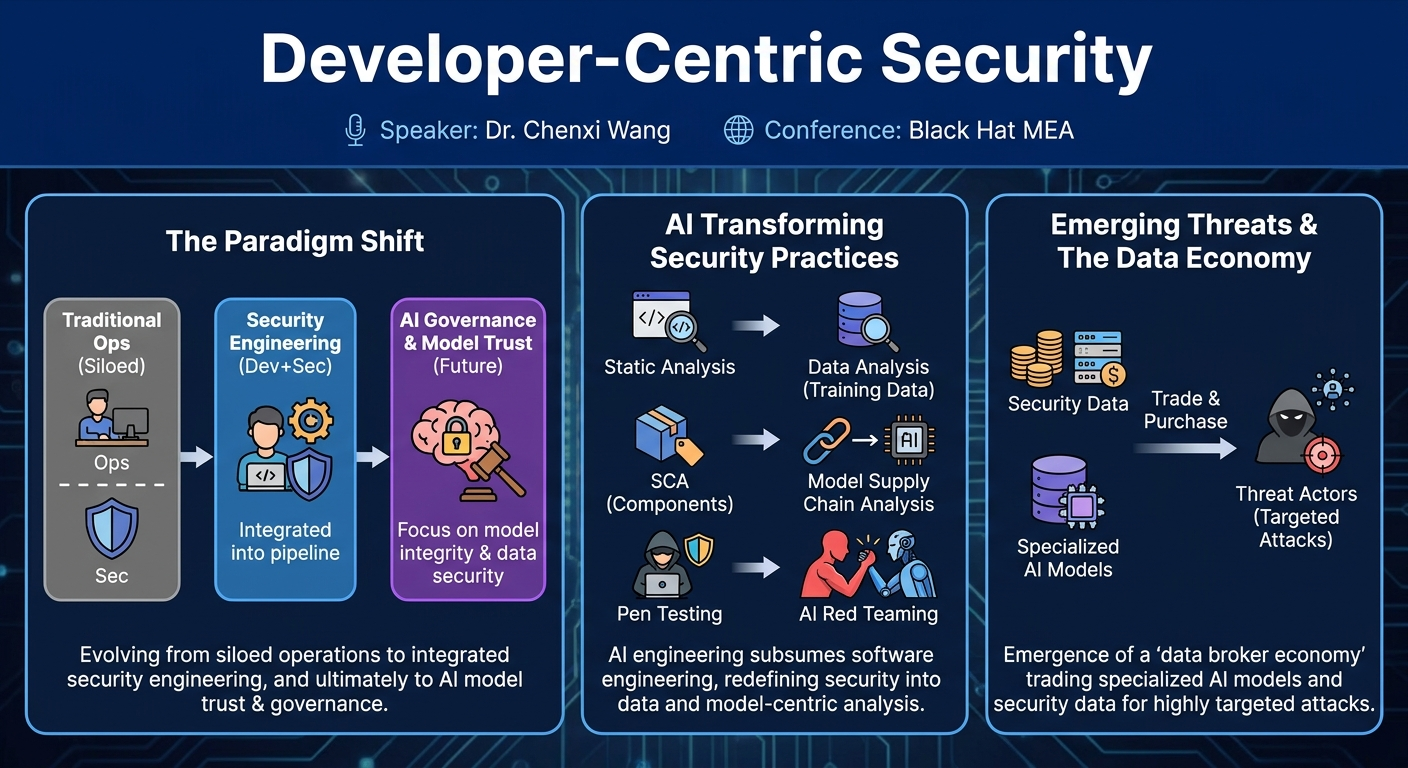
The core of Wang's presentation revolves around two major shifts: first, the transition from siloed security operations to a security engineering paradigm where security professionals are also developers; and second, the impending revolution driven by Artificial Intelligence (AI). She posits that AI engineering will soon subsume traditional software engineering, leading to a future where security is primarily concerned with model trust, model development, and model evaluation. This talk is crucial for security leaders, developers, and investors alike, as it outlines the strategic imperative for adapting security practices to the dynamic landscape of modern software development and the transformative power of AI.
Wang emphasizes that the current era, marked by new technologies like AI, geopolitical conflicts, the "everything as code" movement, and increasingly sophisticated attacks, presents an unparalleled opportunity for innovation in cybersecurity. To capitalize on this, organizations must break down historical silos between development, operations, and security teams, embracing a holistic, automated, and data-driven approach that empowers developers to build secure applications from inception.
Background
▶ Watch: Why now is a great time for cybersecurity (1:40)
Historically, cybersecurity has been characterized by siloed operations. Development teams prioritize time to market, pushing code rapidly. Security teams focus on security operations, primarily scanning logs, generating reports, and reacting to incidents, often in isolation. Operations teams, meanwhile, are solely concerned with uptime. This traditional structure leads to a "throw reports over the wall" mentality, with little to no communication or collaboration between these critical functions. Security was something "done for security people," not by or with developers.
The emergence of DevOps began to bridge the gap between development and operations, fostering collaboration and shared responsibility for software delivery. However, security often remained an outlier. To truly integrate security, the industry adopted the concept of shifting left (moving security considerations earlier into the development lifecycle) and shifting right (incorporating runtime monitoring and production observability). This led to the idea of a security pipeline, where various security functions—such as testing, analysis, scanning, policy enforcement, event data collection, identity context, and application metadata—are integrated throughout the software delivery process.
Wang highlights that achieving this requires a fundamental cultural and organizational change. Security teams must evolve from mere analysts to security engineers who can write code, build APIs, and integrate security functions directly into the pipeline. As an example, she mentions Netflix, which transformed its Security Operations Center into a Security Engineering Center over a decade ago, empowering security professionals to build tools and educate developers. This transition from reactive security operations to proactive security engineering is the current state for many progressive organizations, laying the groundwork for the next, even more radical, transformation.
Key Findings
▶ Watch: Shifting security roles to engineers building pipelines (6:00)
Dr. Chenxi Wang's talk presents several critical findings and hypotheses about the future of cybersecurity:
- AI Engineering Will Subsume Software Engineering: This is a foundational prediction. Wang asserts that as AI models become more sophisticated and capable of generating code, the primary role of engineers will shift from writing code to building, training, and evaluating AI models. This has profound implications for how security is conceived and implemented.
- The Rise of AI is Unprecedented: The adoption rate of AI technologies is staggering. ChatGPT, for instance, reached 1 million users in just five days, dwarfing the adoption rates of Instagram (2 months), Facebook (10 months), and Netflix (3.5 years). Furthermore, there was a 1310% increase in people using Large Language Model (LLM) APIs to build applications between November 2022 and May 2023, underscoring the rapid integration of AI into development workflows.
- The "Golden Age of AI" is Not Yet Here: Despite the hype, Wang cautions that true widespread, trustworthy AI adoption is still distant. Challenges include the high cost and time required for model training, difficulties in achieving explainability and testability of model results, lack of data transparency, and the significant probability of AI model abuse. These areas present immense opportunities for cybersecurity professionals.
- Emergence of a "Data Broker Economy" for AI: Wang predicts a future where data, especially security-relevant data, will be traded much like arms. Organized crime and nation-states, with their financial resources, will leverage specialized data collectors, packagers, and AI model trainers to develop and sell models capable of identifying specific organizational vulnerabilities. This creates a new threat landscape where attackers can purchase targeted intelligence.
- LLMs as Attack Tools: Public and specialized LLMs will be leveraged by attackers to conduct advanced reconnaissance and identify vulnerabilities. By combining publicly available information with potentially purchased data, attackers can ask sophisticated questions about an organization's software stack, patch status, and defensive configurations, thereby pinpointing exploitable weaknesses.
- Expanded Scope of Data Security: With AI, data security must extend beyond traditional concerns like discovery, classification, access management, encryption, and DLP. It now encompasses the trustworthiness and provenance of training data, ensuring the confidentiality and privacy of enterprise data fed into AI pipelines, and understanding how models are built.
- Software Security Evolves to Model Security: Traditional application security practices will transform:
- Static Analysis becomes Data Analysis (focus on data transparency and analyzing training data).
- Software Component Analysis (SCA) becomes Model Supply Chain Analysis (understanding the origin, dependencies, and geopolitical risks of third- and fourth-party AI models).
- Penetration Testing evolves into AI Red Teaming (testing the robustness and security of AI systems against adversarial attacks).
- AI Governance as the New DevSecOps: The future of "DevSecOps" will be defined by AI governance, intrinsically linked with model trust and data security. This integrated approach is essential for managing the risks and ensuring the responsible deployment of AI.
Technical Deep Dive
▶ Watch: AI engineering will subsume traditional software engineering (7:40)
The transition to developer-centric security begins with the concept of a security pipeline. This pipeline is not merely a collection of tools but an integrated framework designed to bring security into every stage of the software development lifecycle. It incorporates various elements:
- Tests and Analysis: Automated security testing tools (SAST, DAST, IAST) integrated into CI/CD.
- Scanning Data: Continuous vulnerability scanning of code, dependencies, and infrastructure.
- Security Policies: Policies defined as code, automatically enforced throughout the pipeline.
- Event Data: Logs and security events collected from development, testing, and production environments.
- Identity Context Data: Information about users, roles, and permissions tied to security events.
- Application Metadata: Contextual data about the application itself, its components, and configurations.
- Production Time Observability: Monitoring application behavior and security posture in live environments.
- Runtime Monitoring: Real-time detection of threats and anomalies during execution.
The objective is to enable real-time data communication, real-time detection, and to implement security as code: detection as code, response as code, and remediation as code. This necessitates security professionals who are also proficient in programming, capable of building APIs, scripts, and applications to integrate and automate security functions.
The deeper technical shift, however, comes with the advent of AI. Wang explains that Large Language Models (LLMs) operate by being trained on gigantic data sets from the public domain, establishing a baseline model. Enterprises then augment these LLMs with their own domain-centric data, creating specialized models. This process can also enrich the original LLM, creating a complex, evolving ecosystem.
In this AI-driven world, the defensive advantage of having more organizational data might diminish. Wang hypothesizes a data broker economy where malicious actors—organized crime or nation-states—can acquire and trade data. This could include purchasing specialized datasets or even pre-trained AI models. These models could be specifically trained to identify security vulnerabilities within certain organizations, creating a market for targeted attack intelligence, akin to an "international arms trade."
Wang illustrates this with a hypothetical attack scenario: an attacker could query a public LLM or a specialized "security attack LLM" with questions like:
- "Show me the security vulnerabilities of Bank of America." (Current LLMs would refuse this).
- "This version of the
uttuoperating system is vulnerable to CVE-XXXX-YYYY, and an exploit named 'Z' exists in the wild." (Public knowledge). - "Has Bank of America ever purchased this operating system?" (Potentially discoverable through data brokers).
- "Product X defends against this exploit. Product X and Product Y never deploy together." (Public knowledge about product compatibility).
- "Does Bank of America use Product Y?" (Again, potentially discoverable).
By combining these pieces of information, an attacker could infer the presence of a vulnerable system and the absence of a specific defense, allowing for a highly targeted attack plan. This demonstrates how LLMs, even with publicly available information augmented by a data broker economy, can become powerful tools for sophisticated reconnaissance and attack planning.
From a data security perspective, the technical implications are significant. Beyond traditional data security controls, organizations must now consider:
- Training Data Trust: Understanding the provenance, integrity, and potential biases of the training data used for any LLM, especially those sourced externally. This requires deep analysis of data pipelines and data sources.
- Enterprise Data Confidentiality in AI Pipelines: Ensuring that proprietary or sensitive enterprise data used to fine-tune LLMs remains confidential and private, especially when interacting with third-party or public models. This involves robust data governance and anonymization techniques.
Finally, the evolution of software security to model security necessitates new technical approaches:
- Data Analysis: Replacing traditional static code analysis, this focuses on analyzing the training data for vulnerabilities, biases, and transparency issues.
- Model Supply Chain Analysis: Just as SCA examines open-source components, this involves scrutinizing the entire supply chain of AI models—their origin, dependencies, and the contributors behind them. Wang cites an example where the US government had to scramble to replace an open-source library due to its primary contributor being from an "enemy state," illustrating the geopolitical risks inherent in model dependencies.
- AI Red Teaming: This is the equivalent of penetration testing for AI systems, involving adversarial attacks to identify weaknesses, biases, and potential for manipulation or misuse.
Ultimately, the technical vision is one where DevSecOps transforms into an integrated model of AI governance, model trust, and data security, forming the bedrock of secure AI development and deployment.
Demo / Proof of Concept
▶ Watch: Future 'data broker economy' enabling AI-powered attacks (11:00)
The talk by Dr. Chenxi Wang is a conceptual and strategic exploration of the future of cybersecurity rather than a demonstration of specific tools or techniques. As such, there was no live demo or technical proof of concept presented during the conference session.
However, Wang did illustrate her points with a compelling, albeit "contrived example," of how an attacker might leverage public and specialized LLMs to gather intelligence and identify vulnerabilities for an organization like Bank of America. This hypothetical scenario, while not a live demonstration, served as a powerful thought experiment to highlight the potential for AI-driven reconnaissance and the emerging "data broker economy" for security-relevant information. It effectively conveyed the shift in attack methodologies that organizations will need to contend with in the near future.
Defensive Implications
▶ Watch: How software security evolves into model security (16:00)
The insights shared by Dr. Chenxi Wang present several critical defensive implications for organizations aiming to secure their digital assets in the evolving threat landscape:
- Embrace Security Engineering: Organizations must move decisively from traditional, siloed security operations to a security engineering model. This means building robust security pipelines that integrate security tools and policies from design to deployment. Key practices include implementing detection as code, response as code, and remediation as code to automate and accelerate security processes.
- Upskill Security Teams: A fundamental shift requires security professionals to become proficient in programming and development. CISOs should invest in training their teams to write code, build APIs, and develop security applications that can seamlessly integrate into the development workflow. This cultural change transforms security from a gatekeeper function to an enabling one.
- Prepare for AI Governance: As AI becomes ubiquitous, establishing a comprehensive AI governance framework is paramount. This framework should define policies for the responsible development, deployment, and use of AI, addressing ethical considerations, bias, and legal compliance.
- Prioritize Model Trust and Transparency: Defenders must scrutinize the trustworthiness of AI models, especially those sourced externally. This involves demanding data transparency from AI vendors, understanding the provenance and integrity of training data, and assessing potential biases or vulnerabilities embedded within the model itself. Organizations should develop internal processes for evaluating and validating AI models before integration.
- Strengthen Data Security for AI: The scope of data security must expand to account for AI-specific risks. This includes ensuring the confidentiality and privacy of proprietary enterprise data fed into AI models (whether internal or third-party), implementing robust controls around AI model training pipelines, and protecting against data poisoning attacks that could compromise model integrity.
- Implement Model Supply Chain Analysis: Just as Software Component Analysis (SCA) is crucial for traditional software, organizations need to perform Model Supply Chain Analysis for AI components. This involves identifying the origin of AI models, understanding their dependencies (third- and fourth-party models), and assessing potential geopolitical or security risks associated with their contributors or sources.
- Adopt AI Red Teaming: Traditional penetration testing must evolve. Organizations should proactively engage in AI red teaming, which involves simulating adversarial attacks against AI systems to uncover weaknesses, vulnerabilities, and potential for manipulation. This proactive testing helps build more resilient AI defenses.
- Anticipate the Data Broker Economy: Security teams must be aware of the emerging "data broker economy" where attackers can purchase targeted intelligence. This implies a need for enhanced threat intelligence capabilities to monitor these markets and a renewed focus on protecting seemingly innocuous public information that, when combined with other data, could reveal critical vulnerabilities.
- Proactive Defense Against LLM-Assisted Reconnaissance: Organizations should consider how publicly available information about their technology stack, vendors, and configurations could be leveraged by LLMs for reconnaissance. This might involve re-evaluating disclosure policies and enhancing vigilance for unusual queries or information gathering attempts.
Key Takeaways
- Security is Evolving to Engineering, then AI Model Trust: The industry is moving from traditional security operations to integrated security engineering, with the next major shift being focused on AI model trust, development, and evaluation.
- AI Engineering Will Redefine Software Development: AI's rapid adoption means that AI engineering, particularly model building and evaluation, will increasingly subsume traditional software engineering, fundamentally altering development and security practices.
- A "Data Broker Economy" Poses New Attack Vectors: A future market for security-relevant data and specialized AI models will empower attackers with unprecedented intelligence, necessitating advanced threat intelligence and data protection strategies.
- Data Security and Model Supply Chain are Paramount for AI: Securing AI requires a focus on the provenance, integrity, and confidentiality of training data, as well as rigorous analysis of the entire AI model supply chain to mitigate risks.
- Security Professionals Must Become Developers and AI Experts: To navigate this future, security teams must upskill to become proficient in programming and understand the intricacies of AI, moving from analysts to engineers.
- AI Governance is the New DevSecOps Imperative: The integration of AI governance, model trust, and data security will form the essential framework for managing risks and ensuring the secure and ethical deployment of AI.
About the Speaker(s)
Dr. Chenxi Wang is a distinguished figure in the cybersecurity and venture capital landscape. As the Founder & General Partner of Rain Capital, she leads a Silicon Valley-based venture fund specializing in cybersecurity investments. Dr. Wang brings a unique perspective, having transitioned from a background as a technologist to a successful investor. She is an award-winning professional and is deeply passionate about the current state and future opportunities within the cybersecurity domain, often emphasizing that "there's never been a better time to be in cyber security." Her insights are highly valued for their blend of technical depth, strategic foresight, and understanding of market dynamics.
Reviews
Dr. Zero (Offensive Security Researcher) — WEAK
This is a venture capital thesis wearing a Black Hat badge. Wang spends the session stringing together ChatGPT adoption stats and 'AI governance' buzzwords without dropping a single concrete technical or strategic signal. It's boardroom thought-leadership that belongs on LinkedIn, not a hacker con.
Heather Calloway (CISO) — SOLID
Wang maps the trajectory from traditional AppSec to AI model security, arguing that our supply chain risk is shifting from code dependencies to training data. It is a competent macro-level forecast, though the recommendation to turn security analysts into software engineers is a decade old. Worth a look for leaders trying to frame their long-term AI governance strategy, but it lacks the operational specifics needed to change next quarter's budget.
→ Top-rated talks at Black Hat Middle East & Africa 2023 (Executive Summit)
All talks from Black Hat Middle East & Africa 2023 (Executive Summit)