Your Organization's Path to Cyber Maturity
Mohammed Albadrani (VP, Digital & ICT Solutions · Mobily)
Black Hat Middle East & Africa 2023 (Executive Summit) · Day 1 · Executive Summit
Overview
In this insightful Black Hat MEA talk, Mohammed Albadrani, VP of Digital & ICT Solutions at Mobily, presented a comprehensive roadmap for organizations seeking to enhance their cyber maturity. The session, titled "Your Organization's Path to Cyber Maturity," underscored the critical importance of robust cybersecurity in today's rapidly evolving digital landscape. Albadrani highlighted that effective cyber defenses are no longer merely an IT concern but a fundamental business imperative, crucial for protecting sensitive data, ensuring business continuity, and maintaining customer trust and brand reputation.
Key moments
- 0:00 Saudi Cyber Security Landscape and Attack Statistics
- 4:40 Organizational Challenges and Shifting Security Importance
- 6:50 Six Key Domains for Organizational Cyber Maturity Strategy
- 8:20 Building a Next-Generation Security Operation Center (Next-Gen SOC)
- 11:00 Crucial Importance of Cyber Security Asset Visibility
- 13:20 Continuous Improvement and Essential Cyber Security Awareness Programs
Your Organization's Path to Cyber Maturity
Speakers: Mohammed Albadrani, VP, Digital & ICT Solutions, Mobily
Conference: Black Hat MEA
YouTube: https://www.youtube.com/watch?v=sOQ8eJ5D18s
Overview
In this insightful Black Hat MEA talk, Mohammed Albadrani, VP of Digital & ICT Solutions at Mobily, presented a comprehensive roadmap for organizations seeking to enhance their cyber maturity. The session, titled "Your Organization's Path to Cyber Maturity," underscored the critical importance of robust cybersecurity in today's rapidly evolving digital landscape. Albadrani highlighted that effective cyber defenses are no longer merely an IT concern but a fundamental business imperative, crucial for protecting sensitive data, ensuring business continuity, and maintaining customer trust and brand reputation.
The talk provided a strategic perspective on the current cybersecurity environment, particularly focusing on trends and challenges within the Saudi Arabian market. Albadrani presented sobering statistics, revealing that 56% of Saudi organizations were attacked in 2021, a figure that surged to 70% in 2022—a stark 200% increase in attack prevalence. This escalation, coupled with an average data breach cost of nearly $6 million, emphasizes the severe financial and operational risks faced by businesses of all sizes. The presentation outlined a six-domain strategy designed to guide organizations through the complexities of achieving and sustaining a high level of cyber maturity.
Albadrani's presentation resonated with decision-makers and cybersecurity professionals by framing cybersecurity as a continuous journey rather than a one-time achievement. He emphasized the necessity of ongoing effort, adaptation to new technologies, and a proactive approach to evolving threats. The talk served as a call to action for organizations to integrate cybersecurity deeply into their operational fabric, moving beyond basic compliance to establish a resilient and trustworthy digital presence capable of navigating the challenges of the modern threat landscape.
Background
▶ Watch: Saudi Cyber Security Landscape and Attack Statistics (0:00)
The cybersecurity landscape in Saudi Arabia has undergone a significant transformation over the past five years, driven by extensive cybersecurity awareness programs and concerted efforts from key national entities. Albadrani specifically lauded the contributions of the National Cybersecurity Authority (NCA) and the Saudi Federation for Cybersecurity, Programming and Drones, which have played a pivotal role in elevating market awareness and promoting best practices. These initiatives have fostered a culture of technology adoption and collaboration, culminating in Saudi Arabia achieving an impressive rank number two globally in the Global Cybersecurity Index. This progress, however, is not a static achievement; Albadrani stressed that maintaining and improving cyber maturity requires continuous, ongoing effort.
Despite these advancements, organizations face a myriad of persistent challenges. The rise of distributed workforces, exemplified by the prevalence of work-from-home models, complicates security perimeters and demands new safeguarding strategies. The increasing complexity of interconnectivity, spanning data centers, hyper-cloud environments, and emerging technologies like 5G, creates intricate attack surfaces that are difficult to secure holistically. A critical challenge highlighted is the pervasive skills gap in the cybersecurity market, leaving many organizations struggling to find and retain qualified personnel capable of managing advanced threats.
Crucially, Albadrani identified a significant shift in the perceived importance of security within organizations. Cybersecurity is no longer confined to technical departments but has become a "hot topic" at the board level. This elevation is a direct consequence of high-profile data breaches, the profound impact on customer trust and brand reputation, and the necessity of ensuring business continuity and resilience. This increased executive attention, which Albadrani humorously termed a "board level indicator of compromise," is a positive development, providing cybersecurity leaders with the crucial executive buy-in needed to implement robust, long-term security strategies.
Key Findings
▶ Watch: Six Key Domains for Organizational Cyber Maturity Strategy (6:50)
Albadrani's core contribution was the articulation of a six-domain strategy for achieving organizational cyber maturity. These domains represent a holistic and integrated approach, moving beyond fragmented security measures to a unified, resilient posture:
- Building Digital Trust and Cyber Resilience: This foundational domain emphasizes securing stakeholder confidence by prioritizing customer data privacy and protection, and ensuring the integrity of digital transactions. It involves adhering to and updating data privacy regulations as they evolve, making trust a central pillar of the organization's digital identity.
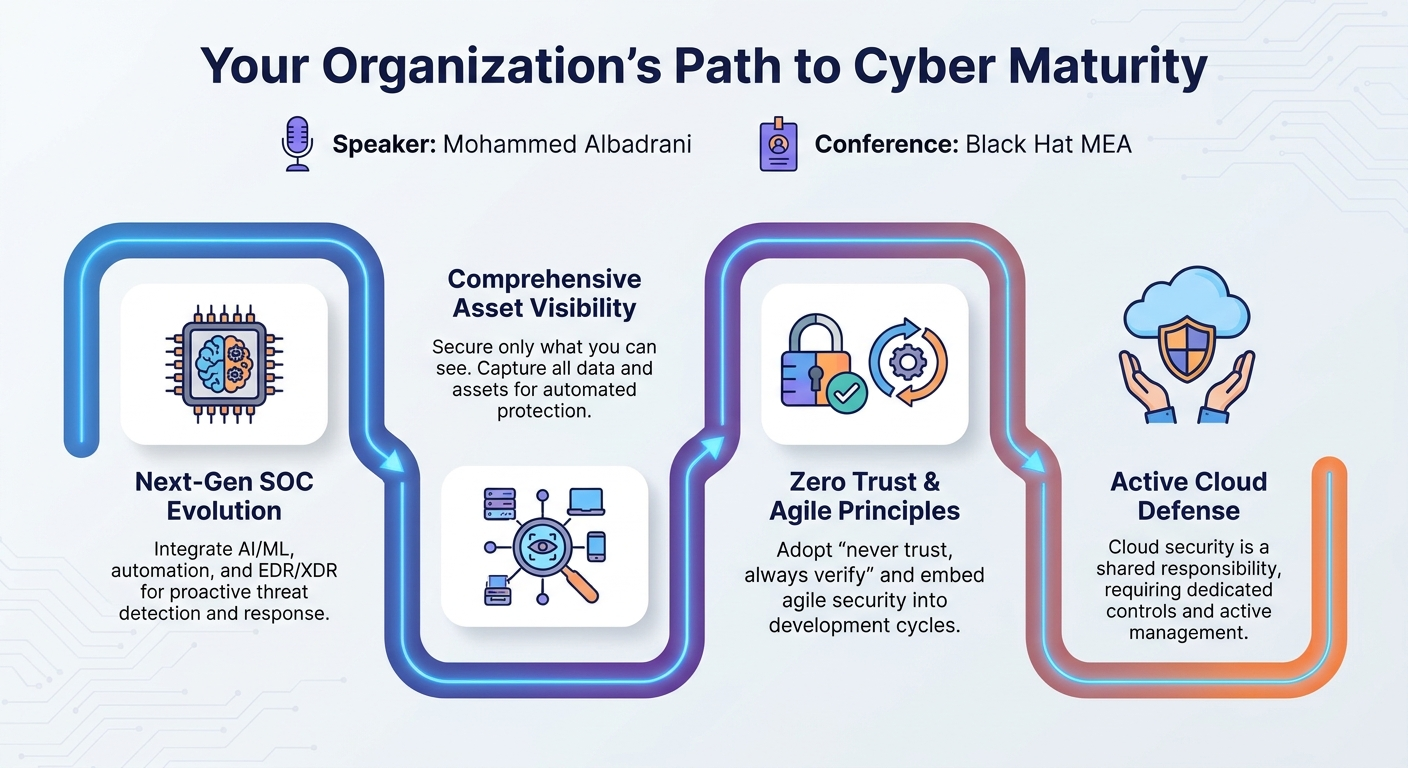
- Building a Next-Generation Security Operation Center (SOC): Moving beyond traditional SOC models, Albadrani advocated for a Next-Generation SOC capable of handling the immense volume of data generated today. This advanced SOC must leverage Artificial Intelligence (AI) and Machine Learning (ML) for threat detection and response, incorporate automated tools, and strategically address the prevalent cybersecurity skills gap through training and investment. The integration of Endpoint Detection and Response (EDR) and Extended Detection and Response (XDR) solutions is also critical.
- Securing Cloud Infrastructure and Applications: Acknowledging the common misconception that cloud platforms are inherently secure, this domain stresses the necessity of actively securing cloud environments. It requires organizations to ensure their cloud service providers implement robust security solutions, manage risks associated with hyper-cloud infrastructure (where solutions from different providers must integrate seamlessly), and prioritize the security of web, mobile, and other applications hosted in the cloud.
- Cybersecurity Asset Visibility: A fundamental principle, encapsulated by the adage "you cannot control or secure what you cannot see." This domain focuses on achieving comprehensive visibility across the entire organizational infrastructure, capturing all relevant data, and automating tools to protect, segregate, and mitigate risks associated with identified assets.
- Continuous Improvement and Transformation: Cybersecurity is not a static goal but an ongoing journey. This domain mandates continuous efforts, a structured plan for sustained security enhancements, and the adoption of agile security methodologies. A key component is the implementation of a Zero Trust approach, fundamentally shifting security paradigms.
- Cybersecurity Awareness: Recognizing that human error remains a primary attack vector, this domain underscores the critical importance of continuous, long-term cybersecurity awareness programs for all team members. Regular vulnerability assessments are essential to test the effectiveness of these efforts and close identified security gaps.
These six domains collectively form a strategic framework designed to guide organizations toward a robust and adaptive cyber maturity posture, addressing both technological and human elements of security.
Technical Deep Dive
▶ Watch: Building a Next-Generation Security Operation Center (Next-Gen SOC) (8:20)
Albadrani's six-domain strategy for cyber maturity, while presented at a strategic level, implies significant technical undertakings and shifts in operational paradigms.
The concept of a Next-Generation SOC moves beyond reactive monitoring to proactive, intelligent defense. Such a SOC is designed to ingest and process massive volumes of security data, far exceeding the capabilities of traditional human-centric analysis. This necessitates the integration of AI and Machine Learning (ML) algorithms for advanced threat detection, anomaly identification, and predictive analytics. AI can sift through logs, network traffic, and endpoint data to spot subtle indicators of compromise that might elude human analysts. Automated tools are crucial for rapid incident response, orchestrating tasks such as quarantining compromised systems, blocking malicious IPs, or initiating forensic data collection. This automation helps mitigate the skills gap by allowing fewer analysts to handle a larger workload and focus on more complex, strategic threats. Furthermore, the inclusion of EDR (Endpoint Detection and Response) and XDR (Extended Detection and Response) is paramount. EDR provides deep visibility and control over individual endpoints, detecting and responding to threats that bypass traditional antivirus. XDR extends this capability across multiple security layers—endpoints, network, cloud, email, and identity—providing a unified view of threats and enabling faster, more comprehensive investigations and responses. This integrated approach allows for a more cohesive threat hunting and incident management strategy, crucial for a truly next-generation defense.
Securing Cloud Infrastructure and Applications requires a nuanced understanding that the cloud's shared responsibility model means security is not solely the provider's burden. Organizations must implement their own security controls, often leveraging native cloud security services (e.g., AWS Security Hub, Azure Security Center) alongside third-party solutions. For hyper-cloud infrastructure, where workloads span multiple cloud providers (e.g., AWS and Azure), the technical challenge intensifies. This demands unified security policies, cross-cloud visibility, and integrated security solutions that can communicate and enforce controls consistently across disparate environments. This often involves orchestrators, Cloud Security Posture Management (CSPM) tools, and Cloud Workload Protection Platforms (CWPP) that can span multiple cloud vendors. Application security tools are vital, focusing on DevSecOps practices to embed security throughout the software development lifecycle. This includes Static Application Security Testing (SAST) for code analysis, Dynamic Application Security Testing (DAST) for runtime vulnerability detection, and API security gateways to protect increasingly interconnected microservices. For mobile and web applications, specific security frameworks and secure coding guidelines must be rigorously applied to prevent common vulnerabilities like SQL injection, cross-site scripting (XSS), and insecure API endpoints.
Cybersecurity Asset Visibility is achieved through comprehensive asset discovery and inventory solutions. This involves deploying tools that can scan networks, cloud environments, and endpoints to identify all connected devices, software, services, and data repositories. These tools often include network scanners, endpoint agents, cloud configuration auditors, and data classification engines. Once assets are identified, automation tools are essential for continuous monitoring, vulnerability management, and policy enforcement. This might involve Security Information and Event Management (SIEM) systems for log aggregation and correlation, Security Orchestration, Automation, and Response (SOAR) platforms for automated playbooks, and Configuration Management Databases (CMDBs) to maintain an accurate, real-time inventory of assets and their security posture. The goal is to move from reactive detection to proactive identification and mitigation of unknown or unmanaged assets, which often represent significant security gaps.
The domain of Continuous Improvement and Transformation encompasses adopting modern security methodologies. Agile security integrates security considerations into every sprint and development cycle, ensuring that security is not an afterthought but an intrinsic part of the project lifecycle. This often involves security champions within development teams, automated security testing in CI/CD pipelines, and regular security reviews. The Zero Trust approach is a paradigm shift, fundamentally challenging the traditional perimeter-based security model. Instead of trusting anything inside the network, Zero Trust operates on the principle of "never trust, always verify." Every user, device, and application attempting to access resources, regardless of its location, must be authenticated, authorized, and continuously validated. Technically, this involves micro-segmentation of networks, strong multi-factor authentication (MFA), least privilege access controls, continuous monitoring of user and device behavior, and context-aware access policies that dynamically adjust based on risk factors. Implementing Zero Trust requires significant architectural changes and a robust identity and access management (IAM) infrastructure.
Finally, Cybersecurity Awareness programs, while seemingly non-technical, are critical technical controls. They reduce the attack surface by making employees the "human firewall." This includes regular phishing simulations, training on social engineering tactics, secure password practices, and reporting suspicious activities. Regular vulnerability assessments are the technical validation of these efforts, and of the overall security posture. These assessments, which include penetration testing, vulnerability scanning, and security audits, help identify technical weaknesses in systems, applications, and configurations, allowing organizations to remediate them before they can be exploited. This iterative process of training, testing, and remediation ensures that both human and technical defenses are continually hardened.
Demo / Proof of Concept
▶ Watch: Crucial Importance of Cyber Security Asset Visibility (11:00)
The talk delivered by Mohammed Albadrani was a strategic overview and roadmap for achieving cyber maturity, focusing on organizational strategy, challenges, and recommended domains. As such, the presentation did not include a live demonstration or a proof of concept of any specific tools, exploits, or security solutions. The content remained at a high-level, guiding principles and frameworks rather than technical implementation specifics.
Defensive Implications
▶ Watch: Continuous Improvement and Essential Cyber Security Awareness Programs (13:20)
Organizations can leverage Albadrani's framework to significantly bolster their defensive capabilities and advance their cyber maturity. The primary implication is the need to move beyond a fragmented, reactive security posture towards an integrated, proactive, and continuously improving model.
Firstly, organizations must invest in and implement a Next-Generation SOC. This means deploying advanced SIEM and SOAR platforms integrated with AI/ML capabilities to process and analyze the massive influx of security data. The focus should be on automating routine tasks and leveraging EDR/XDR solutions to gain comprehensive visibility and control over endpoints and across the entire digital estate. To mitigate the skills gap, organizations should prioritize internal training programs, partner with educational institutions, or consider managed security service providers (MSSPs) that offer next-gen SOC capabilities.
Secondly, securing cloud environments demands a proactive stance. Defenders must scrutinize their cloud service provider (CSP) contracts and ensure that shared security responsibilities are clearly understood and met. Implementing Cloud Security Posture Management (CSPM) tools is crucial to continuously monitor cloud configurations for misconfigurations and compliance deviations. For hyper-cloud deployments, a unified security strategy is paramount, requiring robust API security, consistent identity and access management (IAM) policies across all clouds, and potentially a Cloud Access Security Broker (CASB) for data protection and threat prevention. Application developers must embed security from the outset through DevSecOps practices, utilizing SAST and DAST tools in their CI/CD pipelines to catch vulnerabilities early.
Thirdly, establishing comprehensive cybersecurity asset visibility is non-negotiable. Organizations need to deploy automated asset discovery and inventory tools that provide a real-time, accurate picture of all hardware, software, and data assets, including shadow IT. This visibility forms the foundation for effective vulnerability management, patch management, and risk assessment. What cannot be seen cannot be protected, making this a critical first step in any robust defense strategy.
Finally, the adoption of Zero Trust principles and agile security methodologies is a transformative defensive measure. Implementing micro-segmentation to isolate critical assets, enforcing least privilege access, and requiring strong multi-factor authentication (MFA) for all access requests are fundamental. Continuous monitoring of user and entity behavior (UEBA) can help detect anomalous activities indicative of compromise. Simultaneously, embedding security into agile development cycles ensures that security is a core design principle, not an afterthought. This proactive integration, combined with continuous cybersecurity awareness training and regular vulnerability assessments and penetration testing, creates a resilient defense-in-depth strategy that adapts to the evolving threat landscape and human factors.
Key Takeaways
- Cybersecurity is a Business Imperative: Beyond IT, cybersecurity is crucial for business continuity, customer trust, and brand reputation, necessitating board-level attention and investment.
- Embrace Next-Generation SOC: Move beyond traditional SOCs by integrating AI/ML, automation, EDR/XDR, and strategies to address the cybersecurity skills gap for proactive threat detection and response.
- Cloud Security is a Shared Responsibility: Organizations must actively secure their cloud infrastructure and applications, ensuring CSPs meet security standards and implementing robust controls for hyper-cloud environments and cloud-native applications.
- Achieve Comprehensive Asset Visibility: "You cannot secure what you cannot see." Implement tools and processes to capture all organizational data and assets, automating protection and mitigation based on this visibility.
- Adopt Zero Trust and Agile Security: Implement Zero Trust principles (never trust, always verify) and integrate agile security into development lifecycles for continuous, adaptive defense.
- Prioritize Continuous Improvement and Awareness: Cybersecurity is an ongoing journey, requiring perpetual efforts, regular vulnerability assessments, and sustained cybersecurity awareness programs for all employees.
About the Speaker(s)
Mohammed Albadrani is the Vice President of Digital & ICT Solutions at Mobily. In his role, he is responsible for driving digital transformation and managing information and communications technology solutions. His expertise lies in navigating the complexities of the digital landscape and formulating strategic approaches to cybersecurity, as evidenced by his insights into organizational cyber maturity and the challenges faced by enterprises in the Saudi Arabian market.
Reviews
Dr. Zero (Offensive Security Researcher) — HARD PASS
This is a pure corporate marketing deck masquerading as a keynote. Albadrani stood on a Black Hat stage to read a CISO buzzword bingo card out loud, offering zero insider signal or actionable strategy.
Heather Calloway (CISO) — WEAK
This is a paint-by-numbers recitation of generic security pillars that offers no operational reality. It relies heavily on buzzwords without addressing the organizational friction required to execute them. Skip this unless you are building your very first security program and need a baseline glossary.
→ Top-rated talks at Black Hat Middle East & Africa 2023 (Executive Summit)
All talks from Black Hat Middle East & Africa 2023 (Executive Summit)