Unanswered Questions in Cybersecurity
William Lin (Co-founder & CEO · AKA Identity)
Black Hat Middle East & Africa 2023 (Executive Summit) · Day 1 · Executive Summit
Overview
In his Black Hat MEA talk, "Unanswered Questions in Cybersecurity," William Lin, Co-founder and CEO of AKA Identity, distills a decade of cybersecurity investment and leadership experience into a concise, forward-looking analysis of the industry's most pressing challenges. Lin emphasizes that cybersecurity is fundamentally a business of risk, uncertainty, and curiosity, asserting that these elements drive its constant evolution. The presentation serves as a strategic compass, guiding security professionals and leaders through the complex landscape of emerging threats and shifting priorities.
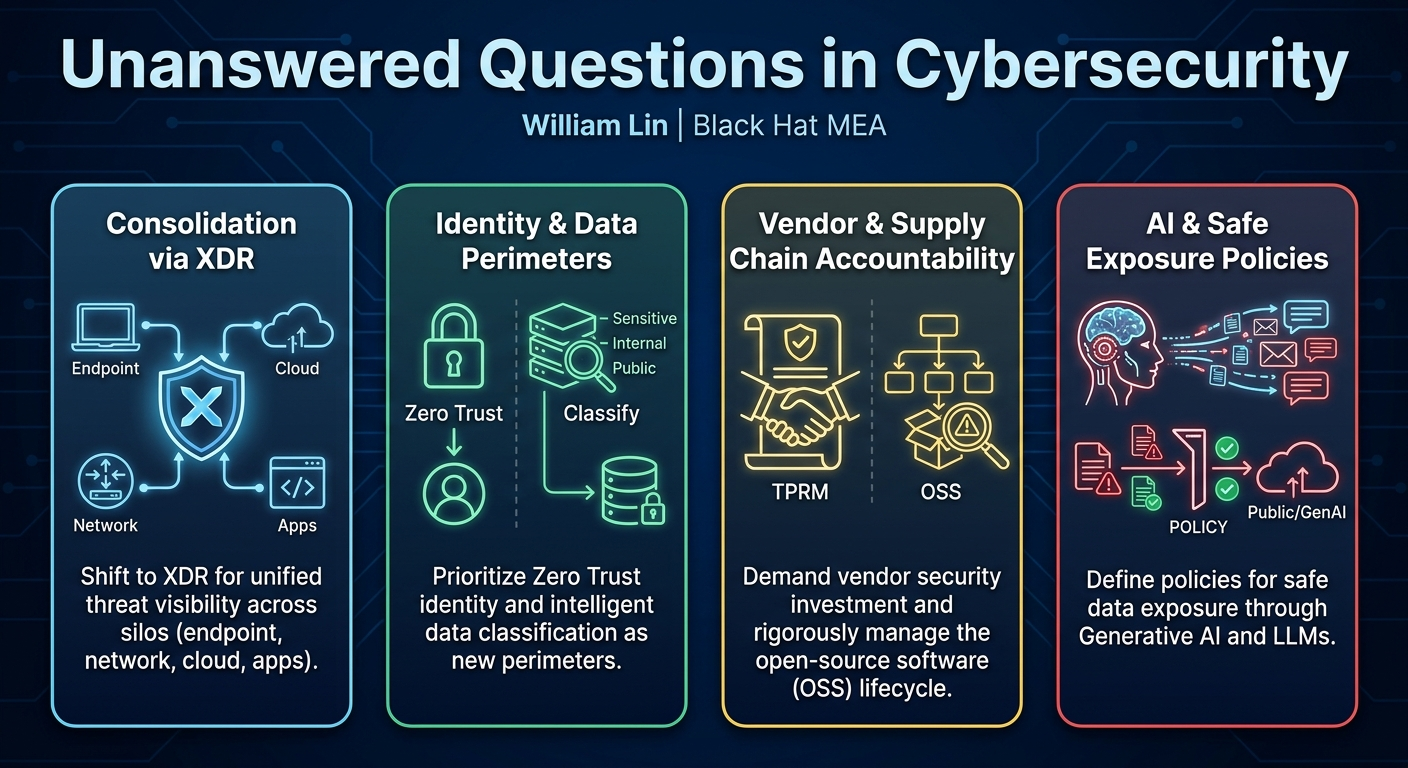
Key moments
- 0:00 Introduction and Talk Theme: Unanswered Questions
- 2:00 Understanding Cybersecurity Through Foundational Frameworks
- 4:30 Evolving Cybersecurity Priorities: Past, Present, and Future
- 8:00 Introducing the Top 10 Unanswered Cybersecurity Questions
- 10:00 Third-Party Risk & Vendor Accountability (e.g., Octa, SEC)
- 14:00 The Future of Data Security & Classification Strategies
- 19:40 AI's Impact on Privacy and Safe Data Exposure
Unanswered Questions in Cybersecurity
Speakers: William Lin, Co-founder & CEO, AKA Identity
Conference: Black Hat MEA
YouTube: https://www.youtube.com/watch?v=eSyzatnmxsI
Overview
In his Black Hat MEA talk, "Unanswered Questions in Cybersecurity," William Lin, Co-founder and CEO of AKA Identity, distills a decade of cybersecurity investment and leadership experience into a concise, forward-looking analysis of the industry's most pressing challenges. Lin emphasizes that cybersecurity is fundamentally a business of risk, uncertainty, and curiosity, asserting that these elements drive its constant evolution. The presentation serves as a strategic compass, guiding security professionals and leaders through the complex landscape of emerging threats and shifting priorities.
Lin leverages his extensive background—including investing in over 40 cybersecurity startups, mentoring 50+ CISOs, and founding a nonprofit for security leaders—to identify the top ten "unanswered questions" that will define the cybersecurity agenda in 2024. His insights are grounded in real-world observations of market trends, technological shifts, and the practical struggles faced by organizations. The talk is particularly relevant for those seeking to understand the strategic direction of cybersecurity, optimize their security investments, and prepare for the next wave of challenges.
The core value of Lin's presentation lies in its ability to synthesize vast amounts of industry knowledge into actionable insights. By framing future challenges as "unanswered questions," he encourages a proactive and analytical mindset, urging the audience to move beyond conventional solutions and embrace the inherent uncertainties of the field. This talk is not merely a summary of current trends but a strategic roadmap for navigating the complexities of modern cybersecurity, offering a rare glimpse into the collective concerns of top security leaders and investors.
Background
▶ Watch: Introduction and Talk Theme: Unanswered Questions (0:00)
Lin begins by establishing a foundational understanding of cybersecurity through established frameworks. He introduces the Visibility, Intelligence, and Action (VIA) loop, a relatively new framework emphasizing the necessity of seeing data, analyzing it for actionable intelligence, and then executing decisions. This concept is closely related to the military's OODA Loop (Observe, Orient, Decide, Act), both highlighting the iterative process of data-driven decision-making in security.
Building on these, Lin presents a more advanced framework developed by his colleague Sunil Yu, author of "The Cyber Defense Framework." This enhanced model integrates the widely recognized NIST Cybersecurity Framework (NIST CSF) with five additional control axes, creating a 25-box matrix. This matrix allows organizations to map different security projects, ideas, and goals, enabling a holistic view of their security posture. CISOs and security leaders commonly use this matrix to conduct "red, green, yellow" assessments, identifying areas of strength (green), areas needing improvement (yellow), and areas of significant concern (red). Lin stresses that striving for perfection across all 25 boxes is economically unfeasible and counterproductive; instead, effective security leadership involves strategically balancing risk and investment to achieve optimal protection within budget constraints.
The talk also provides a historical context for the current state of cybersecurity, illustrating how global events like COVID-19, increased globalization, and the widespread adoption of remote work have dramatically reshaped the threat landscape. Lin points out significant shifts, such as the rise of Identity and Access Management (IAM) as a top priority (with 46% of security leaders expecting increased IAM budgets), driven by the complexities of managing hybrid workforces and securing provisioning/de-provisioning processes. Similarly, Network Security has become paramount due to the distributed nature of modern enterprises, while Cloud Security (specifically public cloud providers like AWS, Azure, and GCP) and Application Security (AppSec) continue to evolve, incorporating concepts like DevSecOps. A notable trend highlighted is the decline of "endpoint security" as a standalone category, leading to one of the first "unanswered questions" about its future. This evolution sets the stage for the deeper dive into the ten critical questions that follow.
Key Findings
▶ Watch: Evolving Cybersecurity Priorities: Past, Present, and Future (4:30)
The central contribution of William Lin's talk is the identification and articulation of ten "unanswered questions" that are poised to dominate the cybersecurity discourse and strategic planning in 2024. These questions are not merely a list of trends but represent areas of significant uncertainty, evolving challenges, and critical shifts in industry focus. Derived from Lin's unparalleled access to and engagement with over 200 top security leaders and 40+ cybersecurity startups, these findings offer a unique, insider perspective on the industry's collective concerns.
A fundamental finding is the shift from siloed security domains to a more integrated and consolidated approach. This is exemplified by the evolution from traditional endpoint security to Extended Detection and Response (XDR), where data from various sources (endpoint, network, cloud, application) is unified for comprehensive threat intelligence. Another key finding is the increasing emphasis on vendor accountability within Third-Party Risk Management (TPRM), driven by high-profile incidents and regulatory pressures.
Furthermore, Lin highlights the critical role of identity as the new perimeter, pushing towards widespread adoption of Zero Trust architectures. The perennial challenge of security hygiene is reframed through the lens of the 80/20 rule, acknowledging budget constraints and the need for strategic prioritization. The exponential growth and movement of data necessitate a renewed focus on data classification and inventory, moving beyond mere access control to understanding data's inherent value and sensitivity.
The rise of SaaS-first IT strategies and the persistent challenges of securing IoT/OT environments also emerge as significant areas of uncertainty. In Application Security, the focus is shifting from simply "shifting left" to prioritizing exploitable vulnerabilities and robustly managing the open-source software supply chain. Finally, the talk underscores the changing dynamics of cyber insurance in the face of executive liability and the profound, yet still undefined, security implications of Generative AI and Large Language Models (LLMs), particularly concerning what information can be safely exposed. These ten questions collectively paint a picture of an industry grappling with complexity, seeking consolidation, demanding accountability, and adapting to unprecedented technological shifts.
Technical Deep Dive
▶ Watch: Introducing the Top 10 Unanswered Cybersecurity Questions (8:00)
Lin meticulously details each of the ten unanswered questions, providing context from 2022, current challenges in 2023, and projected priorities for 2024. This historical progression illuminates the dynamic nature of cybersecurity and the continuous evolution of solutions.
1. Life After EDR / XDR:
In 2022, the industry saw endpoint security, particularly Endpoint Detection and Response (EDR), drop off the top priority lists. This wasn't due to a decline in importance but a re-conceptualization. The "unanswered question" for 2024 is how organizations will effectively consolidate their security platforms while still achieving "best of breed" capabilities. The answer lies in the growing trend of Extended Detection and Response (XDR). Companies like Cisco and CrowdStrike are championing XDR, aiming to integrate and consolidate data from diverse sources—endpoints, network, cloud, and applications—into a unified platform. This shift is driven by the need for a more holistic view of threats and a desire to maximize existing investments in platforms like Microsoft, Palo Alto, or Okta, rather than managing a multitude of disparate vendors.
2. Third-Party Risk Management (TPRM):
2022 focused on improving inefficient and manual TPRM processes. In 2023, the emphasis shifted to assessing which vendors genuinely invest in security, highlighted by high-profile incidents involving critical identity providers like Okta. The unanswered question for 2024, catalyzed by actions from regulators such as the U.S. SEC imposing fines for inadequate security disclosures, is how to effectively hold vendors accountable for their security posture. This pushes beyond mere contractual obligations to a demand for demonstrable security investment and transparency.
3. Identity:
Identity has evolved rapidly. 2022 centered on securing remote identity. 2023 saw a focus on hybrid identity as workforces balanced office and remote presence. For 2024, the primary unanswered question is the full realization and practical implementation of Zero Trust. With work models solidified, organizations are looking to "clean up" and optimize their identity management, moving towards a state where trust is never implicitly granted, regardless of location or device.
4. Security Hygiene:
Previously known as vulnerability or patch management, security hygiene in 2022 and 2023 focused on "back to basics"—identifying fundamental security practices. The 2024 question revolves around applying the 80/20 rule: identifying the 20% of hygiene activities that yield 80% of the security value. This pragmatic approach acknowledges budget constraints and aims to maximize impact by prioritizing the most critical foundational tasks.
5. Data Focus:
The challenge of data security intensified in 2022 with data moving everywhere—SaaS applications, public clouds, and vendor platforms, leading to issues like Shadow IT and misconfigured S3 buckets. 2023 concentrated on identifying "who has unnecessary or irresponsible open access." In 2024, the unanswered question is about data classification and inventory. The realization is that not all data is equal; some is highly sensitive, some can slow business if compromised, and some requires less stringent protection. Accurately classifying and inventorying data is crucial for applying appropriate security controls.
6. SaaS Security / IT Style:
SaaS security is the evolution of traditional network security, moving from perimeter firewalls to securing cloud-native environments. 2023 focused on choosing SASE (Secure Access Service Edge) styles (proxy vs. network agent). The 2024 question delves into an organization's fundamental IT style: whether to become a SaaS-only company, securing all applications as such, or maintain a hybrid model with legacy on-premise or mainframe applications. This strategic decision dictates the approach to securing the entire enterprise.
7. IoT/OT Management:
The explosion of IoT/OT devices presented a management conundrum in 2022, leading to vertical-specific OT security solutions. 2023 saw discussions around how 5G would reimagine access to these devices. For 2024, the core unanswered question is the fundamental mindset for managing these devices: will it be primarily through asset management (inventory), identity management (who has access to what device and what do devices have access to), or pure security management (vulnerability, detection/response, configuration)? This mirrors themes from identity and data classification.
8. Application Security:
In 2022, AppSec focused on "shift left"—getting vulnerability data to developers for early remediation. However, 2023 revealed developers were overwhelmed by the sheer volume of scanner outputs (high, medium, low). This led to a focus on vulnerability prioritization, specifically emphasizing exploitability (identifying vulnerabilities actively being exploited). The 2024 unanswered question is about Open Source Software (OSS) lifecycle management. As open source forms the backbone of many applications, shifting left further to manage open-source dependencies more accurately and responsibly is paramount for supply chain security.
9. Cyber Insurance:
Cyber insurance became prohibitively expensive in 2022 due to a surge in ransomware and costly breaches. 2023 saw CISOs trying to minimize premiums. However, tying back to TPRM and SEC actions, the 2024 question is about executive protection. With increased accountability for security incidents, executives are concerned about personal liability, seeking ways to ensure they aren't scapegoated for hard-to-prevent breaches.
10. Privacy / Data Science (AI):
2022 focused on ensuring data science was inherently private and secure. 2023 was dominated by the awe-inspiring capabilities of Large Language Models (LLMs) and Generative AI. The profound unanswered question for security practitioners in 2024 is: "What can we safely expose via AI?" Lin views AI as a new UI/UX layer for existing information. The challenge is to determine what data can be safely disseminated through AI assistants or LLMs without compromising sensitive information, recognizing that perfect access management on generative AI is not yet feasible.
Demo / Proof of Concept
▶ Watch: The Future of Data Security & Classification Strategies (14:00)
This particular talk by William Lin was a conceptual and strategic overview rather than a technical demonstration. There were no live demos or proof-of-concept presentations of specific tools or vulnerabilities during this session. The focus remained on high-level industry trends and strategic challenges.
Defensive Implications
▶ Watch: AI's Impact on Privacy and Safe Data Exposure (19:40)
The "unanswered questions" presented by William Lin provide a clear mandate for cybersecurity defenders, urging them to adapt their strategies and investments for 2024 and beyond.
- Embrace XDR for Unified Visibility: Defenders should actively explore and implement Extended Detection and Response (XDR) solutions to consolidate security data from endpoints, networks, clouds, and applications. This integration is crucial for gaining a holistic view of threats, improving detection accuracy, and accelerating response times, moving beyond fragmented security tools.
- Strengthen Third-Party Risk Management (TPRM) with Accountability: Organizations must evolve their TPRM programs from mere compliance checklists to rigorous assessments of vendor security investment and posture. This includes demanding transparency, understanding the security practices of critical providers (like Okta), and incorporating potential SEC-like regulatory liabilities into vendor selection and management.
- Accelerate Zero Trust Implementation: With identity as the new perimeter, defenders should prioritize the full implementation of Zero Trust architectures. This involves continuous verification of user and device identities, least-privilege access, and micro-segmentation, irrespective of location, to minimize the attack surface.
- Strategically Prioritize Security Hygiene: Due to budget and resource constraints, security teams should apply the 80/20 rule to their hygiene efforts. Identify the 20% of fundamental security controls (e.g., critical patching, strong configurations, basic access reviews) that will deliver 80% of the risk reduction, ensuring resources are optimally allocated.
- Implement Robust Data Classification and Inventory: Defenders must gain a comprehensive understanding of their data landscape. This requires implementing robust data classification schemes to identify sensitive information and maintaining a detailed data inventory. Not all data requires the same level of protection, and intelligent classification enables targeted security controls.
- Define and Secure Your IT Style: Organizations need to make a strategic decision about their future IT architecture – whether to fully embrace a SaaS-only model or maintain a hybrid environment with legacy on-premise applications. This decision will dictate the appropriate security architecture, including the selection and deployment of SASE solutions or specialized security for traditional infrastructure.
- Adopt a Clear IoT/OT Management Mindset: For IoT/OT environments, defenders must establish a clear management philosophy. Whether focusing primarily on asset management (comprehensive inventory), identity management (controlling who and what has access), or pure security (vulnerability management, detection & response), a defined strategy is essential to address the unique challenges of these devices.
- Enhance Application Security with Prioritization and OSS Management: Shift AppSec efforts beyond simply identifying vulnerabilities to prioritizing those with known exploitability. Furthermore, a strong focus on Open Source Software (OSS) lifecycle management is critical to secure the software supply chain, proactively identifying and mitigating risks within third-party components.
- Re-evaluate Cyber Insurance and Executive Liability: Defenders should work closely with legal and finance teams to understand the evolving landscape of cyber insurance and the increasing focus on executive liability. This includes ensuring appropriate coverage, understanding policy exclusions, and preparing for potential regulatory scrutiny following incidents.
- Develop Policies for Safe AI Exposure: As Generative AI becomes pervasive, security practitioners must proactively develop policies and controls for "what can be safely exposed via AI." Viewing AI as a new UI/UX layer, organizations need to carefully assess the risks of data dissemination through LLMs and AI assistants, implementing safeguards to prevent inadvertent leakage of sensitive information.
Key Takeaways
- Cybersecurity is inherently a business of uncertainty and dynamic risk. Organizations must adopt adaptive strategies rather than seeking perfect, static solutions.
- Consolidation through XDR is the future of security operations. Integrating data from endpoints, networks, cloud, and applications is crucial for comprehensive threat detection and response.
- Identity and data classification are the new cornerstones of security. Zero Trust principles and intelligent data inventory are paramount for protecting distributed assets.
- Vendor accountability and open-source supply chain security are critical and growing concerns. Organizations must demand higher security standards from their third-party partners and rigorously manage their open-source dependencies.
- AI introduces significant opportunities but also new vectors for data exposure. Careful consideration and policy development are required to manage what information can be safely disseminated through AI systems.
- Strategic prioritization, like the 80/20 rule, is essential to maximize security impact within budget constraints, focusing on the most exploitable vulnerabilities and impactful hygiene practices.
About the Speaker(s)
William Lin is a highly accomplished and respected figure in the cybersecurity industry, known for his deep insights into market trends and emerging technologies. He is the Co-founder and CEO of AKA Identity, a startup focused on addressing complex identity challenges. Lin brings over a decade of experience as a prominent investor in the cybersecurity space, having invested in more than 40 cyber security companies.
Beyond his investment career, William is a dedicated community builder and thought leader. He founded a non-profit organization that convenes over 200 of the world's leading cybersecurity executives, fostering collaboration and knowledge sharing. He is also a prolific writer, having authored over 50 talks and articles, and is the author of "The VC Field Guide," a comprehensive resource on venture capital. His extensive background in both the financial and operational aspects of cybersecurity provides him with a unique perspective on the industry's most pressing "unanswered questions."
Reviews
Dr. Zero (Offensive Security Researcher) — HARD PASS
This is a VC reading your LinkedIn feed back to you on a Black Hat stage. Ten 'unanswered questions' that are just 2024's buzzword bingo card wrapped in a suit. If you want to know what Gartner is selling this quarter, watch it; if you want actionable strategic signal, skip it.
Heather Calloway (CISO) — SOLID
This is a clean, accurate map of the macro risk environment facing security leaders. It correctly identifies our core friction points—vendor accountability, SEC disclosures, executive liability, and the AI data-exposure problem—but it stops at asking the questions rather than answering them. Worth routing to new directors to frame their thinking, but veteran executives are already living this list.
→ Top-rated talks at Black Hat Middle East & Africa 2023 (Executive Summit)
All talks from Black Hat Middle East & Africa 2023 (Executive Summit)