Mastering the Art of Employment: How Not to Lose Your Job in 13 Months
Sam Curry (CISO · Zscaler)
Black Hat Middle East & Africa 2023 (Executive Summit) · Day 1 · Executive Summit
Overview
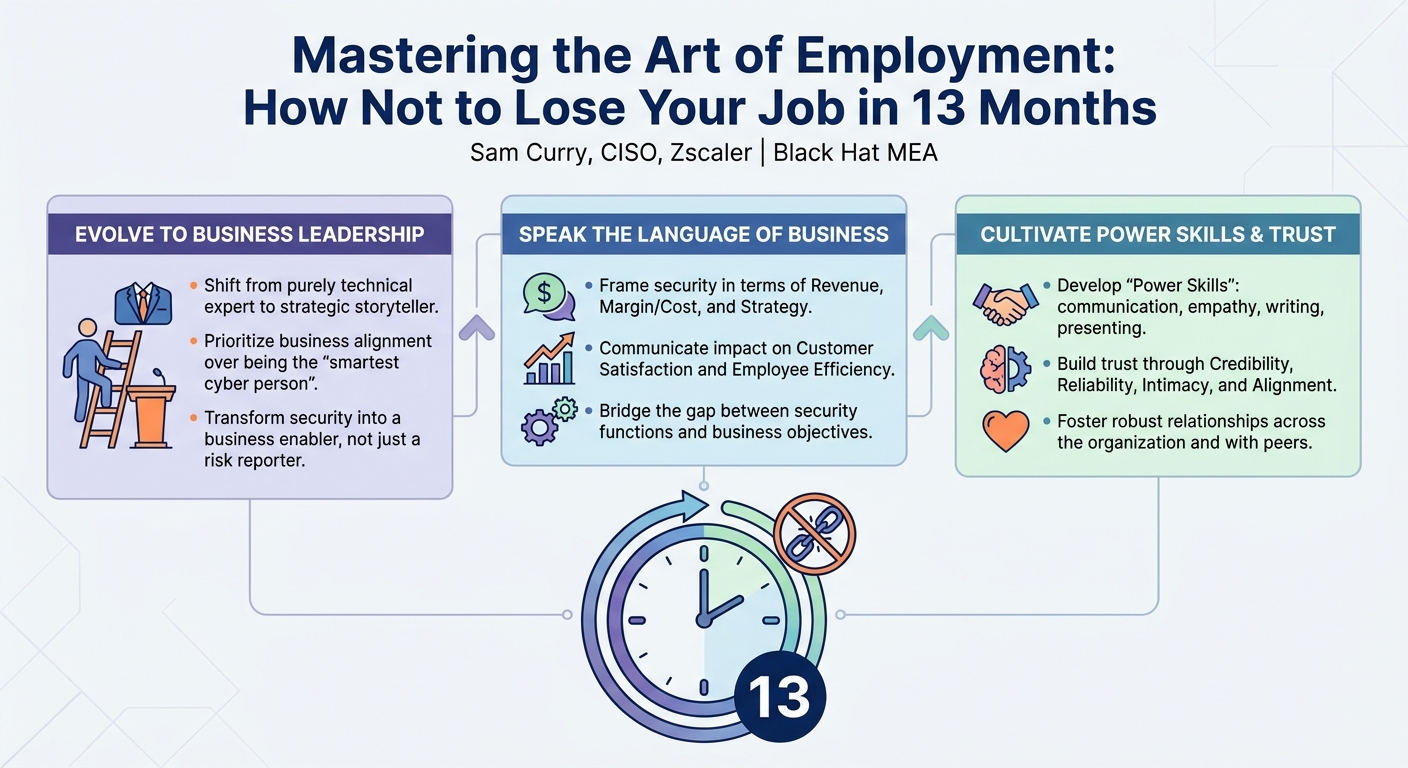
In his compelling Black Hat MEA talk, "Mastering the Art of Employment: How Not to Lose Your Job in 13 Months," Sam Curry, CISO at Zscaler, delivers a critical examination of the CISO role, its inherent challenges, and the essential skills required for long-term success. Curry argues that the biggest problem in cybersecurity is not technical, but rather the significant gap between cybersecurity functions and the broader business objectives. This disconnect, he contends, is a primary driver behind the alarmingly short average tenure of Chief Information Security Officers.
Key moments
- 0:00 Introduction: Bridging the cyber-business gap
- 3:10 The 13-month average CISO tenure challenge
- 5:15 CISO's true role: Business person, not smartest cyber expert
- 7:00 Chief risk storytelling officer: Engaging the board effectively
- 9:30 High CISO burnout and the human cost
- 11:15 Five business-focused words to use instead of 'risk'
- 14:30 Building 'power skills' and grooming future leaders
- 16:30 The Trust Equation: Credibility, reliability, intimacy, alignment
Mastering the Art of Employment: How Not to Lose Your Job in 13 Months
Speakers: Sam Curry, CISO, Zscaler
Conference: Black Hat MEA
YouTube: https://www.youtube.com/watch?v=n45ihiCJCGw
Overview
In his compelling Black Hat MEA talk, "Mastering the Art of Employment: How Not to Lose Your Job in 13 Months," Sam Curry, CISO at Zscaler, delivers a critical examination of the CISO role, its inherent challenges, and the essential skills required for long-term success. Curry argues that the biggest problem in cybersecurity is not technical, but rather the significant gap between cybersecurity functions and the broader business objectives. This disconnect, he contends, is a primary driver behind the alarmingly short average tenure of Chief Information Security Officers.
Drawing from over 30 years of experience in the cybersecurity industry, including five stints as a CISO, Curry offers candid insights into his own past failures and successes. His presentation is a powerful call for CISOs to evolve beyond purely technical expertise, transforming into strategic business leaders capable of articulating risk in terms understandable to the C-suite and board. The talk serves as both a cautionary tale and a practical guide for current and aspiring CISOs seeking to navigate the complex landscape of corporate security leadership and avoid the dreaded "13-month curse."
Curry's central thesis underscores the imperative for security leaders to prioritize business alignment, develop robust "power skills" (formerly known as soft skills), and cultivate trust across the organization. He emphasizes that effective security leadership is less about being the "smartest cyber person in the room" and more about logistics, social influence, and strategic storytelling. This talk is highly relevant for anyone in a leadership position within cybersecurity, offering actionable advice to foster resilience, reduce burnout, and ensure that security initiatives genuinely support and enable business growth.
Background
▶ Watch: Introduction: Bridging the cyber-business gap (0:00)
The premise of Sam Curry's talk stems from a stark reality within the cybersecurity industry: the average tenure of a CISO is a mere 13 months, consistently the lowest among all C-level executives. This alarming statistic, which Curry discovered in a Forbes article back in 2017, became the catalyst for his "Next Generation CISO" presentation, a topic that resonated deeply, attracting 3,000 registrants in just one week. The short tenure points to a systemic issue, suggesting that many individuals stepping into the CISO role are ill-equipped for its unique demands, often leading to rapid burnout or dismissal.
Curry explains that the vast majority of CISOs—approximately 87%, according to recent surveys he cited—ascend through a purely technical career path. The remaining few typically originate from finance or legal backgrounds. This technical genesis often leaves CISOs feeling like "strangers in a strange land" when confronted with the predominantly business-focused discussions at the executive level. Conversely, CISOs from non-technical backgrounds struggle to gain credibility with their technical teams, who may perceive them as "suits" lacking genuine understanding of the security challenges. This fundamental mismatch between a CISO's technical training and the strategic, business-oriented nature of the C-suite role creates the fertile ground for failure.
Curry openly shares his own experience of a six-month stint at MicroStrategy where he admittedly "failed to make it clear that I was a business person first." His mistake was attempting to prove he was the "smartest cyber person in the room," a habit ingrained from his prior technical career. This not only prevented him from delegating cyber ownership to other C-level peers like the CIO or CTO but also alienated him from the core business conversation. The problem, as Curry highlights, is further exacerbated by the immense pressure and stress associated with the role. He references primary research from John Oltsik at ESG, indicating that a staggering 37% of CISOs either quit or dream of quitting their job, leading to significant waste of talent and, tragically, severe personal consequences including addiction, poor health, and even suicide. This backdrop underscores the urgent need for a paradigm shift in how CISOs approach their role and how organizations support them.
Key Findings
▶ Watch: CISO's true role: Business person, not smartest cyber expert (5:15)
Sam Curry's talk unveils several critical findings that challenge traditional perceptions of the CISO role and offer a roadmap for greater success and longevity. The overarching discovery is that the most significant hurdle in cybersecurity is not a technical one, but rather the profound gap between cybersecurity and the business. Bridging this gap is paramount for any CISO hoping to thrive beyond the average 13-month tenure.
A central finding is the necessity for CISOs to evolve from being mere technical experts to becoming business leaders and strategic risk storytellers. Curry emphasizes that a CISO's primary job is to ensure the security department is aligned with business objectives, achieving "acceptable risk for acceptable return." This necessitates making trade-offs and communicating security in terms that resonate with non-technical executives. His personal revelation at MicroStrategy—that he was no longer required to be the "smartest cyber person in the room"—highlights this pivotal shift in responsibility.
Curry identifies the persistent 13-month tenure as a symptom of this misaligned expectation and skill gap. The high turnover rate among CISOs, the lowest at the C-level, indicates a widespread struggle to adapt to the strategic demands of the position. This not only represents a tremendous waste of talent but also contributes to the industry's ongoing talent shortage.
Furthermore, the talk stresses the critical importance of "power skills". Curry rebrands "soft skills" as "power skills" to underscore their formidable impact on a CISO's effectiveness. These include presenting, writing, communicating, and empathy—abilities that can be learned and honed, and are crucial for building cultural bridges and fostering understanding across diverse teams and departments.
Finally, Curry introduces the "trust equation" (credibility, reliability, intimacy, and alignment) as a foundational framework for building strong relationships. While credibility (knowing your business) and reliability (doing what you say) are often assumed or blamed when trust breaks down, Curry argues that intimacy (liking to be together, genuinely caring) and alignment (sharing common outcomes and objectives) are the most critical factors for executive-level trust. Cultivating these elements is essential for a CISO to be seen as a trusted partner rather than just a technical gatekeeper.
Technical Deep Dive
▶ Watch: High CISO burnout and the human cost (9:30)
While "Mastering the Art of Employment" is fundamentally a strategic and leadership-focused talk rather than a deep dive into specific security technologies or vulnerabilities, it nevertheless outlines a crucial shift in the "technical architecture" of the CISO role itself. The "technical deep dive" here is into the operational protocols and strategic frameworks a CISO must adopt to effectively integrate cybersecurity into the business fabric.
Curry implicitly argues for a re-architecting of the CISO's communication stack. Instead of defaulting to technical jargon or purely risk-centric language, CISOs must translate security concerns into the business's native tongue. He proposes five core business-centric terms that CISOs should master and use consistently when interacting with the C-suite and board:
- Revenue: How does a security initiative protect or enable revenue streams?
- Margin or Cost: How does it optimize operational efficiency or reduce financial overhead?
- Customer Satisfaction: How does it enhance the customer experience or protect customer data and trust?
- Employee Efficiency: How does it streamline workflows or secure employee productivity?
- Strategy: How does it align with and enable the overarching business strategy?
This framework serves as a new communication protocol, ensuring that security discussions are immediately relevant and impactful to business outcomes. For example, instead of merely stating "we need to implement a new firewall," a CISO employing this protocol would articulate, "implementing a next-generation firewall will reduce our operational costs by X% (Margin/Cost) by automating threat blocking, thereby improving employee efficiency by reducing incident response time (Employee Efficiency), and safeguarding customer data, which directly impacts customer satisfaction and trust (Customer Satisfaction)."
Curry also touches upon the use of risk quantification as a technical tool, acknowledging its importance but cautioning CISOs to "do so carefully knowing how quantification is done in a company." This implies that while the underlying methodologies of FAIR (Factor Analysis of Information Risk) or other quantitative risk models are technical, the ultimate presentation and interpretation of these metrics must be human-centric and story-driven. The technical output needs to be translated into a narrative that resonates with the board, particularly through the influence of a "technical person on the board" who can validate the CISO's message.
The "technical deep dive" extends to the CISO's internal operational model for team building. Curry advocates for recruiting and retaining a team with diverse skills and backgrounds, akin to building a resilient, distributed system with redundancy and varied capabilities. He uses the analogy of his former boss, Leo, who sought "every religion, every ethnicity, every gender" on his team, not just for ethical reasons, but because "the enemy has it," implying that a diverse team brings a wider array of perspectives and problem-solving approaches to security challenges, mirroring the adaptability of sophisticated adversaries. This organizational "architecture" fosters innovation and robust defense.
In essence, while the talk avoids specific vulnerabilities or exploit techniques, its "technical deep dive" is into the sophisticated "operating system" and "application layer" of CISO leadership, emphasizing the critical need for a new set of communication protocols and organizational design principles to achieve long-term effectiveness.
Demo / Proof of Concept
▶ Watch: Five business-focused words to use instead of 'risk' (11:15)
This particular talk, "Mastering the Art of Employment," does not feature a traditional technical demonstration or a proof of concept in the sense of showcasing a tool, exploit, or security architecture. Sam Curry's presentation is entirely focused on strategic leadership, career development, and interpersonal effectiveness within the CISO role.
Instead of a live demo, the core "proof of concept" is embedded within Curry's own career trajectory and the lessons he has learned over his 30+ years in cybersecurity, including his five CISO positions. He uses his personal experiences, particularly his candid account of a six-month tenure at MicroStrategy where he "failed to make it clear that I was a business person first," as a real-world case study. This serves as an experiential demonstration of what not to do and how a CISO's approach can impact their tenure and effectiveness.
Furthermore, Curry cites anecdotal evidence and advice from other seasoned professionals, such as Jim Ralph, a CISO at Etna (then MassMutual), who provided insights on how to effectively communicate with boards. Ralph's advice—to identify and pre-brief the "technical person on the board" and present information as a "story"—acts as a conceptual "proof of concept" for effective executive communication. The success of this strategy is implicitly validated by the CISO's ability to gain board approval and trust.
The "proof of concept" also extends to the broader industry statistics Curry references, such as the 13-month average CISO tenure and the 37% of CISOs who consider quitting. These statistics, alongside the tragic personal consequences of stress and burnout he mentions, serve as a stark "proof of concept" for the systemic failures resulting from the current model of CISO leadership. Conversely, his own extended tenures at companies like McAfee, CA, and RSA (where he spent seven years as CTO) implicitly demonstrate the potential for long-term success when the principles he advocates are applied.
In essence, the "demo" of this talk is a narrative one, relying on personal anecdotes, industry data, and strategic advice to demonstrate the principles of successful CISO leadership. It’s a compelling argument for a shift in mindset and skill set, validated by both cautionary tales and examples of resilience within the demanding CISO profession.
Defensive Implications
▶ Watch: The Trust Equation: Credibility, reliability, intimacy, alignment (16:30)
The defensive implications of Sam Curry's talk are profound and directly actionable for any organization and individual involved in cybersecurity, especially those in or aspiring to leadership roles. The core message is that effective cybersecurity defense extends far beyond technical controls; it requires robust business integration and strategic communication.
For CISOs and aspiring CISOs, the primary defensive implication is a mandate to radically shift their focus. They must transition from being purely technical guardians to business enablers and risk storytellers. This means actively seeking to understand the business's core objectives, revenue streams, cost structures, customer experience, and strategic priorities. By framing security initiatives in terms of Revenue, Margin/Cost, Customer Satisfaction, Employee Efficiency, or Strategy, CISOs can defend their programs more effectively, secure necessary resources, and gain executive buy-in. This proactive communication style is a defense against being perceived as a cost center or a blocker.
Organizations should empower their CISOs to develop "power skills" such as communication, empathy, writing, and presenting. Investing in leadership training, public speaking courses, and executive coaching for security leaders is a defensive measure against miscommunication, internal friction, and ultimately, a CISO's short tenure. A CISO who can effectively articulate risk and opportunity to the board is better positioned to defend against underinvestment in security.
Building trust through Curry's "trust equation" (credibility, reliability, intimacy, and alignment) is a critical defensive strategy. CISOs must actively cultivate relationships, both within their organization ("lateral" relationships with peers, "up" with bosses, and "down" with their teams) and externally. This network acts as a crucial support system, providing intelligence, collaboration opportunities, and resilience during crises. A CISO who is trusted and aligned with the business is far better equipped to navigate breaches, budget constraints, and organizational changes.
Furthermore, Curry's emphasis on recruiting and retaining a diverse and capable team is a direct defensive imperative. A diverse team, encompassing varied backgrounds, experiences, and perspectives, is inherently more robust and adaptable in identifying and defending against a wider range of threats. CISOs must also focus on grooming their successors, ensuring a strong "next layer" of leadership. This not only builds organizational resilience against leadership turnover but also frees the CISO to focus on higher-level strategic concerns, acting as a defense against single points of failure.
Finally, adopting an agile mindset for continuous self-improvement and organizational flexibility is a defense against stagnation in a rapidly evolving threat landscape. CISOs and their teams must constantly hone their skills, embrace humility, and be open to learning from both successes and failures. This continuous adaptation is essential for maintaining an effective defensive posture against emerging cyber threats and evolving business demands. In essence, the talk argues that a well-communicated, business-aligned, and trust-based security program is the strongest defense an organization can build.
Key Takeaways
- The CISO role is fundamentally a business and social leadership position, not purely technical. Successful CISOs must evolve from being the "smartest cyber person in the room" to being strategic storytellers and integrators of security with business objectives.
- Bridge the business-security gap by speaking the language of the business. Frame security discussions in terms of their impact on Revenue, Margin/Cost, Customer Satisfaction, Employee Efficiency, and overall Business Strategy to gain executive trust and secure resources.
- Cultivate "Power Skills" (communication, empathy, writing, presenting) and deep business acumen. These are learnable skills that are crucial for building cultural bridges, influencing stakeholders, and understanding the company's unique operational context beyond technical security.
- Build robust trust through "Credibility, Reliability, Intimacy, and Alignment." Actively foster genuine relationships, both internal and external, and ensure shared objectives with peers and leadership to become a trusted advisor, not just a risk reporter.
- Recruit, retain, and groom a diverse and capable team. Empower and delegate to your team, focusing on finding individuals smarter than yourself, and fostering diversity to build a resilient and adaptable security function.
- Embrace an agile mindset for continuous learning and adaptation. The cybersecurity landscape is constantly changing; CISOs must continuously hone their skills, maintain humility, and lead their teams in incremental improvements and flexible responses.
About the Speaker(s)
Sam Curry is a highly experienced and respected figure in the cybersecurity industry, currently serving as the CISO at Zscaler. With an impressive career spanning over 30 years, Curry has held numerous leadership positions, including five stints as a CISO. His extensive background includes significant roles at prominent technology and security companies.
Prior to joining Zscaler in March 2023, he held the CISO position at Cyberreason. Notably, he also served as CTO at RSA for seven years, and held key roles at McAfee (five years), Computer Associates (CA), and Arbor Networks. Curry is known for his candid insights into the challenges and opportunities within cybersecurity leadership, drawing heavily on his personal experiences, including both successes and admitted failures, to provide practical guidance. He is a strong advocate for bridging the gap between technical security and business strategy, emphasizing the importance of leadership, communication, and team development in the CISO role.
Reviews
Dr. Zero (Offensive Security Researcher) — SOLID
Sam Curry delivers the requisite 'CISOs need to speak business' sermon, but saves it from being total vaporware by dissecting his own career failures. It’s an MBA survival guide for technical operators drowning in the C-suite. Solid advice for aspiring executives, even if the core message is older than most of the attendees.
Heather Calloway (CISO) — STRONG ACCEPT
Sam Curry addresses the existential crisis of the CISO role: the 13-month average tenure and the institutional disconnect that drives it. This is a mandatory watch for any security director stepping into their first C-level role, and a necessary gut-check for veterans. He correctly diagnoses that our failure is rarely technical—it is a failure of translation, alignment, and executive trust.
→ Top-rated talks at Black Hat Middle East & Africa 2023 (Executive Summit)
All talks from Black Hat Middle East & Africa 2023 (Executive Summit)