Women in Cyber: Driving Bigger Impact
Aseel Al Fehaid (Data Protection & Privacy Director), Rasha Abu AlSaud (Saudi National Bank), Dr. Reem AlShammari (Founding Partner · Women in Cyber Security Middle East (WiCSME))
Black Hat Middle East & Africa 2023 (Executive Summit) · Day 1 · Executive Summit
Overview
The "Women in Cyber: Driving Bigger Impact" panel at Black Hat MEA brought together prominent female leaders in cybersecurity to discuss the evolving landscape of gender diversity within the industry. The discussion featured Aseel Al Fehaid, Rasha Abu AlSaud, Dr. Reem AlShammari, and another panelist, who collectively explored the challenges, progress, and strategic imperatives for increasing women's participation from global, regional, and national perspectives. This insightful session underscored not only the ethical imperative of diversity but also its critical role in bolstering national cybersecurity resilience and fostering innovation in an increasingly complex threat environment.
Key moments
- 0:40 Global gender diversity trends and why it matters
- 3:10 Middle East's cultural drivers for women in cyber
- 8:10 Saudi's national strategy and ecosystem for women empowerment
- 16:50 Overcoming career barriers: mindset and resilience
- 21:45 Individual responsibility for self-development and career growth
- 24:55 Government, academia, corporate roles in promoting diversity
- 29:00 Strategies for retaining and advancing women in cyber roles
Women in Cyber: Driving Bigger Impact
Speakers: Aseel Al Fehaid (Data Protection & Privacy Director), Rasha Abu AlSaud (Saudi National Bank), Dr. Reem AlShammari (Founding Partner, Women in Cyber Security Middle East).
Conference: Black Hat MEA
YouTube: https://www.youtube.com/watch?v=npE2rD5reQU
Overview
The "Women in Cyber: Driving Bigger Impact" panel at Black Hat MEA brought together prominent female leaders in cybersecurity to discuss the evolving landscape of gender diversity within the industry. The discussion featured Aseel Al Fehaid, Rasha Abu AlSaud, Dr. Reem AlShammari, and another panelist, who collectively explored the challenges, progress, and strategic imperatives for increasing women's participation from global, regional, and national perspectives. This insightful session underscored not only the ethical imperative of diversity but also its critical role in bolstering national cybersecurity resilience and fostering innovation in an increasingly complex threat environment.
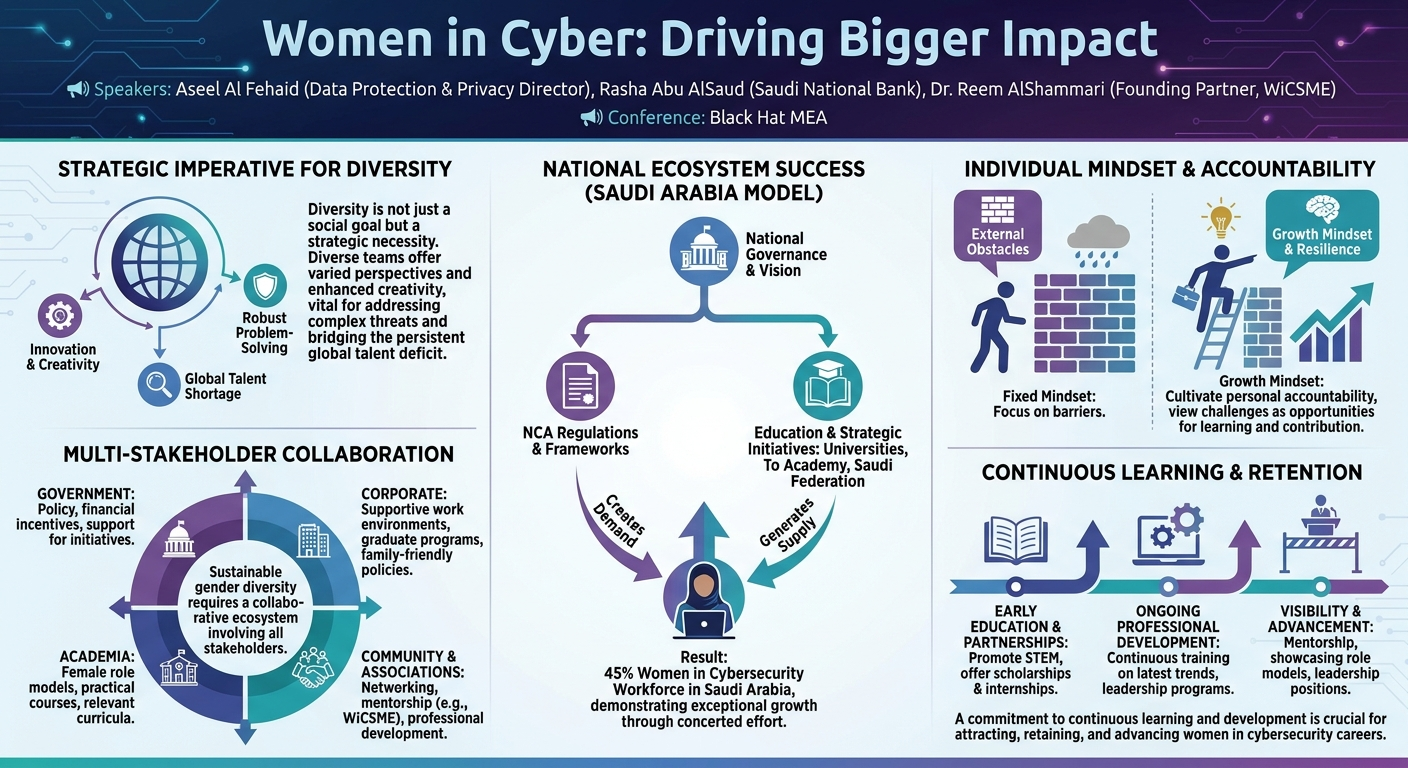
The core message resonating throughout the panel was that diversity in cybersecurity is not merely a matter of social equity but a strategic necessity. With a persistent global talent shortage in the field, leveraging the full spectrum of available talent, irrespective of gender, is paramount. Furthermore, diverse teams bring varied perspectives, fostering greater creativity and more robust problem-solving capabilities—qualities indispensable for effectively addressing the ever-evolving and sophisticated nature of cyber threats. The panelists shared compelling data and real-world examples, particularly highlighting the remarkable strides made in Saudi Arabia, to illustrate how concerted efforts can significantly enhance women's representation and impact in cybersecurity.
Background
▶ Watch: Global gender diversity trends and why it matters (0:40)
Historically, the fields of Science, Technology, Engineering, and Mathematics (STEM), including cybersecurity, have been characterized by significant gender imbalance. Globally, women currently represent approximately 38% of the overall STEM workforce, with their representation in cybersecurity lagging further at around 25%. Just five years prior, in 2018, these figures were even lower, with women constituting only 25% of the STEM workforce and a mere 11% in cybersecurity. This persistent underrepresentation has contributed to a global talent deficit in cybersecurity, a critical issue given the escalating volume and sophistication of cyberattacks.
However, the discussion also illuminated unique cultural dynamics in the Middle East that have historically fostered women's engagement in STEM fields. Dr. Reem AlShammari recounted that even in the 1990s, computer engineering classes in the region often saw a majority of female students, reflecting a cultural emphasis on education and a natural inclination towards scientific and engineering disciplines. This inherent cultural predisposition has provided a fertile ground for initiatives aimed at further empowering women in technology. In Saudi Arabia, specifically, this drive aligns seamlessly with Vision 2030, a national strategic framework focused on economic diversification, social reform, and increasing women's participation in the workforce across various sectors, including the crucial domain of cybersecurity. The panel aimed to dissect how these global trends and regional specificities are being addressed to drive greater impact.
Key Findings
▶ Watch: Saudi's national strategy and ecosystem for women empowerment (8:10)
The panel revealed several compelling findings that underscore both the progress made and the strategic importance of continued efforts in promoting gender diversity in cybersecurity:
- Significant Global Progress: While challenges remain, there has been notable improvement in women's participation in cybersecurity globally. The percentage of women in the sector has more than doubled in five years, rising from 11% in 2018 to 25% currently. This upward trend, though still indicating underrepresentation, signals a positive shift in industry dynamics and a growing recognition of the value women bring to the field.
- Saudi Arabia's Exceptional Leadership: Saudi Arabia has emerged as a global leader in fostering women's participation in cybersecurity. According to 2022 statistics from the Saudi Federation for Cyber Security, Programming and Drones, women constitute an impressive 45% of the cybersecurity workforce in the Kingdom—a figure significantly higher than the global average. Furthermore, recent university graduation data indicates an almost 50/50 split between male and female graduates entering the cybersecurity task force, suggesting that this positive trend is set to continue and potentially exceed current figures.
- Black Hat MEA's Record-Breaking Diversity: The commitment to diversity in Saudi Arabia was visibly demonstrated at Black Hat MEA. In 2021, the conference, in collaboration with Saudi entities, recorded the highest number of female speakers in Black Hat's 70-80 year history globally. This achievement highlights not only the volume of female talent but also their prominent role in thought leadership and knowledge sharing within the regional cybersecurity community.
- Growth of Women in Cyber Security Middle East (WiCSME): Dr. Reem AlShammari, a founding partner of Women in Cyber Security Middle East (WiCSME), detailed the remarkable expansion of WiCSME. Established in 2018 with just eight co-founding ladies, the organization has grown to encompass over 2,500 members across 23 Arab countries, ranging from students to executives. This robust community network serves as a powerful platform for learning, mentorship, and professional development, demonstrating the strong demand and collective effort among women in the region.
- National Recognition and Global Competitiveness: Saudi Arabia's strategic focus on women empowerment has directly contributed to its enhanced global standing in cybersecurity. The Kingdom has jumped to the second rank in the Global Cybersecurity Index (GCI) and maintained this position for three consecutive years, with women empowerment identified as a significant factor in this achievement. Dr. AlShammari's own recognition as the Cyber Security Woman of the Year 2023 under the "Barrier Breaker" category further exemplifies the impactful contributions of women from the region.
- Diversity Drives Creativity and Solutions: Beyond statistics, the panelists consistently emphasized that diversity is a fundamental driver of creativity and innovation. Different perspectives lead to a broader range of solutions and a more comprehensive understanding of complex cyber threats, which is indispensable for effective risk mitigation and defense.
Technical Deep Dive
▶ Watch: Overcoming career barriers: mindset and resilience (16:50)
While this panel did not delve into specific code or exploit techniques, its "technical deep dive" was into the architecture of national and organizational strategies required to build a robust, diverse cybersecurity workforce. The discussion highlighted the creation of a comprehensive ecosystem, particularly exemplified by Saudi Arabia's multi-faceted approach.
National Ecosystem in Saudi Arabia: A Model for Diversity
Rasha Abu AlSaud articulated how Saudi Arabia's success is rooted in a meticulously constructed national ecosystem designed to foster cybersecurity capabilities and women's empowerment.
- Demand Creation through National Governance:
- The establishment of the National Cyber Security Authority (NCA) in 2017 was a pivotal moment. The NCA was tasked with improving the national cybersecurity posture across all levels.
- Crucially, the NCA issued a Cybersecurity Framework in 2017 along with various regulations. These mandates compelled organizations across diverse sectors to ensure they possessed sufficient cybersecurity capabilities and specific skill sets. This top-down approach effectively created a significant demand for cybersecurity professionals throughout the Kingdom.
- Supply Generation through Education and Initiatives:
- Academic Responsiveness: Universities responded rapidly and positively to the NCA's demand by integrating cybersecurity topics into their academic curricula. This ensured a steady pipeline of graduates equipped with relevant knowledge.
- Government-Led Programs: The government spearheaded several initiatives to further cultivate talent. The Saudi Federation for Cyber Security, Programming and Drones was established to host and sponsor major events like Black Hat MEA, providing platforms for knowledge exchange and skill development. The To Academy was also created to ensure the availability of capable resources through specialized training programs.
- Community and Center of Excellence Initiatives: Complementing government efforts, community-led initiatives flourished. Dr. Reem AlShammari's C initiative, for instance, focuses on providing technical training to the younger generation. Additionally, the Center of Excellence for Cyber Security at King Saud University contributes significantly to research, development, and talent nurturing. These combined efforts ensured a robust supply of qualified cybersecurity professionals.
- Strategic Direction for Women Empowerment:
- A critical element was the national strategic direction for women empowerment, which was announced at the Global Cybersecurity Forum (GCF) in 2020. This initiative positioned the empowerment of women in cybersecurity as a strategic goal not only for Saudi Arabia but also for the Kingdom to lead globally.
- This strategic endorsement encouraged organizations to overcome historical hesitations from HR professionals regarding accepting CVs from women in technology and cybersecurity domains. The national support provided the necessary impetus for organizations to actively increase women's participation in their workforces.
Multi-Stakeholder Approach for Sustained Diversity
Another panelist expanded on global best practices, emphasizing that promoting gender diversity is a collective effort involving multiple stakeholders:
- Government's Role: Governments act as coordinators, fostering cooperation between public and private sectors. They can leverage financial incentives, such as decreasing taxes for companies investing in graduate programs or initiatives aimed at increasing women in cyber. Governments can also establish expert groups focused on specific security topics and diversity and inclusion.
- Corporate's Role: Companies have a responsibility to create supportive work environments. This includes implementing family-friendly policies like flexible working arrangements and even establishing on-site kindergartens, allowing women to balance professional responsibilities with family life more effectively. Corporate graduate programs are crucial for attracting and nurturing young talent, providing clear pathways into the industry.
- Academia's Role: Educational institutions need more female role models and subject matter experts who are practical, hands-on professionals. These women can provide lectures and courses, demonstrating that women excel in technical roles and offering diverse teaching methodologies that might appeal to a broader range of students.
- Community and Associations: Organizations like "Women in Technology," "Women in Cyber Security," "InfoSec Girls," and "Coding Girls" play a vital role in promoting women in the field. Governments can actively participate by sponsoring or supporting these associations, bringing their efforts together for greater impact.
Aseel Al Fehaid further highlighted strategies for fostering an environment to retain and advance women:
- Early Education & Partnerships: Promoting STEM education from an early age and partnering with educational institutions to provide scholarships, mentorship programs, and internships specifically for women in cybersecurity.
- Continuous Professional Development: Offering ongoing training to keep women updated with the latest cybersecurity trends and providing leadership programs to prepare them for higher positions.
- Visibility and Representation: Increasing the representation of women in leadership positions within cybersecurity departments and showcasing successful women as role models to inspire others.
The discussion underscored that the "technical" solution to gender diversity in cybersecurity is not a single tool or framework, but a complex, interconnected ecosystem of national policies, educational reforms, corporate initiatives, and community support, all driven by a strategic commitment to inclusivity and talent development.
Demo / Proof of Concept
▶ Watch: Government, academia, corporate roles in promoting diversity (24:55)
This panel discussion, "Women in Cyber: Driving Bigger Impact," focused on strategic, policy, and human capital development within the cybersecurity industry. As such, it did not include a technical demonstration or proof of concept of any cybersecurity tools, exploits, or defensive mechanisms. The content was entirely dedicated to the analysis of diversity trends, initiatives, and best practices.
Defensive Implications
▶ Watch: Strategies for retaining and advancing women in cyber roles (29:00)
The insights shared by the panelists have profound implications for cybersecurity defense at multiple levels—organizational, national, and individual. Recognizing and actively addressing gender diversity is not merely a social objective but a critical component of building a resilient and effective cyber defense posture.
At the organizational level, the primary defensive implication is that diverse teams are inherently stronger and more adaptable in the face of evolving cyber threats. Organizations should actively embrace diversity not just as an HR mandate but as a strategic imperative for enhanced threat intelligence, incident response, and innovative security solutions. This means:
- Enhanced Problem Solving: Diverse perspectives, as highlighted by another panelist, lead to more creative and comprehensive solutions, which is crucial for identifying and mitigating complex, multi-faceted cyber risks that homogeneous teams might overlook.
- Talent Acquisition and Retention: In a field plagued by a chronic talent shortage, organizations cannot afford to exclude any segment of the population. By actively recruiting, retaining, and promoting women, companies can tap into a wider talent pool, strengthening their defensive capabilities. This requires implementing supportive HR policies, such as flexible working arrangements, mentorship programs, and clear career advancement paths, as emphasized by Aseel Al Fehaid.
- Building an Inclusive Culture: Fostering a culture where women feel valued, supported, and empowered, as discussed by Rasha Abu AlSaud, directly contributes to team cohesion and resilience. Organizations must provide leadership training and coaching to help all employees, especially those in leadership roles, understand and champion diversity.
At the national level, the defensive implications are even broader, impacting national security and critical infrastructure protection:
- Strategic Workforce Development: Saudi Arabia's model demonstrates that a national strategic direction, spearheaded by entities like the NCA, can effectively create both demand and supply for cybersecurity talent. This involves establishing frameworks and regulations that mandate cybersecurity capabilities, investing in national education and training programs (e.g., To Academy, Saudi Federation), and fostering community-led initiatives.
- Global Competitiveness: A strong, diverse cybersecurity workforce, as evidenced by Saudi Arabia's rise in the GCI, directly correlates with a nation's ability to defend itself against state-sponsored attacks, cyber warfare, and economic espionage.
- Policy and Collaboration: Governments play a crucial role in coordinating efforts across academia, industry, and the private sector. Tax incentives for diversity initiatives and support for women-focused associations can amplify these efforts, creating a robust national defense ecosystem.
Finally, at the individual level, the defensive implications revolve around personal resilience and continuous contribution:
- Accountability and Growth Mindset: Dr. Reem AlShammari's powerful analogy of "pointing the 10 digits at yourself" underscores the importance of individual accountability. Cybersecurity professionals, regardless of gender, must cultivate a mindset of continuous learning, problem-solving, and resilience to overcome challenges rather than succumbing to them. This proactive stance is a personal defense mechanism against professional stagnation and burnout in a high-pressure field.
- Mentorship and Support: Individuals should actively seek coaching and mentorship, and organizations should facilitate these opportunities. This personal development contributes to a stronger, more capable workforce, enhancing overall defensive readiness.
In essence, the panel argued that effective cybersecurity defense in the 21st century requires a holistic approach that integrates technological solutions with a deeply diverse, skilled, and resilient human element. Ignoring gender diversity is not just an ethical oversight; it is a critical vulnerability.
Key Takeaways
- Diversity is a Strategic Imperative, Not Just a Social Goal: Addressing the global cybersecurity talent shortage and enhancing creativity in problem-solving necessitates the active inclusion of women and diverse perspectives.
- National Strategies Drive Exceptional Results: Saudi Arabia's success, with women comprising 45% of its cyber workforce, demonstrates that a concerted national effort—involving governance (NCA), education (universities, To Academy), and strategic empowerment initiatives—can yield outstanding progress.
- Overcoming Barriers Requires a Mindset Shift: Individuals should cultivate personal accountability and a growth mindset, viewing challenges as opportunities for learning and contribution, rather than external obstacles.
- A Multi-Stakeholder Ecosystem is Essential: Sustainable gender diversity requires collaborative efforts from governments (policy, incentives), corporations (supportive environments, training), academia (role models, relevant curricula), and community associations (networking, mentorship).
- Continuous Learning and Professional Development are Crucial: For both attracting and retaining women in cybersecurity, ongoing training, leadership programs, and mentorship opportunities are vital to ensure skill relevancy and career advancement.
About the Speaker(s)
- Aseel Al Fehaid: A Data Protection & Privacy Director, Aseel brings expertise in safeguarding sensitive information and ensuring compliance within organizations. Her insights highlight the importance of robust frameworks and educational opportunities for women in cybersecurity.
- Rasha Abu AlSaud: Associated with the Saudi National Bank, Rasha provided valuable perspectives on the impact of national efforts and strategic directions in fostering women's participation in cybersecurity, particularly within the financial sector.
- Dr. Reem AlShammari: A highly inspiring figure, Dr. AlShammari is a founding partner of Women in Cyber Security Middle East (WiCSME), an organization that has grown significantly under her leadership. She was recently recognized as the Cyber Security Woman of the Year 2023 under the "Barrier Breaker" category, acknowledging her profound impact and resilience in the field. She also leads the C initiative, providing technical training to the younger generation.
- Another Panelist: Another panelist shared global perspectives on gender diversity, emphasizing the roles of government, corporations, and academia in creating a balanced and inclusive cybersecurity environment.
- The Moderator: The moderator skillfully moderated the panel, guiding the discussion across global, regional, and national landscapes, and facilitating a rich exchange of insights among the esteemed panelists.
Reviews
Dr. Zero (Offensive Security Researcher) — SOLID
I usually skip workforce panels, but this one is rescued by actual structural receipts. When Rasha Abu AlSaud and Dr. Reem AlShammari explain how Saudi Arabia hit 45% female cyber workforce participation, they aren't just reciting platitudes. They're detailing a masterclass in nation-state market manipulation that actually worked.
Heather Calloway (CISO) — SOLID
A clear-eyed look at how national policy and top-down mandates can successfully engineer a diverse cybersecurity talent pipeline. Worth a watch for leaders who still treat diversity as an HR initiative rather than a critical solution to our structural headcount deficit.
→ Top-rated talks at Black Hat Middle East & Africa 2023 (Executive Summit)
All talks from Black Hat Middle East & Africa 2023 (Executive Summit)