Understanding the Expanding Influence of Cybersecurity Across the Enterprise & Business Functions
Eric Tan (CIO & Chief Security Officer · Flock Safety), Sam Curry (CISO · Zscaler), Chris Wysopal (Founder & CTO · Veracode), Ayoub Fathi (VP of Information Security & CISO · Noon), Trevor Dearing (Illumio), Prashant Prasad (Director of Technology · Spire Solutions)
Black Hat Middle East & Africa 2023 (Executive Summit) · Day 2 · Executive Summit
Overview
This Black Hat MEA panel discussion, "Understanding the Expanding Influence of Cybersecurity Across the Enterprise & Business Functions," brought together a distinguished group of cybersecurity leaders to explore the evolving role of security within modern organizations. Moderated by Eric Tan, the panel featured Sam Curry, Chris Wysopal, Ayoub Fathi, Trevor Dearing, and Prashant Prasad, all of whom shared their unique perspectives as CISOs, CTOs, and industry veterans. The discussion transcended purely technical concerns, delving into the strategic, operational, and cultural shifts required for cybersecurity to effectively support and enable business objectives.
Key moments
- 0:50 Chris Wysopal: Legitimizing white hat hackers
- 6:00 Advice for Founders: Identifying tech gaps and trends
- 14:30 Sam Curry on collaboration, trust, and business goals
- 24:00 Sam Curry: Don't secure everything; focus on resilience
- 32:30 Budgeting: Build alliances with CFOs, make trade-offs
- 35:30 Prashant: Security as a revenue center, not cost
- 38:40 Chris Wysopal: Vendor accountability and supply chain risk
- 42:00 Sam Curry's 2024 prediction: AI and SECOps revolution
Understanding the Expanding Influence of Cybersecurity Across the Enterprise & Business Functions
Speakers: Eric Tan (CIO & Chief Security Officer, Flock Safety), Sam Curry (CISO, Zscaler), Chris Wysopal (Founder & CTO, Veracode), Ayoub Fathi (VP of Information Security & CISO, Noon), Trevor Dearing (Illumio), Prashant Prasad (Director of Technology, Spire Solutions)
Conference: Black Hat MEA
YouTube: https://www.youtube.com/watch?v=h1Xpf4VLskQ
Overview
This Black Hat MEA panel discussion, "Understanding the Expanding Influence of Cybersecurity Across the Enterprise & Business Functions," brought together a distinguished group of cybersecurity leaders to explore the evolving role of security within modern organizations. Moderated by Eric Tan, the panel featured Sam Curry, Chris Wysopal, Ayoub Fathi, Trevor Dearing, and Prashant Prasad, all of whom shared their unique perspectives as CISOs, CTOs, and industry veterans. The discussion transcended purely technical concerns, delving into the strategic, operational, and cultural shifts required for cybersecurity to effectively support and enable business objectives.
The core of the talk centered on the critical need for cybersecurity to integrate deeply with all facets of the enterprise, moving beyond its traditional "department of no" image. Speakers emphasized the importance of collaboration, strategic risk management, and the innovative use of resources to build resilient organizations in an increasingly complex threat landscape. This talk is highly relevant for security professionals, business leaders, and aspiring entrepreneurs, offering practical advice on everything from building security programs on limited budgets to navigating the challenges of an ever-expanding attack surface and leveraging emerging technologies like AI.
The insights shared underscored a fundamental paradigm shift: cybersecurity is no longer an isolated technical function but a pervasive business imperative. The panel offered a holistic view, touching upon entrepreneurship, inter-departmental collaboration, budget allocation, and predictions for the future, making it a comprehensive guide for anyone seeking to understand or contribute to the strategic evolution of enterprise security.
Background
▶ Watch: Chris Wysopal: Legitimizing white hat hackers (0:50)
The journey of cybersecurity, as illuminated by the panelists, reflects a significant transformation from its nascent stages to its current critical role. Chris Wysopal, a prominent figure from the early days of "white hat hacking" in the 1990s, recounted a time when security researchers were often viewed as an "annoyance" rather than trusted professionals. His personal experience, including testifying before the Senate, played a pivotal role in legitimizing the adversarial mindset as an indispensable asset for security teams. This historical context sets the stage for the ongoing struggle to integrate security thinking from the periphery to the core of business operations.
The problem cybersecurity aims to solve has grown exponentially. Trevor Dearing highlighted the shift from securing isolated PCs to complex, interconnected networks, and eventually to the pervasive challenges of IoT, Cloud, and AI. This expansion of the attack surface means that traditional, siloed approaches to security are no longer sufficient. Prashant Prasad emphasized that the "one-size-fits-all" solution is obsolete in today's dynamic environment, where attackers are increasingly sophisticated, capable of silent persistence within networks for extended periods.
Moreover, the panel addressed the persistent perception of cybersecurity as a cost center. Sam Curry shared an anecdote where a CFO characterized security's demands as merely wanting "toys," underscoring the communication gap between security teams and business leadership. This perception often leads to constrained budgets and a lack of strategic alignment, hindering the ability to build robust security programs. The existing landscape is also plagued by siloed security departments, as noted by Prashant, where vulnerability management, red teams, and SOCs operate independently, lacking crucial communication and technological integration. This fragmentation prevents a holistic view of an organization's security posture and resilience, making it challenging to defend against coordinated attacks.
Key Findings
▶ Watch: Sam Curry on collaboration, trust, and business goals (14:30)
The panel's discussion yielded several crucial insights into the evolving nature of cybersecurity and its integration with business functions:
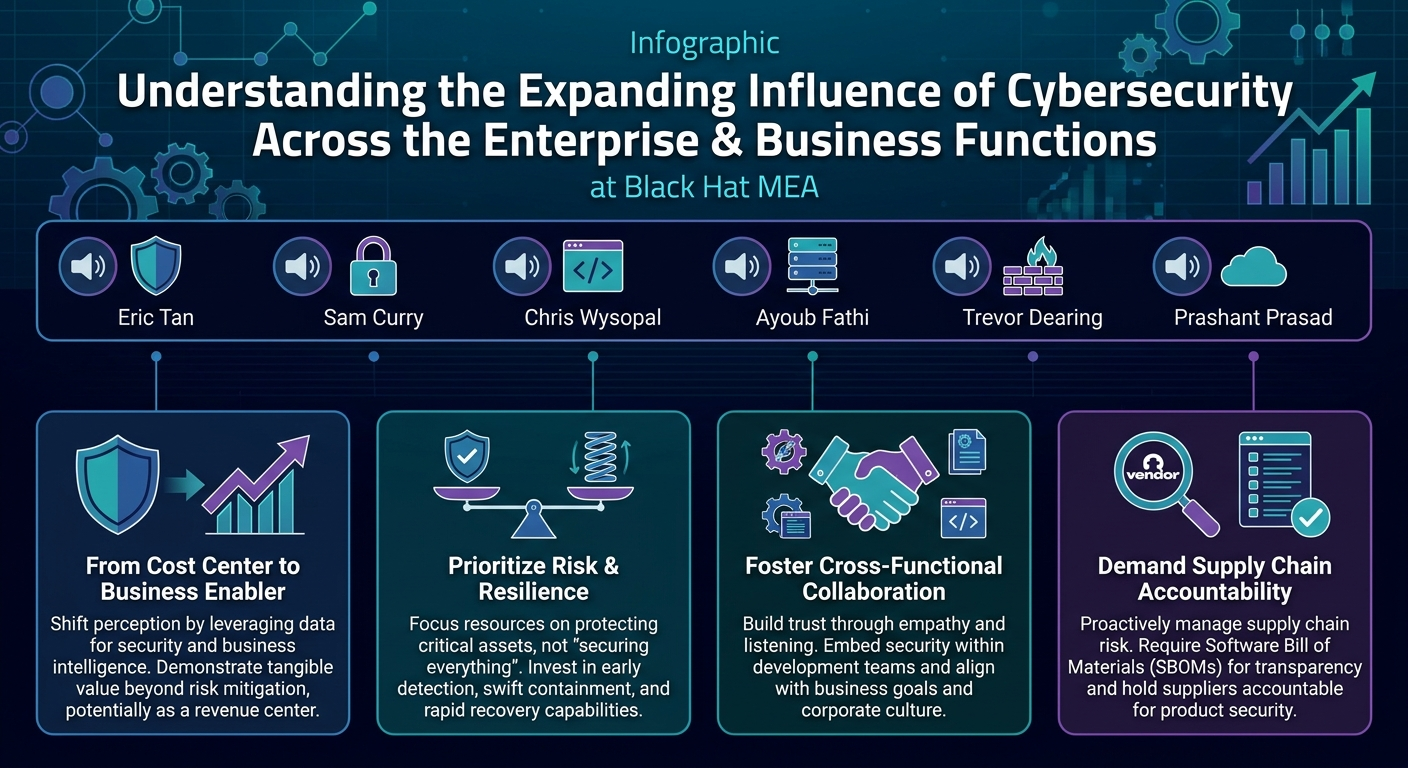
- Cybersecurity as a Business Enabler, Not Just a Cost Center: A recurring theme was the need to reframe cybersecurity's value proposition. Prashant Prasad advocated for viewing security as a revenue center by leveraging data collection for both security and business intelligence, potentially enabling charge-back models to other departments. This strategic shift moves away from justifying security spend solely on risk mitigation to demonstrating tangible business value.
- Collaboration and Trust are Paramount: Sam Curry stressed that effective collaboration hinges on trust, earned through listening, humility, and demonstrating care for other departments' goals. He highlighted the importance of understanding the business's ultimate outcomes and corporate culture to influence decision-making. Ayoub Fathi echoed this, emphasizing identifying "natural allies" (risk, legal, IT, technology) and embedding security engineers within development teams to build empathy and identify practical challenges.
- Focus on Risk and Resilience, Not "Securing Everything": Sam Curry provocatively stated, "you don't secure everything." Instead, the focus should be on protecting "what matters" and building resilience. This involves understanding risk scenarios, prioritizing based on a risk registry, and optimizing for rapid detection and recovery (reducing time to patch, time to recovery) rather than attempting perfect prevention. Trevor Dearing reinforced this, noting that many organizations lack proper recovery plans, highlighting the need to plan for "what happens next" after an attack.
- Strategic Resource Allocation and Vendor Accountability: With limited budgets, panelists offered practical advice. Ayoub Fathi suggested investing in junior talent and comprehensive training programs, coupled with automation and bug bounty programs, as low-cost, high-return strategies. Chris Wysopal recommended vendor consolidation to free up budget and leverage comprehensive solutions. Furthermore, he emphasized the critical need to hold suppliers accountable for the security of their products, citing government initiatives like President Biden's executive order requiring Software Bill of Materials (SBOMs).
- The Promise of AI for Defenders: Several panelists expressed optimism about the role of Artificial Intelligence (AI). Chris Wysopal predicted AI would help defenders more than attackers due to resource constraints on the defensive side. Ayoub Fathi envisioned AI/ML technologies emerging to learn attack traffic and enable auto-defense. This suggests a future where AI could significantly augment human security capabilities, accelerating detection and response.
Technical Deep Dive
▶ Watch: Budgeting: Build alliances with CFOs, make trade-offs (32:30)
While the talk was a panel discussion rather than a deep technical presentation, several technical concepts and approaches were highlighted as crucial for modern enterprise security.
Microsegmentation for Cyber Resilience: Trevor Dearing introduced Illumio's approach to cyber resilience, which focuses on containing ransomware attacks to prevent them from spreading to critical parts of the organization. This is achieved primarily through microsegmentation, a security technique that divides data centers and cloud environments into small, isolated segments. By applying granular controls, microsegmentation restricts lateral movement, significantly limiting the blast radius of a breach and protecting high-value assets. This strategy shifts the focus from perimeter defense to internal containment, acknowledging that breaches are inevitable.
Visibility and Data-Driven Security: Prashant Prasad underscored that visibility is the key to effective security. Organizations often operate in silos, preventing a unified view of their security posture. He argued that traditional, proprietary point solutions fail to provide the agility and flexibility needed. Instead, he advocated for a comprehensive technology stack that enables robust behavior analytics. This requires sufficient historical data, challenging the common practice of retaining data for only 30 or 90 days. Without long-term data, meaningful behavioral baselines and anomaly detection are severely hampered.
AI in Defense and its Measurement: The potential of AI was discussed from multiple angles. Ayoub Fathi envisioned AI and Machine Learning (ML) learning attack traffic patterns for auto-defense. Chris Wysopal believed AI would empower defenders, helping overcome resource constraints. However, Prashant Prasad raised a critical point about the evaluation of AI models: accuracy alone (e.g., 97%) does not define how good a model is. This implies a need for deeper understanding of metrics like precision, recall, and robustness, especially in adversarial contexts where attackers might try to evade AI detection. Building and testing AI models effectively requires specialized skills, such as those of data scientists and engineers, which many organizations currently lack.
Supply Chain Security and SBOMs: Chris Wysopal highlighted the critical vulnerability introduced by the supply chain. He noted that for years, organizations failed to demand sufficient security from their suppliers, leading to a constant influx of exploitable software. This is changing with initiatives like President Biden's executive order, which mandates that vendors attest to their security practices and provide Software Bill of Materials (SBOMs). An SBOM is a formal, machine-readable list of ingredients that make up software components, allowing organizations to understand the open-source and third-party components within their purchased software and assess associated risks. This represents a significant shift towards greater transparency and accountability in the software ecosystem.
Strategic Frameworks and Centralization: Trevor Dearing emphasized the move from reactive security (threat-product cycle) to proactive, strategic approaches. He mentioned the growing influence of regulators pushing for frameworks like Zero Trust and NIST CSF (Cybersecurity Framework). Zero Trust operates on the principle of "never trust, always verify," requiring strict identity verification for every user and device attempting to access resources, regardless of their location. NIST CSF provides a flexible framework for managing cybersecurity risk. Prashant Prasad's prediction of centralization further supports this, advocating for a unified approach to tools, technologies, and people to achieve a complete cybersecurity vision, bridging the gap between isolated departments.
Demo / Proof of Concept
▶ Watch: Prashant: Security as a revenue center, not cost (35:30)
This session was a panel discussion focused on strategic insights and industry trends. As such, there was no live demonstration or technical proof of concept presented by any of the speakers. The format was entirely conversational, drawing on the panelists' extensive experience and expertise.
Defensive Implications
▶ Watch: Sam Curry's 2024 prediction: AI and SECOps revolution (42:00)
The insights from this panel offer a robust roadmap for cybersecurity defenders to navigate the complexities of the modern threat landscape and elevate their function within the enterprise.
- Prioritize and Manage Risk Strategically: Defenders must abandon the futile goal of "securing everything." Instead, adopt a risk-based approach by developing and maintaining a clear risk registry. Engage with business leaders to identify critical assets and define acceptable risk tolerances. Focus resources on protecting what truly matters and build resilience measures for scenarios that cannot be fully prevented. This involves understanding the business impact of various attack types, as exemplified by Josh Corman's work on healthcare and the four-minute diversion threshold.
- Foster Cross-Functional Collaboration and Build Trust: Security teams must actively seek out "natural allies" across the organization, including legal, risk, IT, and especially software development. Implement strategies like embedding security engineers within development teams to build empathy and understand day-to-day challenges. Sam Curry's emphasis on listening, humility, and demonstrating care for others' goals is crucial for earning trust and moving beyond the "department of no" perception. Regular, informal interactions and understanding corporate culture are vital for effective influence.
- Embrace Resilience, Detection, and Rapid Recovery: Shift the focus from absolute prevention to cyber resilience. This means investing heavily in capabilities for early detection of attacks and swift containment to prevent widespread propagation. Critical metrics should include reducing the time to detection, time to patch, and time to recovery. Organizations must have well-defined and regularly practiced incident response and disaster recovery plans that extend beyond technical solutions to include business continuity and operational recovery, as highlighted by Trevor Dearing regarding critical infrastructure.
- Leverage Data for Dual Business and Security Value: Explore opportunities to transform cybersecurity from a cost center into a revenue center. This can be achieved by consolidating data collection infrastructure that serves both security analytics and broader business intelligence needs. By demonstrating how security investments contribute to overall business insights and operational efficiency, defenders can justify budgets more effectively and even explore charge-back models to other departments, as proposed by Prashant Prasad.
- Demand Accountability from the Supply Chain: Proactively manage supply chain risk by scrutinizing vendors and demanding higher security standards. This includes requiring Software Bill of Materials (SBOMs) to understand the components within third-party software and assessing their vulnerabilities. Defenders should integrate security requirements into procurement processes and actively hold suppliers accountable for the security posture of the products and services they provide.
- Invest in Talent and Automation: With limited budgets, consider hiring and training junior talent to build internal expertise and scale the security team over time. Complement this with extensive automation of repetitive tasks to free up senior engineers for more strategic work. Implementing bug bounty programs can also be a cost-effective way to crowdsource vulnerability identification and leverage external expertise.
- Adopt Strategic Frameworks and Centralization: Move away from a reactive, point-solution approach to a proactive, strategic one. Implement recognized frameworks like Zero Trust and NIST CSF to guide security architecture and operations. Strive for centralization of security tools, technologies, and processes to break down silos and create a unified, agile defense posture, as advocated by Prashant Prasad.
- Explore AI for Defensive Augmentation: Begin exploring and investing in AI and Machine Learning (ML) capabilities to augment defensive operations. This includes leveraging AI for accelerated threat detection, anomaly identification, and potentially auto-defense mechanisms. However, it's crucial to understand how to effectively test and evaluate AI models beyond simple accuracy percentages to ensure their real-world efficacy and avoid false confidence.
Key Takeaways
- Cybersecurity is a Business Enabler: Shift the perception of cybersecurity from a cost center to a strategic business function that drives resilience and can even generate revenue through data leverage.
- Prioritize Risk and Resilience: Don't try to secure everything; focus on protecting critical assets and building robust detection, containment, and recovery capabilities.
- Collaboration is Key to Scaling Security: Foster trust and empathy across departments by actively listening, understanding business goals, and embedding security expertise.
- Demand Supply Chain Accountability: Hold vendors responsible for the security of their products, leveraging tools like SBOMs and integrating security into procurement.
- Strategic Budgeting and Talent Development: Optimize resources through vendor consolidation, investing in junior talent, automation, and cost-effective initiatives like bug bounty programs.
- Embrace AI for Defensive Advantage: Explore how AI and ML can augment human defenders, accelerate threat detection, and enable auto-defense, while also understanding how to properly evaluate these technologies.
About the Speaker(s)
- Eric Tan: Serving as CIO & Chief Security Officer at Flock Safety, Eric moderated the panel, guiding the discussion on the expanding influence of cybersecurity.
- Sam Curry: CISO at Zscaler, Sam brings a background in documentation, QA, and engineering, having stumbled into cybersecurity and found a passion for protecting consumers. His career spans RSA, CA, and McAfee. He emphasizes trust, humility, and understanding corporate culture for effective security leadership.
- Chris Wysopal: Founder & CTO of Veracode, Chris is a renowned figure in cybersecurity, having started as a white hat hacker in the 90s. He played a significant role in legitimizing the adversarial mindset within professional security and has testified before the Senate. He advises founders to identify gaps in securing emerging technologies.
- Ayoub Fathi: VP of Information Security & CISO at Noon, the largest technology e-commerce company in the region. Ayoub has a strong background in bug bounty hunting, having submitted hundreds of vulnerabilities to Fortune 500 companies, including Meta. He previously ran a security consultancy firm.
- Trevor Dearing: Representing Illumio, Trevor has a long career in networking and security, working for organizations like Nortel, Juniper, and Palo Alto Networks. His company focuses on cyber resilience through microsegmentation to contain ransomware attacks.
- Prashant Prasad: Director of Technology at Spire Solutions, Prashant started his career in computer assembling and gaming before spending 13 years at Dell. He transitioned from infrastructure to cybersecurity five years ago, focusing on customer needs and strategic technology adoption.
Reviews
Dr. Zero (Offensive Security Researcher) — HARD PASS
Six vendor executives and CISOs walked onto a stage to play buzzword bingo, and the audience lost. This panel regurgitates a decade of LinkedIn posts about escaping the 'department of no' without offering a single concrete metric or novel strategy. Skip this entirely unless you need white noise while writing YARA rules.
Heather Calloway (CISO) — WEAK
This is a panel of vendors and practitioners reciting ten-year-old truisms about business alignment. Your leadership team does not need another lecture on why security shouldn't be the 'department of no'—they expect you to already operate that way. Skip it.
→ Top-rated talks at Black Hat Middle East & Africa 2023 (Executive Summit)
All talks from Black Hat Middle East & Africa 2023 (Executive Summit)