Combating Lookalike Attacks
Peter Gibbs (Security Business Leader EMEA · Infoblox)
Black Hat Middle East & Africa 2023 (Executive Summit) · Day 2 · Executive Summit
Overview
In an era where digital identity is paramount and cyber threats are increasingly sophisticated, Peter Gibbs, Security Business Leader EMEA at Infoblox, delivered a compelling talk at Black Hat MEA on "Combating Lookalike Attacks." This presentation delves into the escalating threat of lookalike domains – malicious domains designed to mimic legitimate ones – and outlines a comprehensive strategy for their detection and mitigation. Gibbs introduces the critical concept of identifying the "intent to compromise," arguing that proactive monitoring of DNS (Domain Name System) activity can provide early warning signals, akin to a "pre-crime" detection system for cyberattacks.
Key moments
- 0:50 Rising threat of lookalike domains and 'intent to compromise'
- 4:00 Key statistics on malicious domains and DNS attacks
- 5:30 Recognizing DNS as a powerful security control
- 7:50 Explaining homographs, typosquats, and other attack types
- 11:00 Infoblox tools for proactive lookalike domain detection
- 14:00 Guaranteed domain mitigation and takedown services
- 16:20 CISA-recommended rapid domain takedown process
Combating Lookalike Attacks
Speakers: Peter Gibbs, Security Business Leader EMEA, Infoblox
Conference: Black Hat MEA
YouTube: https://www.youtube.com/watch?v=c9ZBsnS6MyU
Overview
In an era where digital identity is paramount and cyber threats are increasingly sophisticated, Peter Gibbs, Security Business Leader EMEA at Infoblox, delivered a compelling talk at Black Hat MEA on "Combating Lookalike Attacks." This presentation delves into the escalating threat of lookalike domains – malicious domains designed to mimic legitimate ones – and outlines a comprehensive strategy for their detection and mitigation. Gibbs introduces the critical concept of identifying the "intent to compromise," arguing that proactive monitoring of DNS (Domain Name System) activity can provide early warning signals, akin to a "pre-crime" detection system for cyberattacks.
The talk highlights the alarming rise in these attacks, with some organizations reporting a 30-40% increase within a single year. These lookalike domains serve as the initial vector for a wide array of subsequent threats, from credential theft and ransomware to brand impersonation and supply chain compromise. Gibbs emphasizes that traditional security approaches often fall short, underscoring the necessity of leveraging specialized DNS threat intelligence to turn the tables on adversaries. Infoblox, with its deep expertise in DNS, positions itself at the forefront of this battle, offering both advanced detection capabilities and robust domain mitigation services to protect organizations from the multifaceted dangers posed by lookalike threats.
Background
▶ Watch: Rising threat of lookalike domains and 'intent to compromise' (0:50)
The foundational infrastructure of the internet, the Domain Name System (DNS), has reached its 40th anniversary this month. Conceived in 1983 by Paul Mockapetris with the benign intent of making internet navigation user-friendly, DNS has evolved significantly. While initially a utility, its ubiquitous nature and critical role in nearly all internet communications have made it a prime target and vector for malicious activities. Peter Gibbs posits that DNS is now undergoing a critical transformation, being recognized not just as an operational necessity but as a potent security control.
The scale of the problem is staggering. With over 61 billion internet-connected devices in 2023 and an estimated 200,000 to 400,000 new domains registered daily, the digital landscape is expanding at an exponential rate. Alarmingly, Infoblox's threat intelligence indicates that approximately 85% of newly registered domains are malicious. Furthermore, a 2020 observation by an NSA official, Anne Neuberger, highlighted that 92% of malware and command-and-control (C2) operations depend on DNS, explicitly calling out DNS as an area that must be protected. This underscores why DNS has become a cornerstone for attackers, who exploit its fundamental role to launch campaigns like ransomware, which targeted 76% of organizations in 2022.
Prominent examples illustrate the pervasive nature of these attacks. The "Fano" campaign, identified by Sicks, saw Chinese hackers deploy 42,000 imposter domains to target 400 companies, including major brands in the US and EMEA, with this sophisticated operation gestating from 2017 to 2019 before becoming widely visible. More recently, in 2022, Microsoft warned that over 10,000 organizations were targeted by "adversary-in-the-middle" attacks designed to steal multi-factor authentication (MFA) credentials in real-time. These incidents highlight the extensive effort and resources attackers dedicate to lookalike domains, making robust DNS-centric defenses indispensable for modern cybersecurity.
Key Findings
▶ Watch: Recognizing DNS as a powerful security control (5:30)
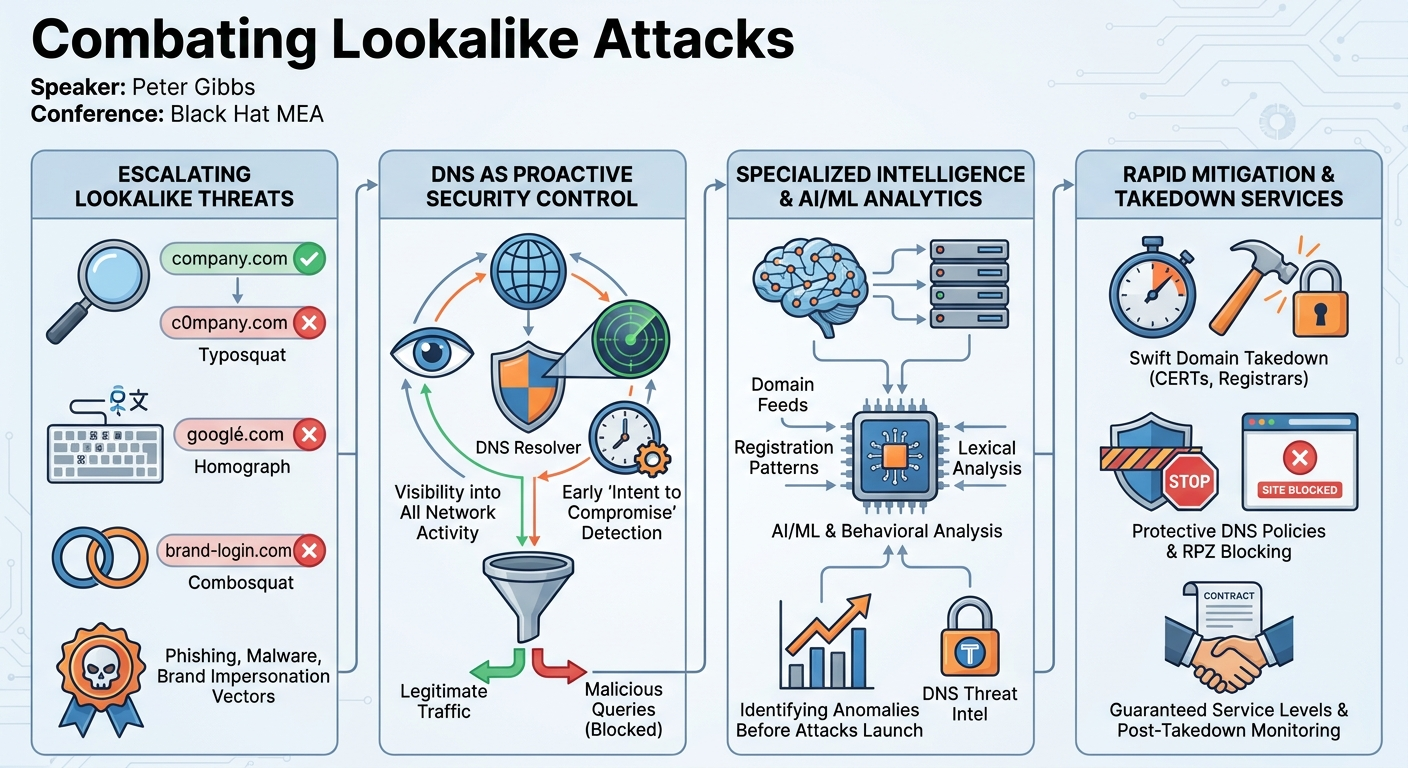
The core revelation presented by Peter Gibbs is the critical, yet often underutilized, role of DNS as a primary security control. Unlike other security layers that might offer partial visibility, DNS observes all user and device activity, providing a holistic view of network interactions and making it the closest point to network assets for threat detection and blocking. This unique positioning transforms DNS from a mere networking service into a powerful defensive tool, capable of turning the tables on attackers.
Infoblox's reorganized threat intelligence group, led by an ex-NSA expert, has shifted its focus to purely DNS-centric threat intelligence. Their findings are stark:
- Over 1,600 domains were identified containing a combination of corporate and MFA lookalike features, specifically designed for credential harvesting.
- In under a year, Infoblox's threat intelligence group detected over 300,000 lookalike domains targeting various entities.
- The group processes over 70 billion DNS queries daily, providing an unparalleled dataset for identifying malicious patterns and anomalies.
These statistics underscore the immense scale of the lookalike domain problem and the necessity of a specialized approach. The concept of Protective DNS emerges as a key finding, advocating for a DNS server augmented with robust DNS threat intelligence, a flexible policy engine for enforcement, and advanced analytics powered by AI and machine learning. This integrated approach allows organizations to proactively detect and mitigate threats at the earliest possible stage, moving beyond reactive responses to a state of "intent to compromise" prediction. By effectively leveraging DNS, organizations can significantly enhance their overall security posture and make their existing security stack more effective.
Technical Deep Dive
▶ Watch: Explaining homographs, typosquats, and other attack types (7:50)
Lookalike attacks exploit human fallibility and the visual similarities of domain names, manifesting in several distinct technical forms:
- Homographs: These domains use visually similar characters, often from different character sets (e.g., Cyrillic, Greek, or Latin extended characters) that render identically or near-identically to legitimate ASCII characters. For instance, the talk cited a
keypasslookalike domain registered using homographs. This domain was registered on October 15th, identified in Infoblox's newly observed domain feed by the 16th, flagged as suspicious, and by the 18th, was publicly recognized as distributing fake .bat malware. The speed of detection is critical here, as malicious homographs can quickly lead to malware distribution.
- Typosquats: These exploit common typing errors, where a legitimate domain is slightly misspelled. A vivid example shared was the inadvertent routing of US military emails to the country of Mali for a decade, due to recipients mistakenly typing
.mlinstead of.mil. Such subtle errors can lead to massive data leaks or misdirection of critical communications.
- Combosquats: A hybrid approach combining elements of homographs and typosquats, often adding brand names or keywords to existing legitimate domains. An example given was
google.co, where the two 'o's were rendered in Cyrillic characters, making it appear identical to the legitimate Google domain to an unsuspecting user.
- Sound Squats: While less common, these domains are chosen because they sound similar to legitimate ones, leading to confusion, especially in verbal communication or when users attempt to type a domain they've heard.
Attackers distribute these lookalike domains through various channels, including SMS phishing (smishing), phone calls (vishing), direct messages, emails, and QR codes (which saw a resurgence during COVID-19).
Infoblox's technical solution for combating these threats is multi-layered and DNS-centric:
- Custom Watch for Lookalike Domains: Organizations can input their own legitimate domains into Infoblox's Dossier tool. The system then continuously monitors for new domain registrations that bear visual or lexical similarity to these protected domains.
- Suspicious Domains Feed: This is a relatively new and highly efficacious feed, born from Infoblox's re-organization of its threat intelligence. It leverages over 20 new algorithms developed within a year to identify domains exhibiting suspicious characteristics indicative of malicious intent, even before they are actively used in an attack.
- Multiple Algorithm Approach: Infoblox employs a diverse set of algorithms, often leveraging AI and machine learning, to analyze various attributes of newly registered or active domains. This includes lexical analysis, character set analysis, domain age, registration patterns, and historical reputation to determine if "something doesn't look right."
- RPZ (Response Policy Zone) Solutions: For early detection and response, Infoblox offers RPZ capabilities. RPZ allows DNS resolvers to return custom responses (e.g., block, redirect) for specific domain names, effectively preventing users from accessing known or suspected malicious lookalike domains.
- Comprehensive UI for Alerts: A user interface (UI) summarizes detected lookalikes and alerts customers, providing actionable intelligence. This allows security teams to visualize the scope of potential attacks, whether they are popular phishing campaigns targeting general users or spear phishing attempts against specific employees (e.g.,
infobenefits.commimicking a company's benefits portal). The UI also highlights the critical impact on brand reputation, an often-overlooked consequence of successful lookalike attacks.
By integrating these capabilities, Infoblox aims to provide organizations with the means to detect the "intent to compromise" long before an actual breach occurs, leveraging the inherent visibility and control offered by DNS.
Demo / Proof of Concept
▶ Watch: Guaranteed domain mitigation and takedown services (14:00)
While Peter Gibbs's presentation did not include a live, step-by-step demonstration, he vividly described and illustrated the capabilities of Infoblox's platform through screenshots and use cases, effectively serving as a conceptual demonstration of its functionality. The core of this "demo" revolved around the Dossier tool and its associated portal.
Gibbs showcased a scenario where an organization might input a domain they wish to protect, such as gmao. The Infoblox system would then proactively identify potential lookalikes, such as Gmail login reset.com, flagging it as a phishing attack. The portal allows users to "drill in even further" to gather extensive intelligence about these detected threats. This includes:
- Timeline: When the suspicious domain was set up or registered.
- Registration Details: Who registered it (registrant information), where it was registered (registrar's name), and its associated IP addresses.
- Threat Intelligence: The specific type of threat identified (e.g., phishing, malware distribution) and links to external threat intelligence sources like Malwarebytes, as demonstrated with the
keypasshomograph example.
This functionality effectively transforms security teams into threat hunters within the DNS space. By providing granular details and a clear timeline, the tool empowers analysts to understand the nature and origin of the threat, enabling informed decisions for mitigation. The ability to customize watched domains ensures that the detection capabilities are directly aligned with an organization's specific brand and digital assets, providing highly relevant and actionable intelligence against lookalike attacks.
Defensive Implications
▶ Watch: CISA-recommended rapid domain takedown process (16:20)
The insights shared by Peter Gibbs provide a clear roadmap for defenders to counter lookalike attacks, emphasizing both proactive detection and swift, decisive mitigation.
Proactive Detection and Prevention:
- Embrace Protective DNS: Organizations must recognize DNS as a critical security control. Implementing a protective DNS solution, such as Infoblox's, that integrates advanced threat intelligence, policy enforcement, and AI/ML analytics is paramount. This enables the filtering of malicious DNS queries before they reach end-users, effectively blocking access to lookalike domains at the network's edge.
- Leverage Specialized DNS Threat Intelligence: Generic threat intelligence often lacks the depth and focus required for DNS-specific threats. Defenders should utilize threat intelligence feeds that are purpose-built for DNS, capable of identifying subtle anomalies, homographs, typosquats, and other lookalike variations. Infoblox's feeds, including their "suspicious domains" feed and custom domain watching, are designed precisely for this.
- Implement Granular Policies: A robust policy engine is essential to enforce security rules based on threat intelligence. This allows organizations to define how different categories of lookalike domains (e.g., popular phishing, spear phishing) are handled, ensuring that policies align with risk tolerance and operational needs.
- Proactive Monitoring and Threat Hunting: Security teams should actively monitor for newly observed domains that mimic their brand, employees, or supply chain partners. Tools like Infoblox's Dossier enable "threat hunting" within the DNS environment, allowing defenders to identify potential "intent to compromise" early, before attacks materialize.
- Educate Users: While technology provides a strong defense, user awareness remains crucial. Employees, customers, and suppliers should be educated about the dangers of lookalike domains, phishing, and the importance of verifying URLs, especially when prompted for credentials or sensitive information.
Reactive Mitigation and Takedown Services:
Even with the best proactive measures, some lookalike domains may slip through or be identified after deployment. For these instances, a rapid and effective domain mitigation strategy is vital. Infoblox offers domain mitigation services designed to quickly take down malicious lookalike domains:
- Streamlined Takedown Process: Organizations submit identified malicious domains and supporting evidence. Infoblox then validates the threat.
- Expert Liaison and Reputation: Infoblox leverages its long-standing relationships and strong reputation with over 15,000 organizations, including domain registrars, CERTs (Computer Emergency Response Teams), and ISPs (Internet Service Providers). This extensive "rolodex" allows for a multi-pronged approach to expedite takedowns.
- Guaranteed SLAs: Infoblox commits to aggressive Service Level Agreements (SLAs). They guarantee contact within 15 minutes during normal working hours. Takedowns are typically achieved within 24 hours for US-registered domains and within 72 hours for international domains, acknowledging the challenges of reaching various global entities. Notably, Infoblox reported test cases where takedowns were completed within 90 minutes.
- Post-Takedown Monitoring: After a domain is taken down, Infoblox continues to monitor it for 30 days. If attackers attempt to reactivate the domain, Infoblox will initiate a free re-takedown.
- Service Guarantee: Infoblox guarantees its mitigation service; if SLAs are not met, credits are returned, but the pursuit of the malicious domain continues until it is removed.
- Trusted Authority: Infoblox is one of only three organizations recommended by CISA (Cybersecurity and Infrastructure Security Agency) for US federal government domain takedowns, underscoring their credibility and effectiveness in this specialized field.
By integrating these proactive detection capabilities with a robust and guaranteed reactive mitigation service, organizations can establish a formidable defense against the ever-present threat of lookalike attacks, protecting their brand, data, and users from compromise.
Key Takeaways
- DNS is a Critical Security Control: Beyond its role as a networking utility, DNS provides ubiquitous visibility into all network activity, making it an indispensable platform for early threat detection and mitigation.
- Lookalike Attacks are Escalating: The proliferation of homographs, typosquats, combosquats, and sound squats is a growing threat, with some organizations reporting a 30-40% increase in attacks and Infoblox detecting over 300,000 lookalike domains in under a year.
- "Intent to Compromise" is Detectable: By leveraging specialized DNS threat intelligence, AI/ML-driven analytics, and proactive monitoring tools, organizations can identify malicious domain registrations and activities before they lead to successful attacks.
- Proactive Detection is Key: Solutions like Infoblox's Dossier tool and suspicious domain feeds empower organizations to custom-watch their domains, detect lookalikes early, and enforce policies via Protective DNS and RPZ.
- Rapid Domain Mitigation is Essential: When malicious lookalike domains are identified, swift takedown services are crucial. Specialized providers with established relationships with registrars and ISPs can significantly reduce the time a malicious domain remains active, minimizing potential damage.
- Brand Reputation is at Stake: Lookalike attacks not only lead to data breaches and financial fraud but also severely damage brand trust and reputation, necessitating comprehensive defensive strategies that cover both technical and reputational aspects.
About the Speaker(s)
Peter Gibbs is a Security Business Leader for EMEA at Infoblox. In this role, he focuses on guiding organizations through the complexities of modern cybersecurity, particularly in the realm of DNS-based threats. His expertise centers on leveraging Infoblox's advanced threat intelligence and security solutions to combat sophisticated attacks like lookalike domains, helping businesses protect their digital assets and maintain their brand integrity. His insights are informed by Infoblox's extensive work in DNS threat intelligence, including the processing of billions of daily DNS queries and the development of cutting-edge algorithms for threat detection.
Reviews
Dr. Zero (Offensive Security Researcher) — HARD PASS
This isn't a security briefing, it's a 40-minute commercial for Infoblox's Dossier tool and takedown services. Explaining homoglyphs and typosquatting to a Black Hat audience in 2024 is insulting enough, but wrapping it in 'AI-powered pre-crime' marketing speak is where I draw the line.
Heather Calloway (CISO) — PASS
This isn't a security briefing; it's an Infoblox product pitch. While DNS-based threat intelligence and automated domain takedowns are necessary components of a mature security program, this session offers no new strategic or operational insights outside of an extended commercial for their Dossier tool and takedown SLAs.
→ Top-rated talks at Black Hat Middle East & Africa 2023 (Executive Summit)
All talks from Black Hat Middle East & Africa 2023 (Executive Summit)