Everyone Has a Plan Until They Get Punched: Digital Warfare and Information Operations
Col. Gerard M. Acosta (US Defense Logistics Agency)
Black Hat Middle East & Africa 2023 (Executive Summit) · Day 2 · Executive Summit
Overview
In an era defined by escalating cyber threats and geopolitical tensions, Colonel Gerard M. Acosta, formerly the Chief Operations Officer at the US Defense Logistics Agency Central Command and Special Operations Command, delivered a compelling address at Black Hat MEA. Titled "Everyone Has a Plan Until They Get Punched: Digital Warfare and Information Operations," the talk, co-presented with a representative from Cyletics (referred to as "S"), underscored a critical paradigm shift in national security and enterprise defense: the urgent need to move from reactive incident response to proactive predictive intelligence in the digital domain. Colonel Acosta, a PhD in economics and logistics management, emphasized that success in modern warfare and business hinges on understanding and controlling the digital environment, a concept he termed "digital domain awareness."
Key moments
- 2:00 Digital domain awareness: the new battleground
- 4:10 MoveIT breach: demonstrating predictive intelligence
- 7:55 CHIPS Act: the future of Silicon dollar
- 12:05 Reactive vs. proactive: Mike Tyson's punch
- 14:15 Building proactive technology: understanding attacker patterns
- 18:10 Case study: detecting cyber criminal infrastructure months ahead
- 22:00 Empowering Cyber Warriors with LLMs
Everyone Has a Plan Until They Get Punched: Digital Warfare and Information Operations
Speakers: Col. Gerard M. Acosta, Chief Operations Officer (Ret.), US Defense Logistics Agency
Conference: Black Hat MEA
YouTube: https://www.youtube.com/watch?v=Vi_-vLvazR4
Overview
In an era defined by escalating cyber threats and geopolitical tensions, Colonel Gerard M. Acosta, formerly the Chief Operations Officer at the US Defense Logistics Agency Central Command and Special Operations Command, delivered a compelling address at Black Hat MEA. Titled "Everyone Has a Plan Until They Get Punched: Digital Warfare and Information Operations," the talk, co-presented with a representative from Cyletics (referred to as "S"), underscored a critical paradigm shift in national security and enterprise defense: the urgent need to move from reactive incident response to proactive predictive intelligence in the digital domain. Colonel Acosta, a PhD in economics and logistics management, emphasized that success in modern warfare and business hinges on understanding and controlling the digital environment, a concept he termed "digital domain awareness."
The presentation highlighted that traditional security postures, which react to attacks after they occur, are no longer sufficient. Instead, organizations and nations must cultivate the capability to anticipate threats, identify malicious infrastructure before it is leveraged, and make informed decisions in real-time. This proactive stance, demonstrated through real-world examples like the MoveIT breach and SolarWinds attack, is presented not merely as an aspiration but as an achievable state through advanced data analytics and sophisticated threat intelligence platforms. The talk posits that mastering this predictive capability is paramount for safeguarding critical infrastructure, economic stability, and national security in an increasingly interconnected and vulnerable world.
The significance of this discussion extends beyond military applications, directly impacting every enterprise grappling with persistent cyber threats. Colonel Acosta and his co-presenter argued that the future belongs to those who can predict and preempt digital attacks, transforming the cybersecurity landscape from a perpetual game of catch-up to one of strategic advantage. This article delves into the core tenets of their argument, exploring the technical underpinnings, real-world implications, and essential takeaways for defenders.
Background
▶ Watch: Digital domain awareness: the new battleground (2:00)
The landscape of modern conflict and commerce has undergone a profound transformation, shifting from traditional physical battlegrounds to the pervasive and often invisible digital domain. Colonel Acosta articulated this evolution by contrasting the old adage "intelligence drives operations" with the contemporary reality where "the digital environment... the digital warrior that sets the conditions for success." This fundamental change necessitates a re-evaluation of how security is conceived and implemented, both at a national and corporate level.
The concept of "digital domain awareness" is central to this new paradigm. It's defined as the ability to synthesize data analytics, business analytics, and intelligence factors into a real-time dashboard, enabling leaders to make expedited, predictive decisions. This stands in stark contrast to the historically reactive approach, where security teams respond to breaches only after damage has been inflicted. The talk referenced Mike Tyson's famous quote, "Everybody has a plan until you get punched in the face," to vividly illustrate the inadequacy of a purely reactive defense strategy. While reacting to events is a necessary component of any security protocol, the true "art of the justice" lies in predicting the next threat with a high degree of accuracy, thereby enabling proactive blocking and prevention.
Several high-profile cyber incidents served as stark reminders of the vulnerabilities inherent in a reactive security posture. The MoveIT breach, for instance, impacted over 2,400 organizations and exposed an estimated 73 million records from entities like Shell, British Airways, PWC, and Johns Hopkins University. Similarly, the SolarWinds supply chain attack and the Colonial Pipeline ransomware attack underscored the profound impact of cyber warfare on critical national infrastructure, from information systems to energy distribution. The Log4J vulnerability further exemplified the widespread and systemic risks posed by pervasive software flaws. These incidents collectively highlighted that the economic and operational consequences of successful attacks are not merely inconvenient but can be catastrophic, necessitating a more advanced, predictive defense.
Adding another layer of strategic importance, the speakers discussed the CHIPS and Science Act of 2022. This legislative initiative, signed by President Joe Biden, allocates $280 billion to boost domestic research and manufacturing of semiconductors in the United States. Colonel Acosta explained that while the US leads in technology development, the actual production of critical silicon carbide and silicon nitride often occurs overseas due to environmental regulations and global supply chain dynamics. The CHIPS Act aims to reverse this, fostering domestic production to secure a strategic advantage in what he called the "Silicon dollar" era. This economic and geopolitical context directly ties into cybersecurity, as the critical infrastructure supporting semiconductor production and distribution will become prime targets for information operations and digital warfare, further cementing the need for robust, predictive cyber defenses.
Key Findings
▶ Watch: CHIPS Act: the future of Silicon dollar (7:55)
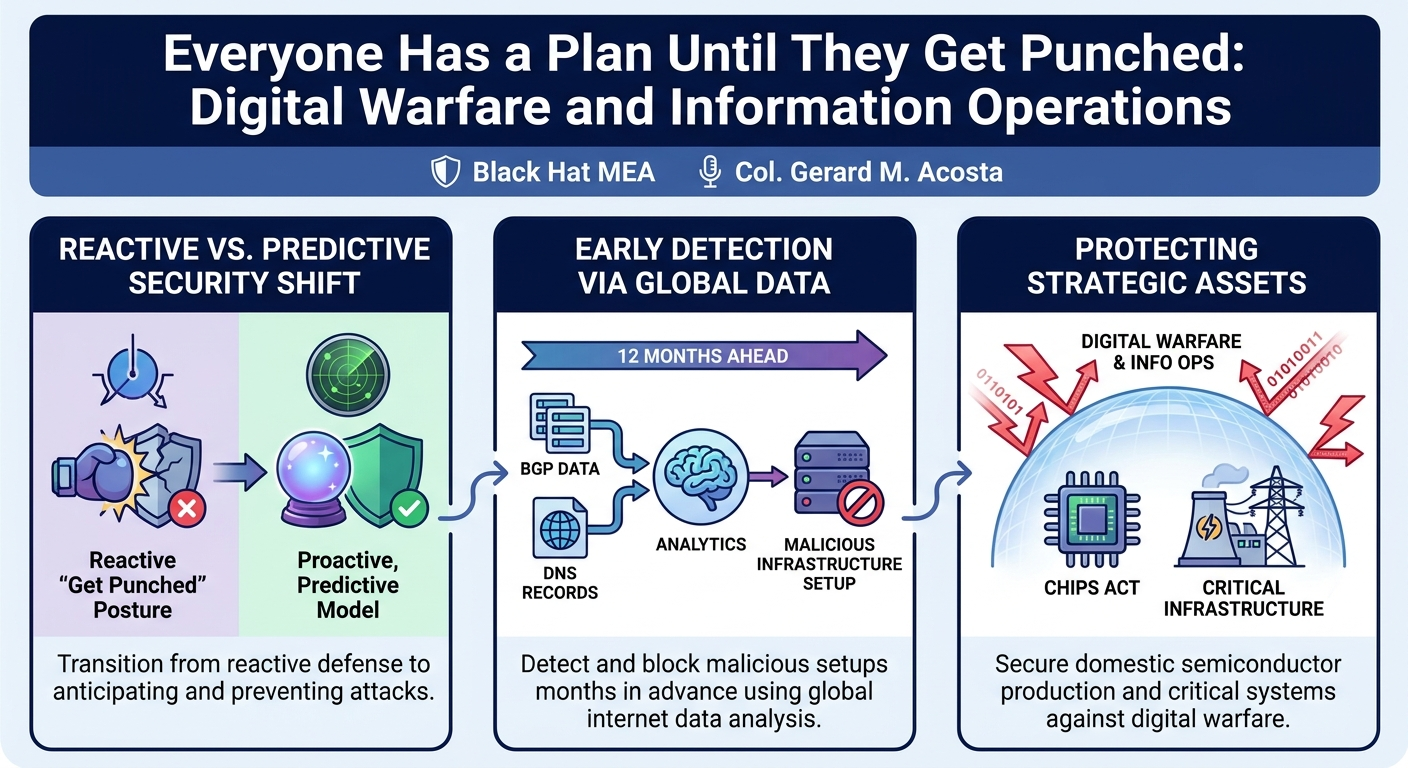
The central and most impactful finding presented in the talk is the demonstrably achievable capability of shifting from reactive cybersecurity to proactive, predictive threat intelligence. The speakers asserted that it is possible to anticipate and prevent cyberattacks months in advance by understanding and analyzing the behavioral patterns of cybercriminals and their infrastructure setup.
Specifically, the key findings include:
- Predictive Infrastructure Detection: Cybercriminals, regardless of their sophistication, follow discernible patterns when setting up infrastructure for attacks. This infrastructure can include command-and-control (C2) servers, malware delivery platforms, or ransomware drop points. By detecting these setup patterns, defenders can identify and block access to malicious infrastructure long before an attack is launched.
- Months-Ahead Protection: The technology developed by Cyletics (the company represented by "S") has successfully enabled organizations, including those within the Department of Defense (DoD), to block access to malicious infrastructure up to 12 months in advance of an anticipated attack. This significantly extends the defensive window compared to traditional detection methods.
- Low False Positive Rates: A critical challenge in predictive security is maintaining a low false positive rate to avoid disrupting legitimate operations. The presented methodology claims high confidence in its predictions, ensuring that proactive blocks do not unduly impact business continuity. This is crucial for gaining "freedom of movement" within an organization, allowing for decisive action without fear of widespread unintended consequences.
- Leveraging Diverse Data Sources: The predictive capability relies on ingesting and analyzing vast quantities of external data. The speakers mentioned processing approximately three terabytes of data daily from various sources, including Border Gateway Protocol (BGP) data and DNS data. This aggregation and analysis of non-network-specific intelligence provide a holistic view of emerging threats.
- Threat Actor Attribution: Beyond simply blocking infrastructure, the advanced analysis allows for the attribution of identified infrastructure to specific threat actor groups. This includes nation-state actors and cybercriminal organizations targeting diverse sectors such as financial, healthcare, and government entities, providing invaluable intelligence for strategic defense planning.
- digital domain awareness as a Framework: The DoD's concept of "digital domain awareness" serves as a strategic framework to operationalize these findings. It emphasizes the need to capture threat data, put it into a visual and actionable format, and empower leaders (business, tactical, government) to make critical, real-time decisions, thereby creating a highly efficient and effective organization in the face of digital warfare.
These findings collectively present a compelling case for a fundamental reorientation of cybersecurity strategy, moving from an inherently reactive stance to one that actively predicts and preempts threats, ultimately granting defenders a significant advantage.
Technical Deep Dive
▶ Watch: Reactive vs. proactive: Mike Tyson's punch (12:05)
The technical foundation for achieving predictive cybersecurity, as described in the talk, revolves around sophisticated data collection, analysis, and pattern recognition to identify and attribute malicious infrastructure before it becomes operational. This approach fundamentally shifts the focus from endpoint or network-centric detection to a broader, internet-wide intelligence gathering strategy.
The core methodology can be broken down into several key components:
- Massive Data Ingestion and Aggregation:
- The system processes an immense volume of external data, estimated at three terabytes daily. This data is not sourced from the target organization's internal network but from publicly available or commercially acquired internet intelligence.
- Key data types mentioned include:
- Border Gateway Protocol (BGP) data: BGP is the routing protocol that makes the internet work, exchanging routing information between autonomous systems (AS). Analyzing BGP data can reveal patterns of new network allocations, routing changes, or suspicious peering arrangements that might indicate the setup of new infrastructure, potentially for malicious purposes. Anomalies in BGP announcements can be early indicators of hostile activity.
- DNS (Domain Name System) data: DNS records (A, CNAME, NS, MX, etc.) provide crucial information about domain registrations, IP address mappings, and server configurations. Monitoring newly registered domains, domain squatting, fast flux DNS, or unusual DNS queries can expose nascent attack infrastructure. Correlating DNS data with other intelligence can help identify domains associated with known threat actors or those exhibiting characteristics of future C2 servers.
- Other Data Sources: While not explicitly detailed, the "multiple data sources" likely include passive DNS, WHOIS records, SSL certificate transparency logs, malware sample analysis, dark web monitoring, open-source intelligence (OSINT), and potentially even telemetry from honeypots or reputation feeds. The breadth of data ensures a comprehensive view of the global threat landscape.
- Pattern Recognition and Behavioral Analysis:
- The collected data is subjected to advanced analytics, likely employing machine learning (ML) algorithms and artificial intelligence (AI) to identify subtle patterns in how cybercriminals "move" and establish their operational base.
- The speakers emphasized that cybercriminals, despite their attempts at obfuscation, are "human beings" and exhibit "same sequence of activities" when preparing attacks. These patterns could include:
- Bulk domain registration: Registering many domains simultaneously or in rapid succession.
- Infrastructure provisioning: The rapid spin-up of virtual private servers (VPS) or cloud instances in specific regions or using particular providers, often with generic configurations.
- Network block acquisition: Leasing or acquiring new IP address ranges.
- Specific software/service deployments: The installation of particular web servers, proxies, or C2 frameworks that are commonly used by certain threat groups.
- The goal is to move beyond simple indicator-of-compromise (IOC) matching to indicator-of-behavior (IOB) analysis, predicting future actions based on observed preparatory steps.
- Predictive Modeling and High-Confidence Alerting:
- Based on identified patterns, the system generates predictive intelligence, forecasting that a particular piece of infrastructure is being set up for malicious intent (e.g., malware delivery, C2 communication, ransomware deployment).
- A critical aspect is achieving a low false positive rate. This suggests that the models are highly refined and validated, ensuring that legitimate infrastructure is not mistakenly blocked. The confidence in these predictions is what allows organizations to take proactive measures, such as blocking IP ranges or domains, months in advance.
- Threat Actor Attribution:
- By correlating the identified infrastructure patterns with existing threat intelligence databases, the system can attribute the setup to known threat actor groups. This goes beyond generic alerts, providing context on who might be behind the impending attack, their typical targets, and their modus operandi. This level of attribution is invaluable for strategic defense, allowing defenders to understand the adversary's capabilities and intent.
- Operationalizing "digital domain awareness":
- The technical output – predictive alerts, attribution, and confidence scores – is then translated into actionable intelligence for leaders. This involves creating dashboards and visualizations that make complex data accessible for real-time decision-making.
- The objective is to allow leaders to "make the critical decision at that point in time to put their resources at best use," ensuring "freedom of movement" and "freedom of decision making" within the organization. This means empowering security teams to proactively block threats without waiting for an attack to materialize.
In essence, the technical approach described is a form of adversary behavior analytics on a global scale, using diverse internet data to predict the "punch" before it lands, rather than merely reacting to the impact.
Demo / Proof of Concept
▶ Watch: Case study: detecting cyber criminal infrastructure months ahead (18:10)
While the talk did not feature a live, interactive technical demonstration, it prominently highlighted a case study as its primary proof of concept. The speakers encouraged the audience to scan a QR code on a slide to access this study, emphasizing its significance as a testament to their predictive capabilities.
This case study served to demonstrate to various agencies and entities, including the Department of Defense (DoD), that exploitable patterns exist in cybercriminal behavior, allowing defenders to be "months ahead" of attackers. The core of the demonstration, as explained in the talk, was the ability to:
- Identify Infrastructure Setup: The system successfully detected the initial setup of malicious infrastructure by cybercriminals. This infrastructure was intended for launching future attacks, such as delivering malware, establishing command-and-control (C2) communications, or deploying ransomware.
- Proactive Blocking: Based on these early detections, the system enabled customers to proactively block access to this identified infrastructure. Crucially, this blocking occurred almost 12 months in advance of when the attacks were expected to hit their networks.
- High Confidence, Low False Positives: The success of this pre-emptive blocking was attributed to a "low false positive rate," indicating that the predictive models were highly accurate and did not disrupt legitimate operations.
- Threat Actor Attribution: The analysis within the case study also facilitated the attribution of the identified infrastructure to multiple specific threat actor groups. These groups were noted for frequently targeting the US across various critical sectors, including financial, healthcare, and government.
The case study, therefore, functioned as a retrospective yet powerful demonstration of the predictive intelligence platform's efficacy. It provided concrete evidence that by leveraging diverse data sources (BGP, DNS, and others, totaling approximately three terabytes daily), it is possible to gain a significant temporal advantage over adversaries, moving from a reactive defense to a truly proactive and preventive security posture. This real-world validation underscored the feasibility and strategic importance of their approach to digital warfare.
Defensive Implications
▶ Watch: Empowering Cyber Warriors with LLMs (22:00)
The insights shared in this talk carry profound implications for cybersecurity defenders across all sectors, urging a fundamental re-evaluation of current security strategies. The shift from reactive to predictive defense is not merely an enhancement but an existential imperative in the face of sophisticated and persistent threats.
Here are the key defensive implications:
- Invest in Predictive Intelligence Technologies: Organizations must prioritize investment in technologies capable of gathering, analyzing, and operationalizing external threat intelligence. This includes platforms that leverage BGP, DNS, and other internet-wide data sources to identify nascent malicious infrastructure and behavioral patterns of adversaries. Relying solely on internal network monitoring is no longer sufficient.
- Embrace "digital domain awareness": Adopt the DoD's concept of "digital domain awareness" as a guiding principle. This means building systems that aggregate data analytics, business analytics, and intelligence into actionable dashboards, enabling real-time, predictive decision-making for leaders at all levels. The goal is to create "freedom of movement" for defenders, allowing them to act decisively before an attack materializes.
- Proactive Infrastructure Blocking: Implement mechanisms to proactively block identified malicious infrastructure (IP ranges, domains, C2 servers) based on high-confidence predictive intelligence. This pre-emptive action can disrupt attack campaigns months before they reach an organization's perimeter, significantly reducing the attack surface and potential for compromise.
- Strengthen Critical Infrastructure Protection: Given the discussion around the CHIPS Act and the vulnerabilities highlighted by incidents like the Colonial Pipeline attack, organizations involved in critical infrastructure (energy, manufacturing, financial services, healthcare, defense supply chains) must recognize themselves as prime targets. Their defensive strategies must integrate predictive intelligence to safeguard against both direct attacks and information operations aimed at destabilizing national capabilities.
- Empower and Equip "Digital Warriors": The human element remains crucial. Security teams, or "digital warriors," need to be equipped with the most advanced tools and training to leverage predictive intelligence effectively. This includes providing them with the analytical capabilities to interpret complex data and the authority to implement proactive defenses. The talk even touched upon the potential use of Large Language Models (LLMs) to enhance the efficiency and effectiveness of these cyber warriors, suggesting a future where AI assists in rapidly synthesizing intelligence and recommending defensive actions.
- Focus on Adversary Behavior, Not Just Signatures: Move beyond traditional signature-based detection and IOC matching. Defenders need to develop capabilities to understand and anticipate adversary TTPs (Tactics, Techniques, and Procedures) by analyzing their infrastructure setup, command structures, and operational flows. This behavioral approach enables detection of zero-day threats and polymorphic malware that evade conventional defenses.
- Foster Collaboration and Information Sharing: The efficacy of internet-wide predictive intelligence relies on broad data collection. While not explicitly stated as a defensive implication, the nature of this work suggests that collaboration within industries and with government agencies (like the DoD) can enhance collective defensive postures by sharing insights into emerging threat infrastructure and adversary patterns.
In essence, the defensive implication is a call to action: to transform cybersecurity from a reactive cost center into a strategic advantage by embracing prediction and preemption as the cornerstones of modern defense.
Key Takeaways
- Shift from Reactive to Predictive Security: The paramount takeaway is the urgent need for organizations to transition from a reactive "get punched and react" security posture to a proactive, predictive model that anticipates and prevents cyberattacks.
- "digital domain awareness" is Key: The Department of Defense's concept of "digital domain awareness" is a critical framework for modern security, advocating for the real-time synthesis of data analytics and intelligence to empower leaders with predictive decision-making capabilities.
- Leverage Global Internet Data for Early Warning: Advanced threat intelligence platforms can detect the setup of cybercriminal infrastructure (e.g., C2 servers, malware delivery platforms) months in advance by analyzing vast quantities of external data, including BGP and DNS records.
- Proactive Blocking with High Confidence: It is technically feasible to block malicious infrastructure up to 12 months ahead of an attack, with a low false positive rate, thereby granting organizations "freedom of movement" and significantly reducing their exposure to threats.
- Strategic Importance of Critical Infrastructure and Semiconductors: The CHIPS Act highlights the strategic national importance of domestic semiconductor production. Protecting this and other critical infrastructure (energy, financial) from digital warfare and information operations is paramount for economic stability and national security.
- Empower "Digital Warriors" with Advanced Tools: Cybersecurity professionals, or "digital warriors," must be equipped with cutting-edge predictive intelligence tools and potentially advanced AI/ML capabilities (like LLMs) to enhance their efficiency and effectiveness in proactively defending against evolving threats.
About the Speaker(s)
Colonel Gerard M. Acosta is a distinguished military officer and scholar with a profound background in logistics, economics, and operations. Until recently, he served as the Chief Operations Officer at the Defense Logistics Agency (DLA), specifically overseeing operations for Central Command (CENTCOM) and Special Operations Command (SOCOM). Colonel Acosta holds a PhD in economics and logistics management, which underpins his analytical approach to complex operational challenges, including those in the digital domain. His extensive experience in defense operations provides a unique perspective on the intersection of military strategy, logistics, and cybersecurity.
The talk also featured a co-presenter, referred to as "S," who is a "PhD fellow friend" and "mentor" to Colonel Acosta, and the CEO of Cyletics. While not explicitly listed in the metadata as a primary speaker, "S" played a crucial role in detailing the technical aspects of predictive intelligence and the capabilities of Cyletics' technology, particularly in anticipating cybercriminal movements and infrastructure setup.
Reviews
Dr. Zero (Offensive Security Researcher) — HARD PASS
This is a vendor pitch for Cyletics wrapped in a DoD camouflage uniform. They claim they can predict cyberattacks 12 months in advance using basic BGP and DNS data, which is pure marketing fiction. If you want a masterclass in buzzword bingo instead of actual threat intelligence research, here's your talk.
Heather Calloway (CISO) — WEAK
This is a military doctrine presentation wrapped around a vendor pitch for predictive threat intelligence. While analyzing BGP and DNS for malicious infrastructure is a standard practice, the claim that enterprises can block attacks twelve months in advance without breaking business operations is vendor optimism, not operational reality.
→ Top-rated talks at Black Hat Middle East & Africa 2023 (Executive Summit)
All talks from Black Hat Middle East & Africa 2023 (Executive Summit)