Breakthroughs in Security Operations Through Simplification
Jeff Scheaffer (VP, Product Management, Security Service Edge · Cisco)
Black Hat Middle East & Africa 2023 (Executive Summit) · Day 2 · Executive Summit
Overview
In this Black Hat MEA presentation, Jeff Scheaffer, VP of Product Management for Security Service Edge at Cisco, delivered a compelling argument for a paradigm shift in security operations, advocating for radical simplification as the key to future breakthroughs. The talk, titled "Breakthroughs in Security Operations Through Simplification," addresses the escalating complexity plaguing modern security environments, proposing a holistic approach centered on platform consolidation, advanced data telemetry, artificial intelligence, and a dramatically simplified user and IT experience. Scheaffer’s insights are particularly pertinent for security leaders grappling with tool sprawl, multi-cloud challenges, and the increasing sophistication of cyber threats.
Key moments
- 0:00 Introduction: Four areas for security breakthroughs
- 2:10 The problem: Proliferation of security tools
- 4:00 Cisco's vision: Network and security into one platform
- 5:45 Beyond aggregation: Cross-domain native telemetry for XDR
- 6:40 Applying AI for security operations: Insights and simplification
- 9:00 Simplifying user experience: Cisco Secure Access and zero trust
- 13:30 Smart MFA and simplified IT management platform
- 17:50 Stopping ransomware: XDR with cross-domain native telemetry
Breakthroughs in Security Operations Through Simplification
Speakers: Jeff Scheaffer, VP, Product Management, Security Service Edge, Cisco
Conference: Black Hat MEA
YouTube: https://www.youtube.com/watch?v=lx8vq-pBblw
Overview
In this Black Hat MEA presentation, Jeff Scheaffer, VP of Product Management for Security Service Edge at Cisco, delivered a compelling argument for a paradigm shift in security operations, advocating for radical simplification as the key to future breakthroughs. The talk, titled "Breakthroughs in Security Operations Through Simplification," addresses the escalating complexity plaguing modern security environments, proposing a holistic approach centered on platform consolidation, advanced data telemetry, artificial intelligence, and a dramatically simplified user and IT experience. Scheaffer’s insights are particularly pertinent for security leaders grappling with tool sprawl, multi-cloud challenges, and the increasing sophistication of cyber threats.
Scheaffer emphasized that the current state of security, characterized by a fragmented ecosystem of specialized tools, is unsustainable. He outlined four core areas where innovation and simplification are critically needed: core security innovation through platform consolidation, leveraging cross-domain native telemetry for deeper insights, applying AI to enhance efficacy and efficiency, and fundamentally simplifying the security experience for both end-users and IT professionals. The talk posits that by addressing these areas comprehensively, organizations can move beyond reactive threat hunting to proactive, machine-speed defense, making digital experiences safer for everyone.
The presentation draws upon Cisco's extensive discussions with security professionals across the Middle East and Africa, synthesizing common challenges and emerging best practices. It highlights Cisco's strategic direction in integrating network and security controls into unified platforms, enhancing detection and response capabilities with extended detection and response (XDR) solutions, and embedding AI throughout the security lifecycle. Ultimately, the session serves as a blueprint for organizations aiming to streamline their security operations, reduce complexity, and improve their overall security posture in an increasingly intricate threat landscape.
Background
▶ Watch: Introduction: Four areas for security breakthroughs (0:00)
The contemporary cybersecurity landscape is defined by an overwhelming and unsustainable level of complexity. As Scheaffer articulated, innovation in security has historically been a "patchwork" response: each new exploit or threat vector has typically led to the development of a new, specialized tool. This reactive approach has resulted in an ecosystem where a typical Security Operations Center (SOC) often manages anywhere from 70 to 150 different tools. While each vendor's tool might excel at its specific task—be it spam filtering, endpoint detection, or credential protection—the sheer volume and disparate nature of these solutions create an unmanageable security stack.
This problem is exacerbated by the rapid adoption of multi-cloud environments. Organizations are not only contending with a proliferation of tools but also facing different, often incompatible, toolchains for each cloud platform, whether it's AWS, Azure, Google Cloud, or other regional providers like Alibaba. This fragmentation means security teams must manage multiple sets of controls, policies, and monitoring systems across various private and public cloud infrastructures, leading to significant operational overhead and increased risk.
Furthermore, traditional approaches to security data aggregation are proving insufficient. Current methods involve collecting telemetry information on a domain-by-domain basis, aggregating it into specific security tools, and then further consolidating it into a Security Information and Event Management (SIEM) solution. While helpful, this process often requires extensive manual threat hunting and highly skilled analysts to piece together disparate clues. This fragmented data view makes it challenging to identify sophisticated, multi-stage attacks that unfold slowly over time, leaving organizations vulnerable to advanced persistent threats and evolving ransomware tactics. The cumulative effect of tool sprawl, multi-cloud complexity, and inadequate data correlation creates a significant barrier to effective security operations, demanding a fundamental shift towards simplification and integration.
Key Findings
▶ Watch: Cisco's vision: Network and security into one platform (4:00)
Jeff Scheaffer's presentation unveiled several key findings and strategic imperatives for achieving breakthroughs in security operations through simplification. These can be categorized into four interconnected pillars:
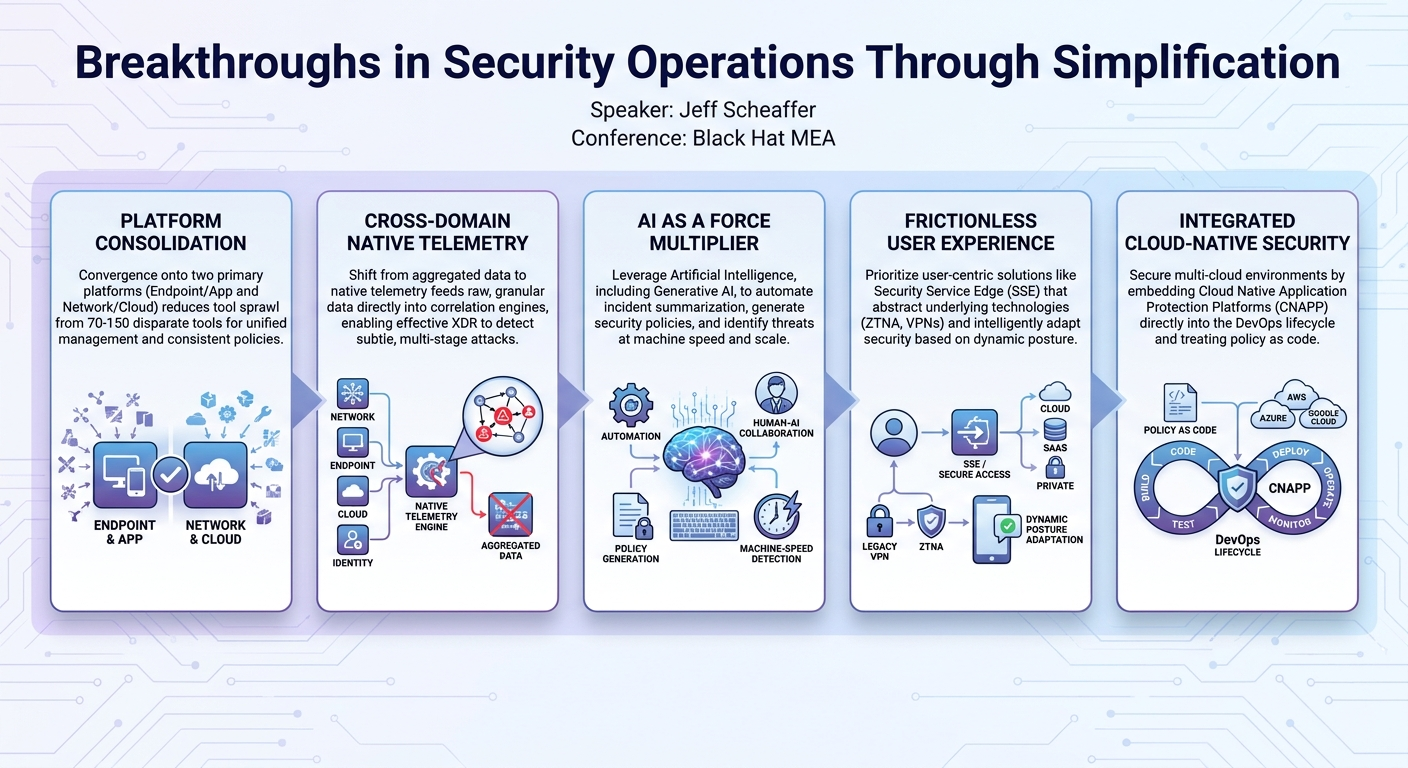
- Core Security Innovation through Platform Consolidation: The market is poised to converge around two primary security platforms: one focused on the endpoint and application, and another centered on the network and cloud. Scheaffer emphasized that true simplification will come from reducing the current sprawl of 70-150 tools into these consolidated platforms. This approach promises a single cloud management platform for orchestration, configuration, and operation of security controls, along with shared services that improve efficacy and consistency across various control points based on unified policies and identity.
- Importance of Cross-Domain Native Telemetry: Moving beyond traditional aggregated telemetry, the talk highlighted the critical need for cross-domain native telemetry. Instead of synthesizing data through intermediaries, native data is fed directly into a correlation engine. This allows for the analysis of multivariate effects across multiple native signals, enabling the pinpointing of subtle, slowly unfolding exploits that are often missed by aggregated views. This native data is foundational for effective Extended Detection and Response (XDR) solutions.
- Leveraging Artificial Intelligence (AI) for Actionable Intelligence: AI, encompassing machine learning, deep learning, and contemporary approaches like Large Language Models (LLMs) and Generative AI, is crucial for transforming rich data sets into actionable intelligence. AI can significantly improve security efficacy and efficiency by identifying risks, vulnerabilities, and threats at machine speed, beyond human scale, and below human sensitivity. Practical applications include summarizing incidents, generating zero-trust policies, and correlating signals against frameworks like MITRE ATT&CK.
- Dramatic Simplification of the Security Experience: The ultimate breakthrough lies in simplifying the implementation and user experience of security controls. This involves reimagining how users connect to applications, abstracting underlying technologies like Zero Trust Architectures (ZTNA) or VPNs. For IT, simplification means a single, centralized cloud management platform. For developers, it means integrating security directly into the DevOps lifecycle. The goal is to create a frictionless, inherently secure environment that is "safer for everyone," reducing complexity not just in technology but also in adoption and operation.
These findings collectively advocate for a strategic move away from fragmented, reactive security towards an integrated, proactive, and simplified operational model, leveraging advanced technologies to achieve a more robust and efficient security posture.
Technical Deep Dive
▶ Watch: Applying AI for security operations: Insights and simplification (6:40)
The technical core of Scheaffer's talk revolved around a multi-faceted strategy for simplifying security operations, deeply integrating advanced technologies and architectural shifts.
Platform Consolidation and Multi-Cloud Defense:
Cisco's vision centers on consolidating security tools into unified platforms. Scheaffer posits that the market will coalesce around two key platforms: one for the endpoint and application, and another for the network and cloud. Cisco aims to lead the latter, leveraging its network heritage to provide a single cloud security platform that offers independence across diverse multi-cloud environments. This platform would feature a unified management console for orchestration, configuration, and operation, along with shared services for consistent policy enforcement, identity management, and Service Level Agreements (SLAs) across heterogeneous infrastructures.
For multi-cloud environments, a critical challenge is the disparity between traditional IP-based segmentation (macro/micro) in data centers and the service-based nature of cloud-native applications. Cisco's Multi-Cloud Defense Solutions are designed to implement a crucial translation layer, enabling unified policy enforcement across both on-premises and cloud-based services, abstracting the underlying network complexities.
Cross-Domain Native Telemetry and XDR:
A significant technical shift proposed is moving from aggregated telemetry to cross-domain native telemetry. Unlike traditional SIEMs that aggregate data from various tools, native telemetry involves directly feeding raw, granular data from multiple security domains (network, endpoint, cloud, identity) into a correlation engine. This allows for a multivariate analysis of signals, enabling the detection of subtle, multi-stage attacks that might otherwise go unnoticed. This rich, native data is the backbone of effective Extended Detection and Response (XDR) solutions, providing a "complete view" of potential risks and threats within an environment, far surpassing the limited insights offered by aggregated data.
AI Integration for Enhanced Efficacy:
AI, encompassing machine learning, deep learning, and generative AI, is positioned as a force multiplier for security operations. Scheaffer highlighted its application in three key areas:
- Rich Data: Leveraging the cross-domain native telemetry as the foundation.
- Domain-Specific Models: Developing models, often based on frameworks like MITRE ATT&CK, to correlate signals from diverse data sources, identify attack patterns, and generate quick inferences.
- Simplified Experience: Utilizing generative AI for a "prompt interface" into the SOC. This allows security analysts to use natural language prompts to perform tasks like summarizing complex incidents, rapidly generating Zero Trust policies, and scaling security operations beyond human capacity. AI helps identify threats at machine speed, at greater than human scale, and below human sensitivity thresholds.
Simplified User Experience with Cisco Secure Access (SSE):
Cisco's Secure Access, a comprehensive Security Service Edge (SSE) solution, exemplifies the simplification of the user experience. It reimagines user connectivity by abstracting underlying technologies. A single agent on the endpoint provides a suite of microservices: Zero Trust Network Access (ZTNA), VPN as a Service, posture assessment, digital experience monitoring, and telemetry collection. The user experience is simplified to "authenticate, connect, and go to work," with the system intelligently determining the necessary "plumbing" for application access (web, SaaS, private, legacy).
Scheaffer detailed the evolution of Zero Trust: while approximately 60% of applications conform well to client-initiated ZTNA, about 40% still require traditional VPN-as-a-service or direct network access. This 40% includes server-initiated applications (monitoring tools), multi-channel applications (ERP like SAP reports), and peer-to-peer applications (SIP, IP telephony). Cisco Secure Access's single agent is designed to support the full breadth of these application architectures using multiple tunnel and head-end technologies, ensuring a frictionless experience.
The solution leverages a Global Network of Points of Presence (PoPs), including local nodes in regions like Saudi Arabia, to provide security controls close to the user and application, avoiding latency-inducing backhauling. It utilizes industry-leading, low-latency protocols like QUIC and MASQUE framework. ThousandEyes integration provides full-stack observability, offering insights from the client, across the LAN/WAN, to the application, enabling rapid troubleshooting of any digital experience issues.
Adaptive Multi-Factor Authentication (MFA):
The talk also touched on simplifying MFA without compromising security. Cisco's platform can persist user validation after the initial MFA. However, if there's a change in posture (e.g., leaving the office and connecting to a different Wi-Fi SSID), the system traps this change and can force a revalidation. This revalidation is simplified via a push notification. For more stringent policies, verified push (requiring a PIN code) can be enforced, striking a balance between security and user convenience, thereby frustrating attackers without frustrating users through "push fatigue."
Cloud-Native Application Protection Platforms (CNAPP):
Through its Panoptica acquisition, Cisco is focusing on simplifying Cloud Native Application Protection Platforms (CNAPP). This involves securing cloud-native workloads and APIs from the developer perspective. Key components include workload and API security, integrating static analysis during code build and runtime analysis when the code is operational, and building in full-stack observability. This approach aims to embed security directly into the DevOps process, treating policy as code and ensuring continuous protection from development to runtime.
Ransomware Detection and Response:
Scheaffer highlighted the increasing sophistication of ransomware, moving beyond simple emails to AI-driven social engineering (e.g., referencing social media activity). Such attacks often involve a sequence: sophisticated phishing, suspicious DNS queries, malware download (e.g., PowerShell), and network worming. Cisco's XDR solution, powered by cross-domain native telemetry, is designed to detect and troubleshoot these complex, slow-burn attacks. This capability is underpinned by Cisco Talos, its threat intelligence system, which processes over 400 billion security events per day and is supported by over 500 threat researchers. Talos builds and refines models, often in collaboration with the industry, to correlate threat intelligence and map it to frameworks like MITRE ATT&CK, providing actionable insights for detect and respond capabilities.
Demo / Proof of Concept
▶ Watch: Simplifying user experience: Cisco Secure Access and zero trust (9:00)
While the presentation did not feature a live, explicit demonstration of a specific tool or exploit, Jeff Scheaffer effectively articulated the concept of a simplified user experience through the capabilities of Cisco Secure Access. He described how the solution "reimagines that experience in its entirety," starting from the end-user and working backward to build an architecture that abstracts complexity. The discussion around the single agent handling diverse connectivity needs (Zero Trust, VPN as a service) and adaptively managing MFA based on posture changes serves as a conceptual proof of concept for the desired simplification. The detailed explanation of how a user simply authenticates, connects, and goes to work, with the system intelligently managing the "plumbing" for various application types, acts as a virtual demonstration of the intended frictionless experience.
Defensive Implications
▶ Watch: Stopping ransomware: XDR with cross-domain native telemetry (17:50)
The insights shared by Jeff Scheaffer carry significant implications for security defenders seeking to bolster their posture and operational efficiency:
- Prioritize Platform Consolidation: Defenders should actively resist the impulse to acquire a new tool for every new threat. Instead, focus on consolidating security functions onto integrated platforms that offer unified management, policy, and identity. This reduces operational overhead, improves visibility, and minimizes configuration complexity associated with managing 70-150 disparate tools.
- Invest in Cross-Domain Native Telemetry for XDR: Shift away from simply aggregating disparate logs. Prioritize solutions that offer cross-domain native telemetry to feed raw, granular data directly into correlation engines. This is crucial for building effective XDR capabilities that can detect sophisticated, multi-stage attacks by analyzing multivariate signals across endpoints, networks, clouds, and identity.
- Embrace AI for Automation and Efficacy: Actively explore and integrate AI-driven capabilities into security operations. Leverage AI to automate incident summarization, generate security policies (e.g., Zero Trust), and accelerate threat detection beyond human capabilities. Focus on AI solutions that utilize domain-specific models and integrate with frameworks like MITRE ATT&CK for actionable intelligence.
- Adopt a User-Centric Security Model (SSE/ZTNA): Reimagine security from the user's perspective. Implement Security Service Edge (SSE) solutions like Cisco Secure Access that provide a frictionless experience for users while enforcing robust Zero Trust Network Access (ZTNA). Ensure the solution can seamlessly handle both client-initiated and legacy/server-initiated/multi-channel applications (the 40% that still require VPN-like connectivity) through a single, intelligent agent.
- Enhance Adaptive MFA Strategies: Move beyond static Multi-Factor Authentication (MFA). Implement adaptive MFA that can persist validation on known networks but intelligently revalidate users when posture changes (e.g., a different Wi-Fi network). Utilize features like verified push for high-risk applications to combat push fatigue and increase assurance without unduly burdening users.
- Integrate Security into Cloud-Native Development (DevSecOps/CNAPP): For organizations leveraging cloud-native architectures, integrate security from the earliest stages of the development lifecycle. Adopt Cloud Native Application Protection Platforms (CNAPP) that provide comprehensive security for workloads and APIs, including static and runtime analysis, and full-stack observability. Treat security policy as code to embed protection directly into the DevOps process.
- Leverage Advanced Threat Intelligence: Ensure security solutions are backed by robust, real-time threat intelligence like Cisco Talos. The ability to process 400 billion security events per day and leverage 500 threat researchers is critical for staying ahead of evolving threats, particularly sophisticated ransomware tactics.
By adopting these defensive strategies, organizations can significantly reduce operational complexity, improve detection and response capabilities, and create a more resilient and secure digital environment.
Key Takeaways
- Simplification is Paramount: The current complexity of security operations due to tool sprawl (70-150 tools) and multi-cloud environments is unsustainable; radical simplification across technology and user experience is critical for future breakthroughs.
- Platform Consolidation is Key: The market is converging towards two primary security platforms (endpoint/app and network/cloud); consolidating disparate tools onto these unified platforms will reduce complexity, streamline management, and improve policy consistency.
- Native Telemetry Fuels XDR: Moving beyond aggregated data to cross-domain native telemetry is essential for effective Extended Detection and Response (XDR), enabling the detection of subtle, multi-stage attacks by correlating granular signals from across the environment.
- AI is a Force Multiplier: Artificial intelligence, including Generative AI, is vital for enhancing security efficacy and efficiency, automating tasks like incident summarization and policy generation, and detecting threats at machine speed and scale.
- User Experience Matters: Security solutions, like Cisco Secure Access (SSE), must prioritize a frictionless user experience by abstracting underlying complexities (ZTNA, VPNs) and intelligently adapting security controls like MFA based on dynamic posture.
- Cloud-Native Requires Integrated Security: Securing multi-cloud and cloud-native environments demands a unified approach that bridges traditional segmentation with service-based policies and integrates Cloud Native Application Protection Platforms (CNAPP) directly into the DevOps lifecycle.
About the Speaker(s)
Jeff Scheaffer is the Vice President of Product Management for Security Service Edge at Cisco. In his role, he is responsible for driving the strategy and innovation behind Cisco's comprehensive security solutions, particularly in the evolving landscape of cloud-delivered security. His expertise lies in understanding the complex challenges faced by modern security operations and translating them into simplified, effective product offerings. Scheaffer's insights are informed by extensive engagement with security professionals globally, focusing on how to leverage platforms, data, and AI to enhance security efficacy and user experience.
Reviews
Dr. Zero (Offensive Security Researcher) — HARD PASS
This is a 45-minute Cisco sales pitch masquerading as a keynote. Scheaffer spent the entire slot stringing together acronyms—SSE, ZTNA, CNAPP, XDR—to tell you the revolutionary solution to tool sprawl is buying his product suite. Zero technical value, zero new strategic signal, just pure vendor marketing.
Heather Calloway (CISO) — WEAK
This is a polished Cisco product roadmap disguised as a presentation on SOC simplification. While it correctly diagnoses the operational nightmare of tool sprawl, the proposed remedy—consolidating your entire network and cloud defense onto a single vendor platform—glosses over the massive vendor concentration risk it creates.
→ Top-rated talks at Black Hat Middle East & Africa 2023 (Executive Summit)
All talks from Black Hat Middle East & Africa 2023 (Executive Summit)