Protecting Data and Operations with Modern Threat Intelligence
Gene Yoo (CEO · Resecurity)
Black Hat Middle East & Africa 2023 (Executive Summit) · Day 2 · Executive Summit
Overview
In his Black Hat MEA talk, "Protecting Data and Operations with Modern Threat Intelligence," Gene Yoo, CEO of Resecurity, challenges conventional wisdom surrounding threat intelligence (TI). Yoo argues that despite significant investments in cybersecurity, organizations continue to face breaches because current approaches often amount to "security theater." He contends that the industry's focus on technical indicators like IOCs (Indicators of Compromise), TTPs (Tactics, Techniques, and Procedures), and IP addresses often lacks meaningful context for risk reduction and fails to address the underlying business implications of cyber threats. Instead, Yoo advocates for a paradigm shift, urging organizations to move beyond reactive measures and embrace a holistic, mission-oriented approach centered on data aggregation, normalization, and proactive risk mitigation.
Key moments
- 0:00 Introduction: Security theater and constant breaches
- 1:06 Beyond IOCs: Threat intelligence reduces risk
- 3:20 Cybersecurity is an 'infinite game,' no winning
- 6:25 Predictive analytics is a myth, events are opportunistic
- 7:20 Fusion Center's goal: cause friction, slow adversaries
- 10:45 Dark web data is 3-6 months old, triage not react
- 12:15 Unified Fusion Center: mission-oriented, cross-departmental
- 14:40 Fusion Center: people, process, technology, not a product
Protecting Data and Operations with Modern Threat Intelligence
Speakers: Gene Yoo, CEO, Resecurity
Conference: Black Hat MEA
YouTube: https://www.youtube.com/watch?v=ngSLgKV-D3g
Overview
In his Black Hat MEA talk, "Protecting Data and Operations with Modern Threat Intelligence," Gene Yoo, CEO of Resecurity, challenges conventional wisdom surrounding threat intelligence (TI). Yoo argues that despite significant investments in cybersecurity, organizations continue to face breaches because current approaches often amount to "security theater." He contends that the industry's focus on technical indicators like IOCs (Indicators of Compromise), TTPs (Tactics, Techniques, and Procedures), and IP addresses often lacks meaningful context for risk reduction and fails to address the underlying business implications of cyber threats. Instead, Yoo advocates for a paradigm shift, urging organizations to move beyond reactive measures and embrace a holistic, mission-oriented approach centered on data aggregation, normalization, and proactive risk mitigation.
The core of Yoo's presentation revolves around transforming how organizations perceive and utilize threat intelligence. He criticizes the common misconception that readily available "dark web" data constitutes actionable intelligence, revealing that such information is typically 3-6 months old and reactive. Yoo proposes the adoption of Unified Fusion Centers – a model that extends beyond traditional Security Operations Centers (SOCs) to integrate diverse departments like physical security, risk management, and business operations. This integrated approach, he argues, is essential for enabling organizations to play an "infinite game" against adversaries, focusing on causing friction and slowing down attacks rather than striving for an unattainable "win" or permanent disruption. By emphasizing measurable risk reduction and the strategic enablement of business objectives, Yoo provides a compelling vision for modern threat intelligence that is both practical and impactful.
Background
▶ Watch: Introduction: Security theater and constant breaches (0:00)
The landscape of cybersecurity is often characterized by a cacophony of data and a proliferation of tools, yet organizations frequently find themselves in a perpetual state of vulnerability. Gene Yoo highlights this paradox, suggesting that much of what is marketed as threat intelligence contributes to "security theater" – an illusion of protection without substantive defense. A fundamental issue, he explains, is the pervasive misunderstanding of what threat intelligence truly entails. Many organizations equate TI with a mere collection of IOCs, TTPs, or IP addresses, failing to grasp its potential for broader application in reducing organizational risk. This narrow perspective often leads to a reactive posture, where security teams are constantly chasing alerts and indicators that may already be stale or irrelevant to their unique business context.
Yoo points to several systemic problems that contribute to this ineffective state. Firstly, the sheer volume of data from various sources – peer-to-peer forums, dark web markets, open web, and Tor sites – creates an overwhelming "noise" that security teams struggle to process and prioritize. Without proper aggregation, normalization, and an ETL (Extract, Transform, Load) process, this data remains unstructured and largely unusable. Secondly, the traditional Security Operations Center (SOC) model, often siloed within IT or information security, struggles to connect technical threats to broader business risks. This functional, rather than mission-oriented, approach prevents a comprehensive understanding of an organization's threat landscape. Lastly, there's a significant misconception about the timeliness and utility of dark web intelligence. As Yoo emphatically states, if a compromise is appearing on the dark web or social media, the event likely "ended three months ago," meaning the information is reactive and often too late for proactive defense. This delay, typically 3 to 6 months between initial compromise and public disclosure, means that adversaries have already monetized and exploited the stolen data multiple times over, rendering a reactive response to such intelligence largely ineffective.
Key Findings
▶ Watch: Cybersecurity is an 'infinite game,' no winning (3:20)
Gene Yoo's talk delivers several critical findings that challenge established cybersecurity practices and advocate for a fundamentally different approach to threat intelligence:
- Threat Intelligence as a Multi-Disciplinary Tool: Yoo asserts that TI's utility extends far beyond the traditional cybersecurity team. It can and should be leveraged for fraud detection, military intelligence, law enforcement operations, and crucially, for business operations and enterprise risk management. This broader application means ingesting not just technical data but also operational and functional data to serve diverse purposes, enabling better understanding and combatting of various forms of crime and risk.
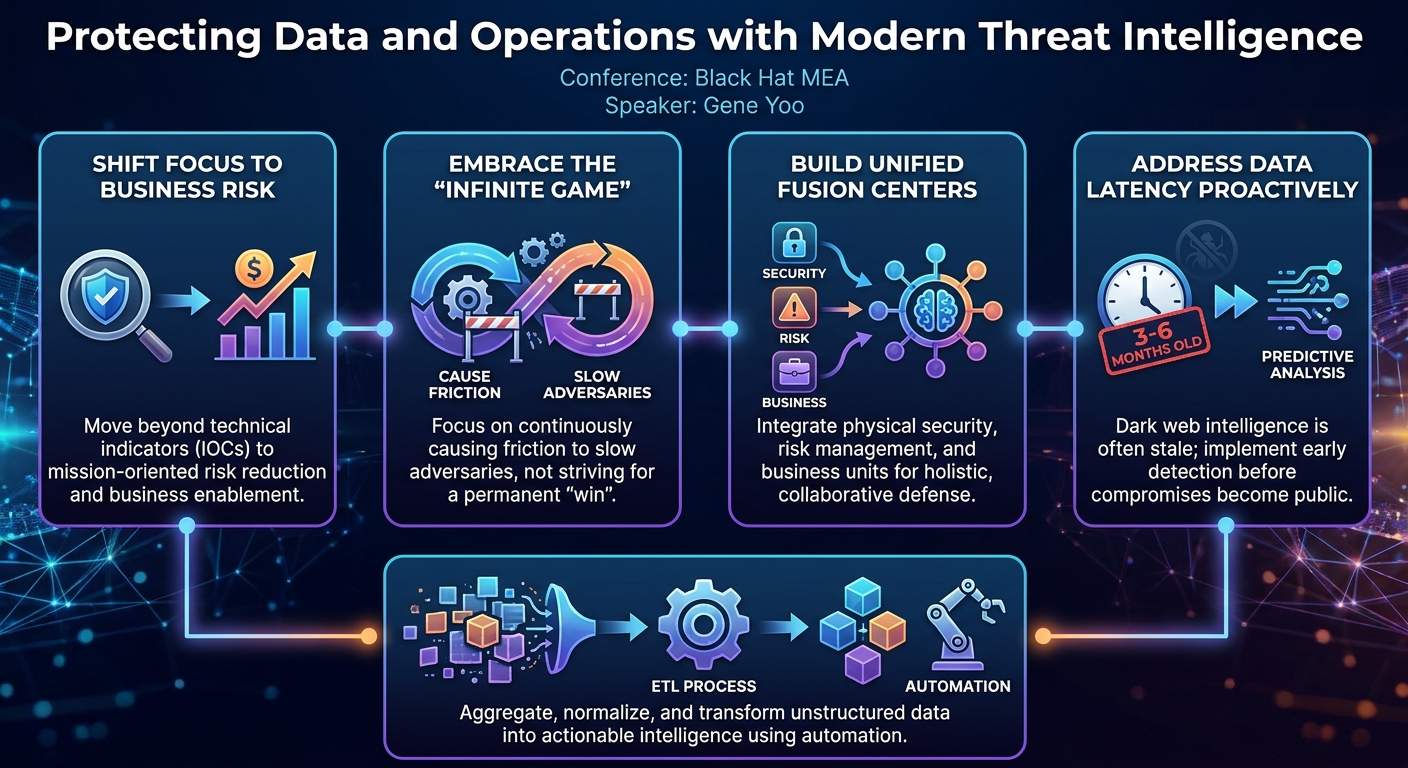
- The "Infinite Game" of Cybersecurity: Yoo introduces the concept of finite versus infinite game theory in the context of cybersecurity. He argues that there's "no winning or losing" in this domain, as the battle against adversaries is continuous, driven by the constant potential for monetization of vulnerabilities and criminal activity. The goal, therefore, is not to achieve a definitive victory but to continuously play the game effectively. This means shifting focus from "disrupting the environment" (which adversaries can quickly rebuild) to causing friction and slowing down their Speed and Agility.
- Stale Dark Web Intelligence: A significant revelation is the inherent latency of dark web data. Yoo states that by the time information about a breach or compromise appears on the dark web or social media, it is typically 3 to 6 months old. The initial access brokers have already exploited and sold this data multiple times. Reacting to such aged intelligence is akin to being "behind the curve," necessitating a proactive approach that identifies threats much earlier.
- Shift from Centralized SOCs to Unified Fusion Centers: Yoo advocates for a fundamental architectural change, moving from a centralized Security Operations Center (SOC) to a Unified Fusion Center. The key difference lies in unification, which involves bringing together not just security engineers but also physical security, risk management, and other business stakeholders. This collaborative model fosters a common goal and a mission-oriented focus, integrating business and other analytics information to provide a holistic view that transcends traditional endpoint and network security.
- The Myth of Predictive Analytics and the Importance of Metrics: While the desire for predictive analytics is strong, Yoo dismisses its feasibility for most organizations. He estimates that 98% of cyber events are opportunistic, not sophisticated nation-state attacks, making true prediction incredibly difficult. Instead, he stresses the absolute necessity of measurable metrics for threat intelligence. Without understanding the output and its contribution to risk reduction, the value of TI remains unquantifiable and unprovable.
- Core Value Proposition: Risk Reduction and Automation: Ultimately, the primary value of modern threat intelligence is to reduce risk and enable business growth. This is achieved through automation and orchestration, which are crucial for managing the overwhelming volume of data and alleviating the burden on limited resources. Proactive defense, enabled by comprehensive data points from business, technology, and security, allows organizations to identify and mitigate friction points before they escalate into major incidents.
Technical Deep Dive
▶ Watch: Fusion Center's goal: cause friction, slow adversaries (7:20)
The technical underpinnings of Gene Yoo's vision for modern threat intelligence revolve around intelligent data management, architectural transformation, and strategic application of information. At its core, the approach emphasizes the systematic collection, processing, and contextualization of vast, disparate datasets.
The journey begins with data collection, drawing from various layers of the digital underworld: peer-to-peer forums, the dark web, the open web, and numerous Tor sites. Yoo clarifies that the "dark web" is often simply a scraper that pulls information from these sources. The challenge isn't just collection, but the subsequent aggregation and normalization of this raw, often unstructured data. Organizations deal with immense volumes of information – Yoo mentions 30,000 to 50,000 different sources – including financial transactions, mobile application data, authentication logs, and customer records. Without a robust standard operating procedure (SOP) for handling this data, it remains disparate and unusable.
This normalization process is central to the Fusion Center concept. Unlike traditional SOCs that might focus primarily on security logs, a Fusion Center necessitates an ETL (Extract, Transform, Load) process to convert unstructured data into a structured format. This is critical for enabling subsequent analysis, whether human-driven or augmented by AI/ML (Artificial Intelligence/Machine Learning) (though Yoo notes AI/ML is a "whole different conversation" that comes after foundational data normalization). The goal is to create a cohesive dataset where various components, such as a financial transaction, a mobile app event, and a customer authentication attempt, can be mapped together to reveal a comprehensive picture of risk.
The Unified Fusion Center itself is not merely a technological solution but an architectural shift. It moves beyond the image of "security engineers working on their little computers with a big screen." Instead, it represents a collaborative environment designed to "unify" diverse organizational functions. This means integrating data and insights from:
- Information Security/Cybersecurity: Traditional threat detection and response.
- Physical Security: Bridging the gap between digital and real-world threats.
- Risk Management: Assessing and quantifying enterprise-level risks.
- Business Units: Understanding operational context and strategic objectives.
This unification allows for a holistic view of threats, enabling the Fusion Center to identify risks that impact business continuity and growth, rather than just technical vulnerabilities. The purpose is to move beyond functional silos to a mission-oriented focus on protecting the business and enabling its expansion.
Yoo also highlights the importance of automation and orchestration. Given the sheer volume of data and the constant need for analysis, these capabilities are not just beneficial but essential. They reduce the burden on human resources, streamline data processing, and accelerate the identification of potential "friction points" – areas where adversaries can be slowed down.
Finally, Yoo uses the analogy of a Bloomberg Terminal to illustrate the ultimate goal. He emphasizes that it's "not about having a single pane of glass" but about "understanding where the data is coming from and actually making sense out of it." This means having the ability to rapidly access, correlate, and analyze diverse data streams to understand their implications for the organization's risk posture. The "Golden Eye Crystal Ball" program mentioned by Yoo further encapsulates this aspiration: a capability to understand current environmental events from data, allowing for informed, proactive decision-making.
Demo / Proof of Concept
▶ Watch: Dark web data is 3-6 months old, triage not react (10:45)
While the talk did not feature a live, explicit demonstration or proof of concept, Gene Yoo frequently referenced the practical application of his proposed methodologies and the capabilities of Resecurity's platform. He noted, "we have a platform that allows you to do all these things and we do that for you," implying that the concepts discussed, such as data aggregation, normalization, and the creation of a Fusion Center, are actively implemented and deliver tangible results. Yoo also alluded to a "special program I heard about a golden eye crystal ball," which he described as a mechanism "to understand from data to what's happening in your environment." This suggests that the underlying principles of collecting, processing, and contextualizing diverse data streams to achieve a comprehensive understanding of risk are not theoretical but are being put into practice by his organization and others who have adopted similar approaches. The absence of a direct demo does not detract from the clear articulation of how these advanced threat intelligence strategies function in a real-world context.
Defensive Implications
▶ Watch: Fusion Center: people, process, technology, not a product (14:40)
Gene Yoo's talk provides a robust framework for defenders looking to evolve their cybersecurity strategies beyond traditional, often ineffective, approaches. The defensive implications are profound, demanding a shift in mindset, operational structure, and measurement criteria:
- Adopt an "Infinite Game" Mindset: Defenders must recognize that cybersecurity is a continuous engagement, not a war to be won. The focus should shift from complete eradication of threats to causing friction and slowing down adversaries. This means investing in capabilities that increase the cost and time for attackers, rather than solely aiming for permanent disruption of their infrastructure, which is often futile.
- Prioritize Risk Reduction as the Core Mission: Move beyond merely identifying IOCs and TTPs. Threat intelligence must be directly tied to reducing tangible business risk. This requires understanding the organization's critical assets, business processes, and potential impact of compromise, and then using TI to inform decisions that mitigate those specific risks.
- Establish Unified Fusion Centers: Traditional, siloed SOCs are no longer sufficient. Organizations should architect Unified Fusion Centers that integrate physical security, risk management, business analytics, and other relevant departments. This collaborative model ensures a comprehensive view of threats and enables a mission-oriented approach to protect the entire enterprise.
- Be Proactive, Not Reactive to Stale Intelligence: Understand that dark web intelligence is often 3-6 months old. Defenders should focus on developing internal capabilities for early detection, correlating internal telemetry with external threat feeds, and identifying initial access brokers before compromised data hits public forums. This involves ingesting a wide array of operational and functional data for earlier indicators of compromise.
- Implement Robust Data Handling and Normalization: To combat the "noise" of vast datasets, organizations must establish standard operating procedures (SOPs) for collecting, aggregating, and normalizing threat intelligence data. Utilizing an ETL process to transform unstructured data into a structured, usable format is crucial for effective analysis and correlation across diverse sources.
- Demand Measurable Metrics for TI Effectiveness: Security leaders must insist on clear, quantifiable metrics that demonstrate how threat intelligence contributes to risk reduction. Avoid the pitfall of chasing "predictive analytics" (given that 98% of events are opportunistic) and instead focus on measurable outcomes related to reduced incident response times, mitigated vulnerabilities, or prevented financial losses.
- Conduct a Comprehensive Asset Inventory: Before investing in more tools, defenders should perform a thorough inventory of all organizational assets, data, and systems. Understanding "everything that you own" is foundational to identifying what needs protection and where threat intelligence can be most effectively applied.
- Leverage Existing Tools and Data First: Avoid the trap of "too many tools." Evaluate current security stacks and existing logging data to identify their full potential. Only after deciphering the value from current resources should organizations consider adding new solutions to address demonstrable gaps.
Key Takeaways
- Modern threat intelligence (TI) must shift from chasing technical indicators (IOCs, TTPs) to a mission-oriented focus on reducing tangible business risk and enabling business growth.
- Embrace the "infinite game" theory in cybersecurity: the goal is not to "win" but to continuously cause friction and slow down adversaries, as complete disruption is often temporary.
- Transition from centralized Security Operations Centers (SOCs) to Unified Fusion Centers that integrate physical security, risk management, and business units for a holistic, collaborative defense.
- Understand that dark web intelligence is often 3-6 months old and reactive; true proactive defense requires earlier detection and internal data correlation before compromises become public.
- Implement robust data aggregation, normalization, and an ETL process to transform vast, unstructured data into actionable intelligence, supported by automation and orchestration to reduce resource burden.
- Demand measurable metrics that demonstrate the direct impact of TI on risk reduction, and conduct a comprehensive inventory of assets before acquiring more security tools.
About the Speaker(s)
Gene Yoo is the CEO of Resecurity, a cybersecurity company specializing in threat intelligence. Throughout his talk, Yoo demonstrates a deep understanding of the challenges facing modern enterprises in the digital age, drawing from extensive experience in the field. His insights are informed by frequent interactions with customers and board members, where he often discusses the strategic implications of cybersecurity and the need for a more pragmatic approach. Yoo's expertise lies in dissecting the complexities of threat intelligence, advocating for practical, business-aligned strategies that move beyond mere technical jargon to deliver measurable risk reduction and operational resilience.
Reviews
Dr. Zero (Offensive Security Researcher) — WEAK
Gene Yoo gets on stage to tell us that dark web feeds are stale garbage and SOCs need to look at business risk. True, but we've known this since 2015. This is a vendor pitch for Resecurity masquerading as a thought-leadership keynote, complete with Simon Sinek book quotes.
Heather Calloway (CISO) — SOLID
The speaker correctly diagnoses that raw threat indicators and dark web alerts are usually months too late to prevent a breach. However, the proposed solution—a massive 'Unified Fusion Center'—glosses over the organizational realities of budget, turf wars, and headcount. It's a useful reality check on threat intel spending, even if the architectural advice is a heavy lift.
→ Top-rated talks at Black Hat Middle East & Africa 2023 (Executive Summit)
All talks from Black Hat Middle East & Africa 2023 (Executive Summit)