Empowering Employees for the Total Experience
Gary Sorrentino (Global CIO · Zoom)
Black Hat Middle East & Africa 2023 (Executive Summit) · Day 2 · Executive Summit
Overview
In his Black Hat MEA talk, "Empowering Employees for the Total Experience," Gary Sorrentino, Global CIO at Zoom, delivered a compelling address on the fundamental and irreversible shift in the global work landscape. Challenging the widespread organizational desire to revert to pre-pandemic norms, Sorrentino argued that the employees who returned to work are fundamentally different from those who were sent home three years prior. This talk is not merely an observation of change but a strategic imperative for organizations to adapt, innovate, and prioritize the Total Experience (TX), which holistically integrates both Employee Experience (EX) and Customer Experience (CX).
Key moments
- 0:00 No going back: The new reality of work
- 4:40 Understanding proximity bias and the 90-day rule
- 8:40 Upskill employees for new collaboration in a multi-generational workforce
- 13:40 Merging employee and customer experiences into 'Total Experience'
- 17:00 Reduce 'toggle tax' by integrating business applications
- 18:20 Zoom's vision: total experience, AI, and integrated platforms
Empowering Employees for the Total Experience
Speakers: Gary Sorrentino, Global CIO, Zoom
Conference: Black Hat MEA
YouTube: https://www.youtube.com/watch?v=FVD3w5S1S8w
Overview
In his Black Hat MEA talk, "Empowering Employees for the Total Experience," Gary Sorrentino, Global CIO at Zoom, delivered a compelling address on the fundamental and irreversible shift in the global work landscape. Challenging the widespread organizational desire to revert to pre-pandemic norms, Sorrentino argued that the employees who returned to work are fundamentally different from those who were sent home three years prior. This talk is not merely an observation of change but a strategic imperative for organizations to adapt, innovate, and prioritize the Total Experience (TX), which holistically integrates both Employee Experience (EX) and Customer Experience (CX).
Sorrentino’s presentation underscored the critical importance of empowering employees to thrive in a hybrid, asynchronous, and technology-driven environment. He highlighted the pervasive inefficiencies and dissatisfaction stemming from outdated workplace strategies, including issues like proximity bias, high employee turnover, and the debilitating toggle tax associated with fragmented digital tools. While not a traditional cybersecurity deep dive, the implications of Sorrentino's message for organizational security are profound: a disempowered, frustrated, or inefficient workforce is inherently more susceptible to human error, less engaged in security protocols, and potentially more vulnerable to insider threats or external social engineering attacks. By advocating for intelligent platforms, integrated workflows, and a culture of inclusion, Sorrentino implicitly laid out a framework for a more resilient, productive, and, by extension, more secure organizational ecosystem.
This article dissects Sorrentino's insights, exploring the catalysts behind the modern work evolution, the tangible challenges facing CIOs and CFOs, and the strategic solutions for fostering an empowered workforce. It delves into the technical underpinnings of an integrated "Total Experience" platform, examines the speaker's proposed remedies for common productivity drains, and extrapolates the critical defensive implications for security professionals grappling with the complexities of the contemporary enterprise.
Background
▶ Watch: No going back: The new reality of work (0:00)
The journey to the current state of work, as articulated by Sorrentino, is a tale of rapid adaptation followed by a struggle for strategic alignment. At the onset of the pandemic, organizations worldwide underwent an unprecedented, forced migration to remote work. This initial phase, which Sorrentino humorously dubbed "the year of the CIO" (03:00), saw an abundance of resources directed towards merely keeping employees connected. The prevailing mindset was to "make the string a little longer" (03:00), extending existing processes rather than fundamentally rethinking work methodologies. Employees, however, independently innovated, upgrading their home offices with enhanced screen real estate (01:00) and discovering personalized optimal work schedules, often outside the traditional 9-to-5 paradigm (02:00).
As the pandemic evolved, the focus shifted from connectivity to cost-efficiency and a push for hybrid work models, marking "the year of the CFO" (04:00). This period introduced new organizational challenges and lexicon, including quiet quitting and quiet hiring. Sorrentino specifically highlighted two critical issues: proximity bias and the 90-day rule. Proximity bias, historically understood as favoring those physically present, has taken on a new dimension in hybrid environments, where remote employees are often excluded from informal, critical decision-making processes that occur in physical offices (05:00). He illustrated this with a poignant anecdote of a major decision being made in a coffee room before a scheduled virtual meeting, leaving remote participants marginalized.
The 90-day rule refers to the alarming global trend of new employees quitting their jobs within 90 days, reaching its highest level since 2008 (04:00). This phenomenon, particularly pronounced among Gen Z workers, stems from a significant mismatch between communicated job expectations and the actual day-to-day reality, leading to rapid disillusionment. Sorrentino underscored that the workforce itself has undergone a profound transformation; the employees returning to offices are not the same individuals who left (00:00). Their expectations regarding flexibility, collaboration, and the overall work experience have irrevocably changed. A staggering 70% of employees, an Amazon statistic cited by Sorrentino, feel unprepared for the future of work, not in terms of their core job skills, but specifically in how they are expected to collaborate in a multi-generational, hybrid setting (08:00). This backdrop sets the stage for the urgent need to empower employees and redefine the work experience.
Key Findings
▶ Watch: Upskill employees for new collaboration in a multi-generational workforce (8:40)
Sorrentino's talk unveiled several critical findings that underscore the urgency for organizations to evolve their strategies for the modern workforce. These findings serve as foundational truths for understanding the current landscape and designing effective solutions:
Firstly, the most fundamental finding is that "there's no going back" (00:00) to pre-pandemic work norms. Employees have evolved, adapting their work styles, expectations, and personal setups. This irreversible shift means that strategies attempting to simply reinstate old models are doomed to fail, leading to dissatisfaction and attrition.
Secondly, the prevalence of proximity bias is a significant impediment to equitable collaboration and decision-making in hybrid environments (05:00). This bias directly disadvantages remote workers, excluding them from critical informal interactions and potentially hindering their career progression, fostering a sense of disinclusion.
Thirdly, high employee turnover, particularly the 90-day rule, is a global issue indicating a severe misalignment between employer expectations and employee realities (04:00). This rapid attrition highlights a failure in onboarding, communication, and expectation setting, leading to substantial recruitment and training costs.
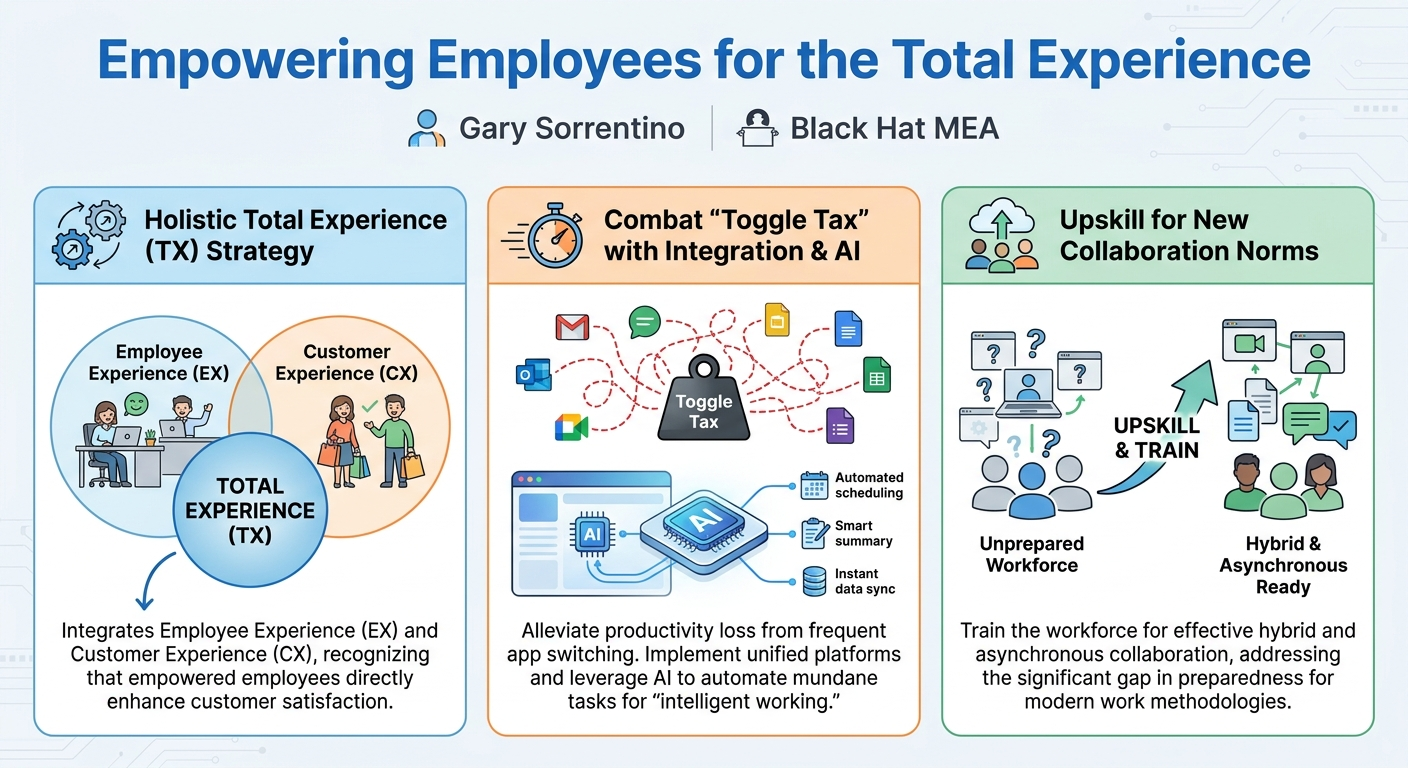
Fourthly, Sorrentino emphasized that the future of work is inherently experience-based (06:00). Both employees and customers demand better experiences. This led to the crucial concept of Total Experience (TX), which necessitates the integration of Employee Experience (EX) and Customer Experience (CX) (14:00). Organizations can no longer treat these as separate silos managed by distinct departments (HR vs. Sales/Marketing); they must be designed holistically to ensure seamless interactions, as demonstrated by his coffee shop anecdote (14:00). Empowering frontline employees to deliver customer delight, he argued, is only possible if their own experience is prioritized (15:00).
Fifthly, a significant productivity drain, dubbed "toggle tax," was identified (17:00). The average global employee switches applications an astounding 1,100 times a day, wasting approximately 1.25 hours of productive time daily. This constant context-switching is a direct result of fragmented application ecosystems and a lack of seamless integration between essential business tools.
Finally, Sorrentino revealed that a substantial portion of the workforce—70% of employees—feels unprepared for the future of work, specifically regarding new ways of collaboration across diverse generational cohorts (08:00). This isn't a deficiency in their core job skills but a gap in understanding and adapting to asynchronous communication, varied work styles, and integrated digital platforms. This highlights a critical need for upskilling focused on collaboration rather than traditional job training.
Technical Deep Dive
▶ Watch: Merging employee and customer experiences into 'Total Experience' (13:40)
Sorrentino's talk, while focused on strategic organizational shifts, outlined several key technical and architectural considerations essential for enabling the Total Experience. The core technical thrust revolves around platform integration, intelligent automation (AI), and fostering a developer ecosystem to create a seamless, productive, and adaptive work environment.
A primary technical challenge identified is the fragmentation of enterprise applications, leading to the debilitating toggle tax. To combat this, Sorrentino advocates for a unified platform for productivity (11:00). This means moving beyond rudimentary "cut and paste" operations, which signify a lack of interoperability, towards deeply integrated applications. The goal is to eliminate the manual transfer of data between disparate systems—such as copying a phone number from a CRM into a separate dialer application (18:00). Instead, the platform should intelligently connect these tools, allowing for actions like click-to-dial directly from a CRM record, reducing friction and saving significant time. This requires robust API integrations and potentially a unified workspace interface that brings together essential functions from various applications.
The integration strategy extends to fostering a developer ecosystem (19:00). As Zoom's Global CIO, Sorrentino highlighted Zoom's own approach: being open to organizations bringing their applications into the Zoom platform, and equally, allowing Zoom's functionalities to be embedded within other enterprise applications. This bidirectional integration philosophy is crucial for achieving true interoperability and reducing the toggle tax. It implies a move towards composable enterprise architecture, where IT systems are built from modular, interoperable components that can be easily connected and configured to create custom workflows.
Another significant technical lever is the strategic investment in Artificial Intelligence (AI) for intelligent working (16:00). Rather than simply working "smarter, not harder," AI should be leveraged to automate mundane and repetitive tasks. Examples include AI-powered meeting assistants that automatically take notes, summarize discussions, and identify action items, freeing human participants to focus on strategic engagement. Furthermore, AI can assist in content generation, such as auto-drafting presentation slides based on key points, reducing the 80-85% of time typically spent on formatting and aesthetics, and allowing more focus on core content (16:00). This requires the deployment of secure, privacy-preserving AI models that can interact with and process organizational data effectively.
The shift towards asynchronous communication also has technical implications. While not explicitly a "technical finding," the adoption of chat over traditional calls, as Sorrentino noted his own transition to (10:00), requires robust, feature-rich messaging platforms that support diverse media, threading, and integration with project management tools. This necessitates a reliable, scalable communication infrastructure that can handle high volumes of messages and ensure timely delivery, irrespective of time zones.
Finally, the concept of "earning your employees' commute" (12:00) implies a need for a modern, technologically advanced physical office environment. This means equipping conference rooms with state-of-the-art collaboration technology that surpasses home setups, providing seamless connectivity, and intuitive tools for hybrid meetings. The office should be a destination for collaboration, not just a place to compute in isolation, demanding a sophisticated AV and network infrastructure that supports complex, multi-modal interactions. This includes advanced video conferencing systems, interactive whiteboards, and reliable high-speed internet.
In essence, the technical deep dive advocated by Sorrentino is an architectural overhaul: moving from a collection of siloed applications to an integrated, AI-augmented, and developer-friendly platform that prioritizes seamless user experience and intelligent workflow automation, thereby empowering employees to be more productive and engaged.
Demo / Proof of Concept
▶ Watch: Reduce 'toggle tax' by integrating business applications (17:00)
The talk did not feature a live technical demonstration or proof of concept in the traditional sense of showcasing a new exploit, a software tool's functionalities, or a direct implementation of a proposed solution. Instead, Gary Sorrentino presented a conceptual framework and strategic vision for empowering employees through a holistic approach to the Total Experience. His points were supported by anecdotal evidence, industry statistics (e.g., the 70% of employees feeling unprepared, the 1,100 daily application switches), and illustrative scenarios (e.g., the coffee shop example for TX, the coffee room exclusion for proximity bias). The emphasis was on high-level strategy, challenges, and proposed directions for organizational change, rather than a hands-on technical walkthrough of specific products or code.
Defensive Implications
▶ Watch: Zoom's vision: total experience, AI, and integrated platforms (18:20)
While Gary Sorrentino's talk primarily focused on employee experience, productivity, and IT strategy, its principles carry significant defensive implications for cybersecurity professionals. A well-designed, integrated, and employee-centric digital environment, as advocated, inherently strengthens an organization's security posture in several key areas.
Firstly, addressing toggle tax and promoting application integration directly mitigates risks associated with shadow IT. When official tools are cumbersome, employees often seek unauthorized third-party applications or workarounds to complete tasks, creating unmanaged entry points, data sprawl, and compliance nightmares. By providing a seamless, integrated platform that meets productivity needs, organizations reduce the incentive for employees to use unapproved software, thereby shrinking the attack surface and enhancing data governance. However, this also necessitates robust supply chain security measures for all integrated third-party applications and the developer ecosystem, ensuring that each connection point is vetted for vulnerabilities and adheres to security standards.
Secondly, the emphasis on upskilling employees for new ways of collaboration is crucial for human-centric security. Beyond technical skills, this includes training on secure communication practices, recognizing phishing attempts in asynchronous channels, and understanding data handling policies within integrated platforms. An empowered and educated workforce is less prone to falling victim to social engineering attacks, data leakage through insecure sharing, or misconfigurations that expose sensitive information. Clear expectations and boundaries (07:00), if communicated effectively, can also reduce insider risk by fostering a transparent and accountable work environment.
Thirdly, the concept of Total Experience (TX), particularly the focus on inclusion and combating proximity bias, has implications for insider threat mitigation. Employees who feel marginalized, excluded from critical decisions, or unfairly treated are more susceptible to disgruntlement, which can be a precursor to malicious insider activity. By ensuring equitable access to information and decision-making for all employees, regardless of their physical location, organizations can foster a stronger sense of belonging and reduce potential motivations for insider threats. Secure collaboration platforms must ensure all participants have equal access to meeting content, decisions, and follow-up actions.
Fourthly, the adoption of AI for intelligent working introduces new security considerations. While AI can automate mundane tasks like note-taking, it also means sensitive corporate data is being processed by AI models. Organizations must ensure that AI implementations adhere to strict data privacy and security-by-design principles. This includes secure data ingress and egress, access controls for AI-generated content, auditing of AI actions, and ensuring that AI models are not susceptible to adversarial attacks or data poisoning. The integrity and confidentiality of information processed by AI are paramount.
Finally, the vision of a modern workplace infrastructure that "earns the commute" by offering superior collaboration tools also extends to endpoint security. While employees may have upgraded their home offices, the corporate IT team must ensure that all devices accessing company data, whether personal or corporate-issued, comply with security policies, are regularly patched, and are protected by appropriate security software. For office environments, the advanced AV and network infrastructure must be secured against unauthorized access and potential eavesdropping.
In summary, by fostering an environment of efficiency, integration, inclusion, and intelligent automation, organizations can create a more secure operational foundation. An empowered, satisfied, and well-equipped employee base is a formidable line of defense against both external threats and internal vulnerabilities, making the principles of the Total Experience a strategic imperative for comprehensive cybersecurity.
Key Takeaways
- Embrace the Irreversible Shift: The post-pandemic workforce is fundamentally different, with evolved expectations for flexibility, collaboration, and work-life integration. Organizations must adapt rather than attempt to revert to old norms.
- Prioritize Total Experience (TX): Integrate Employee Experience (EX) and Customer Experience (CX) into a unified strategy. Empowering employees directly translates to enhanced customer delight and overall business success.
- Upskill for Collaboration, Not Just Jobs: Invest in training employees to collaborate effectively in hybrid, asynchronous, and multi-generational environments, addressing the 70% who feel unprepared for new work methodologies.
- Combat Toggle Tax with Integration and AI: Alleviate the significant productivity drain caused by switching between disparate applications. Implement integrated platforms and leverage AI to automate mundane tasks and foster "intelligent working."
- Make the Office a Collaboration Destination: Reconfigure physical office spaces to be magnets for collaboration, equipped with superior technology and designed to facilitate in-person interaction, rather than just isolated computing.
- Foster Inclusion and Set Clear Boundaries: Actively work to eliminate proximity bias by ensuring equitable access and decision-making for all employees. Leaders must set explicit expectations and boundaries regarding communication and work schedules.
About the Speaker(s)
Gary Sorrentino is the Global Chief Information Officer (CIO) at Zoom, a role that places him at the forefront of digital transformation and modern work strategies. His extensive experience in IT leadership, particularly within a company central to global remote and hybrid work, provides him with unique insights into the challenges and opportunities facing organizations today. Sorrentino is a vocal advocate for evolving workplace models, emphasizing the critical importance of employee experience and the strategic integration of technology.
Throughout his talk, Sorrentino drew upon his personal experiences, such as upgrading his home office during the pandemic, discovering his optimal late-night work hours, and adapting his own communication style from a "Boomer" calling approach to a "Gen Z" preference for asynchronous chat. These anecdotes lend authenticity to his arguments, demonstrating his deep understanding of how technology and evolving expectations impact individual productivity and organizational culture. His role at Zoom positions him as a practitioner and thought leader in delivering the very solutions he advocates for, making his perspectives highly relevant for leaders grappling with the future of work.
Reviews
Dr. Zero (Offensive Security Researcher) — HARD PASS
Gary Sorrentino took a Black Hat MEA keynote slot and turned it into an HR webinar. If I wanted to hear about 'quiet quitting' and 'Total Experience,' I'd go to a LinkedIn influencer retreat, not a security con. A hollow vendor pitch that delivers zero actionable signal for anyone in the room.
Heather Calloway (CISO) — WEAK
Gary Sorrentino packages standard post-pandemic IT observations into a vendor pitch for platform consolidation. While he correctly identifies that workplace friction breeds shadow IT, the proposed 'Total Experience' framework offers buzzwords instead of a governance strategy. Your leadership team can skip this.
→ Top-rated talks at Black Hat Middle East & Africa 2023 (Executive Summit)
All talks from Black Hat Middle East & Africa 2023 (Executive Summit)