Cyber Leadership: What Does Great Leadership Look Like in Cybersecurity?
Dr. Mary Haigh (Global CISO · BAE Systems)
Black Hat Middle East & Africa 2023 (Executive Summit) · Day 2 · Executive Summit
Overview
In an era where cybersecurity is increasingly recognized as a critical business function rather than a mere technical overhead, the effectiveness of leadership within this domain has become paramount. Dr. Mary Haigh, Global CISO at BAE Systems, delivered a compelling talk at Black Hat MEA, dissecting the unique challenges and imperative qualities of cyber leadership. Her presentation posited that while foundational leadership principles remain universal, the specific context of cybersecurity—marked by rapid technological evolution, a persistent skills gap, and an often-misunderstood threat landscape—demands a distinct approach.
Key moments
- 0:45 Why cyber leadership differs from traditional leadership
- 6:05 Defining a compelling, world-class vision for cybersecurity
- 10:30 Data-driven dashboards prevent 'confetti cannon' reporting
- 12:30 The leader as a 'translator' between technical and business
- 16:00 Recruiting for aptitude and values, not just skills
- 19:00 Defining team culture: courage, integrity, collaboration
- 22:00 Leadership is essential for strong cyber resilience
Cyber Leadership: What Does Great Leadership Look Like in Cybersecurity?
Speakers: Dr. Mary Haigh, Global CISO, BAE Systems
Conference: Black Hat MEA
YouTube: https://www.youtube.com/watch?v=XxFy22GyAvs
Overview
In an era where cybersecurity is increasingly recognized as a critical business function rather than a mere technical overhead, the effectiveness of leadership within this domain has become paramount. Dr. Mary Haigh, Global CISO at BAE Systems, delivered a compelling talk at Black Hat MEA, dissecting the unique challenges and imperative qualities of cyber leadership. Her presentation posited that while foundational leadership principles remain universal, the specific context of cybersecurity—marked by rapid technological evolution, a persistent skills gap, and an often-misunderstood threat landscape—demands a distinct approach.
Dr. Haigh emphasized that cybersecurity is inherently a "team sport," requiring seamless collaboration across diverse organizational functions, from legal and HR to IT and engineering. Without an effective team galvanized by strong leadership, even the most advanced tools and processes are insufficient. The talk meticulously explored the specific environmental factors that differentiate cyber leadership from other established disciplines like finance, highlighting the critical need for CISOs to not only master technical domains but also excel as strategic communicators, culture architects, and talent cultivators.
This article delves into Dr. Haigh's insights, examining why traditional leadership models fall short in the cyber realm and outlining a comprehensive framework for cultivating world-class cyber resilience. It explores the dual imperatives of establishing an influential organizational environment and building high-performing, resilient security teams, providing actionable strategies for cybersecurity professionals aiming to elevate their leadership impact within their respective organizations.
Background
▶ Watch: Why cyber leadership differs from traditional leadership (0:45)
Dr. Haigh began by asserting that while good leadership is universally beneficial, good cyber leadership is not merely a subset of general good leadership; it faces unique challenges that necessitate tailored approaches. These distinctions stem from several systemic issues inherent to the cybersecurity landscape:
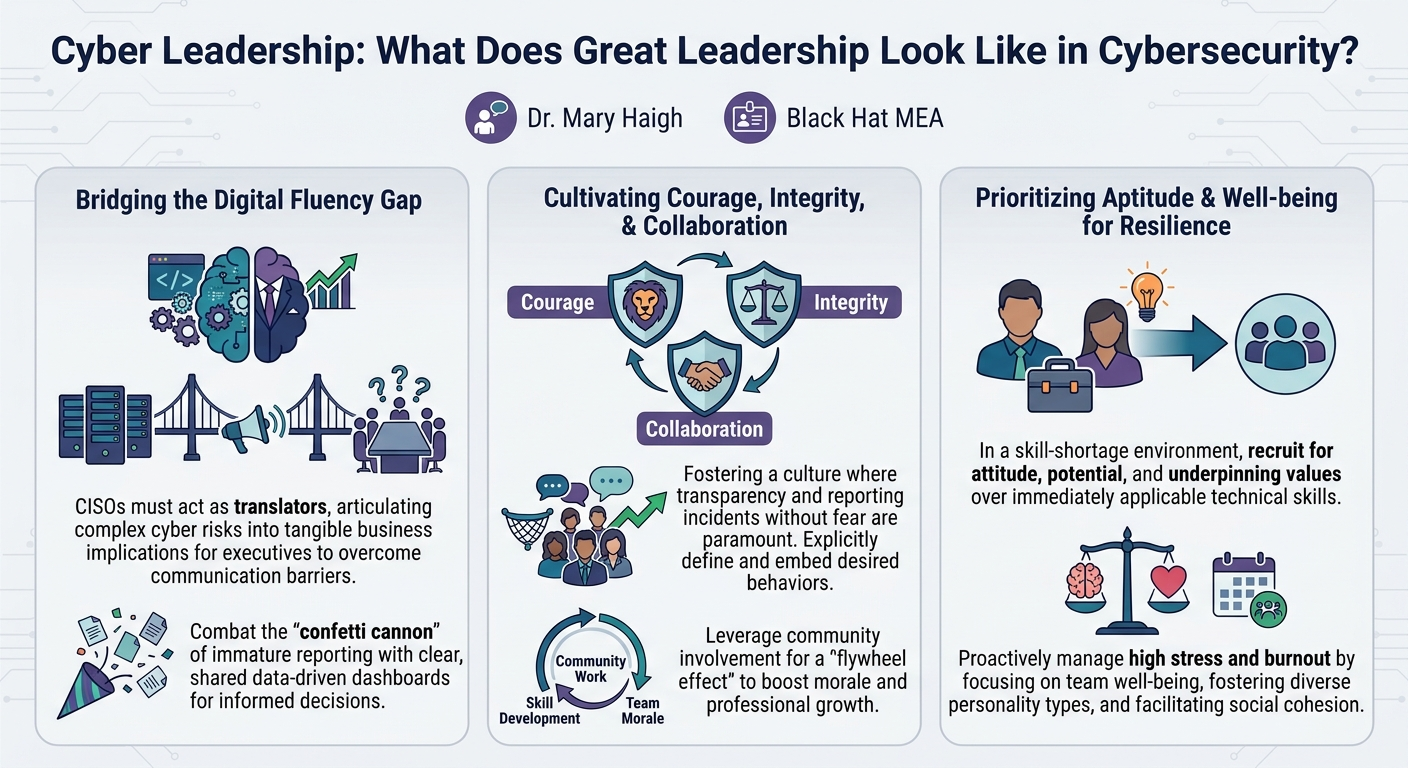
Firstly, a significant digital fluency gap persists at executive and board levels. Unlike finance, where concepts like profit and loss or balance sheets are universally understood, board members often admit to needing education on cybersecurity fundamentals. This lack of comprehension creates a profound communication barrier for CISOs, who must translate complex technical risks into understandable business implications.
Secondly, the pervasive cybersecurity skill shortage exacerbates this issue. Many highly technical cybersecurity professionals are rapidly promoted into senior leadership roles, often without adequate training in executive communication or strategic influencing. These experts, comfortable discussing intricate technical details with peers, suddenly find themselves briefing a leadership community that lacks their digital fluency, leading to potential miscommunication and an inability to convey the gravity of cyber risks effectively.
Thirdly, cybersecurity reporting remains immature and unregulated, a stark contrast to the highly standardized and regulated world of financial reporting. Companies lack a consistent framework for reporting cyber posture, leading to highly variable and often opaque metrics. This "confetti cannon effect," as Dr. Haigh described it, makes it difficult to establish a clear, shared understanding of risk across an organization, hindering agile decision-making and enabling the dangerous practice of "greenwashing", where the full picture of cyber risk is intentionally or unintentionally obscured.
Fourthly, the absence of a universally agreed-upon cyber moral code adds another layer of complexity. Unlike established ethical norms in other fields, the "right and wrong" in cyber security can vary significantly between nations and organizations. This forces cyber leaders to be overtly deliberate in defining their company's ethical stance and operational principles in the digital space.
Finally, the inherent nature of cybersecurity—a 24/7, high-stress environment with constant threats and the potential for devastating incidents—contributes to high stress levels and significant retention issues among professionals. Leaders must therefore equip their teams with not only technical skills but also the mental resilience and support systems necessary to operate effectively under sustained pressure. These factors collectively underscore why cyber leadership demands a distinct, highly deliberate, and empathetic approach.
Key Findings
▶ Watch: Data-driven dashboards prevent 'confetti cannon' reporting (10:30)
Dr. Haigh structured her framework for effective cyber leadership around two core pillars: creating an environment for effective influence and building and managing a high-performing team. Her findings offer a prescriptive guide for CISOs navigating the intricate landscape of modern cybersecurity.
For establishing an environment of influence, she identified several critical components:
- Clear Messages and Compelling Vision: Leaders must articulate a singular, easily digestible vision that transcends technical jargon. Dr. Haigh shared BAE Systems' vision, which moved beyond mere compliance to aspire for "world-class" cyber security, recognizing it as a critical differentiator and operational necessity in a domain of warfare. This vision centered on reducing business risk, building trust, fostering agility, and embedding cyber into the organization's DNA, making it "everybody's role." This clear direction prevents leaders from being pulled into "whack-a-mole" firefighting at the operational level.
- Robust Governance: Effective governance clarifies "who does what and who decides what." By establishing clear forums and decision-making authorities, organizations can ensure decisions "land and stick," promoting agility. This structure also facilitates the upward flow of risk visibility, from detailed technical discussions to high-level board oversight, ensuring decisions are made at the appropriate level.
- Clear Policies: Policies serve as essential guidance, ensuring consistent operation at scale across the organization. They are not "crutches" for blind decision-making but rather frameworks that promote uniformity and adherence to standards.
- Data-Driven Reporting: To counter the "confetti cannon effect" of disparate and confusing metrics, Dr. Haigh advocated for shared, consistent dashboards that provide a unified picture of risk. This enables data-driven, rather than opinion-driven, decision-making, taking emotion out of discussions and allowing leaders to identify genuine problem areas, as illustrated by the example of a business unit claiming 100% compliance while dashboards showed 50%.
- Translational Leadership Style: The CISO must act as a translator, bridging the gap between complex technical concepts and business implications. For boards, this means using analogies and focusing on business risk. For teams, it involves inspiring and energizing them, providing clear direction, and fostering a sense of shared purpose. Dr. Haigh quoted Ruth Ginsburg: "Fight for the things that you care about, but do it in a way that will lead others to join you," emphasizing the importance of tailoring communication to the audience's lens.
Regarding building and managing the team, Dr. Haigh stressed:
- Strategic People Strategy: A proactive approach to talent attraction and retention is crucial. BAE Systems aimed to make its cyber team so appealing that "people were banging on our door to join," focusing on career growth, excitement, and a positive work environment.
- Recruiting for Aptitude over Skills: Given the rapid evolution of threats and technologies, Dr. Haigh made a deliberate decision to recruit for attitude, potential, and underpinning values rather than specific, immediately applicable skills. She argued that cyber security skills can be taught relatively easily, whereas attitude and moral values are much harder to instill. An example cited was hiring someone who had managed care homes through the COVID crisis, demonstrating immense resilience and problem-solving skills, who then quickly adapted to cyber.
- Community Involvement and "Flywheel Effect": Engaging in community work, such as mentoring, diversity initiatives, and school outreach, not only raises the organization's profile but also provides a "feel-good factor" and safe spaces for team members to develop new skills (e.g., public speaking for women). This creates a positive feedback loop, or "flywheel effect," enhancing morale and professional growth.
- Overt Culture Definition: Culture should never be left to chance. Dr. Haigh recounted a negative experience with a fear-based leadership style, which proved highly ineffective and dangerous in cybersecurity as it discouraged incident reporting. She now explicitly defines desired behaviors: courage, integrity, and collaboration. Courage to report issues and challenge, integrity to be transparent, and collaboration because cyber is a team sport. She also emphasized the importance of "getting your hands dirty" and accepting that "it's okay to make a bit of a mess sometimes."
- Prioritizing Well-being and Diversity: Recognizing the high-stress nature of the field, leaders must focus on team well-being. This includes fostering a mix of personality types (e.g., "inspirers," "observers," "supporters") to create a balanced and effective team. Deliberate social time and team-building activities (like an escape room) are vital for building trust and personal relationships among team members.
Technical Deep Dive
▶ Watch: The leader as a 'translator' between technical and business (12:30)
While Dr. Haigh's talk did not delve into specific code, network protocols, or security architectures in the traditional sense, it provided a robust technical framework for organizational cybersecurity management rooted in leadership principles. The "technical deep dive" here refers to the detailed methodologies and structural approaches proposed for building a resilient and effective cyber security function.
Central to Dr. Haigh's model is the concept of a strategic vision that transcends mere compliance. For BAE Systems, a major defense company, the vision of being "world-class" in cyber security is not an aspirational platitude but a critical operational requirement. Their products, operating in a battle space where cyber is a domain of warfare, must be inherently cyber-secure. This defines cyber as a differentiator and an embedded feature of their offerings, rather than an afterthought. This strategic framing is a technical decision about how security is integrated into the core business model.
The implementation of robust governance is another technical process. This involves defining a clear decision-making matrix that specifies roles, responsibilities, and accountability for cyber risk. Dr. Haigh highlighted the importance of establishing regular meetings at various organizational strata—from detailed technical discussions to high-level board reviews—to ensure a continuous flow of information. This structured approach prevents fragmented decision-making and ensures that risk visibility is maintained across the enterprise, allowing for agile responses to evolving threats. Without this, organizations risk falling into a "whack-a-mole" pattern, reacting to individual vulnerabilities rather than strategically managing their overall risk posture.
The emphasis on data-driven reporting is a critical technical control. Dr. Haigh criticized the "confetti cannon effect" where disparate, unstandardized reports lead to a fractured understanding of risk. Instead, she advocated for shared, consistent dashboards that roll up detailed technical metrics into meaningful business indicators. This systematic approach to cyber risk quantification and communication enables objective, evidence-based decision-making. For instance, comparing a business unit's self-reported compliance to actual dashboard data (e.g., 50% compliance) allows for targeted interventions and helps surface hidden risks, moving beyond subjective opinions to verifiable facts. This is a form of technical auditability applied to organizational risk.
Furthermore, the people strategy itself can be viewed through a technical lens. Recruiting for aptitude and values rather than solely for specific, current skills is a technical strategy for building a future-proof workforce in a rapidly changing domain. It acknowledges that the shelf-life of specific technical skills is short, whereas the ability to learn, adapt, and operate with integrity is a more enduring asset. The "flywheel effect" of community involvement, where team members gain public speaking or leadership experience in "safe smaller spaces," is a form of experiential learning and skill development that directly enhances the team's professional capabilities.
Finally, the deliberate cultivation of a specific organizational culture—emphasizing courage, integrity, and collaboration—is a technical requirement for effective cyber defense. In a field where hiding incidents can have catastrophic consequences, fostering an environment where individuals feel safe to report mistakes and challenge assumptions is paramount. This cultural framework acts as a human control mechanism, ensuring that technical systems are not undermined by fear or lack of transparency. The analogy of "getting your hands dirty" and accepting that "it's okay to make a bit of a mess sometimes" reinforces a culture of learning and continuous improvement, essential for any technical discipline. These leadership and cultural tenets are, in effect, the "architecture" of a resilient human defense layer.
Demo / Proof of Concept
▶ Watch: Defining team culture: courage, integrity, collaboration (19:00)
Dr. Haigh's presentation was a strategic discussion on leadership and organizational dynamics in cybersecurity, not a technical demonstration. Therefore, no specific demo or proof of concept was presented during the talk.
Defensive Implications
▶ Watch: Leadership is essential for strong cyber resilience (22:00)
Dr. Mary Haigh's insights provide critical defensive implications for organizations, shifting the focus from purely technical controls to the overarching leadership and cultural frameworks that underpin effective cybersecurity.
Firstly, strategic communication and risk translation emerge as paramount defensive tools. CISOs must evolve beyond technical jargon, becoming adept translators who can articulate complex cyber risks in terms of tangible business impact to boards and executive committees. This prevents the dangerous digital fluency gap from turning into a strategic blind spot and counters the risk of "greenwashing." By clearly linking cyber security initiatives to business objectives—such as competitive differentiation, operational resilience, and trust—defenders can secure the necessary resources and executive buy-in for robust security programs.
Secondly, implementing robust governance models is a crucial defensive strategy. A clear definition of "who does what and who decides what" ensures that security decisions are made efficiently and consistently across the organization. This reduces ambiguity, prevents conflicting directives, and enables agile responses to emerging threats. Establishing clear reporting lines and decision forums ensures that risk visibility flows effectively from the front lines to the highest levels of leadership, allowing for timely strategic adjustments and resource allocation.
Thirdly, data-driven cyber risk management is essential for proactive defense. Moving away from the "confetti cannon effect" of disparate reporting, organizations should invest in standardized, shared dashboards that provide an accurate, consolidated view of their security posture. This allows defenders to identify true problem areas, track progress, and make objective, evidence-based decisions, rather than relying on subjective opinions or anecdotal evidence. Such a system empowers security teams to demonstrate the efficacy of their controls and justify investments.
Fourthly, a proactive people strategy focused on aptitude and culture is a long-term defensive play. Given the chronic cybersecurity skill shortage, organizations must prioritize recruiting individuals with the right attitude, potential, and values, recognizing that specific technical skills can be taught. Fostering a culture of courage, integrity, and collaboration is arguably the most critical defensive measure, as it ensures that incidents are reported promptly and transparently, and that teams work together rather than engaging in blame. A culture of fear, conversely, leads to hidden incidents, which are far more damaging than reported ones.
Finally, investing in team well-being and resilience is a direct defensive measure against burnout and turnover in a high-stress environment. By acknowledging the 24/7 nature of cyber threats and providing support structures, diverse team compositions, and opportunities for social engagement, organizations can build a more resilient and sustainable security workforce. This not only improves retention but also enhances the team's ability to perform effectively during high-pressure incidents, directly contributing to overall organizational cyber resilience.
Key Takeaways
- Cyber leadership demands unique skills: It requires specific aptitudes beyond general leadership, particularly in bridging the digital fluency gap between technical teams and executive leadership.
- Vision and governance are foundational for influence: A clear, compelling vision that transcends compliance, coupled with robust governance structures, is essential for gaining organizational buy-in and enabling agile decision-making.
- Data-driven reporting is non-negotiable: Organizations must move beyond fragmented "confetti cannon" reporting to implement shared, consistent dashboards that provide objective, data-driven insights into cyber risk, preventing "greenwashing" and enabling informed decisions.
- Talent strategy must prioritize aptitude and culture: In a skill-shortage environment, recruiting for attitude, potential, and core values is more effective than solely for existing technical skills. Building a culture of courage, integrity, and collaboration is paramount for incident reporting and team effectiveness.
- Well-being and diversity enhance resilience: Proactively managing team well-being, fostering a mix of personality types, and facilitating social cohesion are critical for building resilient security teams capable of operating effectively under sustained pressure.
About the Speaker(s)
Dr. Mary Haigh serves as the Global CISO for BAE Systems, a leading defense, aerospace, and security company. Her extensive experience in securing complex, critical systems underpins her insights into cyber leadership. Dr. Haigh is a vocal advocate for bridging the divide between highly technical cybersecurity practitioners and business executives, emphasizing the CISO's role as a "translator" to ensure that cyber risks are understood in a business context. Her leadership philosophy centers on building high-performing, resilient teams through strategic talent management, explicit culture definition, and a focus on integrity, courage, and collaboration.
Reviews
Dr. Zero (Offensive Security Researcher) — WEAK
The CISO of a top-tier defense contractor had the stage and chose to deliver a 45-minute LinkedIn post. We get the standard executive bingo card: cyber is a 'team sport,' we need to 'speak business to the board,' and the supposedly groundbreaking idea of hiring for aptitude. Zero insider signal, zero concrete frameworks.
Heather Calloway (CISO) — SOLID
Dr. Haigh delivers a highly credible, pragmatic breakdown of security leadership, anchored by her tenure at BAE Systems. She accurately targets the 'confetti cannon' of security reporting and the boardroom risk of cyber greenwashing. It is a competent, well-executed primer for new security leaders, though veteran CISOs will find it more of an affirmation of standard operating models than a new strategic playbook.
→ Top-rated talks at Black Hat Middle East & Africa 2023 (Executive Summit)
All talks from Black Hat Middle East & Africa 2023 (Executive Summit)