Defense Against the Dark Arts: Generative AI & Enterprise Risk
Dr. Srijith Nair (CISO · Careem), David Tsao (CISO · Instacart), Philip Martin (CISO · Coinbase), David Cross (SVP & CISO · Oracle SaaS Cloud), Omar Khawaja (Field CISO · Databricks)
Black Hat Middle East & Africa 2023 (Executive Summit) · Day 2 · Executive Summit
Overview
In an insightful panel discussion at Black Hat MEA, a distinguished group of CISOs—Dr. Srijith Nair, David Tsao, Philip Martin, David Cross, and Omar Khawaja—convened to explore the burgeoning landscape of Generative AI (GenAI) and its profound implications for enterprise security. Titled "Defense Against the Dark Arts: Generative AI & Enterprise Risk," the talk delved into the challenges and opportunities presented by this rapidly evolving technology, emphasizing that ignoring GenAI is no longer an option for any organization. The panelists collectively underscored the urgency for security leaders to move beyond fear and actively engage with GenAI, transforming from potential blockers into strategic enablers.
Key moments
- 1:00 Is ignoring Generative AI an option?
- 5:30 CISO's core challenge: Keeping up and adding value
- 9:30 GenAI Policy: Experimentation, iteration, risk-based approach
- 18:00 Integrating AI into SDLC: Same principles, new details
- 25:40 Securing AI: Managing mashed data, models, applications
- 28:50 Leveraging AI for security: SOC, QA, adversarial tests
- 41:00 The future: AI vs. AI in security battles?
Defense Against the Dark Arts: Generative AI & Enterprise Risk
Speakers: Dr. Srijith Nair (CISO, Careem); David Tsao (CISO, Instacart); Philip Martin (CISO, Coinbase); David Cross (SVP & CISO, Oracle SaaS Cloud); Omar Khawaja (Field CISO, Databricks)
Conference: Black Hat MEA
YouTube: https://www.youtube.com/watch?v=H7jimHrlY-Q
Overview
In an insightful panel discussion at Black Hat MEA, a distinguished group of CISOs—Dr. Srijith Nair, David Tsao, Philip Martin, David Cross, and Omar Khawaja—convened to explore the burgeoning landscape of Generative AI (GenAI) and its profound implications for enterprise security. Titled "Defense Against the Dark Arts: Generative AI & Enterprise Risk," the talk delved into the challenges and opportunities presented by this rapidly evolving technology, emphasizing that ignoring GenAI is no longer an option for any organization. The panelists collectively underscored the urgency for security leaders to move beyond fear and actively engage with GenAI, transforming from potential blockers into strategic enablers.
The discussion highlighted a critical dichotomy: while businesses are rapidly adopting AI for productivity gains, security teams often lag in understanding and securing these new deployments. This talk aimed to bridge that gap, offering practical perspectives on how CISOs can proactively manage the inherent risks of GenAI, integrate security into its development lifecycle, and even leverage AI for defensive purposes. The collective wisdom of these industry veterans provided a roadmap for navigating the complex interplay between innovation, risk, and robust cybersecurity in the age of AI.
The core message resonated with the idea that GenAI, much like previous technological shifts such as cloud computing and social media, is here to stay and will fundamentally reshape enterprise operations. The challenge for security professionals is not to halt its progress but to guide its secure adoption, ensuring that the speed and efficiency gains of AI do not come at the expense of an organization's security posture. By fostering a deeper understanding and collaborative approach, CISOs can lead their organizations in harnessing GenAI's power responsibly.
Background
▶ Watch: Is ignoring Generative AI an option? (1:00)
The rapid and ubiquitous adoption of Generative AI has created a unique inflection point for enterprises. As Omar Khawaja pointed out, unlike previous technologies with slow adoption curves, GenAI experienced an "immediate adoption," with "everyone's gotten to experience it in one form or the other." This swift integration into daily workflows and business processes has exposed a significant disconnect: Chief Data Officers and business leaders are aggressively pursuing AI deployments, often without the direct involvement or even awareness of their security counterparts. Khawaja shared a telling anecdote where a CDO, after detailing impressive AI deployments, laughed at the suggestion of a collaborative security team, stating, "Why would I ever tell the CISO we're doing this?" This illustrates the pervasive challenge where GenAI adoption often happens in spite of, rather than because of, the CISO.
The panelists unanimously agreed that ignoring GenAI is not a viable strategy. David Tsao and David Cross both likened AI's permanence to that of social media or the internet itself—it's "here forever." Philip Martin added a crucial perspective, stating that "AI makes things faster," not necessarily better or entirely new, but it "serves to enhance and accelerate existing trends." This acceleration applies equally to both beneficial business processes and potential adversarial activities. The inherent speed of AI means that security responses must also accelerate, moving beyond traditional, slower methodologies.
A recurring theme was the parallel drawn between the current GenAI landscape and the early days of cloud adoption. Organizations are rushing to implement GenAI, often preemptively writing policies for its secure use even before fully understanding its capabilities and risks. This mirrors the initial scramble with cloud computing, where security teams often played catch-up. However, the hope is that lessons learned from the cloud era—the importance of early security integration, risk-based approaches, and iterative policy development—can be applied more effectively to GenAI. The panel stressed that the fear of the unknown ("treating them like snakes") can be overcome by understanding the technology, allowing security teams to become enablers rather than perceived blockers.
Key Findings
▶ Watch: GenAI Policy: Experimentation, iteration, risk-based approach (9:30)
The panel discussion crystallized several key findings regarding Generative AI and enterprise risk:
- Inescapable Ubiquity: GenAI is not a passing fad but a fundamental technological shift akin to the internet or cloud computing. Every business will leverage AI, and security must be intrinsically woven into its fabric from the outset, rather than being an afterthought.
- AI Accelerates, Not Necessarily Innovates: While GenAI can dramatically increase the speed and scale of operations, it primarily enhances existing trends and capabilities. This acceleration applies to both productive business functions and potential attack vectors, demanding a corresponding acceleration in defensive strategies.
- The CISO's Role: Enabler, Not Blocker: The traditional perception of security as a bottleneck must evolve. CISOs need to be proactive, understand GenAI, and become "value add" partners in its adoption. This requires skill development, engagement in core AI working groups, and a shift from a "risk-averse" to a "risk-intelligent" mindset, where risks are taken "intelligently... with appropriate reward."
- Iterative, Risk-Based Policy Development: Heavy-handed, prescriptive policies are counterproductive in the nascent stages of GenAI. Instead, organizations should adopt an iterative, experimental approach, learning from small deployments and evolving policies based on actual risk and implementation nuances. Good engineering practices and high-level principles are more effective initially.
- Security Principles Remain Constant, Implementation Varies: While the underlying security principles (monitoring, logging, authentication, access control) are consistent across technologies, the "where" and "how" of their application differ significantly for GenAI. New constructs like Vector databases, embeddings, model serving, and feature stores introduce new attack surfaces and control points that security teams must understand.
- Collaborative Threat Modeling is Paramount: Security professionals do not need to be AI experts, but they must be security experts. Effective threat modeling for GenAI systems requires deep collaboration with engineering and data science teams, leveraging their domain expertise to identify and mitigate risks.
- AI for Defense: A Significant Opportunity: GenAI offers substantial potential to enhance security operations, from automating SOC analyst tasks (alert review, prioritization) to generating adversarial test cases for code quality and security reviews. This can help address the industry's skill gap by augmenting human capabilities.
- Ethical and Societal Blurring of Lines: Securing GenAI extends beyond traditional cybersecurity to encompass ethics, privacy, brand reputation, and even societal impact. CISOs increasingly need to collaborate with HR, marketing, legal, and privacy officers to navigate these broader implications.
Technical Deep Dive
▶ Watch: Integrating AI into SDLC: Same principles, new details (18:00)
Securing Generative AI systems necessitates a nuanced understanding of their underlying technical architecture and the unique attack vectors they introduce. While the panel affirmed that fundamental security principles like monitoring, logging, authentication, and access control remain paramount, their application shifts significantly in the context of AI. Omar Khawaja highlighted this by explaining that "what really changes is the where you do it," emphasizing the distinct life cycles of data, models, and applications.
At the core of many GenAI deployments are Large Language Models (LLMs). These models are often integrated with internal, structured data, requiring mechanisms like Vector databases and embeddings to store and retrieve contextual information efficiently. Security teams must understand how this data is ingested, processed, and stored, as well as the security implications of the embeddings themselves, which can potentially encode sensitive information.
A critical security challenge identified is prompt injection, where malicious inputs are crafted to manipulate the LLM's behavior, leading to unintended outputs, data exposure, or even system compromise. Deploying controls for prompt injection requires understanding the entire GenAI pipeline, from the initial user input to the model's processing and output generation. This involves considering controls at the training data stage, within the model itself, and at the output interface.
The operationalization of AI models introduces new "work constructs" that security teams must familiarize themselves with:
- Feature Stores: Centralized repositories for curated and transformed data features used in model training and inference. Securing these involves data governance, access control, and ensuring data integrity.
- Model Monitoring: Continuous observation of model performance, drift, and unexpected behavior in production. This extends beyond traditional system monitoring to include aspects like data poisoning detection and adversarial attack indicators.
- Model Serving: The infrastructure and processes used to deploy and expose trained models for inference. This often involves Model Gateways that act as an API layer, requiring robust authentication, authorization, and rate-limiting controls.
- Adversarial Generative Networks (GANs): While not explicitly for security, the concept of a "generative adversarial network" was mentioned by Omar Khawaja in the context of AI assessing AI. This highlights the potential for AI systems to be used both offensively (e.g., generating sophisticated phishing) and defensively (e.g., simulating attacks to test model robustness).
Philip Martin stressed that integrating security into the Software Development Life Cycle (SDLC) for AI systems is conceptually no different than for traditional applications. However, the specific tools and visibility required will adapt to the nuances of AI. This means developing threat modeling expertise that can engage with data scientists and ML engineers, understanding the unique risks associated with model training, data provenance, and the potential for hallucinations (where AI generates plausible but incorrect information). While hallucinations are often seen as a "bug," Omar Khawaja provocatively suggested they could be viewed as a "feature" in creative contexts, highlighting the need for security to understand the intended purpose and acceptable risk levels for each AI application.
The panel also touched upon the use of GenAI for security itself. David Tsao highlighted two key use cases:
- SOC Analyst Augmentation: GenAI can assist Tier 1 SOC analysts by reviewing and prioritizing alerts, summarizing complex security events, and identifying actionable investigations.
- Software Quality Assurance & Security Testing: GenAI can analyze code to propose functional and, more importantly, adversarial test cases. This helps improve test coverage, identify vulnerabilities early, and augment the work of security engineers by pre-populating initial security reviews. Philip Martin humorously questioned "why would you trust humans to write test cases" given their fallibility, advocating for AI-generated tests to undergo the same rigorous review processes as human-written ones, focusing on metrics like code coverage.
Ultimately, the technical deep dive underscores that securing GenAI is about applying established security principles to new computational paradigms, requiring a continuous learning curve for security professionals to understand the specific "where" and "how" of control implementation within the AI ecosystem.
Demo / Proof of Concept
▶ Watch: Leveraging AI for security: SOC, QA, adversarial tests (28:50)
The panel discussion "Defense Against the Dark Arts: Generative AI & Enterprise Risk" did not feature a live technical demonstration or a specific proof of concept. The format was a high-level strategic discussion among CISOs, focusing on policy, risk management, and organizational challenges rather than showing specific tools or exploit techniques.
However, David Tsao did allude to internal organizational experimentation that functions as a form of early-stage proof of concept. He mentioned that Instacart's approach involved "experimentation and small iterations of learning how specifically around GenAI how that really worked." This included deploying "our own playground UI interfaces to chat GPT and others and began to integrate our internal structured data with these LLMs." This hands-on exploration allowed their security team to understand the practicalities of hosting Vector databases, dealing with embeddings, and other "classic challenges" of GenAI tools. While not a public demonstration, this internal process served as a practical learning ground to inform their evolving security posture and policy development.
Defensive Implications
▶ Watch: The future: AI vs. AI in security battles? (41:00)
The rapid ascent of Generative AI demands a proactive and adaptive stance from cybersecurity defenders. The panel outlined several critical implications and actionable strategies for CISOs and their teams:
- Proactive Engagement and Value-Add: CISOs must shift from being perceived as "blockers" to becoming "value add" partners. This means actively participating in AI working groups, understanding business objectives, and guiding secure innovation rather than just enforcing restrictions. As Philip Martin noted, if security is a value-add, they'll "be in the room."
- Upskilling and Foundational Knowledge: While deep AI expertise isn't required for every security professional, a baseline understanding of AI, ML, and LLM fundamentals is crucial. David Cross suggested that security engineers can gain this foundational knowledge through resources like online courses (e.g., Andrew Ng's Coursera course on ML) and then apply existing security principles. This avoids the need for a complete reskilling but enables intelligent engagement.
- Collaborative Threat Modeling: Threat modeling for GenAI systems cannot be done in isolation. It requires a diverse group of stakeholders, including security engineers, data scientists, ML engineers, and business owners. Philip Martin emphasized that security professionals need to be experts in security, not necessarily in LLMs, and facilitate conversations about "what happens if" scenarios with domain experts. This collaborative approach ensures comprehensive risk identification.
- Iterative and Risk-Based Policy Development: Policies for GenAI should evolve through experimentation and learning. Starting with high-level principles and good engineering practices, as described by David Tsao, allows organizations to adapt as their understanding of GenAI risks matures. Policies should clearly define the organization's risk appetite, aligning security efforts with business rewards.
- Secure SDLC Integration: GenAI development must be integrated into the existing Secure SDLC. While the technical specifics differ, the conceptual approach to secure design, code review, testing, and deployment remains consistent. Security teams need to identify the right tools and processes to gain visibility and control over new elements like model training data, feature stores, and model serving infrastructure.
- Leveraging AI for Security Operations: GenAI offers significant potential to enhance defensive capabilities:
- SOC Augmentation: AI can assist SOC analysts by correlating alerts, summarizing incident data, and prioritizing investigations, thereby improving efficiency and reducing analyst fatigue.
- Automated Security Testing: GenAI can generate both functional and adversarial test cases for code, augmenting traditional security reviews and helping identify vulnerabilities faster. This includes generating tests for prompt injection and other AI-specific attack vectors.
- Adversarial AI for Defense: Omar Khawaja mentioned the concept of Adversarial Generative Networks (GANs) being used to "attack the other AI and assess the AI," suggesting a future where AI systems are used to test the robustness and security of other AI systems.
- Third-Party Risk Management (TPRM) for AI Vendors: Organizations must scrutinize the GenAI practices of their third-party vendors and supply chain partners. David Cross advised assessing IP risk, privacy risk, and copyright risk specific to how vendors use AI. This involves understanding their data handling, model security, and ethical AI practices.
- Building a Security Culture: Beyond technical controls, cultivating a strong security culture within engineering and data science teams is paramount. This involves fostering trust, demonstrating the practical value of security, and enabling a "hybrid Builder Breaker" mindset, where engineers understand both development and adversarial perspectives.
- Navigating Ethical and Societal Boundaries: Securing GenAI transcends traditional IT security, bleeding into ethics, privacy, brand, and legal domains. CISOs increasingly need to collaborate with HR, marketing, legal, and compliance teams to address issues like algorithmic aversion, fairness, bias, and the broader societal impact of AI.
In essence, defending against the "Dark Arts" of GenAI requires a holistic strategy that combines technical acumen, organizational collaboration, continuous learning, and a clear understanding of risk, positioning security as an indispensable partner in the AI journey.
Key Takeaways
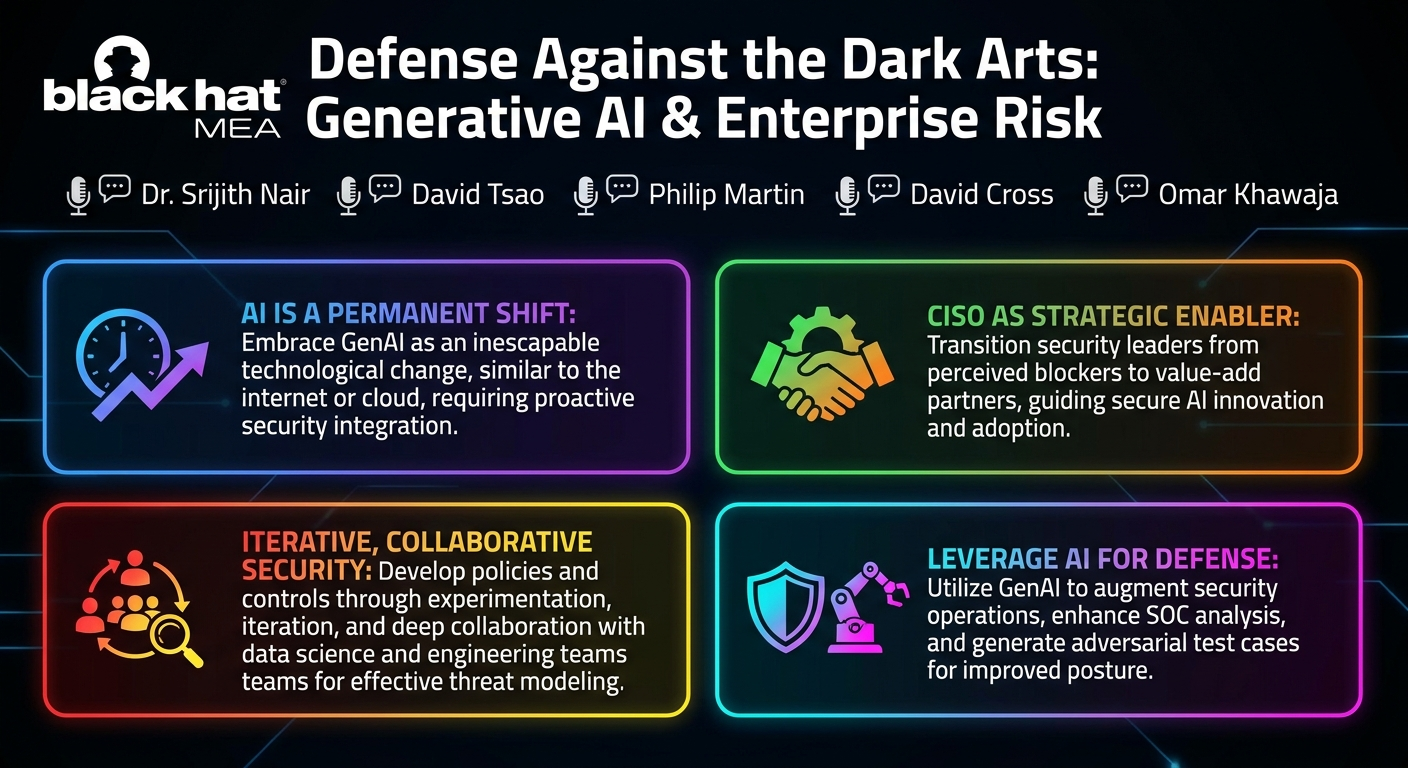
- Embrace, Don't Ignore: Generative AI is a permanent technological shift that enterprises cannot afford to ignore; security must proactively engage and guide its adoption.
- Speed, Not Just Innovation: AI primarily accelerates existing processes and trends, meaning security strategies must also become faster and more agile to counter accelerated threats.
- CISOs as Enablers: Security leaders must transition from being perceived as blockers to being strategic enablers, actively participating in AI initiatives and demonstrating value to the business.
- Iterative & Collaborative Security: Develop GenAI policies and security controls through experimentation, iteration, and deep collaboration with data science and engineering teams, leveraging collective expertise for effective threat modeling.
- Upskill and Adapt: Security professionals need to acquire foundational knowledge of AI/ML concepts to understand new attack surfaces (e.g., prompt injection, model serving, feature stores) and apply traditional security principles effectively.
- Leverage AI for Defense: Utilize GenAI to augment security operations, such as enhancing SOC analysis, generating adversarial test cases, and improving overall security posture.
About the Speaker(s)
- Dr. Srijith Nair: The CISO of Careem and the moderator for this panel, guiding the discussion on Generative AI and enterprise risk.
- David Tsao: The CISO at Instacart, responsible for IT and security, providing insights into balancing productivity pushes with security constraints in AI adoption.
- Philip Martin: The CISO at Coinbase, contributing perspectives on risk appetite, policy development, and the conceptual similarities of securing new technologies.
- David Cross: The SVP & CISO for Oracle SaaS Cloud, and also a Venture Partner with Rain Capital VC. He offered views on governmental executive orders and leveraging the startup community for AI expertise.
- Omar Khawaja: The Field CISO at Databricks, known for his work on the boards of High Trust and the FAIR Institute, and teaching at the CM CISO program at Carnegie Mellon. He provided critical insights into the disconnect between business and security, the ethical dimensions of AI, and the evolution of compliance.
Reviews
Dr. Zero (Offensive Security Researcher) — WEAK
Five major-league CISOs got on stage to tell the audience that AI is exactly like the cloud migration and security shouldn't say 'no.' It's a hollow echo chamber of LinkedIn thought leadership that offers zero concrete frameworks, zero actionable defensive metrics, and zero actual signal.
Heather Calloway (CISO) — SOLID
A pragmatic panel of veteran CISOs discussing how to govern enterprise GenAI adoption. It offers no groundbreaking frameworks, but it provides a highly credible baseline for updating third-party risk registers and SDLC processes. Worth routing to your risk committee if they are still treating AI like a science project instead of a shadow-IT reality.
→ Top-rated talks at Black Hat Middle East & Africa 2023 (Executive Summit)
All talks from Black Hat Middle East & Africa 2023 (Executive Summit)