Generative AI, Intelligence and Automation in Security Strategy
Chris Holden (Chief Client Officer · Recorded Future)
Black Hat Middle East & Africa 2023 (Executive Summit) · Day 2 · Executive Summit
Overview
In an era defined by rapid technological advancements and escalating global conflicts, Chris Holden, Chief Client Officer at Recorded Future, delivered a compelling address at Black Hat MEA, dissecting the profound impact of Generative AI on security strategy. Holden, a veteran with nearly 14 years at Recorded Future, the world's largest commercial intelligence provider, offered a nuanced perspective on how this transformative technology is simultaneously empowering adversaries and presenting unprecedented opportunities for defenders. The talk underscored a critical shift in the security landscape, where the convergence of cyber, physical, and information operations threats demands a new approach to intelligence and risk reduction.
Key moments
- 0:00 Introduction: AI, intelligence, and business risk
- 2:00 Threat convergence: cyber, physical, and information operations
- 4:00 Adversaries using AI for phishing and deepfakes
- 6:20 Connecting AI's potential to business risk outcomes
- 9:30 Recorded Future's digital twin and intelligence graph
- 14:00 Multimodal intelligence: AI amplifies data production
- 17:00 Automating the intelligence cycle with generative AI
- 19:30 AI transforming intelligence: a race, opportunity, and challenge
Generative AI, Intelligence and Automation in Security Strategy
Speakers: Chris Holden, Chief Client Officer, Recorded Future
Conference: Black Hat MEA
YouTube: https://www.youtube.com/watch?v=mQVwFumR5oU
Overview
In an era defined by rapid technological advancements and escalating global conflicts, Chris Holden, Chief Client Officer at Recorded Future, delivered a compelling address at Black Hat MEA, dissecting the profound impact of Generative AI on security strategy. Holden, a veteran with nearly 14 years at Recorded Future, the world's largest commercial intelligence provider, offered a nuanced perspective on how this transformative technology is simultaneously empowering adversaries and presenting unprecedented opportunities for defenders. The talk underscored a critical shift in the security landscape, where the convergence of cyber, physical, and information operations threats demands a new approach to intelligence and risk reduction.
Holden's presentation served as a clarion call for security leaders to move beyond the hype surrounding generative AI and strategically integrate it into their intelligence programs. He emphasized the paramount importance of aligning AI applications with tangible business outcomes, such as preventing financial loss and operational disruption. The core message resonated: while generative AI accelerates the capabilities of threat actors, it also offers a vital means for defenders to automate, augment, and accelerate their own efforts, transforming security into a human-machine partnership capable of addressing a rapidly expanding "big data problem."
The talk highlighted the urgent need for organizations to harness the vast and diverse streams of intelligence data – from internal telemetry to external threat landscapes – at the speed required to counteract sophisticated adversaries. By leveraging AI to process multimodal information and automate elements of the intelligence cycle, security teams can transition from reactive defense to proactive risk management. Holden's insights provided a strategic roadmap for security professionals navigating the complexities of modern threats, advocating for an intelligence-driven, AI-augmented defense posture.
Background
▶ Watch: Introduction: AI, intelligence, and business risk (0:00)
The current security landscape is characterized by a confluence of accelerating technological innovation, particularly in Artificial Intelligence, and a volatile geopolitical environment marked by significant global conflicts. Chris Holden articulated that this period represents both "exciting times" for technological opportunity and "dark times" due to the escalating risk to organizations. From Recorded Future's perspective, this era has seen a remarkable convergence of threat categories – cyber threat, physical threat, and information operations – to the point where they have become almost inseparable for intelligence practitioners. Examples like Russian espionage campaigns against Ukraine illustrate how these domains intertwine, from cyberattacks and physical conflict to the pervasive spread of disinformation via the internet.
Historically, intelligence operations have been heavily reliant on human analysts, with processes like collection, processing, production, and dissemination largely manual. However, the advent of generative AI fundamentally challenges this traditional model. As Holden noted, just two years ago, AI would not have dominated conference agendas to the same extent, indicating the explosive growth and adoption of this technology. This rapid evolution has created a significant challenge: adversaries are not merely observing these advancements; they are actively weaponizing them. Examples include automated phishing campaigns, vulnerability discovery, manipulation of physical devices for surveillance, and the generation of deepfakes and text for social media bots and disinformation.
The problem for defenders is multifaceted. First, the sheer volume of data relevant to security has become overwhelming, creating a "big data problem." Second, there's a chronic shortage of skilled security personnel to process and analyze this data effectively. Third, adversaries are leveraging AI to achieve unprecedented levels of efficiency and scale in their operations, from generating convincing phishing emails 70-90% complete to ideating complex disinformation narratives. This imbalance creates an urgent need for defenders to adopt similar capabilities, not just to keep pace, but to gain a decisive advantage. Holden critically emphasized that any adoption of generative AI must be connected to business outcomes, such as preventing financial loss or operational disruption, to avoid getting "caught up in the excitement of the technology" without delivering tangible value. This foundational understanding sets the stage for how AI can be strategically applied to reduce organizational risk.
Key Findings
▶ Watch: Adversaries using AI for phishing and deepfakes (4:00)
Chris Holden's presentation illuminated several critical findings regarding the transformative role of generative AI in security strategy:
- Adversaries are Rapidly Weaponizing Generative AI: Threat actors are already leveraging generative AI to enhance their efficiency and scale. Examples include the development of custom GPT models for automated phishing email creation, significantly reducing the time and effort required to craft convincing social engineering campaigns. Similarly, AI is being used for generating text for disinformation and deepfakes, automating vulnerability discovery, and even manipulating physical devices for surveillance or combat. This indicates a "buzz" in the criminal community mirroring the excitement in the legitimate tech world.
- Security Has Become a "Big Data Problem": Protecting against modern cyberattacks necessitates processing an enormous volume of internal and external data. This includes technical data (malware analysis, sandbox telemetry), open-source intelligence (security blogs, news), dark web collections, and community-identified threats. Generative AI further amplifies this challenge by exploding the production of content across various modalities.
- Multimodal Intelligence is Imperative: Effective intelligence programs must move beyond traditional text-based analysis to incorporate a wide array of data types. Holden stressed the importance of processing multimodal intelligence, including imagery, audio, and video, recognizing that adversaries are already leveraging these formats. AI capabilities are crucial for processing and deriving insights from this diverse, high-volume content.
- Human-Machine Teaming (Centaur Model) is the Future: The most effective security strategy involves a symbiotic relationship between human operators and AI. Holden used the term "Centaur" (or Transformer) to describe this model, where machinery enhances the capabilities of analysts, and human expertise, in turn, refines and improves AI models. This partnership creates efficiency gains and knowledge capabilities that would be impossible for either humans or machines alone.
- Generative AI Can Automate and Augment the Intelligence Cycle: AI offers significant opportunities to automate and accelerate various stages of the traditional intelligence cycle, from planning and direction (e.g., using internal telemetry to set priorities) to collection, processing (structuring vast amounts of data), production (automated summaries, long-form reports), and dissemination. This augmentation empowers analysts, providing them with specialized knowledge and analytical capabilities they might otherwise lack.
- Business Outcomes Must Drive AI Adoption: A recurring and central theme was the necessity of connecting generative AI applications directly to business outcomes. Holden cautioned against merely adopting technology for technology's sake, emphasizing that AI initiatives must demonstrably contribute to reducing financial loss, preventing operational disruption, and enhancing overall organizational resilience. This focus ensures that technological investments translate into tangible risk reduction.
Technical Deep Dive
▶ Watch: Recorded Future's digital twin and intelligence graph (9:30)
The technical core of Holden's talk revolved around how Recorded Future and other advanced security organizations are leveraging generative AI to address the "big data problem" in security intelligence. At the heart of Recorded Future's approach is the concept of a digital twin of the world. This involves ingesting and organizing a comprehensive array of information from across the globe – from open source intelligence, technical data (such as malware analysis and sandbox telemetry), and dark web collections, to community-identified threats. This vast and disparate data is then structured for both human operator use and algorithmic processing, facilitating machine-to-machine communication and analysis.
A key component of this architecture is the intelligence graph. This graph serves as a foundational layer, combining diverse data streams to provide a holistic view of threats. By linking entities like threat actors, malware, vulnerabilities, and compromised infrastructure, the intelligence graph enables advanced analytics that can inform both human threat analysts and automated security systems such as SIEM (Security Information and Event Management), SOAR (Security Orchestration, Automation, and Response), and ticketing systems. This comprehensive data set is designed to understand the external threat landscape, the organization's external threat surface (supply chain, exposed assets), and its internal digital footprint and telemetry. The power, Holden explained, lies in combining an organization's unique internal telemetry with this rich external intelligence to identify specific risks and implement targeted defenses.
The talk emphasized the critical shift towards multimodal intelligence. Traditional security intelligence has often focused on text-based data, but Holden highlighted the increasing necessity to process imagery, audio, and video. Adversaries are already exploiting these modalities, and generative AI is set to "absolutely explode" the amount of content in these different forms. Therefore, developing analytics and infrastructure capable of combining and processing these diverse assets – rather than treating them as independent "stovepipes" – is crucial for future defense. This involves building models, storage, and analytics that can derive insights from visual, auditory, and textual information simultaneously.
Generative AI's role extends to automating and augmenting the entire intelligence cycle. For instance, in the "planning and direction" phase, AI can process internal telemetry to help organizations set priorities by identifying what's most relevant to their specific risks. In the "collection and processing" stages, AI can handle enormous amounts of data, structuring it for exploitation. Holden provided a concrete example: a generative AI model summarizing all data related to cyberattacks impacting the UK over the last 30 days, complete with reference data. This capability significantly streamlines the "production" phase, allowing analysts to quickly generate long-form reports.
Furthermore, generative AI facilitates a chat interface for analysts, enabling them to ask first-order questions ("What have you seen?"), second-order questions ("What sort of business risk is introduced?"), and even hypothetical scenarios ("What if something goes wrong here?"). This augmented capability allows a threat intelligence team member, even without specialized regional or industry knowledge, to benefit from the machine's vast knowledge base, accelerating analysis and decision-making. This embodies the "Centaur" model, where human analysts, with their specialized skills and knowledge, train and refine the AI, while the AI, in turn, creates efficiencies and knowledge capabilities that would be otherwise unattainable, forming a continuous feedback loop.
Demo / Proof of Concept
▶ Watch: Multimodal intelligence: AI amplifies data production (14:00)
While Chris Holden's presentation did not include a live, interactive demonstration of a specific tool or proof of concept, he effectively described several compelling examples of how generative AI is being applied by both adversaries and defenders, illustrating the technology's practical implications.
On the adversary side, Holden cited the use of custom GPT models to develop highly efficient phishing email creation. He explained how this allows threat actors to generate text campaigns that are "maximally efficient with time," potentially creating content that is "70, 80, 90% complete," thereby freeing up the adversary to focus on tuning and testing. Another example involved generative AI in creating disinformation narratives, significantly boosting the efficiency of influence operations by automating the development of persuasive text components. These examples highlighted the "buzz" and innovation happening within the criminal community, paralleling legitimate technological advancements.
For defenders, Holden mentioned a published example of a new GPT model designed for threat modeling. This tool allows users to input information about an organization's business type, size, industry, location, and dynamics. In response, the AI "will spit out in an automated fashion a sense of the threat model where there might be risks to the organization." This capability offers an "incredible head start" for defensive teams in identifying potential vulnerabilities and prioritizing security efforts.
Holden also detailed how Recorded Future is developing its own generative AI capabilities to support the intelligence cycle. He described a scenario where a generative AI model could summarize vast amounts of data in response to a specific query, such as "what sort of cyber attacks have we seen impacting the UK over the last 30 days?" The model would provide a concise summary with reference data, enabling an analyst to quickly assemble a relevant report. Additionally, he spoke of a chat interface that allows analysts to interact with the AI, asking progressively deeper questions about threat intelligence, business risk, and potential outcomes. This augmentation provides analysts with immediate, specialized knowledge, significantly enhancing their productivity and analytical depth.
These examples, while not live demonstrations, served to concretely illustrate the practical applications and profound impact of generative AI on both sides of the security equation, emphasizing the technology's capacity to automate, augment, and accelerate critical processes.
Defensive Implications
▶ Watch: AI transforming intelligence: a race, opportunity, and challenge (19:30)
The insights shared by Chris Holden offer a clear mandate for security practitioners and organizations: embracing and strategically integrating generative AI is no longer optional but essential for effective defense. The core defensive implications can be summarized as follows:
- Strategic AI Adoption Tied to Business Outcomes: Defenders must prioritize generative AI initiatives that directly address business risk, such as preventing financial loss and operational disruption. It's crucial to avoid technology adoption for its own sake and instead focus on how AI can deliver measurable value in reducing organizational exposure. This requires a deep understanding of organizational priorities and a clear roadmap for AI implementation.
- Harnessing Multimodal Intelligence: The security community must develop capabilities to collect, process, and analyze multimodal data, including text, imagery, audio, and video. As adversaries increasingly use these diverse formats for attacks (e.g., deepfakes, audio manipulation), defenders need AI-driven analytics to derive insights from this exploding volume of content and identify emerging threats that might bypass traditional, text-centric systems.
- Building a Comprehensive Intelligence Graph: Organizations should strive to integrate all available data sources – internal telemetry (SIEM, SOAR, incident response logs) with external threat intelligence (open source, technical data, dark web, community feeds). This creates a holistic intelligence graph that provides a 360-degree view of the threat landscape, enabling more accurate risk assessments and proactive threat detection. Recorded Future's "digital twin of the world" concept exemplifies this integrated approach.
- Automating and Augmenting the Intelligence Cycle: Generative AI offers significant opportunities to automate laborious tasks within the intelligence cycle. Defenders should leverage AI for:
- Planning and Direction: Using internal data to inform threat modeling and prioritize intelligence requirements.
- Collection and Processing: Structuring and normalizing vast, disparate data sets for analysis.
- Production: Generating automated summaries, reports, and alerts, freeing analysts for more complex tasks.
- Analysis: Providing chat interfaces and augmented knowledge bases to empower analysts with on-demand expertise, fostering a Centaur (human-machine) model of collaboration.
- Proactive Threat Modeling with AI: As demonstrated by the mentioned GPT model for threat modeling, AI can provide an "incredible head start" in identifying potential risks. Defenders should explore and implement AI-powered tools that can rapidly assess an organization's threat surface based on its unique characteristics, enabling more agile and comprehensive risk management strategies.
- Developing AI-Powered Detections: Recognizing that AI accelerates adversary tool development, defenders must invest in building AI to detect these new threats. This involves developing machine learning models that can identify novel attack patterns, deepfake indicators, or automated phishing campaigns at scale and speed.
Ultimately, the defensive implications underscore that modern security is a big data problem requiring a strategic, intelligence-driven approach powered by generative AI. Organizations that embrace these principles, focusing on efficiency, augmentation, and a strong connection to business outcomes, will be better positioned to reduce risk and protect against the rapidly evolving threat landscape.
Key Takeaways
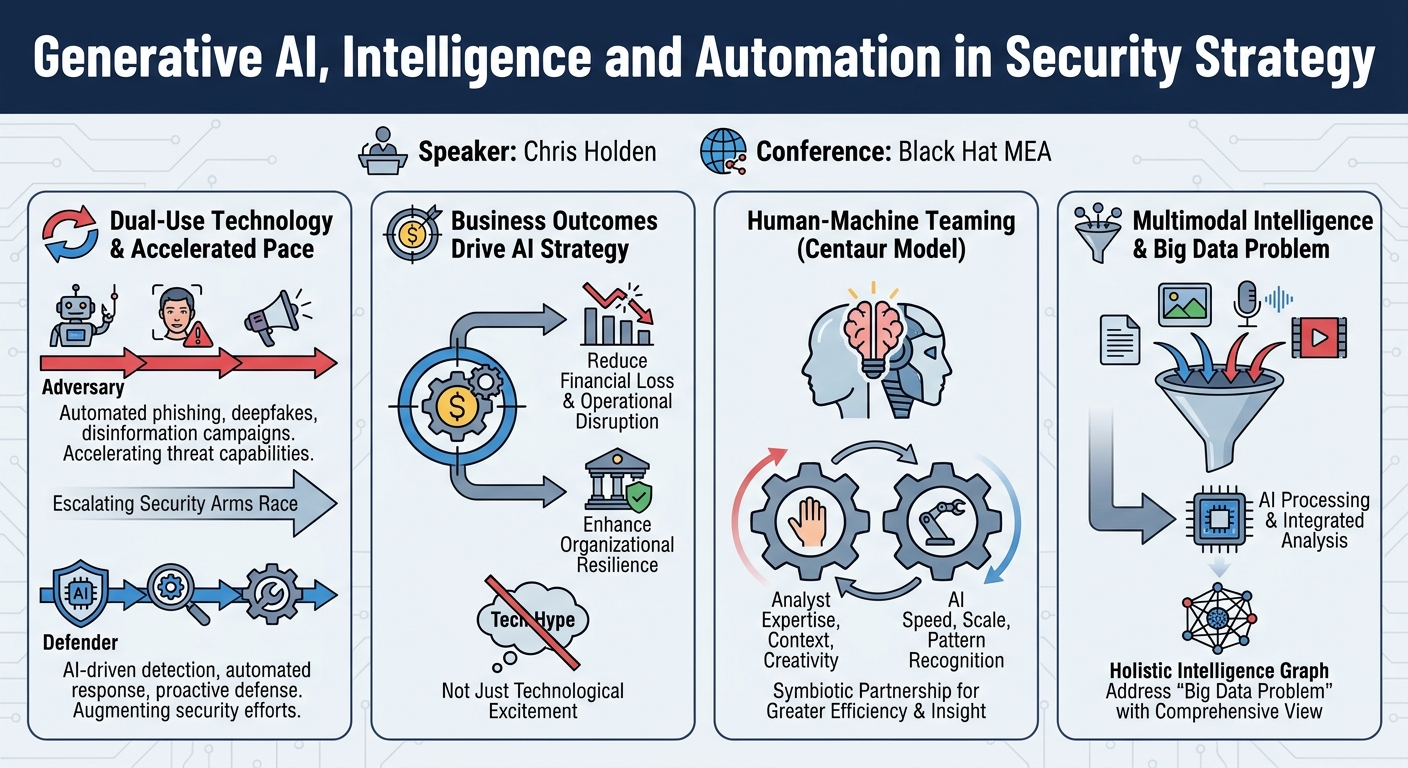
- Generative AI is a Dual-Use Technology: It is rapidly transforming both adversary capabilities (e.g., automated phishing, deepfakes, disinformation) and defender opportunities, accelerating the pace of the security arms race.
- Business Outcomes Must Drive AI Strategy: The adoption of generative AI in security must be explicitly tied to reducing tangible business risks, such as financial loss and operational disruption, rather than solely focusing on technological excitement.
- Multimodal Intelligence is Essential for Comprehensive Defense: Effective security requires processing diverse data types—text, imagery, audio, and video—as adversaries exploit all modalities, and AI is amplifying content production across these forms.
- Human-Machine Teaming (Centaur Model) is the Future: The most effective security strategy involves a symbiotic partnership between human analysts and AI, where each augments the other's capabilities, leading to greater efficiency and deeper insights.
- Automation of the Intelligence Cycle is Critical: Generative AI can significantly automate and accelerate every stage of the intelligence cycle, from planning and collection to processing, production, and dissemination, empowering analysts and improving response times.
- Security is a "Big Data Problem" Requiring Integrated Solutions: Protecting against modern threats necessitates combining vast internal telemetry with comprehensive external threat intelligence via platforms like an "intelligence graph" to gain a holistic and actionable view of risks.
About the Speaker(s)
Chris Holden is the Chief Client Officer at Recorded Future, a leading commercial intelligence provider. With nearly 14 years of experience at the company, Holden has been instrumental in its growth from effectively zero clients to approximately 2,000 today. His extensive tenure has provided him with a unique perspective on the evolution of intelligence programs built in service of security and risk management. Holden's role involves deeply understanding client needs and helping organizations leverage intelligence to achieve better security outcomes, making him a seasoned expert in the practical application of intelligence and emerging technologies in the cybersecurity domain.
Reviews
Dr. Zero (Offensive Security Researcher) — HARD PASS
This isn't a Black Hat talk, it's a Recorded Future sales pitch wearing a trenchcoat. A Chief Client Officer spent his slot reading 2023's AI buzzwords off a prompter to sell their threat intel platform's new LLM wrapper. Absolutely nothing of technical, strategic, or operational value was delivered here.
Heather Calloway (CISO) — WEAK
This is a polished vendor narrative wrapping the current AI zeitgeist in intelligence marketing. While the call to tie AI adoption to business outcomes is correct, the presentation lacks the governance and operational mechanics required to actually deploy these systems. Your leadership team can skip this; they have already heard the pitch that AI is a big data problem.
→ Top-rated talks at Black Hat Middle East & Africa 2023 (Executive Summit)
All talks from Black Hat Middle East & Africa 2023 (Executive Summit)