Anatomy of a Cybersecurity Professional
Brett Matthes (CISO · Coupang)
Black Hat Middle East & Africa 2023 (Executive Summit) · Day 2 · Executive Summit
Overview
In his compelling Black Hat MEA talk, "Anatomy of a Cybersecurity Professional," Brett Matthes, the Chief Information Security Officer (CISO) at Coupang, offered a refreshing perspective on the essential attributes that define not just a successful CISO, but any impactful cybersecurity professional. Moving beyond the conventional focus on purely technical prowess, Matthes meticulously outlined the "power skills" or "soft skills" critical for navigating the complex landscape of modern organizational security. This presentation served as a vital call to action for the cybersecurity community, urging a shift in mindset from being perceived as the "no police" to becoming indispensable business enablers.
Key moments
- 2:00 How I discovered my passion for hacking
- 6:45 Why I decided to become a CISO
- 8:20 Shifting security focus: Enable, not just secure
- 11:00 Identifying and evaluating business risks effectively
- 13:55 Effective communication: Talk business objectives, not security
- 15:45 Be the solution, not the problem
- 18:00 Building a strong, complementary security team
Anatomy of a Cybersecurity Professional
Speakers: Brett Matthes (CISO, Coupang)
Conference: Black Hat MEA
YouTube: https://www.youtube.com/watch?v=qMSVxx_Qzzs
Overview
In his compelling Black Hat MEA talk, "Anatomy of a Cybersecurity Professional," Brett Matthes, the Chief Information Security Officer (CISO) at Coupang, offered a refreshing perspective on the essential attributes that define not just a successful CISO, but any impactful cybersecurity professional. Moving beyond the conventional focus on purely technical prowess, Matthes meticulously outlined the "power skills" or "soft skills" critical for navigating the complex landscape of modern organizational security. This presentation served as a vital call to action for the cybersecurity community, urging a shift in mindset from being perceived as the "no police" to becoming indispensable business enablers.
Matthes's address is particularly significant in an era where cybersecurity is no longer an isolated IT function but a fundamental pillar of business continuity and innovation. He argued that while deep technical understanding remains foundational, the ability to strategically align security with business objectives, effectively manage risk, communicate persuasively, and foster a solution-oriented culture are paramount. For CISOs and aspiring leaders, this talk provided a practical framework for cultivating influence, building robust teams, and ensuring security efforts directly contribute to organizational success rather than impeding it.
The talk resonates deeply with the evolving demands placed on security leaders, who must bridge the gap between highly specialized technical teams and executive-level business stakeholders. By sharing his personal journey and the transformative strategies implemented at Coupang, Matthes demonstrated that the true "anatomy" of a top-tier cybersecurity professional is characterized by a blend of technical acumen, strategic foresight, and exceptional interpersonal skills—qualities that empower security to drive, not merely protect, the enterprise mission.
Background
▶ Watch: How I discovered my passion for hacking (2:00)
Brett Matthes’s journey into cybersecurity leadership is a testament to an unconventional path, illustrating how diverse experiences forge a holistic understanding of security’s role. His early aspirations, initially ranging from a Ninja Turtle to a Transformer and later a fighter pilot, gave way to a pivotal moment at age 10 when his father introduced him to programming via a QBasic book. This ignited a passion that quickly led him to discover the thrill of "hacking" – specifically, bypassing copy protection on a popular game by editing its binary in a hex editor to zero out manual codes. This early foray into understanding and manipulating software laid the foundation for his future career, albeit one that, at the time, lacked a formal "hacker school" career path.
In the 1990s, with no clear route for a professional hacker, Matthes started a small programming company. This entrepreneurial venture instilled critical business acumen: the urgency of delivering results to ensure revenue, pay employees, and cover operational costs. It also exposed him to early cybersecurity challenges like SQL injection, spam, and DDoS attacks, both from a defensive and occasionally an offensive perspective. This practical, hands-on experience was invaluable.
His career then progressed to the Australian Department of Defense, where he delved deeply into reverse engineering, exploit development, and offensive cyber operations. He eventually led Australia's offensive cyber capabilities, gaining profound insights into national security missions and the art of crafting effective "decision briefs" for senior leadership – a crucial skill for communicating complex technical issues in a high-stakes environment.
Despite this impressive offensive background, Matthes initially harbored a strong aversion to becoming a CISO, viewing it as a thankless, defensive role burdened by stress and blame. This perspective shifted dramatically when he joined Coupang, a major South Korean e-commerce company, as Head of Red Team. Witnessing Coupang's 6 AM morning deliveries to countless small, family-run businesses across Korea, he recognized the profound societal impact of their operations. He realized that a security breach, ransomware attack, or PII (Personally Identifiable Information) disclosure would not just be a technical incident but a catastrophic disruption to tens of thousands of livelihoods. This epiphany, coupled with the opportunity to step into the CISO role post-IPO, transformed his understanding: security was not merely about protection, but about enabling the critical mission of the business. This realization underscores why the problem exists – a common disconnect between security teams and the broader business objectives, often leading to security being perceived as a roadblock rather than a partner.
Key Findings
▶ Watch: Shifting security focus: Enable, not just secure (8:20)
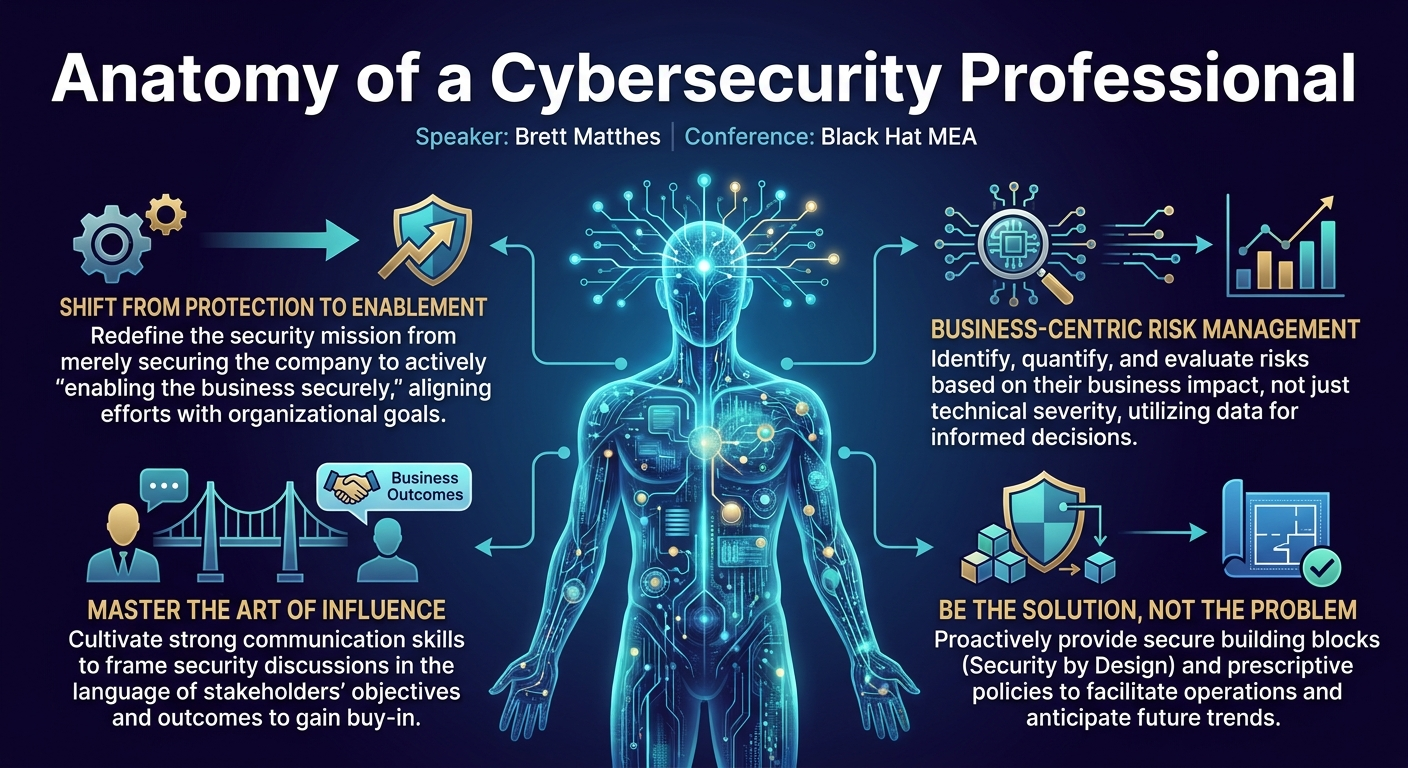
Matthes's core contribution is his identification of four critical "power skills" that form the anatomy of a cybersecurity professional, particularly a CISO. These attributes transcend technical skills, focusing instead on strategic leadership and organizational impact.
- Focused on Enabling the Mission: The most fundamental shift Matthes advocates is redefining the security organization's purpose. He changed Coupang's security vision from "secure Coupang" to "enabling Coupang securely." This seemingly pedantic change is profound: it moves security from a purely protective, often adversarial, stance to one that actively facilitates business objectives. He illustrates this with the analogy of a perfectly secure computer that is turned off and encased in concrete – impenetrable, but utterly useless. True security, he argues, understands the business goals and aligns its efforts to ensure those goals are met with security in mind, rather than security being a barrier. This means security teams must understand the developers' drive for speed and delivery, and find ways to integrate security without causing misalignment or acting as the "no police."
- Risk Identification and Management: Matthes emphasizes that the role of an information security organization is not to eliminate risk entirely, but to effectively identify, quantify, evaluate, and make informed decisions about accepting or mitigating risks. Crucially, he frames these as business risks, not just cybersecurity risks. A data breach, for instance, is a risk to the business's ability to operate, not merely a technical vulnerability. He highlights the challenge of transforming raw data from vulnerability scanners, penetration testing, log ingestion, CTI (Cyber Threat Intelligence), and SBOMs (Software Bill of Materials) into meaningful information for senior leadership. This requires observability across the network and traceability of data flow to present a clear, imminent picture of risk that allows for data-driven decisions.
- Strong Communication / Social Engineering: Matthes views strong communication as a form of "social engineering" – the ability to influence other leaders and stakeholders. The key, he argues, is to **talk about their objectives and outcomes, not just security**. By demonstrating an understanding of their goals and showing how security issues jeopardize those goals, security professionals can gain receptive audiences. He notes that when risks are framed this way, business leaders often become more conservative about risk than security teams and even propose novel mitigation strategies from their domain expertise. This transforms security from a roadblock into an assistant, fostering collaboration and self-moderation across the organization.
- Being the Solution, Not the Problem: Cybersecurity professionals too often present problems without solutions. Matthes urges a shift to being the solution. While there are times to say "no" to unacceptable risks, an effective CISO also helps the company achieve its results. This involves leveraging networking and benchmarking to bring best practices and solutions, promoting security by design by providing secure building blocks, and ensuring policies describe how to do things securely, not just what not to do. Most importantly, it requires anticipating future trends (e.g., generative AI) and proactively developing secure paths forward, so that when urgent business needs arise, security is already prepared with solutions, becoming an enabler rather than an impediment. Finally, he stresses the importance of building a strong, diverse team that complements the CISO's strengths and compensates for weaknesses, ensuring that no single individual is a point of failure and the collective is stronger than the sum of its parts.
Technical Deep Dive
▶ Watch: Identifying and evaluating business risks effectively (11:00)
This particular talk, "Anatomy of a Cybersecurity Professional," explicitly steers away from a traditional technical deep dive into specific code, protocols, or architectural vulnerabilities. Instead, it focuses entirely on the "power skills" and leadership attributes essential for cybersecurity leaders. Brett Matthes's presentation is a strategic and philosophical exploration of how cybersecurity professionals should operate within an organization, rather than what specific technical tools or methods they should employ.
However, it is crucial to understand that Matthes's ability to articulate these strategic insights is deeply rooted in his extensive technical background. His personal narrative highlights early technical engagements with QBasic programming and hex editing to bypass copy protection, which he describes as his first foray into "hacking." Later, his experience running a small programming company exposed him to practical technical challenges like defending against SQL injection, spam, and DDoS attacks. His tenure in the Australian Department of Defense immersed him in highly technical domains such as reverse engineering, exploit development, and leading offensive cyber capabilities. These experiences provide him with an intimate understanding of the technical risks and challenges that underpin business operations, even as he advocates for a higher-level, business-centric approach to security leadership.
While the talk does not detail specific technical implementations, it implicitly references the technical foundations required to execute the strategic principles. For instance, in discussing risk identification and management, Matthes mentions the need for observability across the network and traceability of data flow, which are inherently technical capabilities relying on robust logging, monitoring, and data analytics solutions. He also lists various data sources like login ingestion, vulnerability scanners, CTI (Cyber Threat Intelligence) feeds, and SBOMs (Software Bill of Materials) – all technical artifacts that generate the raw data CISOs must synthesize into actionable business insights. The concept of security by design, though presented as a strategic principle, necessitates deep technical understanding to build secure building blocks and integrate security into the software development lifecycle. Therefore, while the presentation itself is non-technical, it underscores that a profound technical understanding remains the bedrock upon which effective cybersecurity leadership must be built, enabling leaders to understand the implications of technical decisions on business outcomes.
Demo / Proof of Concept
▶ Watch: Be the solution, not the problem (15:45)
This presentation, focusing on leadership principles and the strategic evolution of a cybersecurity professional, did not include a live technical demonstration or proof of concept. The "proof of concept" presented by Brett Matthes was his own career trajectory and the successful transformation of Coupang's security organization by applying the very "power skills" he advocates. His narrative, from an aspiring hacker to a CISO enabling a multi-billion dollar e-commerce platform, served as the primary evidence for the efficacy of his approach.
Defensive Implications
▶ Watch: Building a strong, complementary security team (18:00)
The insights shared by Brett Matthes carry profound defensive implications for organizations and cybersecurity professionals at all levels. Shifting the paradigm from security as a standalone function to security as a business enabler fundamentally changes how defenses are conceptualized and implemented.
- Redefine the Security Mission: Organizations should re-evaluate their security mission statements to explicitly reflect business enablement. Instead of merely "securing the company," the focus should be on "enabling the business securely." This encourages security teams to understand and align with core business objectives, fostering a collaborative environment where security is seen as a partner in achieving goals, not just a barrier. This also means moving beyond a "no" culture to one that seeks to provide secure alternatives or "how-to" guidance.
- Holistic Risk Management: Defenders must move beyond solely technical risk assessments to embrace a holistic business risk framework. This involves actively identifying, quantifying, and evaluating risks in terms of their potential impact on business objectives, rather than just their technical severity. Leveraging data from vulnerability scanners, CTI, SBOMs, and log ingestion is crucial, but the emphasis must be on transforming this raw data into actionable business intelligence for senior stakeholders. This requires robust observability and data traceability to make informed decisions about risk acceptance, mitigation, or transfer.
- Enhance Communication and Influence: Security professionals need to cultivate strong communication skills, effectively becoming "social engineers" within their organizations. This means framing security discussions in the language of business outcomes and stakeholder objectives. By demonstrating an understanding of what other departments are trying to achieve and showing how security helps them succeed, defenders can influence decision-making, gain buy-in, and foster a shared responsibility for security across the enterprise. This persuasive approach can lead to proactive engagement from business units, who may even self-moderate or propose novel security solutions.
- Proactive, Solution-Oriented Security: Instead of reacting to problems, security teams should proactively seek to be part of the solution. This includes implementing security by design principles by providing developers with vetted, secure building blocks and architectural patterns. Policies should be prescriptive, outlining how to achieve security objectives, not just what to avoid. Defenders must anticipate future technological trends, such as the adoption of generative AI, and pre-emptively develop secure strategies and frameworks. By being prepared with solutions, security becomes an accelerator for innovation rather than a bottleneck.
- Build Diverse and Complementary Teams: CISOs and security leaders should prioritize building teams with a diverse mix of skills, including not just technical expertise (engineering, IR), but also policy, risk management, and crisis management. The emphasis should be on complementing the leader's strengths and compensating for their weaknesses. A well-rounded team ensures comprehensive coverage of security domains and resilience, preventing any single point of failure and fostering a more robust, adaptable defensive posture.
Key Takeaways
- Shift from Protection to Enablement: Cybersecurity's core mission should evolve from solely "securing the company" to "enabling the business securely," aligning security efforts directly with organizational objectives.
- Business-Centric Risk Management: Effective security leadership involves identifying, quantifying, and making informed decisions about business risks, not just technical vulnerabilities, using data from various sources like vulnerability scanners and CTI.
- Master the Art of Influence: Strong communication, or "social engineering," is paramount; security professionals must frame discussions in terms of stakeholders' objectives and outcomes to gain buy-in and foster collaboration.
- Be the Solution, Not the Problem: Proactively provide secure building blocks (security by design), offer prescriptive policies, and anticipate future technological needs (e.g., generative AI) to facilitate business operations rather than impede them.
- Strategic Team Building: Cultivate a diverse team that complements the leader's strengths and weaknesses, encompassing a broad range of skills from engineering and incident response to policy and risk management, to ensure comprehensive security coverage.
About the Speaker(s)
Brett Matthes is the Chief Information Security Officer (CISO) at Coupang, a leading e-commerce company based in South Korea. His career trajectory is marked by a blend of deep technical experience and strategic leadership. Matthes began his journey with an early passion for programming and "hacking" in his youth, which led him to start his own programming company. He later served in the Australian Department of Defense, where he gained extensive experience in reverse engineering, exploit development, and leading offensive cyber capabilities and intelligence missions. This background provided him with a profound understanding of the offensive side of cybersecurity.
Before becoming CISO at Coupang, he served as the Head of Red Team there. His transition to the CISO role was driven by a realization of the critical business and societal impact of security, particularly for Coupang's vast network of small businesses relying on their delivery services. Matthes is a strong advocate for focusing on "power skills" – such as mission enablement, risk communication, and solution-oriented thinking – to elevate the impact of cybersecurity professionals within organizations. He champions the idea that effective security leadership requires balancing technical acumen with strategic business alignment and strong interpersonal skills.
Reviews
Dr. Zero (Offensive Security Researcher) — WEAK
Brett Matthes has a serious offensive resume, but this talk is a compilation of every CISO LinkedIn post from the last decade. It's 'Security as a Business Enabler' 101. If you're at Black Hat, you deserve concrete mechanics on how a post-IPO giant actually models risk, not generic advice to stop being the 'department of no.'
Heather Calloway (CISO) — SOLID
Brett Matthes traces his journey from offensive operator to CISO at Coupang, arguing for security as a business enabler rather than the department of 'no.' The core message is undeniably true, but it is also well-worn territory. This is a solid baseline primer for newly promoted security directors, but veteran executives won't find a new playbook here.
→ Top-rated talks at Black Hat Middle East & Africa 2023 (Executive Summit)
All talks from Black Hat Middle East & Africa 2023 (Executive Summit)