A Call for Action: The Journey to Zero Incidents
Saeed Al Saeed (CEO · Cyberani)
Black Hat Middle East & Africa 2023 (Executive Summit) · Day 1 · Executive Summit
Overview
In a compelling presentation at Black Hat MEA, Saeed Al Saeed, CEO of Cyberani, delivered a critical address titled "A Call for Action: The Journey to Zero Incidents." This talk served as a powerful reminder of the escalating global cybersecurity threat landscape and advocated for the comprehensive adoption of Zero Trust principles as a fundamental paradigm shift. Al Saeed, drawing on over two decades of experience with Saudi Aramco and his current leadership role at Cyberani, a joint venture specializing in operational technology (OT) and industrial cybersecurity, emphasized that achieving a state of "zero incidents" is not merely an aspiration but a strategic imperative in today's interconnected and volatile digital world.
Key moments
- 0:00 Introduction to speaker and Zero Trust concept
- 2:00 Global rise and financial impact of cyber attacks
- 4:00 Growing attack surface with IT/OT convergence
- 6:00 Core principles of the Zero Trust framework
- 8:00 First Domain: Empowered governance and supply chain security
- 12:00 Third Domain: Challenges of Zero Trust in IoT/OT environments
- 14:00 Fourth Domain: Leveraging and securing emerging technologies
A Call for Action: The Journey to Zero Incidents
Speakers: Saeed Al Saeed, CEO, Cyberani
Conference: Black Hat MEA
YouTube: https://www.youtube.com/watch?v=Ify70ai0QXw
Overview
In a compelling presentation at Black Hat MEA, Saeed Al Saeed, CEO of Cyberani, delivered a critical address titled "A Call for Action: The Journey to Zero Incidents." This talk served as a powerful reminder of the escalating global cybersecurity threat landscape and advocated for the comprehensive adoption of Zero Trust principles as a fundamental paradigm shift. Al Saeed, drawing on over two decades of experience with Saudi Aramco and his current leadership role at Cyberani, a joint venture specializing in operational technology (OT) and industrial cybersecurity, emphasized that achieving a state of "zero incidents" is not merely an aspiration but a strategic imperative in today's interconnected and volatile digital world.
The core message of the presentation revolved around the idea that traditional perimeter-based security models are no longer sufficient to protect critical assets against sophisticated and persistent threats. Instead, organizations must embrace a proactive stance, assuming breach and treating all users, devices, and systems as untrusted until rigorously verified. Al Saeed highlighted the practical and programmatic approaches outlined by frameworks like NIST, stressing that Zero Trust is not a one-time implementation but a continuous journey requiring deep integration into an organization's cybersecurity DNA. This article delves into the critical insights shared by Al Saeed, exploring the context, technical underpinnings, and actionable strategies for navigating this journey.
Background
▶ Watch: Introduction to speaker and Zero Trust concept (0:00)
The concept of Zero Trust, while gaining significant traction in recent years, emerged several years ago as a theoretical ideal before evolving into a structured, practical framework, notably championed by organizations like NIST. This evolution was driven by an undeniable shift in the global threat landscape. Al Saeed underscored the alarming statistics: an estimated 8,000 to 10,000 cyberattacks per second globally, with the financial ramifications burdening organizations for an average of three years per incident. This pervasive threat is further complicated by the evolving nature of attackers, moving from independent hackers to increasingly sophisticated state-sponsored threat actors whose primary aim often extends beyond financial gain to holding entities hostage and targeting national critical infrastructure.
A poignant example cited was the massive cyberattack on Australian ports operated by DP World, which brought port operations to a standstill, taking weeks to restore. This incident vividly illustrates the profound impact of cyberattacks on physical operations and national economies. Furthermore, the increasing prominence of regions like Saudi Arabia, hosting major international events such as the Asian Winter Olympics and World Cup, elevates their risk profile, making robust cybersecurity measures more critical than ever. The convergence of Information Technology (IT) and Operational Technology (OT) networks has exponentially expanded the attack surface, introducing not only traditional data loss concerns but also significant risks to health, safety, and the environment. Supply chain integration further complicates the security posture, demanding increased due diligence on third-party partners who handle sensitive data and critical transactions. Compounding these challenges, regulatory mandates are increasingly driving security requirements, with severe commercial consequences for non-compliance. These factors collectively necessitate a departure from traditional "security wall" approaches towards more agile and adaptive security models, such as those embodied by Zero Trust, capable of addressing the complexities introduced by dispersed workforces, DevOps practices, and the blurring lines between professional and personal digital lives.
Key Findings
▶ Watch: Growing attack surface with IT/OT convergence (4:00)
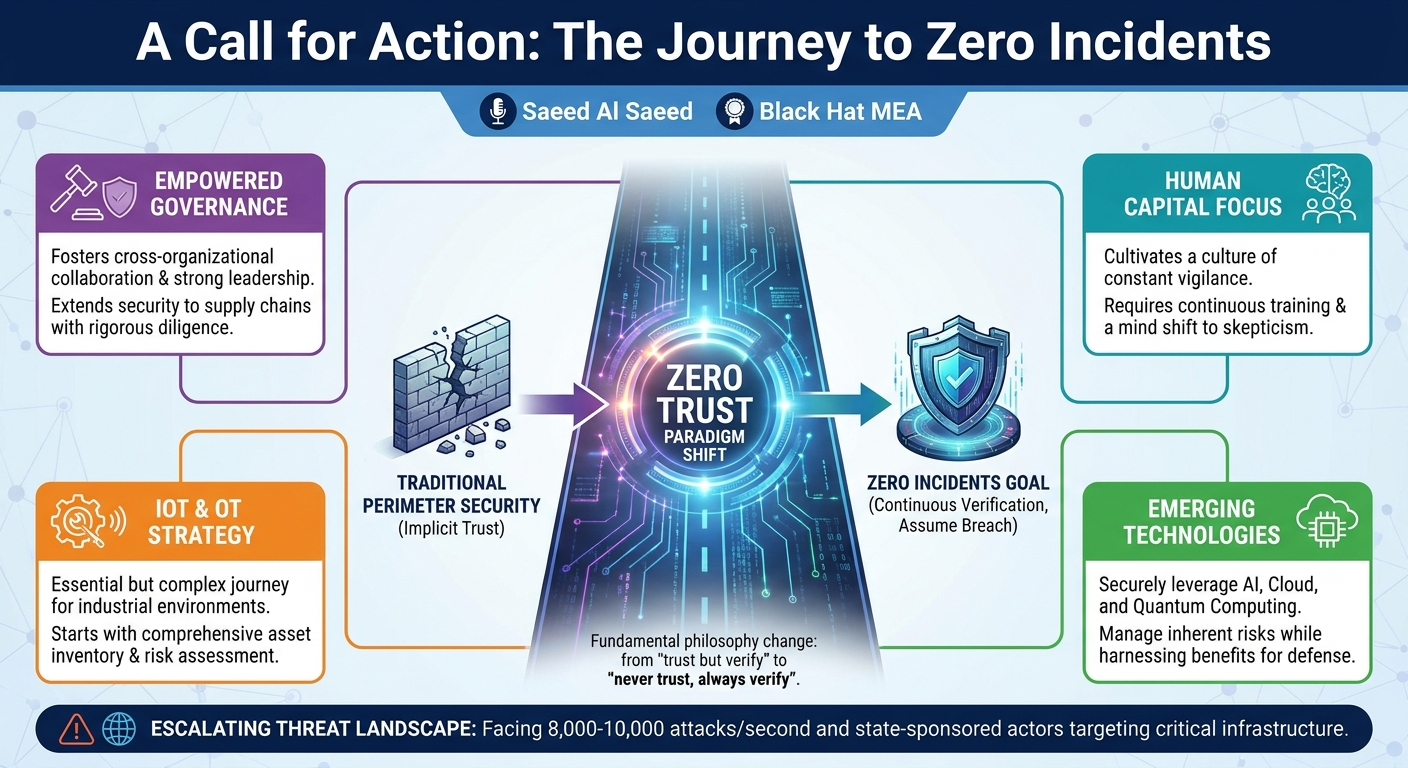
Al Saeed's presentation articulated a clear set of key findings, centering on the imperative for a fundamental shift in cybersecurity strategy towards Zero Trust. The overarching finding is that Zero Trust is not merely a technology but a paradigm shift that organizations must embrace, adapt, and embed into their core cybersecurity DNA to effectively counter the escalating and evolving threat landscape. This paradigm operates on the principle of "assume breach," treating all internal and external entities as untrusted and requiring continuous verification.
The speaker identified four critical domains that underpin a successful Zero Trust implementation journey:
- Empowered Governance: Effective Zero Trust adoption requires strong leadership, cross-organizational collaboration, and robust regulatory support, extending to supply chain security and global information sharing.
- Human Capital Focus: People are at the center of Zero Trust. A successful implementation hinges on cultivating a security-aware culture, continuous training, and fostering a mindset of constant vigilance.
- Renewed Focus on IoT and OT Strategy: Industrial and operational environments, historically designed without security as a primary concern, represent a significant vulnerability. Integrating Zero Trust into these complex systems is a longer, more challenging, but absolutely essential endeavor.
- Adoption of Emerging Technologies: While new technologies like Cloud, AI, and Quantum Computing offer immense opportunities, they also introduce unique and significant cybersecurity risks. Zero Trust principles must be applied to manage these risks effectively, leveraging new technologies for defense while mitigating their inherent vulnerabilities.
Ultimately, the core finding is that achieving "zero incidents" is a long, integrated journey where these four elements must work cohesively, reinforcing each other to deliver practical and pragmatic outcomes in a world where cyberattacks are an inevitable reality.
Technical Deep Dive
▶ Watch: Core principles of the Zero Trust framework (6:00)
The journey to Zero Incidents, as outlined by Saeed Al Saeed, is a multifaceted endeavor deeply rooted in the practical application of Zero Trust principles across four interconnected domains. These domains provide a structured approach to transition from traditional, perimeter-centric security to a model of continuous verification and least privilege.
Empowered Governance
The foundation of any successful Zero Trust implementation lies in robust and empowered governance. This domain emphasizes the critical need for coordinated efforts among various stakeholders, including government entities, regulatory bodies, and private sector companies. The objective is to eliminate silos and create platforms for information sharing, enabling a more effective response to the dynamic threat landscape. In Saudi Arabia, for instance, organizations like the National Cyber Security Authority and the Saudi Federation for Cyber Security, Programming, and Drones are instrumental in orchestrating these efforts, fostering integration and resilience.
A key aspect of empowered governance within a Zero Trust framework is the meticulous assessment of supply chain security. Given the deep integration of third parties, organizations must apply Zero Trust principles to their partners, ensuring that "assume breach" extends beyond their internal perimeter. This means rigorous due diligence, continuous monitoring of third-party access, and contractual obligations that enforce Zero Trust controls. Furthermore, Al Saeed highlighted the importance of supporting Small and Medium Enterprises (SMEs), which often serve as critical links in supply chains but may lack sophisticated security resources. Incentivizing Zero Trust projects, potentially through government programs or industry initiatives, is crucial to getting these projects "off the ground" and fostering a collective, global security posture against advanced, state-sponsored attacks. This global collaboration and information sharing are vital for collective defense, mirroring the interconnected nature of modern threats.
Human Capital Focus
At the heart of any security transformation, particularly one as profound as Zero Trust, lies human capital. Al Saeed stressed that people are not just a component but the central enabler of Zero Trust. This domain focuses on enhancing human capability through continuous training and development. Zero Trust represents a new paradigm, requiring a significant mind shift from implicit trust to explicit verification. Employees must be trained to understand and appreciate the fundamental concepts and approaches of Zero Trust, fostering a culture of constant vigilance where nothing is taken for granted.
The effectiveness of security measures dramatically increases when personnel are well-trained. This involves not only internal training programs but also leveraging a wider ecosystem, including universities, government-funded initiatives like TW Academy, and third-party training providers specializing in Zero Trust methodologies. The goal is to instill a deep understanding that vigilance is an ongoing requirement, and any doubt about access or activity should trigger a verification process. This human element ensures that the technological controls of Zero Trust are complemented by a proactive, security-conscious workforce.
Renewed Focus on IoT and OT Strategy
The third critical domain addresses the unique challenges posed by Internet of Things (IoT) and Operational Technology (OT) environments. These systems, particularly OT, have historically been designed for reliability and uptime, often with little to no consideration for cybersecurity. Consequently, traditional IT cybersecurity management processes, such as asset management and vulnerability management, are frequently absent or poorly implemented in OT environments. The number of cyber threats targeting IoT and OT has skyrocketed, making the integration of Zero Trust principles into these environments a paramount, albeit lengthy and complex, endeavor.
Implementing Zero Trust in an OT environment is acknowledged as an even longer and harder journey than in IT. The strategy begins with adopting a structured governance framework tailored to OT's specific requirements. This progresses step-by-step from conducting thorough asset assessments and inventory exercises—a foundational, yet often overlooked, step in OT—to risk identification, and finally, to building a governance model that explicitly links to Zero Trust principles. This involves segmenting OT networks, enforcing strict access controls for devices and users, continuous monitoring for anomalous behavior, and ensuring that any communication between OT and IT or external networks adheres to the "never trust, always verify" ethos. The ultimate aim is to secure critical infrastructure components that, if compromised, could have severe physical, environmental, and economic consequences.
Adoption of Emerging Technologies
The final domain acknowledges that emerging technologies are a double-edged sword. While they drive human development and business efficiency, each technological evolution introduces unique challenges and risks that must be carefully managed within a Zero Trust framework. Cloud computing, for instance, offers significant benefits but also poses substantial security risks due to its distributed nature and shared responsibility models. Applying Zero Trust to cloud environments involves micro-segmentation, identity-centric access controls, and continuous monitoring of cloud workloads and data flows.
Conversely, emerging technologies can also be leveraged to enhance cybersecurity posture. Artificial Intelligence (AI) is already widely used for advanced threat detection, identifying patterns and anomalies that human analysts might miss. However, the talk also highlighted technologies like Quantum Computing, which promises revolutionary digital transformation opportunities but simultaneously presents significant cybersecurity implications. The potential for quantum computers to break current encryption standards necessitates foresight and the development of quantum-resistant cryptography. This "double-edged sword" situation means organizations must not only adapt Zero Trust principles to secure new technologies but also explore how these technologies can be integrated into their Zero Trust architecture to improve overall defense capabilities, ensuring that innovation does not inadvertently create new vectors for attack. The call is to craft governance, cultivate culture, build architecture, and assess the sustainability impact of these technologies with Zero Trust as the guiding principle.
Demo / Proof of Concept
▶ Watch: Third Domain: Challenges of Zero Trust in IoT/OT environments (12:00)
The presentation by Saeed Al Saeed focused on strategic insights, theoretical frameworks, and practical implementation guidance for Zero Trust principles. It did not include a live demonstration or a proof of concept of any specific tools or technologies. The emphasis was on the overarching philosophy and the four critical domains required for a successful Zero Trust journey.
Defensive Implications
▶ Watch: Fourth Domain: Leveraging and securing emerging technologies (14:00)
The insights presented by Saeed Al Saeed carry profound defensive implications for organizations striving to secure their digital and operational assets. The fundamental shift to a Zero Trust architecture demands that defenders move away from perimeter-based security models and adopt a stance of "assume breach" at all times. This means that every access request, whether from inside or outside the network, must be authenticated, authorized, and continuously validated.
Defenders should prioritize the following actions:
- Establish Strong, Zero Trust-Aligned Governance: Implement a robust governance framework that mandates Zero Trust principles across the entire organization, from executive leadership down to individual contributors. This includes fostering government and business coordination, sharing threat intelligence, and eliminating internal silos that hinder effective security. Specific attention must be paid to supply chain security, treating third-party access with the same rigor as internal users, applying continuous verification and least privilege.
- Invest in Human Capital Development: Recognize that technology alone is insufficient. Defenders must invest heavily in training and education to cultivate a Zero Trust mindset throughout the workforce. This involves continuous security awareness training, specific Zero Trust methodology training for technical teams, and fostering a culture of vigilance where suspicious activities are reported and investigated without hesitation.
- Secure IoT and OT Environments with Deliberate Strategy: Given the unique vulnerabilities of operational technologies, defenders must develop a dedicated IoT and OT cybersecurity strategy. This journey begins with comprehensive asset inventory and risk assessment, followed by the implementation of Zero Trust controls like network segmentation, micro-segmentation, identity and access management (IAM) for devices and users, and continuous monitoring within these environments. Traditional IT security practices must be adapted and applied to OT, acknowledging its distinct operational requirements.
- Strategically Leverage and Secure Emerging Technologies: Defenders need to proactively assess the security implications of adopting new technologies such as Cloud, AI, and Quantum Computing. While embracing these for efficiency and enhanced defensive capabilities (e.g., AI for threat detection), Zero Trust principles must be integrated from the design phase. This includes implementing identity-centric controls for cloud resources, securing AI/ML pipelines, and preparing for future threats like quantum-resistant cryptography. The goal is to manage the inherent risks of these technologies while harnessing their benefits.
- Prioritize Continuous Verification and Response: Zero Trust is not a static state but a continuous process. Defenders must implement systems for continuous authentication, authorization, and monitoring of all users, devices, and applications. This includes advanced threat detection capabilities, automated response mechanisms, and a robust incident response plan built on the assumption that breaches will occur. The focus should be on minimizing the blast radius and rapidly containing any compromise.
By systematically addressing these areas, organizations can construct a resilient defensive posture capable of navigating the complex and ever-evolving cyber threat landscape, moving closer to the goal of "zero incidents" through proactive, verified trust.
Key Takeaways
- Zero Trust is a Paradigm Shift: It's not just a technology but a fundamental change in cybersecurity philosophy, moving from implicit trust within a perimeter to explicit, continuous verification for all access requests.
- Threat Landscape Demands Proactive Measures: With 8,000-10,000 attacks per second and state-sponsored threats targeting critical infrastructure, traditional security is insufficient; organizations must "assume breach."
- Four Pillars for Implementation: A successful Zero Trust journey requires a holistic approach across Empowered Governance, Human Capital Focus, a dedicated IoT/OT Strategy, and the Strategic Adoption of Emerging Technologies.
- Human Factor is Critical: Training, development, and cultivating a culture of constant vigilance are central to making Zero Trust effective, ensuring a "mind shift" towards continuous skepticism and verification.
- OT Security is a Long, Essential Journey: Industrial and operational environments, historically insecure, require a tailored Zero Trust strategy starting with asset inventory and risk assessment, acknowledging the unique challenges compared to IT.
- Leverage and Secure Emerging Tech: While technologies like AI can enhance defense, others like Cloud and Quantum Computing introduce new risks that must be managed with Zero Trust principles from inception.
About the Speaker(s)
Saeed Al Saeed is the Chief Executive Officer (CEO) of Cyberani, a joint venture established between Saudi Aramco and R technology. Prior to his current role, Al Saeed dedicated over 23 years of his career to Saudi Aramco, where he gained extensive experience in the cybersecurity domain. At Cyberani, he leads an organization specialized in providing comprehensive cybersecurity services, including managed services, products, and consulting. Cyberani is particularly noted as a leader in operational technology (OT) and industrial cybersecurity, leveraging its deep relationship and knowledge derived from Saudi Aramco's extensive industrial operations to expand expertise and services in this critical sector.
Reviews
Dr. Zero (Offensive Security Researcher) — HARD PASS
If you need a CEO to tell you that OT networks require asset inventory and that quantum computing is on the horizon, you shouldn't be at Black Hat. This is a hollow, buzzword-laden vendor keynote masquerading as thought leadership. 'Zero incidents' isn't a strategy; it's a marketing delusion.
Heather Calloway (CISO) — PASS
A generic vendor keynote built on buzzwords and the strategically dangerous premise of 'zero incidents.' There is nothing actionable here for a security program, just high-level platitudes about Zero Trust and OT convergence that ignore the realities of enterprise risk.
→ Top-rated talks at Black Hat Middle East & Africa 2023 (Executive Summit)
All talks from Black Hat Middle East & Africa 2023 (Executive Summit)