Why Track Your Vulnerability Management Program
Paul Baird (Chief Technical Security Officer · Qualys)
Black Hat Middle East & Africa 2023 (Executive Summit) · Day 1 · Executive Summit
Overview
In his Black Hat MEA talk, "Why Track Your Vulnerability Management Program," Paul Baird, Chief Technical Security Officer at Qualys, delivered a compelling address on the critical importance of effective measurement and communication within vulnerability management. Drawing from over 25 years of experience across various security roles—from infrastructure engineer to global head of cyber security—Baird argued that while cybersecurity and IT teams often execute their vulnerability management tasks with diligence, the process frequently falters at the reporting stage. This misalignment stems from reliance on poor, stale, or untrended data, leading to a disconnect between operational efforts and strategic insights presented to leadership.
Key moments
- 0:00 Introduction: The challenge of reporting vulnerability management
- 4:00 Key challenges in modern vulnerability management
- 6:00 Understanding the critical window of opportunity for attackers
- 7:50 Distinguishing between metrics and strategic KPIs
- 10:50 Six core KPIs for effective vulnerability management monitoring
- 13:40 Calculating and communicating overall 'True Risk' to the board
- 16:40 Tailoring KPI reporting to different audience types
Why Track Your Vulnerability Management Program
Speakers: Paul Baird, Chief Technical Security Officer, Qualys
Conference: Black Hat MEA
YouTube: https://www.youtube.com/watch?v=BENxigR749g
Overview
In his Black Hat MEA talk, "Why Track Your Vulnerability Management Program," Paul Baird, Chief Technical Security Officer at Qualys, delivered a compelling address on the critical importance of effective measurement and communication within vulnerability management. Drawing from over 25 years of experience across various security roles—from infrastructure engineer to global head of cyber security—Baird argued that while cybersecurity and IT teams often execute their vulnerability management tasks with diligence, the process frequently falters at the reporting stage. This misalignment stems from reliance on poor, stale, or untrended data, leading to a disconnect between operational efforts and strategic insights presented to leadership.
Baird's central thesis is that success in vulnerability management extends beyond merely identifying and patching vulnerabilities; it hinges on the ability to accurately monitor program performance, distill complex technical data into meaningful business risk indicators, and communicate these insights to the appropriate audience. He emphasizes that security professionals must move beyond simple metrics to embrace Key Performance Indicators (KPIs) that directly inform strategic decision-making and demonstrate a tangible reduction in organizational risk. The talk serves as a practical guide for security leaders and practitioners to refine their reporting methodologies, ensuring that the critical work of vulnerability management is understood, valued, and adequately supported at all levels of the business.
The presentation aims not to overhaul existing vulnerability management programs, but rather to equip organizations with the tools and mindset to report on their effectiveness accurately. By adopting a structured approach to KPI definition and audience-specific reporting, Baird contends that organizations can avoid the pitfalls of misleading information, fostering greater trust and enabling more informed resource allocation. This strategic shift is crucial in an increasingly complex and rapidly evolving threat landscape where the stakes for effective vulnerability management have never been higher.
Background
▶ Watch: Introduction: The challenge of reporting vulnerability management (0:00)
Paul Baird frames the necessity for robust vulnerability management tracking against a backdrop of significant shifts in the digital and threat landscapes. His extensive career, encompassing roles from infrastructure engineer to CISO, provides a grounded perspective on the challenges of managing vulnerabilities and communicating their impact to diverse stakeholders. He highlights a pervasive problem: cybersecurity and IT teams often perform "fantastic jobs" in the trenches, but reporting to peers and the board frequently results in misalignment due to inadequate data. Baird likens this to the famous UK meteorologist Michael Fish, who, based on available (but limited) data in 1987, famously dismissed warnings of a hurricane, only for the UK to be hit by its biggest storm, causing 1.5 billion pounds in damages and multiple fatalities. Baird argues that security professionals, like Fish, must avoid making claims they cannot substantiate with robust, trended data.
Several critical factors contribute to the escalating challenge of vulnerability management:
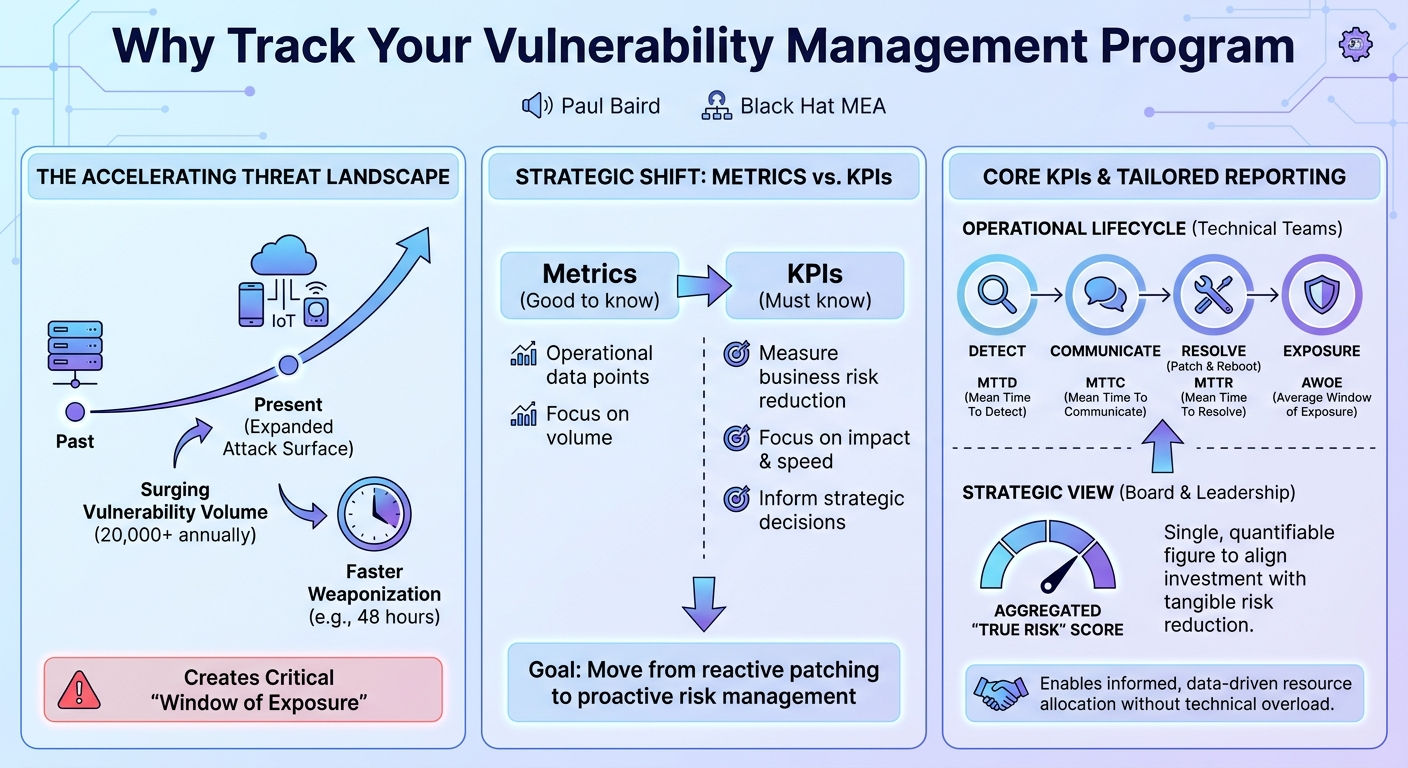
- Explosive Growth of the Digital Landscape: Twenty-five years ago, IT environments were simpler, often consisting of a few servers in a "broom closet." Today, organizations contend with vastly expanded attack surfaces encompassing cloud environments (e.g., OCI, Google Cloud), mobile devices, Operational Technology (OT), Internet of Things (IoT), and containers. This proliferation of assets makes comprehensive vulnerability detection and management exponentially more complex.
- Surging Volume of Vulnerabilities: The sheer number of new vulnerabilities discovered annually is unprecedented. In 2021, the world saw a record 20,171 unique vulnerabilities. This trend continued, with a 25% increase in unique vulnerabilities year-on-year in 2022. As of the talk in late 2023, the count had already reached 24,690, indicating another record-breaking year. This relentless influx overwhelms security teams, making prioritization and remediation incredibly challenging.
- Accelerated Weaponization of Vulnerabilities: The time from vulnerability disclosure to its active exploitation by threat actors has dramatically shrunk. Baird notes that in 2018, the average time to weaponize a vulnerability was approximately 352 days. However, by December 2021, when Log4Shell emerged, it took only 48 hours for it to be not only weaponized but actively exploited. This rapid shift means organizations have a significantly smaller window to patch before becoming targets, moving from months to days, and potentially, soon, to minutes.
- Critical Window of Exposure: Qualys's threat intelligence team presented data on weaponized CVEs from the previous year, highlighting a dangerous timeline. On average, it took 19 days for a disclosed vulnerability to be weaponized. It then took an average of 27 days for that vulnerability to be added to the CISA Known Exploited Vulnerabilities (KEV) list. While the US mandates a 21-day patching window for KEVs, Qualys customers, on average, are patching within 30 days. This leaves an alarming 11-day window of opportunity for threat actors to exploit vulnerabilities after they are weaponized but before they are typically remediated. Given the advanced capabilities of nation-state actors, AI, machine learning, and automation, Baird emphasizes that "11 days is a lifetime, is an eternity" for attackers. This shrinking window underscores the urgent need for faster, more efficient, and better-reported vulnerability management programs.
Key Findings
▶ Watch: Understanding the critical window of opportunity for attackers (6:00)
Baird's core message revolves around a fundamental distinction between metrics and Key Performance Indicators (KPIs). While a metric is a valuable data point that contributes to operational understanding ("good to know"), a KPI is a strategically vital metric that an organization must know, directly impacting business value and risk reduction. A KPI can be a metric, but not all metrics qualify as KPIs. This distinction is crucial for effective communication to leadership.
To effectively monitor a vulnerability management program, Baird proposes a three-step methodology:
- Ask a Series of Questions: Before defining what to measure, organizations must clarify their objectives. Questions include: "What outcomes do I want to illustrate?", "What are my measurable goals?", "What story am I trying to tell?", and crucially, "Who is the audience for this data?". Baird warns against the common pitfall of simply measuring "what can you measure," as this often leads to collecting irrelevant data that doesn't add value or lower business risk.
- Create a Baseline with Trended Data: A fundamental step, creating a baseline is essential for measuring progress. However, this baseline must be established using trended data—ideally over three to six months. Relying on a single "point in time" snapshot is dangerous, as it could represent an unusually good or bad day, skewing future performance evaluations and setting remediation efforts off course.
- Define a Set of Core KPIs: The final step involves identifying KPIs that are meaningful to the organization and, most importantly, contribute to lowering business risk. These KPIs should inform strategic decisions, not just operational tasks.
Baird then introduces his recommended set of six core KPIs that he has consistently used and advises Qualys customers to monitor:
- Mean Time To Detect (MTTD): The average time it takes for a vulnerability management solution to identify a vulnerability within the network.
- Mean Time To Communicate (MTTC): The average time it takes for cybersecurity teams to communicate detected vulnerabilities to IT or service delivery teams responsible for patching. This KPI highlights potential blockers or communication gaps between departments.
- Mean Time To Reboot (MTTRb): The average time from patch deployment to the actual reboot of an endpoint or asset, which is often necessary to fully remediate a vulnerability. This addresses the common issue where a patch is deployed but the vulnerability remains active due to delayed reboots.
- Mean Time To Resolve (MTTR): The overall average time it takes to fully fix a vulnerability, encompassing detection, communication, and remediation (including reboots).
- Average Window of Exposure (AWOE): A comprehensive KPI that measures the total time from when a vulnerability is publicly disclosed by a vendor until it is fully resolved within the organization. This metric captures the entire lifecycle of exposure.
- True Risk: The ultimate strategic KPI, representing a single, arbitrary figure that quantifies the organization's overall vulnerability risk. This figure should trend downwards if the program is effective and upwards if risk is increasing, providing a clear, high-level indicator for board members and CISOs.
A critical finding is the importance of audience segmentation when reporting these KPIs. Baird adopts marketing concepts of "below the line" (tactical/operational, targeted) and "above the line" (strategic, mass media) to differentiate audiences. Tactical and operational metrics (MTTD, MTTC, MTTRb, MTTR, AWOE) are suitable for technical teams and operational managers ("below the line"). However, only the True Risk score should be presented to senior leadership, board members, and department peers ("above the line"). This ensures that leaders receive strategic insights without being overwhelmed by technical minutiae, allowing them to align security spend and headcount with tangible risk reduction.
Technical Deep Dive
▶ Watch: Distinguishing between metrics and strategic KPIs (7:50)
The technical depth of Baird's talk resides in the meticulous definition and interrelation of his six core KPIs, designed to provide a holistic and actionable view of a vulnerability management program's performance. These KPIs move beyond simple vulnerability counts or patch percentages, aiming for a more nuanced understanding of the entire remediation lifecycle and its impact on an organization's security posture.
- Mean Time To Detect (MTTD): This KPI measures the efficiency of the vulnerability scanning and detection infrastructure. A low MTTD indicates a responsive and comprehensive scanning capability, ensuring that newly disclosed or emerging threats are identified quickly within the environment. This is the foundational step, as an undetected vulnerability cannot be remediated.
- Mean Time To Communicate (MTTC): This KPI addresses the often-overlooked human and process element of vulnerability management. In many organizations, cybersecurity teams identify vulnerabilities, but IT or operations teams are responsible for patching. MTTC quantifies the lag between detection and the successful handover of remediation information. A high MTTC signals communication breakdowns, organizational silos, or inefficient workflows that can significantly delay remediation, even if technical teams are otherwise efficient. Identifying these blockers is crucial for streamlining the end-to-end process.
- Mean Time To Reboot (MTTRb): This is a particularly insightful KPI, as Baird emphasizes that "traditional patch management systems would put a big green tick next to that because they've deployed the patch. What they haven't done is they haven't fixed the vulnerability." Many patches, especially in Windows environments, require a system reboot to take full effect. If asset owners delay reboots, the vulnerability persists, despite the patch being "deployed." MTTRb pinpoints these delays, allowing security teams to identify where the fault lies (e.g., with asset owners, maintenance windows) rather than solely blaming cybersecurity or IT. For systems not requiring reboots (like many Linux systems), this metric can be recorded as zero, maintaining its place in the overall calculation.
- Mean Time To Resolve (MTTR): This is the overarching operational KPI for remediation. It encapsulates the time from detection through communication, patching, and final remediation (including reboots). A consistently low MTTR indicates an efficient and effective remediation pipeline, demonstrating the security team's ability to eliminate vulnerabilities in a timely manner.
- Average Window of Exposure (AWOE): This KPI provides a comprehensive view of the entire vulnerability lifecycle from an external perspective. It starts from the point of vulnerability disclosure by the vendor or researcher and extends through detection, communication, patching, and ultimate resolution. This metric is critical because it quantifies the total duration during which an organization is susceptible to exploitation, regardless of internal processing times. AWOE effectively wraps the preceding operational KPIs into a single, end-to-end measure of exposure.
- True Risk: This is the pinnacle KPI, designed specifically for strategic communication. Baird stresses that board members and CISOs do not need to see individual operational KPIs. Instead, they require a single, aggregated, and easily understandable figure that represents the organization's overall vulnerability risk. Baird reveals that this "True Risk" score is calculated "under the hood of Qualys" using a complex formula. He explicitly warns against presenting the formula itself to senior leadership, as it would be counterproductive. The goal is to provide a single, trendable number that goes down when the organization is doing well and up when risk is increasing.
The relationship between these KPIs is illustrated by Baird as a timeline: "As time goes on, risk goes up."
- When a vulnerability is detected, the clock starts.
- It then needs to be communicated.
- After the fix is deployed, the device often needs to be rebooted.
- Finally, the vulnerability is resolved.
- All these steps contribute to the average exposure time, starting from the vendor's initial disclosure.
The "True Risk" score allows the board to directly correlate security investments (spend, headcount, managed services) with tangible outcomes. If investments are high but the True Risk score continues to rise, it signals a systemic problem—be it ineffective tools, misaligned personnel, or specific threat actor targeting. This enables a strategic discussion grounded in quantifiable impact, moving beyond anecdotal evidence or technical jargon.
Demo / Proof of Concept
▶ Watch: Calculating and communicating overall 'True Risk' to the board (13:40)
Paul Baird's talk is primarily a conceptual and strategic discussion about effective reporting and KPI definition in vulnerability management, rather than a demonstration of specific tools or techniques. As such, the presentation did not include a live demo or a detailed proof-of-concept of a vulnerability exploitation or remediation process.
However, Baird frequently references Qualys, his employer, as a platform designed to facilitate the very processes and calculations he advocates. He explicitly mentions that the complex formula for calculating "True Risk" is "under the hood of Qualys," implying that their vulnerability management platform provides the capabilities to generate these advanced KPIs. While a direct demonstration was absent, the talk serves as a theoretical framework supported by the practical capabilities offered by solutions like Qualys. The focus remained on the strategic implications of accurate data rather than the mechanics of a specific tool.
Defensive Implications
▶ Watch: Tailoring KPI reporting to different audience types (16:40)
The insights shared by Paul Baird offer critical defensive implications for organizations seeking to mature their vulnerability management programs and enhance their security posture. The core message is that effective defense requires not just remediation, but intelligent measurement and communication.
- Shift from Metrics to Strategic KPIs: Defenders must move beyond simply tracking raw vulnerability counts or patch rates. Instead, they should identify and monitor Key Performance Indicators (KPIs) that directly correlate with business risk reduction. This means focusing on the impact and speed of remediation rather than just the volume of activity.
- Implement the Six Core KPIs: Organizations should adopt Baird's recommended set of six KPIs:
- Mean Time To Detect (MTTD): Invest in comprehensive, continuous scanning and detection capabilities across the entire digital estate (cloud, mobile, OT, IoT, containers) to reduce the time from vulnerability existence to identification.
- Mean Time To Communicate (MTTC): Establish clear, efficient, and automated communication channels between cybersecurity, IT operations, and asset owners. Identify and resolve inter-departmental blockers that delay remediation handoffs.
- Mean Time To Reboot (MTTRb): Track and manage the reboot process as an integral part of vulnerability remediation. Educate asset owners on the importance of timely reboots and implement policies or automated systems to enforce them where appropriate.
- Mean Time To Resolve (MTTR): Continuously optimize the end-to-end remediation process to reduce the overall time from detection to full resolution. This involves streamlining workflows, improving patch deployment efficiency, and addressing root causes of delays.
- Average Window of Exposure (AWOE): Prioritize vulnerabilities based on weaponization potential and external threat intelligence (like CISA KEV) to minimize the time between disclosure and full remediation. This KPI highlights the overall exposure period to real-world threats.
- True Risk: Develop a mechanism to aggregate all relevant security data into a single, quantifiable "True Risk" score. This score should be the primary metric for communicating overall vulnerability risk to senior leadership and the board, enabling data-driven strategic decisions.
- Establish Trended Baselines: Before implementing new KPIs, organizations must create baselines using several months of historical data. This allows for accurate tracking of progress and demonstrates the impact of new initiatives or investments over time, avoiding misleading point-in-time snapshots.
- Leverage Threat Intelligence for Prioritization: Given the accelerated weaponization of vulnerabilities and the narrow 11-day window of exposure, defenders must integrate threat intelligence feeds (e.g., CISA KEV) into their vulnerability management programs. Prioritize patching efforts on vulnerabilities known to be actively exploited in the wild, focusing on reducing the "window of opportunity" for attackers.
- Tailor Reporting to the Audience: Crucially, defenders must learn to segment their reporting. Technical teams require granular, operational metrics (MTTD, MTTC, MTTRb, MTTR, AWOE) to improve day-to-day processes. Senior leadership and the board, however, need strategic, business-oriented insights, primarily the "True Risk" score, to understand the overall security posture and make informed resource allocation decisions. Presenting technical jargon to the board is counterproductive.
- Invest in Integrated VM Platforms: To effectively track these advanced KPIs and calculate a comprehensive "True Risk" score, organizations should consider investing in modern vulnerability management platforms that offer these capabilities (e.g., Qualys). Such platforms can automate data collection, provide analytics, and generate reports tailored to different audiences, streamlining the reporting process and enhancing accuracy.
By adopting these defensive implications, organizations can transform their vulnerability management from a reactive patching exercise into a proactive, data-driven program that effectively communicates its value, secures necessary resources, and measurably reduces business risk in an increasingly hostile threat landscape.
Key Takeaways
- Effective Vulnerability Management Requires Strategic Reporting: Success isn't just about patching; it's about accurately measuring program performance and communicating its impact on business risk to the right audience.
- Distinguish Metrics from KPIs: Understand that while metrics are good operational data points, Key Performance Indicators (KPIs) are strategically valuable measurements that directly contribute to lowering business risk and informing critical decisions.
- The Threat Landscape Demands Smarter VM: The expanding digital footprint, exploding volume of vulnerabilities (20,000+ annually), and rapidly accelerated weaponization (e.g., Log4Shell in 48 hours) necessitate a more intelligent, data-driven approach to vulnerability management.
- Implement Six Core KPIs for Holistic View: Track Mean Time To Detect (MTTD), Mean Time To Communicate (MTTC), Mean Time To Reboot (MTTRb), Mean Time To Resolve (MTTR), and Average Window of Exposure (AWOE) to gain a comprehensive operational understanding of your program's efficiency and effectiveness.
- "True Risk" is the Essential Board-Level KPI: Aggregate operational data into a single, quantifiable True Risk score. This strategic KPI allows leadership to correlate security investments (spend, headcount) with tangible risk reduction, fostering informed decision-making without technical overload.
- Tailor Communication to Your Audience: Provide granular operational metrics to technical teams for process improvement, but present only strategic, business-oriented insights, like the "True Risk" score, to senior leadership and the board.
About the Speaker(s)
Paul Baird is the Chief Technical Security Officer for Qualys, a leading provider of cloud-based security and compliance solutions. With an extensive career spanning over 25 years in the IT and security industries, Baird brings a wealth of practical experience to his role. His professional background includes diverse positions such as Global Head of Cyber Security, SOC Manager, Security Architect, and Infrastructure Engineer. This broad experience has given him firsthand knowledge of deploying patches, running vulnerability management teams, and the critical challenge of effectively reporting security posture to CISOs and board members. His insights are drawn directly from his "life" in the field, making his advice grounded and highly relevant to security practitioners and leaders alike.
Reviews
Dr. Zero (Offensive Security Researcher) — HARD PASS
This is a vendor pitch wearing a trench coat. Baird spends the whole slot defining standard ITIL metrics we've used for a decade, only to drop the punchline that the ultimate metric is a proprietary black-box score calculated by Qualys. Skip this unless you enjoy sitting through sales presentations.
Heather Calloway (CISO) — SOLID
This is a competent breakdown of vulnerability management SLAs, highlighting the operational bottlenecks that actually matter. It is worth your vulnerability management lead's time to tighten their metrics. However, the proposed board-level approach relies on a proprietary vendor score, which won't survive a serious risk committee review.
→ Top-rated talks at Black Hat Middle East & Africa 2023 (Executive Summit)
All talks from Black Hat Middle East & Africa 2023 (Executive Summit)