The Telecom Tightrope: Balancing Innovation and Security in the Age of Connectivity
Gary Sorrentino (Global CIO · Zoom), Dan Maloney (SVP & Chief Security Officer · Verizon), Bjørn R. Watne (SVP & Chief Security Officer · Telenor Group), Ahmed A. Qaisi (Head of Cybersecurity Operations · NEOM), Suresh Srinivasan (Axiata), Fahad Aljutaily (CEO · sirar by stc)
Black Hat Middle East & Africa 2023 (Executive Summit) · Day 3 · Executive Summit
Overview
In an era defined by relentless digital transformation, the telecommunications sector finds itself navigating a precarious "tightrope" – a delicate balance between the imperative for rapid innovation and the foundational need for robust security. This insightful panel discussion at Black Hat MEA brought together a distinguished group of global security and technology leaders to dissect this critical challenge. Moderated by Gary Sorrentino, Global CIO for Zoom, the panel featured Dan Maloney (Verizon), Bjørn R. Watne (Telenor Group), Ahmed A. Qaisi (NEOM), Suresh Srinivasan (Axiata), and Fahad Aljutaily (sirar by stc), each offering unique perspectives from their vantage points across the industry.
Key moments
- 0:00 Introduction: The Telecom Tightrope
- 2:25 Transforming Telco operating models for security and innovation
- 6:40 Customer data privacy and Neom's smart city challenges
- 14:40 IoT security challenges in future cities like Neom
- 19:50 Spreading cyber responsibility beyond the CISO team
- 30:00 The human element: Beyond 'tick-in-the-box' awareness
- 36:50 Future predictions: AI, Quantum, and the human element
The Telecom Tightrope: Balancing Innovation and Security in the Age of Connectivity
Speakers: Gary Sorrentino (Global CIO, Zoom), Dan Maloney (SVP & Chief Security Officer, Verizon), Bjørn R. Watne (SVP & Chief Security Officer, Telenor Group), Ahmed A. Qaisi (Head of Cybersecurity Operations, NEOM), Suresh Srinivasan (Axiata), Fahad Aljutaily (CEO, sirar by stc)
Conference: Black Hat MEA
YouTube: https://www.youtube.com/watch?v=PX4ghLhm-Ho
Overview
In an era defined by relentless digital transformation, the telecommunications sector finds itself navigating a precarious "tightrope" – a delicate balance between the imperative for rapid innovation and the foundational need for robust security. This insightful panel discussion at Black Hat MEA brought together a distinguished group of global security and technology leaders to dissect this critical challenge. Moderated by Gary Sorrentino, Global CIO for Zoom, the panel featured Dan Maloney (Verizon), Bjørn R. Watne (Telenor Group), Ahmed A. Qaisi (NEOM), Suresh Srinivasan (Axiata), and Fahad Aljutaily (sirar by stc), each offering unique perspectives from their vantage points across the industry.
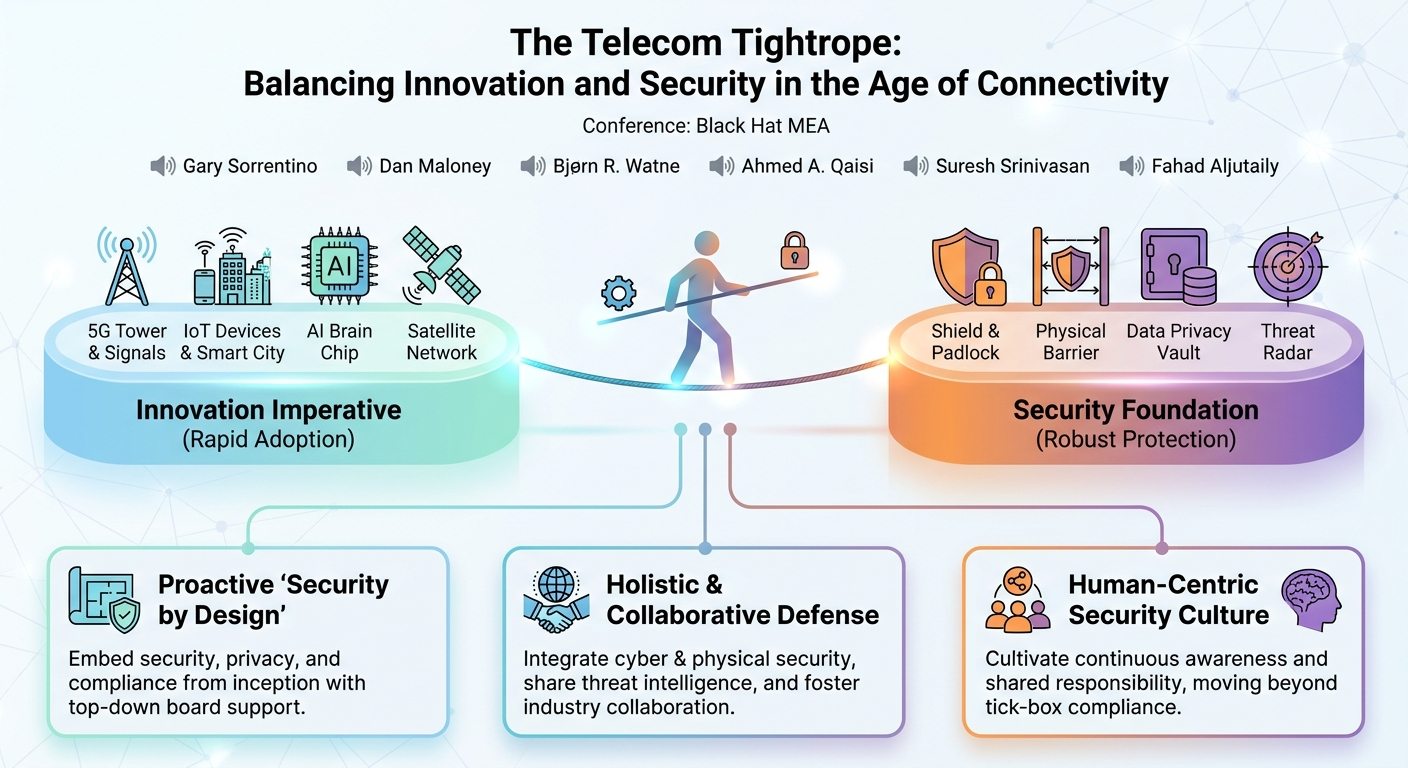
The talk underscored that telecommunications companies are not merely service providers; they are the fundamental enablers of the digital world. Their rapid adoption of cutting-edge technologies like 5G, IoT, AI, and satellite networks is reshaping industries and daily life. However, this accelerated innovation simultaneously expands the attack surface, introduces novel vulnerabilities, and magnifies the potential impact of cyber threats on critical infrastructure, customer data, and even human lives. The discussion emphasized that securing this interconnected future demands a proactive, multi-layered approach that integrates security from the outset, fosters a strong security culture, and promotes unprecedented collaboration across the ecosystem.
Background
▶ Watch: Introduction: The Telecom Tightrope (0:00)
The foundational premise of the discussion was that without continuous innovation in telecommunications, the digital transformation witnessed globally would be impossible. As Fahad Aljutaily, CEO of sirar by stc, eloquently stated, "If there was no telecommunication and innovation in there, we will not be sitting here and discussing what we are discussing today." This highlights the industry's pivotal role as the primary digital enabler. However, this expansion brings an inherent increase in the attack surface, making the balancing act between progress and protection ever more critical.
Despite the growing complexity, the panelists generally agreed that the telecommunications sector stands out as one of the most mature industries in navigating this dual challenge. Historically, the industry has faced opposition and security concerns since the advent of landlines, evolving through 3G, 4G, and now 5G. Dan Maloney, SVP & Chief Security Officer at Verizon, noted that while these challenges are not entirely new, the risks have compounded significantly in recent years. The very definition of what constitutes an "appropriate level of security" has undergone a profound shift, demanding a heightened focus on identifying and addressing the most pertinent risks scalably.
In response to these evolving demands, some telecom companies have fundamentally restructured their operating models. Bjørn R. Watne, SVP & Chief Security Officer for Telenor Group, described a "delayered" approach where physical assets and infrastructure are managed by separate entities, distinct from the platforms and the products/services built on top. This strategic separation allows for a dedicated focus on securing the foundational layers while enabling agile innovation at the service level, embedding security by design from the ground up. This proactive stance is essential in an environment where customer data privacy and ethical considerations surrounding technology deployment are paramount concerns, necessitating a shift towards privacy by design and compliance by design across all new initiatives.
Key Findings
▶ Watch: Customer data privacy and Neom's smart city challenges (6:40)
The panel's discussion yielded several critical insights into navigating the telecom tightrope:
- Layered Security Architecture is Essential: Telenor Group's strategy of delayering its operations into distinct infrastructure, platform, and product/service layers demonstrates a practical approach to embedding security from the foundational level upwards. This allows for specialized focus and robust protection at each tier, ensuring a secure base for innovation.
- The Evolving Threat Landscape Demands Targeted Risk Management: Dan Maloney highlighted that the scope of security has dramatically changed over the past five years. Companies must move beyond a general approach to security, instead focusing on identifying and addressing the right risks with scalable solutions, rather than attempting to tackle every conceivable threat.
- Security Must Be a Core Component of Innovation: Fahad Aljutaily underscored that cyber security must be a "priority number one" and an integral part of the overall strategy for any innovation. This means moving away from security as an afterthought and embedding it into the very fabric of new technologies and services.
- Data Privacy Requires Transparency and Robust Governance: Ahmed A. Qaisi from NEOM emphasized that customer data privacy is paramount. Effective data protection involves not only complying with regulations (like Saudi Arabia's Royal Decree) but also establishing clear policies, procedures, compliance frameworks, regular audits, and, crucially, maintaining transparency with users about how their data is handled.
- Ethical Considerations Drive "Security by Design": Suresh Srinivasan of Axiata advocated for organizations to develop their own ethical integrity practices that go beyond mere legal compliance. This involves proactively building security by design, privacy by design, and compliance by design into every product, platform, and process from inception, rather than reacting retrospectively to incidents.
- Top-Down Support and Security Culture are Non-Negotiable: Bjørn R. Watne stressed that security must be championed from the highest levels, "from the Boardroom to the server room." This executive support is vital for fostering a pervasive security culture that integrates security into daily processes and empowers every employee to contribute.
- Holistic Protection Extends to Physical Infrastructure: Dan Maloney broadened the scope of security beyond cyber, highlighting the increasing threat of physical damage to critical communications infrastructure by extremist groups. This necessitates a holistic approach that integrates physical security measures with cyber defenses.
- The Human Element Remains the Weakest Link: Despite significant technological investments, human error consistently emerges as a primary cause of security incidents. The panelists collectively agreed that fostering a culture of continuous awareness and shared responsibility is paramount, moving beyond "tick-in-the-box" training to genuinely engage individuals.
- The CISO's Role is Evolving into a Strategic Business Partner: The traditional image of the CISO as the "department of no" is obsolete. Modern CISOs, as argued by Suresh Srinivasan and Bjørn R. Watne, must be curious, open-minded, and inventive, actively participating in innovation journeys. The Business Information Security Officer (BISO) model, as discussed by Dan Maloney, embeds security professionals within business functions, ensuring security capabilities scale organically with business growth.
- Collaboration and Regulation are Interdependent: Fahad Aljutaily highlighted the crucial interplay between collaboration and regulation. Industry forums (like Mobile World Congress committees), national initiatives (such as Saudi's Global Cybersecurity Forum), and proactive threat intelligence sharing are vital for building a collective defense posture that transcends national borders and regulatory mandates.
Technical Deep Dive
▶ Watch: IoT security challenges in future cities like Neom (14:40)
The discussion extensively explored how rapidly advancing technologies are reshaping the telecom industry and, consequently, its security landscape. 5G emerged as a central theme, recognized by Fahad Aljutaily as a critical enabler for the ongoing digital transformation, providing the high-speed, low-latency connectivity essential for a truly interconnected world.
However, the proliferation of Internet of Things (IoT) devices represents one of the most significant expansions of the attack surface. Ahmed A. Qaisi provided a compelling case study with the NEOM project in Saudi Arabia. NEOM, envisioned as a cognitive city the size of Belgium, includes ambitious sub-projects like "The Line," a 170 km long linear city. Within such an environment, the sheer volume of IoT devices is staggering. Qaisi illustrated this by comparing NEOM to London, noting that while London has over 900,000 CCTVs, NEOM will feature millions of sensors for everything from weather monitoring and waste management to medical and healthcare applications. Each of these connected devices, regardless of its function, represents a potential entry point for attackers.
The risks associated with this hyper-connectivity are profound. Qaisi warned of scenarios where an entire city could be "taken hostage," leading to massive service disruptions, significant financial losses, and even threats to human life. He cited a chilling example of a recent attack on a health sector globally, where an IoT device—specifically, a fridge storing medicine—was manipulated. The attacker remotely altered the fridge's temperature, leading to the destruction of critical medication and highlighting how a seemingly innocuous device could have devastating, real-world consequences. This underscores the need for stringent supply chain security and device lifecycle management for IoT deployments.
Beyond 5G and IoT, the panel also touched upon other transformative technologies. Satellite networks, such as those NEOM is leveraging through partnerships like OneWeb, are expanding connectivity to remote and geographically challenging areas, but also introduce new vectors for attack and require specialized security considerations for ground stations and space-based assets. Artificial Intelligence (AI) and Edge Computing were identified as rapidly emerging areas. While these technologies promise unprecedented efficiency and new service capabilities, they also bring their own set of security challenges. Ahmed A. Qaisi predicted that future discussions would heavily focus on "cyber security for AI," addressing vulnerabilities within AI models themselves and the integrity of the data they process. Fahad Aljutaily even envisioned a future where meetings occur in a "secure metaverse," an entirely new digital realm enabled by 5G, 6G, and high-speed satellite networks, which will undoubtedly demand novel security paradigms.
To mitigate these technical risks, the panelists emphasized the importance of foundational security practices. Dan Maloney specifically mentioned adherence to established frameworks like the NIST framework as a baseline for cyber security. Furthermore, rigorous vetting of trusted suppliers for both hardware and software is crucial, as vulnerabilities introduced at any point in the supply chain can compromise the entire infrastructure. The overarching principle for all these technical advancements must be security by design, ensuring that security considerations are integrated from the initial conceptualization and development phases, rather than being patched on as an afterthought.
Demo / Proof of Concept
▶ Watch: The human element: Beyond 'tick-in-the-box' awareness (30:00)
The discussion primarily revolved around strategic insights, industry trends, and defensive postures. The transcript does not indicate that any live demonstration or proof of concept was presented during the panel.
Defensive Implications
▶ Watch: Future predictions: AI, Quantum, and the human element (36:50)
The insights shared by the panelists offer a comprehensive roadmap for defenders grappling with the complexities of the modern telecom landscape. The overarching message is that defense must be as innovative, adaptive, and holistic as the threats themselves.
Firstly, adopting a strategic layered security architecture, as described by Bjørn R. Watne, is paramount. By segmenting operations into distinct infrastructure, platform, and service layers, organizations can apply targeted security controls and ensure that foundational elements are robustly protected, providing a secure base for all subsequent innovation.
Secondly, board-level commitment and a top-down security culture are non-negotiable. Security must be viewed as a business imperative, not merely an IT function. This requires executive sponsorship to embed security into every process and foster a shared sense of responsibility across the entire organization. Dan Maloney's emphasis on a holistic approach that protects physical infrastructure alongside cyber assets further underscores this, recognizing that critical communications can be disrupted through both digital and kinetic means.
Thirdly, the principle of security by design, privacy by design, and compliance by design must be integrated into the entire development lifecycle. Suresh Srinivasan highlighted that this proactive stance ensures security is built-in rather than bolted-on, reducing vulnerabilities from the outset. This extends to rigorous supplier vetting to ensure that components and services from third parties meet stringent security standards, preventing supply chain attacks. Adherence to recognized security frameworks such such as the NIST framework should serve as a baseline for establishing and maintaining robust cyber hygiene.
Fourthly, the evolving role of the CISO is critical. Moving beyond the "department of no," CISOs must become Business Information Security Officers (BISOs), as advocated by Dan Maloney. By embedding security professionals within business units, they gain a deeper understanding of operational imperatives, enabling security solutions that are both effective and aligned with business goals. This also fosters a more curious and inventive CISO mindset, encouraging security teams to engage with emerging technologies early and proactively identify potential risks.
Finally, addressing the human element is perhaps the most challenging yet crucial defensive implication. The panel unanimously agreed that human error remains a primary vulnerability. Defenders must move beyond "tick-in-the-box" training to cultivate a continuous security awareness culture that resonates with individuals on a personal level. Fahad Aljutaily passionately argued that security is the responsibility of "each and everyone," from individuals to families, societies, and countries. This requires sustained initiatives that educate, empower, and instill accountability across all levels of an organization and society. Furthermore, proactive collaboration through industry committees, threat intelligence sharing, and engagement with regulatory bodies (as championed by Fahad Aljutaily) is vital for collective defense against an increasingly sophisticated and global threat landscape.
Key Takeaways
- The telecom sector operates on a tightrope, balancing rapid innovation with escalating security threats, requiring security to be a foundational element from design to deployment, with board-level commitment.
- Emerging technologies like 5G, IoT, AI, and satellite networks are transformative but introduce vast new attack surfaces, exemplified by critical infrastructure risks in smart cities like NEOM and the potential for real-world physical harm through device manipulation.
- Data privacy and ethical considerations are paramount, necessitating security by design, privacy by design, and compliance by design, supported by robust regulations, transparent data handling, and continuous auditing.
- The human element remains the weakest link in the security chain, emphasizing the need for a sustained, culturally embedded cyber awareness that goes beyond mere compliance and fosters shared responsibility across all organizational levels.
- Effective cyber security requires a holistic approach, encompassing both physical and digital protections, strong collaboration among industry players and regulators, and the evolution of the CISO role into a proactive business partner (BISO model).
- Looking ahead, discussions will continue to focus on the human element, the intersectionality of physical and digital security, data monetization, and the security implications of Quantum computing and AI, highlighting the dynamic and ever-changing nature of the threat landscape.
About the Speaker(s)
The panel comprised a diverse group of security and technology leaders from prominent global organizations:
- Gary Sorrentino (Moderator): Global CIO for Zoom, responsible for moderating the discussion and guiding the panelists through key topics.
- Dan Maloney: SVP & Chief Security Officer at Verizon in the United States. Maloney brings extensive experience in identifying and delivering scalable security solutions and is a strong advocate for a holistic approach to protecting critical infrastructure, encompassing both cyber and physical threats.
- Bjørn R. Watne: SVP & Chief Security Officer for Telenor Group, a global telecom company originating from Norway. Watne champions the integration of security at the very foundation of all operations and advocates for CISOs to be curious, open-minded, and inventive partners in innovation.
- Ahmed A. Qaisi: Head of Cybersecurity Operations at NEOM. Qaisi leads critical functions including SOC monitoring, intelligence, digital forensics, and incident response for the ambitious cognitive city project, providing a unique perspective on securing large-scale smart city infrastructure.
- Suresh Srinivasan: CISO and Data Protection Officer (DP) for Axiata, a telecom and technology group headquartered out of Malaysia. Srinivasan's focus includes building ethical integrity practices, embedding security, privacy, and compliance by design, and expanding cyber awareness beyond traditional IT departments.
- Fahad Aljutaily: CEO of sirar by stc, a leading cybersecurity company in Saudi Arabia, which is part of the STC telecommunication group. Aljutaily is a key player in digital transformation and 5G implementation, emphasizing the critical role of cybersecurity as a primary consideration and advocating for broad threat intelligence sharing and industry collaboration.
Reviews
Dr. Zero (Offensive Security Researcher) — HARD PASS
This was a C-suite buzzword bingo session where six executives spent an hour violently agreeing that 'security by design' is good and the 'human element' is bad. Absolutely nothing of substance was dropped that you couldn't read in a 2018 vendor whitepaper. If you need a Black Hat panel to tell you that IoT expands the attack surface, you're in the wrong industry.
Heather Calloway (CISO) — WEAK
Skip this one. It is a panel of heavy-hitting telecom executives reciting a bingo card of ten-year-old security clichés. Your team won't learn how to manage vendor concentration in a 5G core or secure an IoT supply chain; they will only hear that the attack surface is growing—something they should have known a decade ago.
→ Top-rated talks at Black Hat Middle East & Africa 2023 (Executive Summit)
All talks from Black Hat Middle East & Africa 2023 (Executive Summit)