Toward a Resilient Digital Society
Bjørn R. Watne (SVP & Chief Security Officer · Telenor Group)
Black Hat Middle East & Africa 2023 (Executive Summit) · Day 3 · Executive Summit
Overview
In a compelling presentation at Black Hat MEA, Bjørn R. Watne, SVP & Chief Security Officer at Telenor Group, challenged the long-held orthodoxies of information security, advocating for a profound shift in focus toward building a resilient digital society. Watne's talk meticulously deconstructed the traditional emphasis on confidentiality, arguing that in our hyper-connected, digitally dependent world, availability and integrity have ascended to paramount importance, often eclipsing confidentiality in their societal impact.
Key moments
- 0:00 Introduction and early security focus on confidentiality
- 3:50 The cost of confidentiality: "at least his data was kept confidential"
- 5:50 COVID-19: Collaboration and data availability enabled rapid vaccine
- 10:00 Weaponized information: The challenge of conflicting truths
- 13:50 Society's digital dependency drives regulatory shift to resilience
- 15:50 DORA: Key pillars of the Digital Operational Resilience Act
- 19:00 New regulations require cross-border information sharing and collaboration
Toward a Resilient Digital Society
Speakers: Bjørn R. Watne, SVP & Chief Security Officer, Telenor Group
Conference: Black Hat MEA
YouTube: https://www.youtube.com/watch?v=S1pcqQY00ps
Overview
In a compelling presentation at Black Hat MEA, Bjørn R. Watne, SVP & Chief Security Officer at Telenor Group, challenged the long-held orthodoxies of information security, advocating for a profound shift in focus toward building a resilient digital society. Watne's talk meticulously deconstructed the traditional emphasis on confidentiality, arguing that in our hyper-connected, digitally dependent world, availability and integrity have ascended to paramount importance, often eclipsing confidentiality in their societal impact.
Watne, drawing from over 25 years in the security domain spanning military, financial services, and telecommunications, posited that the foundational principles guiding security professionals must evolve. As digital services become indispensable to daily life, critical infrastructure, and global collaboration, the ability to access correct and reliable information and services becomes a cornerstone of societal function. This shift is not merely theoretical; it is being codified into new regulatory frameworks, compelling organizations and nations to prioritize operational resilience, collaborative defense, and robust integrity verification.
The core message of Watne's address resonates deeply with the contemporary security landscape, where geopolitical tensions, sophisticated cyberattacks, and the weaponization of information pose existential threats. By examining real-world scenarios from medical emergencies to global pandemics and information warfare, the talk underscored the critical need for security strategies that ensure continuous service delivery, verifiable data truthfulness, and collective defense mechanisms. This comprehensive approach aims to fortify the digital fabric upon which modern society increasingly relies, moving "Toward a Resilient Digital Society."
Background
▶ Watch: Introduction and early security focus on confidentiality (0:00)
Bjørn R. Watne's journey into security, commencing as a military police officer in 1997, provides a vivid illustration of the historical dominance of confidentiality within the information security paradigm. His early duties involved stringent access control, physical security checks (locked doors, windows), and the meticulous collection of sensitive documents mistakenly left on desks by higher-ranking officers. This experience, as Watne recounted, epitomized a security mindset where the primary objective was to safeguard classified information, ensuring it remained "only privy to certain people with certain access levels." In the context of the CIA Triad (Confidentiality, Integrity, Availability), confidentiality was unequivocally "the poster boy" of information security.
This confidentiality-first mentality persisted as Watne transitioned into financial services, where he observed that security leaders were predominantly ex-military or ex-policemen. This demographic often brought with them a similar "red tape" approach, prioritizing the exclusion of unauthorized individuals from information and deeming any data not worth protecting as "not interesting." This historical perspective underscores a period when data breaches were primarily viewed through the lens of unauthorized disclosure of sensitive information, with less emphasis on the broader operational and societal implications of service disruption or data manipulation.
However, Watne stressed that "the world is changing." The exponential growth of digital reliance, interconnected systems, and the pervasive nature of online services have fundamentally altered the risk landscape. He cited a colleague's dark joke about a tombstone inscribed, "At least his data was kept confidential," to highlight the absurdity of prioritizing confidentiality when it comes at the cost of human life due to a lack of availability of critical medical information. This anecdote serves as a powerful metaphor for the evolving priorities in information security, where the ability to access and trust information can have more immediate and severe consequences than its unauthorized disclosure. The problem, as Watne framed it, is that while confidentiality remains important, its singular focus is no longer sufficient to address the complexities and dependencies of a fully digital society.
Key Findings
▶ Watch: COVID-19: Collaboration and data availability enabled rapid vaccine (5:50)
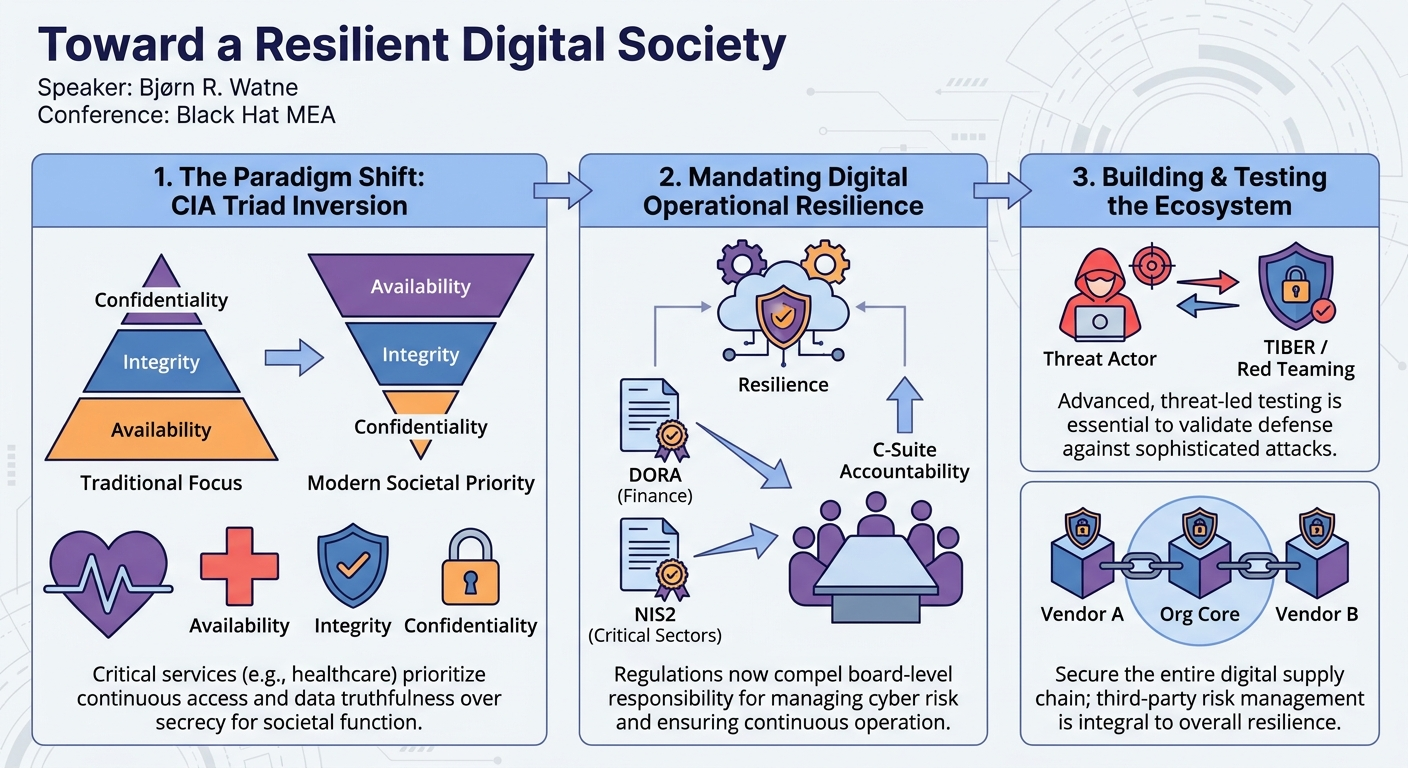
The central premise of Watne's talk is that the traditional hierarchy within the CIA Triad has been inverted, with Availability and Integrity now frequently holding greater importance than Confidentiality in ensuring societal function and well-being. This shift is not merely academic but driven by tangible, real-world consequences.
Watne powerfully illustrated the critical role of availability through a medical emergency scenario. Imagine a person having an accident with a specific medical condition requiring a particular medication, but also having a severe allergic reaction to an alternative. If their medical data is only available digitally, and the network is down or access controls are so stringent they cannot be circumvented, medical personnel might administer the wrong medicine, leading to tragic outcomes. In such a scenario, the confidentiality of the data becomes secondary to its immediate availability for life-saving decisions.
The COVID-19 pandemic served as another compelling example of the transformative power of availability and global collaboration. Watne contrasted the years it took to manage the Spanish Flu a century ago with the "record-breaking time" it took to develop, produce, and distribute COVID-19 vaccines worldwide. This unprecedented speed was directly attributable to the availability of information, cross-border research, and international collaboration. Had data been locked down by national borders or proprietary interests, the global response would have been significantly hampered, underscoring that shared, accessible information can be a powerful force for collective good.
Beyond availability, Watne highlighted the escalating importance of Integrity. In an era plagued by misinformation and "fake news," the ability to trust the information we consume is paramount. He recounted the experience of hosting a refugee from a conflict zone, who, despite being tech-savvy, was consuming information diametrically opposed to facts available in other regions. This phenomenon, where "information was being weaponized" and individuals could genuinely believe "two separate instances of the truth," poses a grave threat to social cohesion and informed decision-making. Watne emphasized that for information security professionals, ensuring the verifiable correctness of information will become "increasingly more important." The internet, he warned, can quickly become a "very dark place" if mechanisms for verifying information integrity are not robustly established.
Recognizing these profound shifts, governments and regulatory bodies worldwide are increasingly focusing on resilience. Watne noted that new regulations in North America, Europe, and Southeast Asia are moving in this direction because "we've put so many digital eggs into this one basket as a society... that if that bag breaks, we're in big trouble." This collective realization signals a systemic acknowledgement that security must evolve from a siloed, confidentiality-centric discipline to a holistic, resilience-focused endeavor that prioritizes the continuous operation and trustworthiness of digital services.
Technical Deep Dive
▶ Watch: Weaponized information: The challenge of conflicting truths (10:00)
The growing recognition of the criticality of availability and integrity has spurred a significant wave of regulatory action, particularly in Europe, aimed at fostering digital operational resilience. Watne detailed the impact of two key legislative initiatives: the Digital Operational Resilience Act (DORA) for financial services and the Network and Information Security Directive (NIS2) for other critical sectors, including telecommunications. These regulations represent a paradigm shift, moving from encouraging best practices to mandating a structured approach to resilience.
DORA, specifically designed for the interconnected financial services ecosystem, addresses the systemic risk posed by the failure of any single actor. As Watne noted, "if one of the actors breaks, if one of the actors gets hacked, they are all interconnected, so it will take the whole financial system down." With the widespread adoption of cashless transactions in Europe, the disruption of digital financial services could trigger widespread societal chaos. DORA is structured around five core pillars:
- Management Responsibility for Cyber Risk: This pillar elevates cyber security from a purely technical concern to a boardroom imperative. For too long, information security was "left to IT people in the server rooms." DORA mandates that management bodies are directly responsible for defining, approving, overseeing, and bearing accountability for the organization's cyber risk management framework. This ensures that the "tone from the top" drives the necessary investments and strategic direction for resilience.
- Harmonized Critical Incident Reporting: Acknowledging the "report fatigue" and "alert fatigue" resulting from disparate and often overwhelming reporting requirements across various jurisdictions, DORA aims to streamline and harmonize incident reporting. The focus will now be exclusively on critical incidents, ensuring that regulatory bodies receive actionable intelligence without being inundated by noise. This allows for a more effective collective response and learning from significant disruptions.
- Digital Operational Resilience Testing: This pillar mandates rigorous and regular testing of digital operational resilience. A key component mentioned by Watne is TIBER (Threat Intelligence Based Ethical Red Teaming). TIBER represents a full-blown, threat intelligence-led red team exercise designed to simulate real-world attacks based on specific threat actors and their tactics, techniques, and procedures (TTPs) relevant to the financial entity. Unlike traditional penetration testing, TIBER aims to assess the organization's ability to withstand, detect, respond to, and recover from sophisticated attacks by known adversaries. This proactive and adversarial testing approach ensures that vulnerabilities are identified and resilience capabilities are proven under realistic stress.
- Third-Party Risk Management: In an increasingly outsourced and interconnected supply chain, DORA recognizes that an organization's resilience is only as strong as its weakest link. This pillar places stringent requirements on financial entities to manage the information and communication technology (ICT) third-party risk. It's no longer sufficient to secure one's own company; organizations must ensure that all vendors, suppliers, and partners they depend on for critical services are "equally secure." This necessitates robust due diligence, contractual obligations, and ongoing monitoring of third-party security postures, fostering an ecosystem-wide approach to resilience.
- Mandatory Information Sharing: Perhaps one of the most significant shifts, DORA explicitly requires financial entities to share information about vulnerabilities, rising threats, and research with their peers. This moves beyond mere encouragement, making collaborative threat intelligence sharing a legal obligation. This cross-border and cross-organizational sharing is intended to create a collective defense mechanism, allowing the entire sector to learn from individual incidents and proactively strengthen their defenses against emerging threats.
Beyond DORA, Watne also briefly referenced the NIS2 Directive, which extends similar principles of resilience, recovery, and collaborative information sharing to a broader range of critical infrastructure sectors, including telecommunications, energy, transport, and healthcare. Both DORA and NIS2 underscore a fundamental paradigm shift: security is no longer solely about preventing breaches, but about ensuring the continuous, reliable operation of essential digital services even in the face of sophisticated attacks and disruptions. These regulations are designed to harden the digital infrastructure at a systemic level, making society more robust against both accidental failures and malicious intent.
Demo / Proof of Concept
▶ Watch: DORA: Key pillars of the Digital Operational Resilience Act (15:50)
This particular talk, "Toward a Resilient Digital Society," was a strategic and conceptual presentation rather than a technical demonstration. As such, it did not include a live demo or a proof of concept of any specific tool, vulnerability, or exploit. Instead, the speaker, Bjørn R. Watne, focused on articulating a critical shift in security philosophy and detailing the regulatory frameworks designed to implement this new paradigm.
Defensive Implications
▶ Watch: New regulations require cross-border information sharing and collaboration (19:00)
The insights shared by Bjørn Watne carry significant defensive implications for security professionals, organizations, and even national strategies. The core message demands a re-evaluation of security priorities and a proactive shift from a purely confidentiality-driven model to one centered on digital operational resilience.
- Elevate Cyber Risk to the Boardroom: Defenders must advocate for and facilitate the elevation of cyber risk discussions to the executive and board levels. With regulations like DORA mandating management responsibility, security leaders have an opportunity to secure the necessary resources and strategic alignment to build resilience. This involves translating technical risks into business impacts and demonstrating how availability and integrity directly underpin organizational and societal functions.
- Prioritize Availability and Integrity: While confidentiality remains important, security teams must broaden their focus. This means investing in robust architectures that ensure continuous service delivery, even under duress (e.g., redundant systems, disaster recovery, business continuity planning). Equally critical is the implementation of strong integrity controls, including data validation, immutable logging, cryptographic signing, and mechanisms to detect and prevent data manipulation, especially in a world of weaponized information.
- Implement Advanced Resilience Testing: Organizations, particularly those in critical sectors, must move beyond basic penetration testing. Adopting methodologies like TIBER (Threat Intelligence Based Ethical Red Teaming) or similar advanced adversarial simulations will become essential. This requires investing in dedicated red teams or engaging specialized third-party firms to conduct realistic, threat intelligence-driven exercises that test not only technical controls but also incident response capabilities and recovery processes under extreme pressure.
- Strengthen Third-Party Risk Management: Given the interconnectedness of modern digital ecosystems, security leaders must significantly enhance their third-party risk management programs. This involves comprehensive due diligence during vendor selection, rigorous contractual security requirements, continuous monitoring of vendor security postures, and establishing clear incident response protocols that extend across the supply chain. Organizations are now accountable for the resilience of their entire digital ecosystem, not just their internal infrastructure.
- Embrace Mandatory Information Sharing: Security teams should proactively prepare for and engage in mandatory information sharing initiatives. This means establishing secure channels for sharing threat intelligence, vulnerabilities, and lessons learned from incidents with peers and regulatory bodies. Beyond compliance, this fosters a collective defense posture, allowing organizations to benefit from the experiences of others and contribute to the overall resilience of their sector.
- Focus on Incident Response and Recovery: The emphasis on resilience underscores that breaches and disruptions are inevitable. Therefore, robust incident response and recovery capabilities are paramount. This includes well-defined incident playbooks, regular drills, investment in automated response tools, and comprehensive data backup and restoration strategies to minimize downtime and data loss, ensuring rapid return to normal operations.
- Cultivate a Culture of Resilience: Ultimately, building a resilient digital society requires a cultural shift. Security is everyone's responsibility, from the C-suite to the front-line employee. Training, awareness, and fostering a proactive security mindset that values availability, integrity, and continuous improvement are crucial for navigating the evolving threat landscape.
Key Takeaways
- The traditional hierarchy of the CIA Triad has shifted: Availability and Integrity are now often paramount, especially in critical digital services, sometimes even over Confidentiality.
- Societal reliance on digital infrastructure necessitates a fundamental shift from solely preventative security to comprehensive digital operational resilience.
- New regulatory frameworks like the EU's DORA (Digital Operational Resilience Act) and NIS2 are mandating this change, requiring board-level accountability for cyber risk.
- Advanced resilience testing, such as TIBER (Threat Intelligence Based Ethical Red Teaming), is becoming a critical requirement to validate an organization's ability to withstand sophisticated attacks.
- Securing the entire digital ecosystem requires robust third-party risk management, as an organization's resilience is intrinsically linked to its vendors and partners.
- Information sharing about vulnerabilities, threats, and research is no longer optional but is becoming a mandatory requirement to foster collective defense and improve sector-wide resilience.
About the Speaker(s)
Bjørn R. Watne is the Senior Vice President and Chief Security Officer (CSO) at Telenor Group, a leading telecommunications company operating across the Nordics, South, and Southeast Asia. With a distinguished career spanning over 25 years in the security domain, Watne brings a wealth of experience from diverse sectors. He began his journey in 1997 as a military police officer for the Norwegian Navy, subsequently moving into financial services as a junior analyst in a Security Operation Center, before taking on his current strategic leadership role in telecommunications. His extensive background provides him with a unique perspective on the evolving challenges and priorities in information and cyber security, particularly in the context of building a resilient digital society.
Reviews
Dr. Zero (Offensive Security Researcher) — WEAK
A C-level recap of the CIA triad and a surface-level summary of European compliance frameworks. Zero insider signal, zero implementation data from Telenor, and zero reason to watch if you already know how to read a DORA press release.
Heather Calloway (CISO) — SOLID
Bjørn Watne delivers a necessary, if unsurprising, defense of the modern security paradigm: operational resilience over secrecy. For organizations staring down the barrel of DORA or NIS2, this serves as a clean, executive-level framing of why regulators are forcing our hands. It won't teach a seasoned CISO anything new, but it is exactly the narrative your risk committee needs to understand.
→ Top-rated talks at Black Hat Middle East & Africa 2023 (Executive Summit)
All talks from Black Hat Middle East & Africa 2023 (Executive Summit)