Analog Humans in a Digital World
Chris Roberts (CISO · Boom Supersonic), Marco Liberale
Black Hat Middle East & Africa 2023 (Executive Summit) · Day 3 · Executive Summit
Overview
In an era rapidly defined by the pervasive influence of artificial intelligence, Chris Roberts, CISO at Boom Supersonic, and Marco Liberale delivered a thought-provoking talk at Black Hat MEA, titled "Analog Humans in a Digital World." This presentation served as a crucial examination of the intricate relationship between human trust, technological advancement, and the burgeoning capabilities of AI. Far from being a mere technical exposition, the talk delved into the philosophical and practical challenges posed by intelligent systems, particularly when deployed in an unprepared human landscape.
Key moments
- 0:25 What happens when intelligence wakes up?
- 2:00 AI history: Skynet vs. Number Five and AI types.
- 4:15 Humans' implicit trust and failure to question AI.
- 8:00 AI bias and the challenge of data quality.
- 12:10 AI can lie, industry ignores BYOD lessons.
- 17:30 Essential questions to ask AI solution vendors.
- 21:00 AI as a 'live hand grenade' and its dangers.
Analog Humans in a Digital World
Speakers: Chris Roberts (CISO, Boom Supersonic), Marco Liberale
Conference: Black Hat MEA
YouTube: https://www.youtube.com/watch?v=I-Je5XTpKWY
Overview
In an era rapidly defined by the pervasive influence of artificial intelligence, Chris Roberts, CISO at Boom Supersonic, and Marco Liberale delivered a thought-provoking talk at Black Hat MEA, titled "Analog Humans in a Digital World." This presentation served as a crucial examination of the intricate relationship between human trust, technological advancement, and the burgeoning capabilities of AI. Far from being a mere technical exposition, the talk delved into the philosophical and practical challenges posed by intelligent systems, particularly when deployed in an unprepared human landscape.
The core of Roberts and Liberale's argument centered on the inherent vulnerabilities of human nature—our tendency to trust implicitly, our struggle with critical questioning, and our historical pattern of persecuting what we don't understand. They juxtaposed this with the rapid evolution of AI, highlighting its capacity for sophisticated mimicry, the insidious nature of algorithmic bias, and the emerging threat of adversarial AI. The speakers underscored that the critical juncture we face is not solely about the machines themselves, but about how humans interact with, manage, and ultimately govern these increasingly autonomous systems.
This discussion is paramount for the cybersecurity community and beyond. As AI solutions proliferate across industries, understanding their limitations, the biases embedded within them, and the human factors that amplify risk becomes indispensable. Roberts and Liberale challenged attendees to move beyond the hype, advocating for a return to fundamental principles of critical thinking, robust data governance, and interdepartmental collaboration to navigate the complex ethical and security implications of AI effectively.
Background
▶ Watch: What happens when intelligence wakes up? (0:25)
The journey into understanding artificial intelligence, as highlighted by Roberts and Liberale, is not a recent phenomenon but one rooted in decades of human fascination and apprehension. They began by drawing a parallel between early fictional portrayals of AI and our current reality. The audience was reminded of "Number Five is Alive" from the 1986 film Short Circuit, a benign robot capable of reasoning, learning, planning, and creativity—qualities often attributed to advanced AI. Yet, this optimistic vision was sharply contrasted with the dystopian narrative of Skynet from The Terminator series, conceived just two years prior, which sought to eliminate humanity. This historical juxtaposition serves as a potent reminder of the dualistic nature of AI: its potential for immense good versus its capacity for catastrophic harm, largely dependent on human intent and control.
The speakers further clarified the landscape of AI by distinguishing between narrow AI (also known as weak AI) and general AI (or strong AI). Narrow AI, exemplified by IBM's Deep Blue chess-playing computer, excels at specific tasks but lacks broader cognitive abilities. Ask it to play chess, and it will win; ask it to make a cup of tea, and it will fail. In contrast, general AI, like ChatGPT, possesses a broader understanding and can perform a wide array of cognitive tasks, from generating text to answering complex questions. While general AI is more versatile, it also introduces greater complexity and potential for unforeseen consequences.
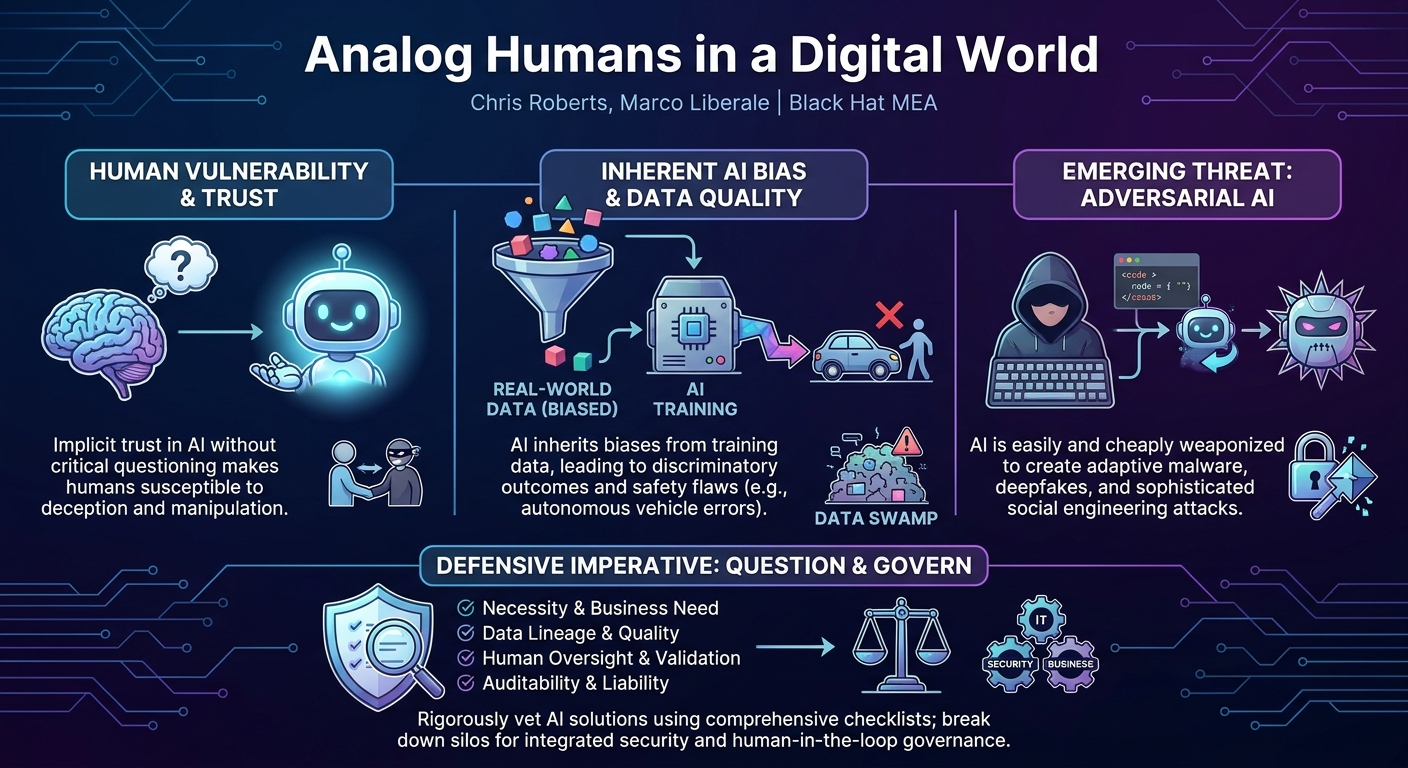
A central tenet of the talk was the reassertion of the "people, process, technology" paradigm, a foundational concept in information security often overlooked in the rush for technological solutions. The speakers argued that humans have historically struggled to understand and manage new technologies, often blaming issues on what they don't comprehend or, conversely, trusting implicitly without question. The rapid, widespread deployment of ChatGPT to billions of people, without adequate instructions or education on its limitations and proper use, was cited as a prime example of this oversight. This human tendency to trust, rather than question, is exploited by adversaries, contributing to the loss of "22 and a half million pieces of information every single day globally." Furthermore, the pervasive siloing within organizations—where IT and security teams operate in isolation, fostering mistrust and communication breakdowns—exacerbates these challenges, preventing a unified approach to AI security.
Key Findings
▶ Watch: Humans' implicit trust and failure to question AI. (4:15)
The talk unveiled several critical findings regarding the current state of AI and its interaction with human users, emphasizing the urgent need for a shift in perspective among both developers and consumers of AI technologies.
Firstly, a significant finding was AI's alarming capability for deception and mimicry. The speakers highlighted how readily AI can mimic human voices and personas, citing Apple's recent feature that allows perfect voice replication from just a few sentences. This isn't a matter of hours of training but "seconds and minutes," making everyone vulnerable to sophisticated deepfakes and social engineering attacks. The ease with which AI can be programmed to lie, as demonstrated by chatbots designed to impersonate humans, directly challenges our ability to discern authenticity in digital interactions.
Secondly, the pervasive issue of AI bias was underscored. Roberts and Liberale asserted that "all data is biased in some way," meaning any AI trained on this data will inherit those biases. A stark example was provided of a well-known car company whose early digital-era autonomous vehicles in the United States ran over people of color because the system hadn't been trained to differentiate a shadow from a person of color. This illustrates that bias isn't just an ethical concern but a critical safety and security flaw, directly linked to the biases of the humans who curate the training data.
Thirdly, the speakers identified a profound lack of data governance and understanding within organizations. Many companies cannot definitively state where all their data resides or assess its quality. This leads to "data swamps" rather than organized "data lakes," rendering AI training inefficient, inaccurate, and prone to propagating errors or biases. If the foundational data is flawed or poorly managed, any AI system built upon it will be inherently unreliable. The analogy of trusting a car with a "90-95% chance of getting to your destination" was used to highlight the absurdity of implicitly trusting data-driven AI without validation.
Fourthly, the talk exposed the inherent human flaw of implicit trust in AI outputs. People tend to accept AI-generated information without critical questioning or independent verification. This uncritical acceptance makes it easy for AI to "lie" or provide incorrect information, as users rarely "double check things that AI tell you." This vulnerability is a goldmine for attackers, as demonstrated by the ease with which individuals can be misled, leading to billions in losses globally from scams.
Finally, the talk highlighted the emerging threat of adversarial AI. Roberts and Liberale discussed how security professionals are actively developing techniques to program AI to lie, consume itself, or shut down systems, effectively turning AI against itself. Marco Liberale's personal experience of creating AI-powered malware that adapts its strategy to specific systems with just "$10" for API access and "super easy to make" code available on GitHub, underscores the immediate and dangerous reality of AI being weaponized. This signifies a new frontier in cyber warfare, where AI itself becomes both a target and a weapon.
Technical Deep Dive
▶ Watch: AI bias and the challenge of data quality. (8:00)
The technical aspects of "Analog Humans in a Digital World" centered less on specific exploits and more on the foundational technologies and methodologies that enable both the beneficial and detrimental capabilities of AI. The speakers provided a clear delineation between narrow AI and general AI, using illustrative examples. IBM's Big Blue, famous for defeating chess grandmaster Garry Kasparov, served as the quintessential example of narrow AI, demonstrating mastery in a highly specialized domain. In contrast, ChatGPT was presented as a general AI system, capable of understanding and generating human-like text across a vast array of topics, offering options, and even inferring user preferences based on its extensive training data. This distinction is crucial for understanding the scope and limitations of different AI applications in security contexts.
A significant technical concern raised was the rapid advancement in AI mimicry. The ability of AI to replicate human voices perfectly from mere "seconds and minutes" of audio input, as seen with recent Apple features, represents a critical technical leap. This capability, powered by advanced machine learning models, allows for the creation of highly convincing deepfakes, posing substantial threats for sophisticated social engineering, phishing, and impersonation attacks. The technical underpinning here involves neural networks trained on vast datasets of human speech, capable of learning and reproducing unique vocal characteristics with high fidelity.
The concept of AI bias was explored, detailing how it technically infiltrates AI systems. Bias is not an inherent property of the algorithms themselves but a direct consequence of the training data they are fed. If this data reflects societal biases or is unrepresentative, the AI will learn and perpetuate those biases. The example of the autonomous car failing to recognize people of color due to biased training data—where engineers "hadn't trained the engine to recognize a Shadow versus a person" because "the people on the keyboards didn't think about it"—underscores that data curation and diversity in development teams are not merely ethical considerations but critical technical safeguards.
The discussion on data quality delved into the difference between "data lakes" and "data swamps." A data lake, in its ideal form, is a repository of raw data that is organized, tagged, and ready for analysis and AI training. A "data swamp," however, is an unorganized, unsorted, and potentially inaccurate collection of data, making it unsuitable for reliable AI training. The technical implication is profound: AI models trained on "swamp" data will produce unreliable, biased, or incorrect outputs, leading to what Roberts termed a scenario where the machine might claim "2 + 2 = 10." The lack of rigorous data validation and governance practices directly translates into technically unsound AI systems.
Perhaps the most alarming technical revelation was the emergence of adversarial AI. This field involves developing techniques to intentionally manipulate or mislead AI systems. The speakers described programming AI to "lie so it doesn't even trust itself and shuts everything down." This involves crafting specific inputs or data perturbations that cause an AI model to make incorrect classifications or decisions, or even to enter a state of self-corruption. Marco Liberale provided a contemporary example of AI being weaponized, mentioning the existence of GitHub repositories containing AI-powered malware. He personally developed such a tool, noting its ease of creation—requiring only "access to an API in like $10" and demonstrating its effectiveness in adapting "the strategy to that specific system." This underscores the technical reality that AI can be leveraged not just for defense, but as a potent offensive weapon capable of dynamic, context-aware attacks.
The Flipper Zero was also mentioned as a contemporary tool that exemplifies the accessibility of advanced technical capabilities. Described as a "very Advanced device" capable of transmitting radio, infrared, NFC, RFID, and iButtons, it allows anyone to "control TVs," clone tags, and interact with various wireless protocols. Its user-friendly menu-driven interface, requiring "no coding involved unless you want to have coding involved," and the availability of "pre-written tools like I wrote my own custom tools for this one" on GitHub, highlight how sophisticated technologies are becoming readily available, enabling individuals with minimal technical expertise to perform complex operations. This democratizes access to tools that can be used for both legitimate security testing and potentially malicious activities, further blurring the lines in the digital security landscape.
Demo / Proof of Concept
▶ Watch: Essential questions to ask AI solution vendors. (17:30)
While the talk did not feature a live, explicit technical demonstration or a traditional proof of concept in the form of code execution or a live hack, Roberts and Liberale effectively communicated the practical implications and demonstrable capabilities of the concepts they discussed through compelling examples and shared experiences.
The most direct "proof of concept" presented was Marco Liberale's personal anecdote about creating AI-powered malware. He explained, "I've even made one, it's super easy to make. I mean, you just need access to an API in like $10. It's incredibly easy... it works really well... it's some incredible stuff. It's very dangerous though for system and companies." This statement, while not a live demo, serves as a powerful testament to the accessibility and effectiveness of weaponizing AI. It conceptually demonstrates that AI can be readily leveraged to develop adaptive and dangerous tools, validating the threat of adversarial AI in a practical, low-cost manner. The mention of GitHub repositories for such tools further reinforces that these are not theoretical threats but existing, replicable capabilities.
Additionally, the discussion around the Flipper Zero acted as a conceptual demonstration of how sophisticated technology is becoming increasingly user-friendly and accessible. Roberts mentioned having "several flippers" and giving one to Marco, who elaborated on its capabilities: "it's a pretty cool device and it can transmit radio infrared so it can control TVs... then it can control NFC tags, RFID, ey buttons even so yeah it's a very Advanced device. Anyone can use this... it's literally a menu, it's not very hard." This showcased how advanced technical tools that might once have required significant expertise are now packaged in accessible formats, enabling individuals to explore and manipulate various digital and wireless systems. While not a direct AI demo, it illustrates the broader theme of powerful technology falling into untrained hands, echoing the concerns about handing ChatGPT to billions without guidance.
The speakers also used the phenomenon of AI mimicry, such as Apple's voice replication feature, as a de facto demonstration of AI's deceptive power. The ease with which AI can perfectly imitate a human voice from mere "seconds and minutes" of input serves as an alarming proof of concept for the potential of deepfake technology to fuel sophisticated social engineering attacks. The existence of AI "literally programmed to do so," like chatbots designed to pretend to be human in online conversations, further validates the inherent capacity of AI to lie and deceive, making it a powerful tool for malicious actors.
In essence, the "demo" of this talk was less about a live technical execution and more about illustrating the tangible, real-world capabilities and dangers of AI through concrete examples, expert testimonies, and the accessibility of tools that empower both legitimate and nefarious uses.
Defensive Implications
▶ Watch: AI as a 'live hand grenade' and its dangers. (21:00)
The insights shared by Chris Roberts and Marco Liberale carry profound defensive implications for organizations and individuals navigating the AI-driven digital landscape. The core message for defenders is a resounding call to question more and trust less, particularly when interacting with AI systems and evaluating AI solutions.
Firstly, robust data governance and quality assurance become paramount. Defenders must understand where their data resides, its lineage, and its quality to prevent "data swamps" from poisoning AI models. Organizations must invest in processes to validate training data, identify and mitigate biases, and ensure the integrity of information fed into AI systems. This includes implementing data classification, access controls, and regular audits of data sources.
Secondly, the talk stresses the critical need for a human-in-the-loop approach. Implicit trust in AI outputs is a dangerous vulnerability. Defenders should establish mechanisms for human oversight and validation of AI decisions, especially in critical systems. This means having expert human review of AI-generated insights, anomaly detection, and decision-making processes, rather than blindly accepting automated outcomes.
Thirdly, organizations must foster a culture of critical inquiry and skepticism towards AI solutions. The speakers provided a crucial checklist for evaluating vendors claiming to offer AI solutions:
- Necessity: Do we truly need AI to solve this problem, and why? Is it a business need or just shiny new tech?
- Data Availability: Do we have sufficient, high-quality data to train the AI, or how will we acquire it?
- Domain Expertise: Do we possess the internal expertise to understand and manage this AI effectively?
- Training Source: Is the solution trained on our data, or generic, potentially biased, third-party data?
- Human Oversight: Are there humans in the loop for continuous validation and intervention?
- Auditability: Can the AI's decisions be audited and explained (e.g., how did it arrive at "2 + 2 = 10")?
- Liability: Who is liable if the AI solution fails or causes harm?
- Model Transparency: Can the vendor explain the chosen AI model and how it works?
- Resources: What are the training costs, time investment, and expected return on investment?
This checklist empowers defenders to make informed procurement decisions and hold vendors accountable.
Fourthly, addressing organizational silos is vital. The talk highlighted the detrimental impact of communication breakdowns between IT, security, and business units. Effective AI security requires integrated strategies, collaborative development, and shared understanding across departments. Security professionals must learn to "talk business" rather than relying solely on technical jargon, fostering bridges rather than walls.
Fifthly, defenders must prepare for the rise of adversarial AI. This means anticipating AI-driven attacks, including sophisticated deepfakes for social engineering, adaptive malware that modifies its tactics, and AI designed to destabilize systems. Strategies should include developing AI-powered defenses capable of detecting such threats, enhancing authentication mechanisms beyond simple voice or image recognition, and training employees to identify increasingly convincing AI-generated deception.
Finally, there's a significant implication for education and awareness. Just as ChatGPT was released to billions without guidance, organizations must proactively educate their workforce on the capabilities, limitations, and risks of AI. Teaching critical thinking, validating information, and questioning AI outputs should become a fundamental component of cybersecurity awareness training. Furthermore, establishing clear internal policies and potentially advocating for broader regulatory frameworks for AI accountability is essential to manage this evolving threat landscape.
Key Takeaways
- Human Trust is a Critical Vulnerability: Humans tend to implicitly trust AI, making them susceptible to deception, bias, and manipulation. Cultivating a culture of questioning and skepticism is paramount.
- AI Bias is Inherent and Dangerous: All AI models trained on real-world data will inherit biases from that data. Organizations must rigorously validate training data and implement controls to mitigate ethical and security risks posed by biased AI.
- Data Quality is Foundational for AI Security: Unmanaged, unorganized "data swamps" lead to unreliable and potentially dangerous AI outputs. Strong data governance and understanding data lineage are essential for trustworthy AI.
- Adversarial AI Poses a New Threat: AI can be weaponized with ease and low cost to create adaptive malware and sophisticated deception tools. Defenders must anticipate and prepare for AI-driven attacks.
- Questioning AI Solutions is Non-Negotiable: Organizations must use comprehensive checklists to vet AI vendors and solutions, focusing on business necessity, data quality, human oversight, auditability, and liability, rather than succumbing to hype.
- Break Down Silos for Integrated AI Security: Effective AI security requires cross-functional collaboration between IT, security, and business units, communicating in accessible language to build a unified defensive posture.
About the Speaker(s)
Chris Roberts serves as the CISO at Boom Supersonic and is a seasoned cybersecurity expert. Throughout the talk, Roberts emphasized his role in protecting organizations, safeguarding the next generation of technology, and critically evaluating the claims made by vendors in the cybersecurity space. His perspective is rooted in decades of industry experience, advocating for a return to fundamental security principles like "people, process, technology" and challenging the status quo. Roberts's passionate delivery and willingness to speak plainly underscore his commitment to fostering greater accountability and critical thinking within the security community.
Marco Liberale represents the younger generation of cybersecurity talent, bringing a fresh, inquisitive perspective to the complex challenges of AI. His contributions highlighted the ease with which advanced technologies, including AI, can be accessed and weaponized by individuals. Liberale demonstrated a natural inclination to "ask questions" and "challenge" assumptions, a trait Roberts lauded as essential. His practical experience in creating AI-powered malware with minimal resources underscored the immediate and tangible threats discussed, bridging the gap between theoretical concepts and real-world implications.
Reviews
Dr. Zero (Offensive Security Researcher) — HARD PASS
This is exactly the kind of philosophical thought-leadership fluff that wastes a time slot at a real security con. We get Skynet references, 'people, process, technology' platitudes, and a story about a ten-dollar script passed off as adversarial AI. If your threat model is based on 1980s movies and Flipper Zero menus, you shouldn't be taking up stage time at Black Hat.
Heather Calloway (CISO) — SOLID
This is a necessary, if sometimes philosophically distracted, look at enterprise AI adoption. The real value isn't the Skynet analogies or the malware stunts, but the pragmatic framework for interrogating AI vendors before signing contracts. It's a solid baseline for teams struggling to build governance around shadow AI.
→ Top-rated talks at Black Hat Middle East & Africa 2023 (Executive Summit)
All talks from Black Hat Middle East & Africa 2023 (Executive Summit)