Exciting Times Ahead for Second-Generation CISOs
Michael Montoya (CISO · Equinix)
Black Hat Middle East & Africa 2023 (Executive Summit) · Day 3 · Executive Summit
Overview
In his Black Hat MEA talk, "Exciting Times Ahead for Second-Generation CISOs," Michael Montoya, the Chief Information Security Officer (CISO) at Equinix, presented a compelling vision for the evolving role of security leadership. Moving beyond the traditional image of the CISO as solely a technical operator, Montoya articulated the imperative for today's security executives to become strategic influencers, governance architects, and business enablers. The core premise of his presentation is that the security landscape's increasing complexity, coupled with burgeoning regulatory demands, necessitates a fundamental shift in how CISOs approach their responsibilities, build their organizations, and communicate risk and value to the enterprise.
Key moments
- 0:00 Introduction: CISO role evolution beyond technology
- 2:00 The first CISO and the second generation of the role
- 4:00 Major headwinds: Threat landscape, data, AI, regulation
- 6:40 Defining CISO responsibility and democratizing accountability
- 10:20 Leveraging enterprise governance to drive security culture
- 13:00 Shifting to a connected, data-driven security platform
- 16:15 Developing a 'balance sheet' for security metrics
- 19:00 Leadership framework for CISO role and mental health
Exciting Times Ahead for Second-Generation CISOs
Speakers: Michael Montoya, CISO, Equinix
Conference: Black Hat MEA
YouTube: https://www.youtube.com/watch?v=hwgfe5Ts1xU
Overview
In his Black Hat MEA talk, "Exciting Times Ahead for Second-Generation CISOs," Michael Montoya, the Chief Information Security Officer (CISO) at Equinix, presented a compelling vision for the evolving role of security leadership. Moving beyond the traditional image of the CISO as solely a technical operator, Montoya articulated the imperative for today's security executives to become strategic influencers, governance architects, and business enablers. The core premise of his presentation is that the security landscape's increasing complexity, coupled with burgeoning regulatory demands, necessitates a fundamental shift in how CISOs approach their responsibilities, build their organizations, and communicate risk and value to the enterprise.
Montoya's address underscored that while technical prowess remains foundational, the "second generation" CISO must master the art of organizational influence, enterprise-wide governance, and transparent reporting to senior leadership and boards. He highlighted critical headwinds such as the accelerating pace of attacks, the commoditization of hacking tools, and the exponential growth of data driven by AI, all of which amplify the challenge for security teams. By sharing observations from his extensive career at companies like Microsoft, Google, and Mandiant, and detailing initiatives at Equinix, Montoya provided a practical roadmap for CISOs to navigate these challenges and transform their function into a truly strategic asset, capable of driving both security efficacy and business innovation.
The talk is particularly relevant for current and aspiring security leaders grappling with the dual mandate of defending against sophisticated threats while aligning security initiatives with broader business objectives. Montoya's insights offer a blueprint for building resilient, adaptable security programs that are not only technically sound but also deeply integrated into the organizational fabric, fostering a collective security culture and demonstrating tangible value in an increasingly risk-averse world.
Background
▶ Watch: Introduction: CISO role evolution beyond technology (0:00)
The CISO role, as Michael Montoya pointed out, is remarkably young, tracing its formal inception to 1995 with the appointment of Steve Katz at Citygroup – less than 30 years ago. In this relatively short period, the security community has achieved significant milestones: establishing robust standards, fundamentally shifting organizational conversations around risk, and making substantial, material progress in safeguarding digital assets. However, this rapid evolution has also brought forth a new set of challenges that define the current era, pushing the CISO role into what Montoya terms its "second generation."
Montoya identified several "big headwinds" confronting modern CISOs. The threat landscape continues to accelerate, characterized by a faster pace of attacks, an increasing mass of attackers, and the commoditization of sophisticated hacking tools, making exfiltration easier and more prevalent. The exponential expansion of data, further exacerbated by the advent of AI, creates an ever-growing surface area for protection. Beyond technical threats, regulatory pressures are intensifying globally, with examples like the SEC's new regulations in the United States placing direct responsibility and enforcement on CISOs. Furthermore, challenges persist around the ownership of security within organizations, where the CISO is often seen as solely responsible, yet accountability can be fragmented or unclear across different departments. Building an organization where everyone is aligned and contributing to security efficacy remains a significant hurdle.
Drawing from his nearly 30 years in the IT field, much of it in security leadership roles at prominent organizations like Microsoft, Google, Mandiant, and currently Equinix, Montoya shared his observations on how these headwinds are shaping the CISO's mandate. He candidly admitted that he still feels "less nervous" performing incident response with "hands on keyboard" than presenting to a board of directors, highlighting the critical shift required from technical operation to executive influence. This personal insight underscores the central theme: while operational strength remains "table stakes," the second-generation CISO must cultivate skills in influence, strategic communication, and enterprise governance to effectively navigate these complex challenges and lead their organizations forward.
Key Findings
▶ Watch: Major headwinds: Threat landscape, data, AI, regulation (4:00)
Michael Montoya's talk revealed several critical findings and actionable strategies for the "second-generation CISO," emphasizing a shift from a purely operational focus to a more strategic, influential, and governance-centric leadership role.
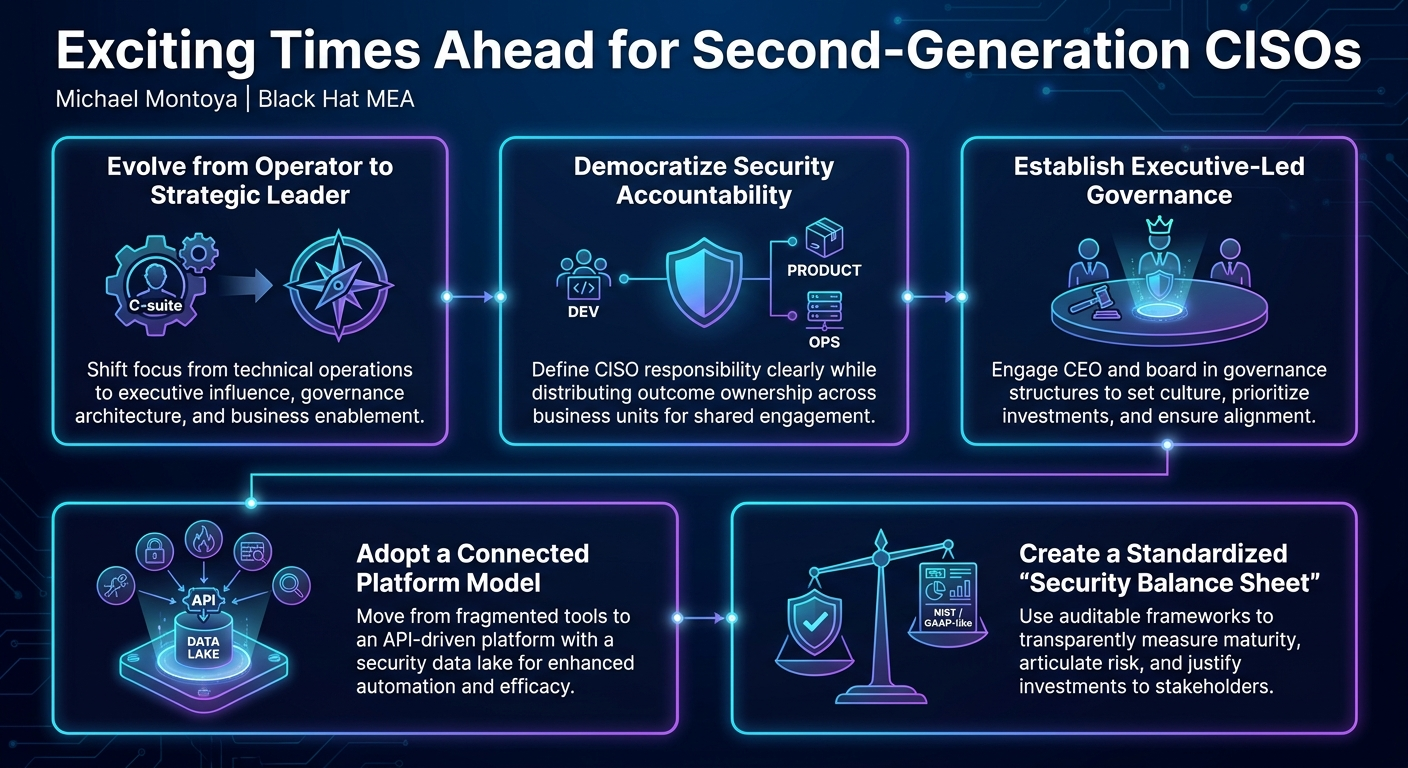
First, a fundamental finding is the absolute necessity for CISOs to clearly define and scope organizational responsibility for security, while simultaneously democratizing accountability across the enterprise. Regulators are increasingly holding CISOs accountable, making this delineation non-negotiable. However, true security efficacy requires broader engagement, moving accountability for specific outcomes to relevant business units, such as development teams.
Second, establishing robust Enterprise Governance structures is paramount. Montoya argued that these structures are the primary mechanism for setting the tone of security culture, driving organization-wide prioritization, and ensuring alignment on security objectives. This involves bringing executive leadership, including the CEO and board, into the governance process to champion security as a corporate imperative.
Third, the evolving complexity of security tools and infrastructure demands that security be treated as a connected, data-driven, and user-centric platform. Moving away from a collection of disparate tools, a platform approach enables greater efficacy, automation, and seamless integration into business processes, ultimately enhancing the user experience and developer velocity.
Fourth, a significant contribution and finding from Montoya is the urgent need for a standardized "security balance sheet." Drawing an analogy to financial reporting, he stressed that CISOs lack a codified, universally understood method to measure security maturity, articulate risk, and justify investments. Adopting a framework like NIST and striving for auditable metrics, akin to GAAP principles, is crucial for transparent communication with boards and executives.
Finally, effective leadership in this evolving landscape requires a deliberate focus on vision, alliance building, and self-effectiveness. Montoya highlighted the importance of fostering relationships, managing burnout, and prioritizing mental health within security teams, recognizing the intense demands placed upon them. These leadership tenets are vital for sustaining a high-performing security function.
Technical Deep Dive
▶ Watch: Leveraging enterprise governance to drive security culture (10:20)
Montoya’s vision for the second-generation CISO is underpinned by several technical and organizational strategies designed to elevate security from a cost center to a strategic enabler. These strategies involve a fundamental re-architecture of how security responsibilities are distributed, governed, and measured within an enterprise.
Redefining Responsibility and Accountability
A cornerstone of Montoya's approach is the precise definition of security responsibility for the CISO and the strategic transfer of accountability to other organizational units. He noted that regulators, particularly in the United States with recent SEC rulings, are increasingly explicit about the CISO's ultimate responsibility for an organization's security posture. At Equinix, this responsibility is scoped across four key areas: achieving clear visibility across all digital architectures, data, and operations; applying comprehensive governance at all levels; maintaining a strong understanding of control efficacy; and ensuring these efforts contribute directly to the overall mission.
While the CISO retains responsibility, true security democratization requires transferring accountability. Montoya detailed how Equinix shifts accountability to groups like software engineering and development organizations. This isn't about dictating specific tools or controls but rather about defining desired business outcomes. For instance, development teams are made accountable for outcomes such as accelerating innovation, quickening the pace of development, achieving inherent security in products, and balancing security for customers and shareholders. This approach fosters a sense of shared ownership, empowering teams to integrate security into their processes in a way that aligns with their operational goals, rather than viewing it as a bottleneck imposed by a central security team.
Establishing Robust Enterprise Governance
To ensure enterprise-wide alignment and prioritization, Montoya emphasized the critical role of enterprise governance structures. At Equinix, this begins with an executive-level committee that includes the CEO, other senior executive unit (SEU) leaders, and even board representation. This top-down engagement sets a powerful cultural tone, signaling that security is a corporate-wide, executive-driven initiative.
Below this executive committee, sub-committees are established, comprising leaders from critical functions such as IT, product, risk, and legal. These individuals act as "cyber champions," extending security awareness and accountability across their respective domains. These sub-committee members are often "voting members," participating in decisions around risk registers, investment prioritization, and the allocation of resources. This structured approach ensures that security discussions are not confined to the CISO’s office but are integrated into broader business decision-making processes. Montoya also mentioned the automation of GRC (Governance, Risk, and Compliance) capabilities to streamline risk categorization, improve transparency around policies and control statements, and enhance the overall efficiency of the governance framework.
Security as a Connected Platform
Addressing the proliferation of security tools and agents, Montoya advocated for a paradigm shift towards viewing security as a connected platform. He highlighted the common challenge of managing numerous disparate tools, agents on user devices, and inline inspection points that often lack seamless integration. The solution proposed is to build a security platform that is extensible (ideally through APIs), user-centric, and operates under a product operating model. This approach focuses on user experience, adoption, and measuring success through product-led growth metrics.
At the core of this platform is a significant investment in a security data lake. This data lake serves as the instrumentation layer, connecting various security tools and GRC processes. It enables the modeling of potential threats, the identification of specific areas requiring action (e.g., in a protective or response mode), and the automation of responses through mechanisms like SOAR (Security Orchestration, Automation, and Response). The goal is to make the platform easily connectable into different business processes. For instance, software engineers can access the platform in a frictionless manner, with security policies embedded directly into APIs and infrastructure-as-code (e.g., Terraform), allowing them to innovate rapidly without being hindered by complex security gatekeepers.
The Security Balance Sheet and Metrics
Perhaps one of Montoya's most insightful technical contributions is the concept of a "security balance sheet." He drew a stark contrast between the mature, codified financial reporting standards (e.g., income statements, cash flow statements, balance sheets, and Generally Accepted Accounting Principles - GAAP) and the often disparate, inconsistent methods used to report on security posture. This lack of standardization makes it challenging for CISOs to effectively communicate risk, justify investments, and demonstrate the return on security programs to boards and executives.
Montoya urged the security community to develop a collective effort to build this balance sheet. Key components include:
- Picking a Framework: Equinix chose the NIST (National Institute of Standards and Technology) framework, adapting its approximately 900 controls to measure security maturity and identify Key Risk Indicators (KRIs). This choice provides a consistent baseline for assessment.
- Regular and Consistent Reporting: Boards and executives need regular, consistent updates that clearly articulate what the chosen framework means for the organization's focus, prioritization, and investment in security programs.
- Audited and Unaudited Views: Striving for an audited view of security posture, similar to financial audits, lends credibility and transparency. This aligns with the increasing regulatory demands for executive sign-off on security programs.
The "security balance sheet" aims to introduce GAAP-like principles for security, providing a standardized, validated, and justifiable way to report on security investments and their outcomes, transforming security reporting into a mature, credible discipline.
Demo / Proof of Concept
▶ Watch: Shifting to a connected, data-driven security platform (13:00)
Michael Montoya's presentation was a strategic and high-level discussion on the evolution of the CISO role and organizational security practices, rather than a technical demonstration of specific tools or solutions. As such, the talk did not include a live demo or a proof of concept. His insights were drawn from extensive career experience and the implementation of these strategic principles within Equinix and other organizations.
Defensive Implications
▶ Watch: Leadership framework for CISO role and mental health (19:00)
The insights shared by Michael Montoya carry profound defensive implications for CISOs and security organizations striving to build resilient and effective programs in the face of escalating threats and regulatory demands. The core message is a call to evolve beyond traditional operational security into a strategic, influential, and integrated function.
Firstly, CISOs must embrace strategic leadership and influence. It is no longer sufficient to be an excellent technical operator; the modern CISO must be adept at communicating risk, value, and strategy to executive leadership and the board. This involves developing strong alliances across the organization and positioning security as a business enabler rather than a mere cost center. Defenders should actively invest in leadership development, communication skills, and understanding the broader business context.
Secondly, clarifying responsibility and democratizing accountability is critical. While the CISO bears ultimate responsibility for the security program, security must become a shared concern. Defensive strategies should involve embedding security accountability into development pipelines, product teams, and operational units. This means shifting from a "security team does everything" mentality to empowering developers to own security outcomes, providing them with the tools, policies, and frameworks (e.g., via APIs and policy-as-code) to build secure systems from the ground up. This distributed accountability enhances security posture by integrating it earlier and more deeply into the development lifecycle.
Thirdly, implementing robust enterprise governance structures is non-negotiable. Defenders need to advocate for and participate in governance committees that include top executives and board members. This ensures that security is a priority at the highest levels, facilitating resource allocation, risk prioritization, and the establishment of a strong security culture across the enterprise. Automating GRC processes can further enhance transparency and efficiency in managing risk and compliance.
Fourth, adopting a "security as a platform" mindset is crucial for operational efficiency and efficacy. Instead of managing a fragmented collection of security tools, defenders should focus on integrating these tools into a cohesive, data-driven platform. This platform should be extensible via APIs, user-centric, and leverage a security data lake for threat modeling, anomaly detection, and automated response (SOAR). This approach enables faster detection, more consistent enforcement of policies, and a more agile response to evolving threats.
Finally, the development of a "security balance sheet" is a critical defensive measure for justifying investments and demonstrating progress. Defenders must work towards standardized, transparent, and ideally auditable metrics (e.g., using NIST controls and GAAP-like principles) to report on security maturity, control efficacy, and risk posture. This allows CISOs to clearly articulate the return on security investments, advocate for necessary resources, and build trust with stakeholders, ultimately strengthening the organization's overall defensive posture. By speaking the language of business and finance, CISOs can better secure the buy-in and resources required to protect the enterprise.
Key Takeaways
- The CISO role is rapidly evolving into a strategic, influential, and governance-focused leadership position, moving beyond a purely technical or operational function.
- Establishing clear security responsibility for the CISO while strategically democratizing accountability across development, product, and other business units is paramount for enterprise-wide security efficacy.
- Robust enterprise governance structures, involving executive leadership (CEO, board) and cross-functional "cyber champions," are essential for setting security culture, prioritizing investments, and ensuring organizational alignment.
- Adopting a "security as a platform" approach, leveraging a connected, API-driven architecture, a security data lake, and a product operating model, enhances control efficacy, automation, and user experience.
- Developing a "security balance sheet" with standardized, auditable metrics (e.g., based on NIST and GAAP-like principles) is crucial for transparently measuring security maturity, articulating risk, and justifying investments to the board and executives.
- Effective CISO leadership requires a strong vision, proactive alliance building, and a deliberate focus on managing personal and team well-being to combat burnout and sustain high performance in a demanding environment.
About the Speaker(s)
Michael Montoya is the Chief Information Security Officer (CISO) at Equinix, a global leader in data center and interconnection services. In this role, he is responsible for overseeing the security of Equinix's extensive data center infrastructure and large interconnection fabric. With nearly 30 years of experience in the IT and security fields, Montoya has a distinguished career, having held significant security leadership positions at prominent technology companies including Microsoft, Google, and Mandiant. His background includes extensive "hands-on keyboard" experience in incident response, which he contrasts with the modern CISO's increasing need for executive influence and strategic communication. Michael Montoya also serves as an independent board director for F5, a major networking and application security company, further underscoring his expertise in the evolving security landscape. His perspective emphasizes the transformation of the CISO role from a technical operator to a strategic business leader and influencer.
Reviews
Dr. Zero (Offensive Security Researcher) — WEAK
Montoya gets on stage to tell us that CISOs need to talk to the board and shift security left. It's a polished delivery of standard CISO track platitudes wrapped in financial analogies. If you've scrolled LinkedIn in the last five years, you've already seen this talk.
Heather Calloway (CISO) — STRONG ACCEPT
Montoya delivers a highly credible blueprint for structuring a modern security organization, focusing on distributed accountability and formalized metrics. It is required viewing for technical leaders struggling to translate operational work into board-level risk conversations. Your leadership team should watch this to understand why security can no longer sit isolated from business unit P&Ls.
→ Top-rated talks at Black Hat Middle East & Africa 2023 (Executive Summit)
All talks from Black Hat Middle East & Africa 2023 (Executive Summit)