IT/OT Convergence in Cybersecurity
Juan Gomez-Sanchez (VP & Global CISO · Whirlpool Corporation)
Black Hat Middle East & Africa 2023 (Executive Summit) · Day 2 · Executive Summit
Overview
In this insightful Black Hat MEA talk, Juan Gomez-Sanchez, VP & Global CISO at Whirlpool Corporation, delves into the critical and evolving landscape of IT/OT convergence in cybersecurity. With over 30 years of experience in cybersecurity, Gomez-Sanchez shares Whirlpool's transformative journey in securing its Operational Technology (OT) environments, a path largely accelerated by a significant ransomware attack in 2020. The presentation highlights the unique challenges posed by OT systems, which historically operated in isolation but are now increasingly interconnected with traditional IT networks, demanding a fundamentally different approach to security.
Key moments
- 0:00 Introduction: 30 years in cyber, Whirlpool's OT journey
- 2:50 Why IT security approaches fail in OT environments
- 4:20 IT and OT teams must collaborate for effective security
- 8:10 Understanding the Purdue Model for OT environment segmentation
- 11:40 Addressing the critical skill gap in OT cybersecurity
- 14:00 Whirlpool's tailored OT security framework and resilience levels
- 17:00 Why manufacturing is a top target for cyberattacks
IT/OT Convergence in Cybersecurity
Speakers: Juan Gomez-Sanchez, VP & Global CISO, Whirlpool Corporation
Conference: Black Hat MEA
YouTube: https://www.youtube.com/watch?v=fdKwTWJFUQU
Overview
In this insightful Black Hat MEA talk, Juan Gomez-Sanchez, VP & Global CISO at Whirlpool Corporation, delves into the critical and evolving landscape of IT/OT convergence in cybersecurity. With over 30 years of experience in cybersecurity, Gomez-Sanchez shares Whirlpool's transformative journey in securing its Operational Technology (OT) environments, a path largely accelerated by a significant ransomware attack in 2020. The presentation highlights the unique challenges posed by OT systems, which historically operated in isolation but are now increasingly interconnected with traditional IT networks, demanding a fundamentally different approach to security.
The talk underscores that securing OT environments, which encompass manufacturing, critical infrastructure, and energy sectors, cannot simply mirror IT security practices. Gomez-Sanchez articulates why applying IT perspectives directly to OT systems often leads to failure, emphasizing the distinct technologies, operational priorities, and organizational cultures involved. He presents a pragmatic framework developed by Whirlpool to build resilience across its global manufacturing footprint, providing a roadmap for other organizations grappling with the complexities of IT/OT convergence and the escalating threat landscape targeting industrial control systems.
This discussion is particularly pertinent given the rising cyberattacks on manufacturing organizations, which, according to recent IBM X-Force reports, are targeted at a higher rate than any other industry. The existential threat posed by downtime in manufacturing environments necessitates a robust and tailored cybersecurity strategy that prioritizes availability above all else. Gomez-Sanchez's experience at Whirlpool offers a real-world case study for navigating this challenging domain, stressing the importance of adaptable frameworks, strategic partnerships, and a deep understanding of OT-specific operational requirements.
Background
▶ Watch: Introduction: 30 years in cyber, Whirlpool's OT journey (0:00)
Historically, Operational Technology (OT) systems, which control physical processes in manufacturing, utilities, and other industrial environments, were designed to be air-gapped. This physical separation from external networks provided an inherent layer of security, making them largely inaccessible to cyber threats originating from the internet. These systems, including Programmable Logic Controllers (PLCs), Supervisory Control and Data Acquisition (SCADA) systems, and servos, were built for reliability, longevity, and real-time performance, with security often being a secondary consideration, if at all.
However, the relentless march of innovation and the drive for greater efficiency, data analytics, and remote management have led to increasing connectivity between OT and Information Technology (IT) networks. This phenomenon, known as IT/OT convergence, has blurred the lines between these previously distinct domains, creating new attack surfaces and complex security challenges. The speaker, Juan Gomez-Sanchez, openly acknowledges that his own initial experience at Whirlpool, which began two and a half years prior to the talk, lacked specific OT cybersecurity expertise. His deep dive into this domain was prompted by a critical event: a significant ransomware attack that hit Whirlpool in 2020. This incident served as a stark wake-up call, catalyzing a strategic shift towards building comprehensive cyber resilience within their manufacturing operations.
A central theme of the talk is the fundamental incompatibility of applying traditional IT cybersecurity perspectives directly to OT environments. Gomez-Sanchez explains that IT security practices, such as patching critical systems every 30 days as part of vulnerability management, are simply not feasible in OT. Such actions could disrupt production, cause physical damage, or compromise the critical availability of operational systems, which is paramount in manufacturing. The technology stack in OT is different, the personnel are different (e.g., control engineers instead of systems engineers), and even the terminology differs. This necessitates the development of distinct security policies, processes, and controls specifically tailored to the unique requirements and constraints of OT. Without a collaborative approach that integrates perspectives from both IT and plant operations, any attempt to secure OT is destined to fail.
Key Findings
▶ Watch: IT and OT teams must collaborate for effective security (4:20)
The talk reveals several critical insights gleaned from Whirlpool's journey in securing its global OT infrastructure:
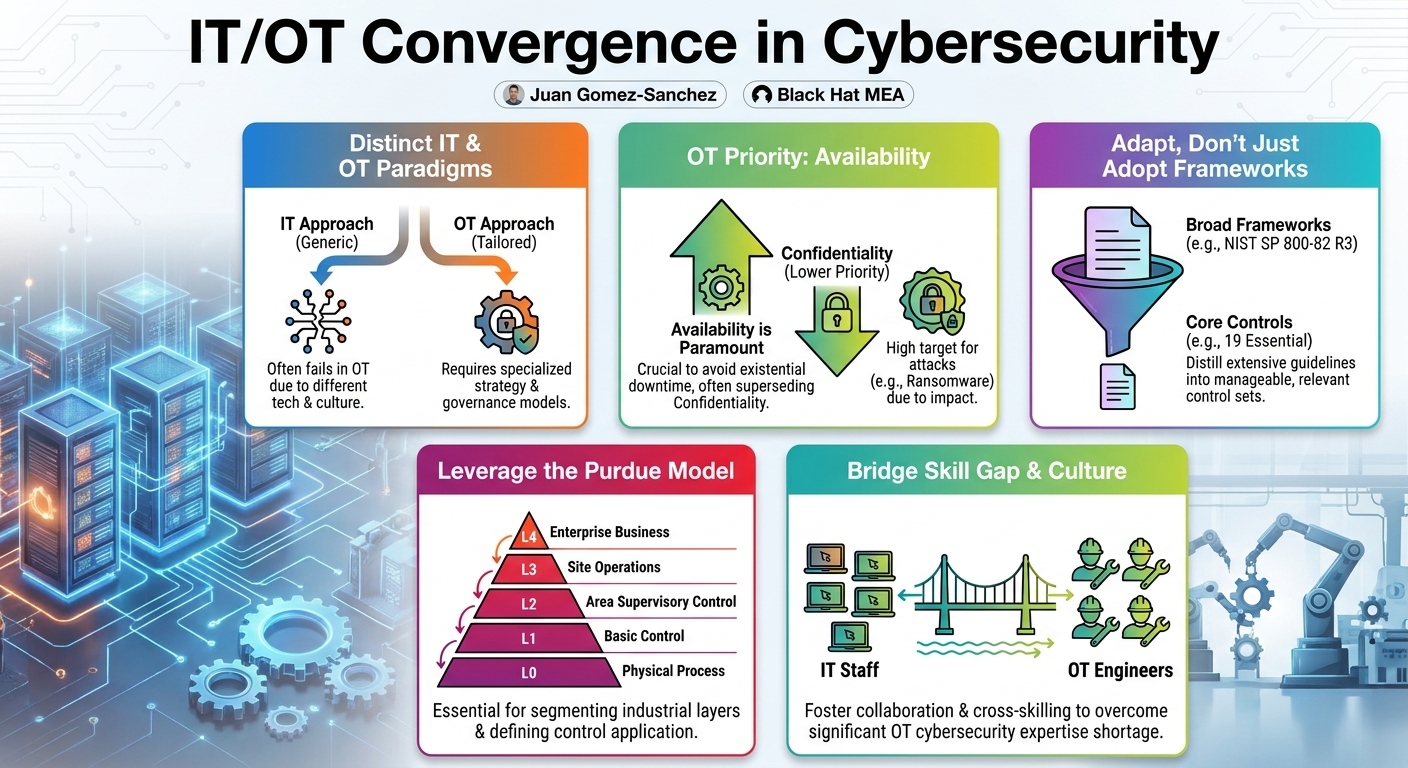
- IT Security Approaches Are Insufficient for OT: The most fundamental finding is that traditional IT security paradigms cannot be directly transposed to OT environments. The distinct technological stacks, operational priorities (e.g., availability over confidentiality), and organizational cultures demand a separate, tailored approach. Whirlpool, for instance, now runs two distinct security programs: an Enterprise (IT) program and an OT security program (referred to as manufacturing cyber resilience).
- Tailored Governance Models are Essential: Unlike IT, OT environments often lack established governance models for critical functions like change management, configuration management, and asset management. This is compounded by the fact that many manufacturing organizations grow through acquisition, leading to a heterogeneous mix of technologies and standards. Building and enforcing a unified, OT-specific governance model is paramount.
- Frameworks Must Be Adapted, Not Adopted Blindly: While foundational frameworks like the NIST Cybersecurity Framework and NIST SP 800-82 R3 provide excellent starting points, they are often too broad and detailed for direct implementation. Whirlpool’s experience demonstrated the necessity of distilling these extensive control sets (from thousands down to 19 critical controls) to fit their specific operational context and timeframes, often in partnership with specialized vendors like Rockwell Automation.
- The Purdue Model as a Foundational Structure: The Purdue Model is presented as a crucial framework for segmenting and understanding OT environments. It provides a layered architecture that helps define where and how different security controls should be applied, acknowledging the varying levels of control and associated difficulties across production lines, control systems, and enterprise IT.
- Cultural Shift and Skill Development are Non-Negotiable: Securing OT is as much about people and processes as it is about technology. There is a significant global shortage of cybersecurity professionals, and this gap is even more pronounced in OT security. Organizations must actively decide whether to upskill IT professionals in OT or vice-versa, and foster a cultural shift to ensure plant operations understand and value cybersecurity.
- Manufacturing is a Prime Target: Citing an IBM X-Force report, Gomez-Sanchez highlights that manufacturing organizations are attacked at a higher rate than any other industry, including financial services. This is primarily due to their high demand for availability, the prevalence of legacy OT systems, and the severe financial and operational consequences of downtime, making them attractive targets for threat actors.
Technical Deep Dive
▶ Watch: Understanding the Purdue Model for OT environment segmentation (8:10)
The technical foundation of Whirlpool's OT security strategy is deeply rooted in adapting established frameworks to the unique characteristics of industrial control systems. A cornerstone of their approach is the Purdue Model for Control Hierarchy, a widely recognized architectural framework that segments industrial control systems into distinct layers, from the physical process at the bottom to enterprise IT systems at the top. Gomez-Sanchez explains this model as a hierarchy where the lower layers (e.g., production lines, devices, control systems) demand more specific and stringent controls due to their direct impact on physical processes, while higher layers (e.g., manufacturing operations management, enterprise IT) can leverage more traditional IT security practices.
The speaker highlights the critical distinction in personnel and technology across these layers. In OT, one encounters control engineers managing PLCs and SCADA systems, MES (Manufacturing Execution Systems) analysts, and plant security leads, whose responsibilities and technical understanding differ significantly from their IT counterparts like systems engineers. This necessitates an educational effort to bridge the cultural and technical gap, ensuring common understanding and collaboration. The Purdue Model helps in this context by providing a common language and structure for discussing security requirements across different operational levels.
Whirlpool's journey began with the comprehensive NIST Cybersecurity Framework, but they quickly identified the need for a more specialized guide. They then turned to NIST SP 800-82 R3 (Guide to Operational Technology (OT) Security), a framework specifically designed for securing OT environments. However, Gomez-Sanchez points out a common challenge with such detailed best practices: they often contain "thousands of controls," many of which may not be immediately applicable or feasible for a given organization. To address this, Whirlpool partnered with Rockwell Automation, a prominent industrial automation vendor, to help distill and prioritize these controls. Through this collaborative process, they drastically reduced the initial list of thousands of controls to 25 basic ones, and further refined them to 19 core important controls that were deemed essential and achievable for their specific operations.
This distillation process led to the development of Whirlpool's custom resilience levels strategy across its approximately 70 production manufacturing sites and research centers globally. This tiered approach aims to achieve security maturity progressively, balancing speed with operational stability:
- Resilience Level 1 (Baseline): This level defines a set of fundamental controls that must be implemented across all manufacturing environments. The goal is broad and quick implementation, understanding that "quick" in an OT context might still mean a couple of years. The primary focus at this stage is maintaining availability, ensuring that security measures do not disrupt critical production.
- Resilience Level 2 (Measured Depth): Once the baseline is established, this level introduces a deeper set of security requirements. It's designed for most manufacturing plants, aiming for a higher standard of security in a measured, deliberate manner.
- Resilience Level 3 (Highest Risk Focus): This advanced level is specifically designed for manufacturing sites identified as having the highest operational risk. It involves a higher perspective and more stringent application of existing controls, rather than an entirely new set, to provide enhanced protection where it's most needed.
This structured approach allows Whirlpool to measure progress and investment value, ensuring that security enhancements are strategically deployed without compromising the paramount operational requirement of availability. Gomez-Sanchez stresses that in manufacturing, availability is King, often superseding confidentiality and sometimes even integrity in immediate priority, because any downtime can have existential consequences for the business.
Demo / Proof of Concept
▶ Watch: Whirlpool's tailored OT security framework and resilience levels (14:00)
This particular talk did not include a live demonstration or a proof of concept. Juan Gomez-Sanchez focused on presenting Whirlpool's strategic journey, lessons learned, and the frameworks they developed for securing their Operational Technology (OT) environments. The emphasis was on the architectural and policy-level changes rather than specific tool or exploit demonstrations.
Defensive Implications
▶ Watch: Why manufacturing is a top target for cyberattacks (17:00)
The insights shared by Juan Gomez-Sanchez offer several critical defensive implications for organizations grappling with IT/OT convergence:
- Establish Separate, Tailored OT Security Programs: Organizations must recognize that a "one-size-fits-all" approach to cybersecurity is ineffective. Create a distinct OT security program with its own policies, processes, and dedicated resources, separate from the traditional IT security program. These policies must respect OT operational imperatives, particularly the primacy of availability.
- Develop OT-Specific Governance Models: Implement robust governance models for OT environments, covering essential areas like change management, configuration management, and asset management. These models must be adapted to the unique characteristics of industrial systems and often heterogeneous environments resulting from acquisitions.
- Adopt and Adapt Industry Frameworks: Leverage established frameworks such as the NIST Cybersecurity Framework and, more specifically, NIST SP 800-82 R3. However, be prepared to extensively distill and customize these frameworks, as Whirlpool did, reducing thousands of controls to a manageable and relevant set (e.g., 19 core controls) that aligns with your organization's specific risk profile, operational context, and resource capabilities.
- Utilize the Purdue Model for Segmentation: Implement network segmentation based on the Purdue Model or similar architectural frameworks. This helps to logically separate critical OT layers from enterprise IT and less critical industrial zones, limiting the blast radius of attacks and enabling the application of appropriate security controls at each level.
- Prioritize Availability: In OT environments, availability is paramount. Defensive strategies must be designed to minimize disruption to operations. This means careful planning for patching, updates, and security control deployments, often requiring pilot programs and phased rollouts to avoid outages.
- Address the OT Security Skill Gap: Proactively develop strategies to bridge the significant skill gap in OT cybersecurity. This could involve cross-training existing IT security professionals in OT principles or upskilling OT professionals in cybersecurity. Investing in specialized training for control engineers, MES analysts, and plant security leads is crucial.
- Foster Cultural Collaboration: Promote a culture of collaboration between IT, OT, and plant operations. Education is key to ensuring that operational staff understand the value and necessity of cybersecurity, and that IT security teams appreciate the unique constraints of OT.
- Partner with OT Vendors and Experts: Seek partnerships with specialized OT cybersecurity vendors and consultants, like Whirlpool did with Rockwell Automation. These partners can provide invaluable expertise in adapting frameworks, implementing controls, and navigating the complexities of industrial systems.
- Monitor the Threat Landscape: Stay informed about the evolving threat landscape targeting manufacturing and critical infrastructure. The IBM X-Force report highlights manufacturing as the most attacked industry, underscoring the urgent need for proactive and robust defenses tailored to this sector's vulnerabilities and high availability demands.
Key Takeaways
- OT security demands a fundamentally different approach than IT security. Direct application of IT practices will likely fail due to distinct technologies, operational priorities (availability first), and organizational cultures.
- The Purdue Model is a critical framework for understanding and segmenting OT environments. It helps define where and how security controls should be applied across different industrial layers, from the physical process to enterprise IT.
- Availability is the paramount concern in manufacturing OT environments. Security measures must be carefully planned and implemented to avoid operational disruptions, as downtime can have existential consequences.
- Industry cybersecurity frameworks like NIST SP 800-82 R3 must be adapted and distilled. Organizations should customize these extensive guidelines to create a manageable set of controls (e.g., Whirlpool's 19 core controls) that are relevant and achievable for their specific operational context.
- Addressing the OT cybersecurity skill gap and fostering cultural shift are crucial for success. Organizations must invest in training, cross-skilling, and education to ensure collaboration between IT, OT, and plant operations.
- Manufacturing is a top target for cyberattacks due to its high availability requirements and legacy systems. This necessitates a proactive, tailored, and robust cybersecurity strategy to protect critical industrial processes.
About the Speaker(s)
Juan Gomez-Sanchez is the VP & Global CISO at Whirlpool Corporation. With a distinguished career spanning approximately 30 years in cybersecurity, he brings extensive experience in safeguarding enterprise-level systems. Gomez-Sanchez joined Whirlpool two and a half years prior to this talk, initially without direct experience in Operational Technology (OT) security. However, following a significant ransomware attack on Whirlpool in 2020, he immersed himself in the OT domain, strategically leading the company's efforts to build cyber resilience within its manufacturing and industrial environments. His insights are drawn from this real-world journey of adapting and implementing comprehensive security frameworks in a complex global manufacturing setting.
Reviews
Dr. Zero (Offensive Security Researcher) — WEAK
A sanitized CISO war story about surviving a 2020 ransomware incident by discovering that OT and IT are, in fact, different. Whirlpool distilling NIST 800-82 down to 19 controls is a practical operational takeaway, but the rest is introductory boilerplate. If you need the Purdue model explained to you at a security con, you're in the wrong room.
Heather Calloway (CISO) — STRONG ACCEPT
This is a pragmatic, CISO-to-CISO playbook from a peer who survived a major ransomware event and recognized that enterprise IT security fails on the plant floor. It details the governance and operational shifts required to secure manufacturing environments without breaking them. I'd make this required viewing for any security leader with a physical operations footprint.
→ Top-rated talks at Black Hat Middle East & Africa 2023 (Executive Summit)
All talks from Black Hat Middle East & Africa 2023 (Executive Summit)