Offensive Security Strategies: From Vulnerability Assessment to Red Teaming
Phillip Wylie
Black Hat Middle East & Africa 2023 (Executive Summit) · Day 2 · Executive Summit
Overview
In an insightful presentation at Black Hat MEA, Phillip Wylie, an experienced Red Team Lead, tackled a pervasive challenge within the cybersecurity industry: the widespread confusion surrounding different offensive security assessment types. His talk, "Offensive Security Strategies: From Vulnerability Assessment to Red Teaming," aimed to demystify the distinctions between vulnerability management, vulnerability assessments, penetration testing, and red teaming (or adversary emulation). Wylie emphasized that a clear understanding of these methodologies is crucial for organizations to make informed decisions about their security investments, build effective security teams, and accurately gauge their defensive posture against real-world threats.
Key moments
- 0:00 Introduction to offensive security and assessment confusion.
- 3:20 Importance of physical security and social engineering tests.
- 8:40 Penetration testing: exploitation, privilege escalation, and data access.
- 10:00 Black, gray, and white box penetration testing approaches.
- 12:00 Red teaming: emulating threat actors and testing people/process.
- 14:00 Comparative overview of vulnerability assessment, pentesting, and red teaming.
- 17:20 PTES methodology and essential post-exploitation activities.
Offensive Security Strategies: From Vulnerability Assessment to Red Teaming
Speakers: Phillip Wylie, Red Team Lead, Global Consumer Products Company
Conference: Black Hat MEA
YouTube: https://www.youtube.com/watch?v=ExYPV0a1YoQ
Overview
In an insightful presentation at Black Hat MEA, Phillip Wylie, an experienced Red Team Lead, tackled a pervasive challenge within the cybersecurity industry: the widespread confusion surrounding different offensive security assessment types. His talk, "Offensive Security Strategies: From Vulnerability Assessment to Red Teaming," aimed to demystify the distinctions between vulnerability management, vulnerability assessments, penetration testing, and red teaming (or adversary emulation). Wylie emphasized that a clear understanding of these methodologies is crucial for organizations to make informed decisions about their security investments, build effective security teams, and accurately gauge their defensive posture against real-world threats.
Wylie's motivation stemmed from his observations as a Red Team Lead, where he frequently encountered a lack of clarity among colleagues and even sales engineers regarding the scope and objectives of various offensive security services. This confusion often leads to misaligned expectations, ineffective security programs, and the misapplication of resources. By dissecting each assessment type, Wylie provided a foundational framework for understanding how these services complement each other, ultimately contributing to a more robust and mature cybersecurity strategy.
The core message of the talk is that effective offensive security extends far beyond mere vulnerability scanning. It requires a nuanced approach that considers threat actor perspectives, human elements, and organizational processes. Wylie argued that just as consumers rely on detailed reviews before purchasing products, organizations need a comprehensive understanding of offensive security services to select the right tools and strategies for their unique environments, ensuring they are truly protected against the evolving landscape of cyber threats, including sophisticated ransomware attacks and nation-state adversaries.
Background
▶ Watch: Introduction to offensive security and assessment confusion. (0:00)
The landscape of cybersecurity is complex and ever-evolving, leading to a natural proliferation of specialized roles, tools, and services. However, this specialization has inadvertently created a challenge: a significant gap in understanding among professionals regarding the precise definitions and objectives of different offensive security practices. Phillip Wylie highlighted this issue, noting that even within organizations, and particularly among sales engineers promoting security products, there's a tendency to conflate terms like "penetration testing" with basic "vulnerability scanning" or to label any offensive engagement as "red teaming," even when it lacks the true scope and stealth of an adversary emulation exercise.
This problem is exacerbated by the dynamic nature of IT environments, where new servers, cloud infrastructure, and applications are constantly being deployed. Organizations often struggle with fundamental asset discovery, making it impossible to secure what they don't even know they possess. Furthermore, the traditional focus on technical vulnerabilities often overlooks critical attack vectors such as physical security and social engineering, which sophisticated threat actors frequently exploit to bypass even the most advanced technical controls. Wylie underscored that a simple vulnerability scan, while important for vulnerability management, is inherently insufficient to uncover the full spectrum of risks, especially those that require complex exploitation, privilege escalation, or lateral movement within an environment.
The need for this clarification is pressing. As Wylie pointed out, organizations often invest heavily in "penetration tests" that are, in reality, little more than automated vulnerability scans, failing to provide a genuine assessment of their resilience against a determined attacker. This misrepresentation, whether intentional or accidental, can leave critical gaps in an organization's security posture, leading to a false sense of security. Wylie's talk aimed to serve as a "Consumer Reports" for offensive security, empowering decision-makers to distinguish between various services and build truly effective defensive capabilities.
Key Findings
▶ Watch: Penetration testing: exploitation, privilege escalation, and data access. (8:40)
Phillip Wylie's presentation delivered several critical insights into the effective application of offensive security strategies, highlighting the distinct roles and objectives of different assessment types:
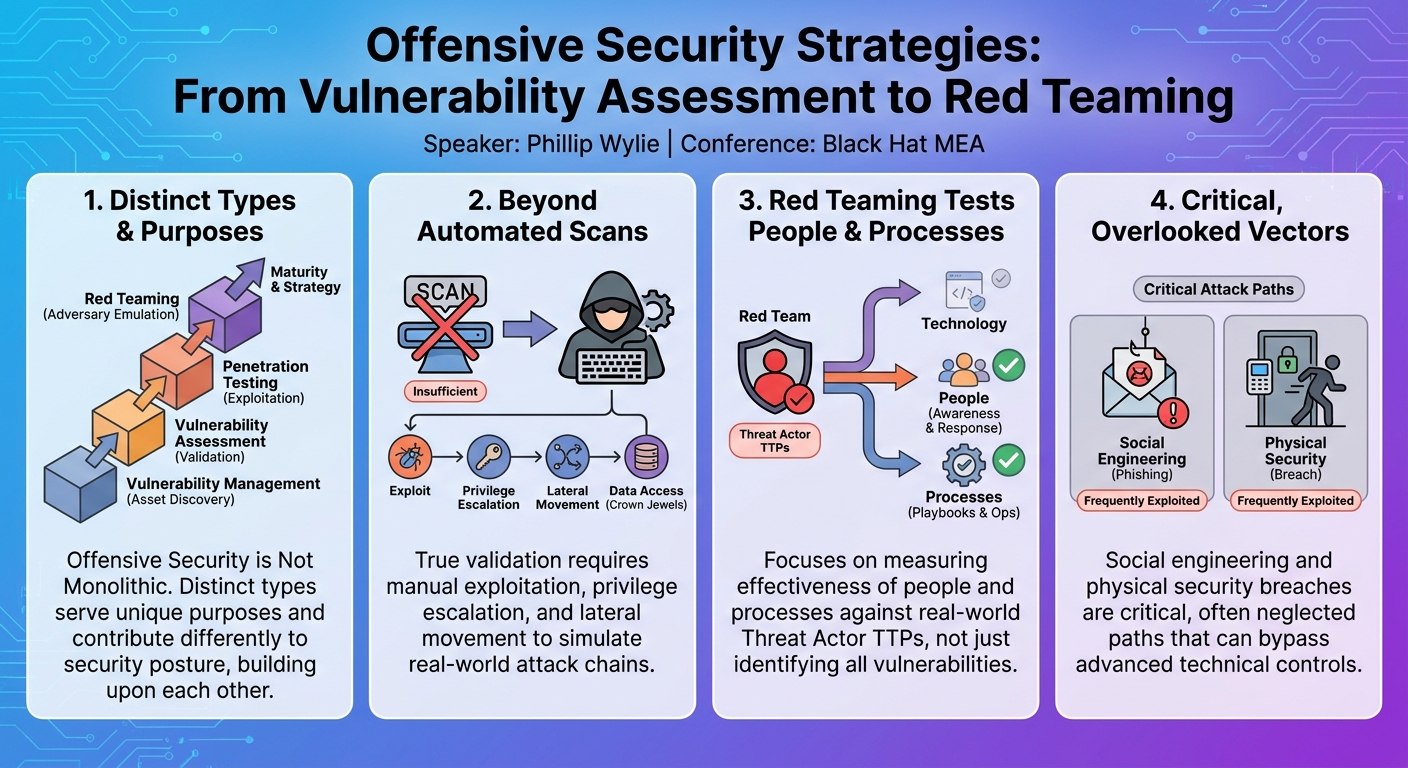
- Distinct Offensive Security Types: The talk clearly differentiated between Vulnerability Management, Vulnerability Assessments, Penetration Testing (Pentesting), and Red Teaming (Adversary Emulation). Each serves a unique purpose and contributes differently to an organization's overall security posture.
- Vulnerability Scanning is Insufficient: While an essential component of vulnerability management, automated vulnerability scanning alone cannot provide a comprehensive security assessment. It often produces false positives and fails to identify exploitable attack chains or the potential for privilege escalation and lateral movement.
- Pentesting Goes Beyond Scanning: A true penetration test involves manual validation of vulnerabilities, exploitation, privilege escalation, and lateral movement to assess the potential impact on an organization's "crown jewels" – its sensitive data. The goal is not just to find vulnerabilities but to demonstrate their exploitability and the potential damage.
- Red Teaming Tests People and Processes: Unlike penetration testing, which primarily focuses on technical vulnerabilities, red teaming emulates real-world threat actors using specific Tactics, Techniques, and Procedures (TTPs). Its objective is to measure the effectiveness of the organization's people, processes, and technology (the Blue Team) in detecting, responding to, and mitigating sophisticated attacks. Red team operations are conducted with limited internal knowledge to simulate a genuine breach scenario.
- Physical Security and Social Engineering are Critical: Wylie stressed that these often-overlooked attack vectors are frequently the easiest path for adversaries. Effective offensive security must include testing for social engineering (e.g., phishing campaigns with malware payloads) and physical security breaches (e.g., tailgating, data center access), as these can bypass advanced technical controls.
- Maturity Matters for Red Teaming: Organizations should not jump directly into red teaming. It is a more advanced assessment that yields the most value when an organization has already established a mature vulnerability management program and regularly conducts penetration tests to address known technical weaknesses.
- Data is the Ultimate Goal: Wylie underscored that the ultimate objective of most attackers is to gain access to, and potentially exfiltrate, sensitive data. Offensive security engagements, particularly penetration tests, should prioritize assessing access to these "crown jewels" rather than merely focusing on achieving domain administrator or root privileges.
These findings collectively provide a roadmap for organizations to strategically approach offensive security, moving beyond superficial scans to comprehensive, threat-informed assessments that truly enhance their resilience.
Technical Deep Dive
▶ Watch: Black, gray, and white box penetration testing approaches. (10:00)
Phillip Wylie's talk meticulously dissected the various forms of offensive security, detailing their methodologies, tools, and objectives. Understanding these nuances is paramount for any organization serious about bolstering its defenses.
Vulnerability Management
The foundational layer of offensive security, vulnerability management, is a continuous, cyclical practice. It involves:
- Asset Discovery and Inventory: A critical, often overlooked first step. As Wylie stated, "If you don't know what you have, you can't secure it." This includes identifying all systems, applications, and cloud infrastructure, which are constantly changing.
- Vulnerability Scanning: Automated tools like Nessus, Nexpose, and Qualys are employed to detect known vulnerabilities (e.g., CVEs) across networks and applications. For web applications, specialized scanners like AppScan and Fortify DAST (formerly WebInspect) are used. Wylie noted that these tools significantly scale the process of vulnerability detection, which was once a manual effort.
- Vulnerability Remediation: This includes patching systems, reconfiguring services, and applying security updates. Wylie shared an anecdote about a penetration test where a low-level vulnerability, initially deemed minor, was exploited within a 90-day retest period, highlighting the importance of timely remediation and continuous testing.
Vulnerability management establishes a baseline, ensuring common weaknesses are identified and addressed regularly.
Vulnerability Assessments
Building upon scanning, a vulnerability assessment takes a more hands-on approach. It involves:
- Validation of Findings: Security professionals manually verify the vulnerabilities reported by scanners to eliminate false positives.
- Manual Detection: Beyond automated tools, assessors use other techniques and tools to uncover additional vulnerabilities. This might include attempting basic password attacks or analyzing configurations that scanners might miss.
- Combination Approach: A vulnerability assessment combines automated scanning with manual techniques, offering a more accurate and comprehensive view of exploitable weaknesses than scanning alone.
The key differentiator here is the human element validating and expanding upon automated results.
Penetration Testing (Pentesting)
Penetration testing is the next logical step, focusing on actively exploiting validated vulnerabilities to demonstrate potential impact. Its stages include:
- Vulnerability Analysis: Identifying which validated vulnerabilities are truly exploitable.
- Exploitation: Actively gaining unauthorized access to systems or applications.
- Post-Exploitation Activities: This is where a pentest truly shines. Wylie detailed:
- Privilege Escalation: Elevating access from a low-level user to higher privileges (e.g., domain admin or root).
- Lateral Movement: Gaining access to other systems within the network from the initial compromise point.
- Data Access: Identifying and accessing sensitive data, the "crown jewels" of the organization. Wylie emphasized that pentesters should focus on accessing data, not just achieving the highest privileges. Even a low-level user might access unprotected storage like S3 buckets.
- Data Exfiltration Testing: Simulating the removal of data from the environment. Crucially, Wylie advised using metadata that mimics sensitive information (e.g., credit card numbers) rather than actual live data for these tests.
Pentesting types vary based on the information provided to the testers:
- Black Box: Simulates an external attacker with no prior knowledge of the target. Requires extensive reconnaissance to discover targets and information (e.g., OSINT on executives for spear phishing).
- Gray Box: Provides testers with some limited information, such as IP ranges or specific domain names, allowing for a more focused test while still requiring some discovery.
- White Box (Crystal Box / Assumed Breach): Testers are given full knowledge of the environment, including architecture diagrams, source code, and even user credentials. This is useful for testing internal threats or what an attacker could do after an initial breach, particularly relevant for bypassing hardened EDR systems. Wylie noted its growing popularity for network pentests, not just web applications.
Red Teaming / Adversary Emulation
Red teaming is the pinnacle of offensive security, designed to emulate real-world threat actors and assess an organization's complete defensive capabilities.
- TTP-Based Approach: Red teams use specific Tactics, Techniques, and Procedures (TTPs) observed in actual threat groups, often leveraging the MITRE ATT&CK framework to select TTPs relevant to the target industry.
- Stealth and Undetected Operations: Unlike pentesting, red teaming typically avoids noisy vulnerability scanning. The goal is to remain undetected by the Blue Team (defenders) for as long as possible, mimicking a persistent attacker.
- Testing People and Processes: A core distinction is that red teaming assesses not only technology but also the organization's people (e.g., security awareness, incident response procedures) and processes (e.g., incident response playbooks, communication). Wylie shared an example where a successful red team operation led a company to call in their external Incident Response team, demonstrating the realism of the exercise.
- Limited Internal Knowledge: To maintain realism, knowledge of a red team operation is typically restricted to a small control group, often just the CISO, preventing the Blue Team from being tipped off.
- Focus on Breach Equivalency: The objective is to achieve a specific goal equivalent to a real breach (e.g., data exfiltration, critical system compromise) rather than finding every single vulnerability.
- Social Engineering and Physical Breaches: Red teaming heavily leverages social engineering (e.g., sophisticated phishing campaigns with malware payloads) and physical security assessments (e.g., tailgating, gaining access to data centers or manufacturing facilities).
Wylie stressed that red teaming should only be pursued once an organization has a mature vulnerability management program and conducts regular penetration tests.
Methodologies and Tools
Wylie highlighted key industry standards and tools:
- PTES (Penetration Testing Execution Standard): A highly regarded methodology developed by industry leaders like Dave Kennedy (TrustedSec), Chris Nickerson (Lares Consulting), Joseph McCrae, and Carlos Perez (TrustedSec). It provides a structured approach, technology guidance, and even customer questionnaires.
- OWASP (Open Web Application Security Project): An invaluable resource for web application testing, including the OWASP Top 10, OWASP API Top 10, and the OWASP Testing Guide.
- Port and Service Scanners: Nmap, Masscan.
- Vulnerability Scanners: Nessus, Qualys.
- Command and Control (C2): Cobalt Strike.
- Exploit Frameworks: Metasploit Framework (open-source), Core Impact (commercial).
This deep dive underscores that each offensive security practice has a unique role, and organizations must carefully select the appropriate strategy to match their security maturity and objectives.
Demo / Proof of Concept
▶ Watch: Comparative overview of vulnerability assessment, pentesting, and red teaming. (14:00)
While Phillip Wylie's presentation did not include a live, interactive technical demonstration in the traditional sense, the core of his talk served as a conceptual proof of concept. Wylie explicitly mentioned creating a "single slide to show the differences, make the comparisons" between various offensive security types for companies he worked with, including educating sales engineers. This slide, or a very similar "assessment comparison types" slide (as seen in the transcript at [14:00]), functioned as the visual centerpiece of his argument, clearly laying out the distinctions between vulnerability management, vulnerability assessments, penetration testing, and red teaming.
This comparison slide visually articulated the key differences: for instance, showing that vulnerability scanning is common in the first three assessment types but deliberately omitted from red teaming to maintain stealth. It highlighted the increasing complexity and scope, from basic scanning to full-scale adversary emulation incorporating social engineering and physical breaches. The slide effectively demonstrated Wylie's ability to simplify complex concepts into an actionable framework, proving the efficacy of his approach in clarifying industry confusion. His personal experience in using this exact method to educate internal teams underscored its practical utility and impact in distinguishing between services that are often conflated.
Defensive Implications
▶ Watch: PTES methodology and essential post-exploitation activities. (17:20)
Understanding the distinctions articulated by Phillip Wylie is not merely an academic exercise; it has profound defensive implications for organizations seeking to build resilient cybersecurity programs.
Firstly, organizations must become informed consumers of security services. Misunderstanding the scope of a "penetration test" can lead to purchasing a service that is essentially a glorified vulnerability scan, leaving critical attack vectors unaddressed. Security leaders should use Wylie's framework to scrutinize vendor offerings, ensuring that the services align with their actual needs and provide the desired level of depth and realism. This prevents wasted investment and a false sense of security.
Secondly, a phased approach to security maturity is crucial. Wylie emphasized that red teaming is an advanced exercise best suited for organizations with mature security programs. Defenders should prioritize:
- Robust Vulnerability Management: Implement continuous asset discovery and inventory to ensure all systems are known and monitored. Regularly conduct vulnerability scanning with tools like Nessus or Qualys and establish efficient patching and remediation processes. The anecdote about the low-level vulnerability becoming exploitable within 90 days highlights the necessity of prompt remediation and retesting.
- Comprehensive Penetration Testing: Move beyond scanning to engage in regular penetration tests that include manual validation, exploitation, privilege escalation, lateral movement, and assessment of data access and exfiltration. This helps identify real-world attack paths and validate the effectiveness of technical controls. Consider assumed breach testing (white box) to understand internal lateral movement and privilege escalation risks if an attacker gains initial access, especially important with hardened EDR solutions.
- Strategic Red Teaming: Once technical vulnerabilities are consistently managed, organizations can leverage red teaming to test their people, processes, and technology against sophisticated TTPs defined by frameworks like MITRE ATT&CK. This provides a "report card" for the Blue Team's detection and response capabilities, identifying gaps in incident response, security awareness, and operational procedures. Blue teams should view red team exercises as valuable training opportunities, not punitive assessments.
Thirdly, overlooked attack vectors must be integrated into defensive strategies. Defenders need to recognize that physical security and social engineering (e.g., phishing with malware payloads) are often the easiest routes for attackers. Implementing robust security awareness training, conducting realistic phishing campaigns (that test for actual malware execution, not just clicks), and performing physical penetration tests of data centers, offices, or critical infrastructure are non-negotiable. Organizations must test their ability to detect and prevent data exfiltration, using metadata to simulate sensitive information, thereby validating their data loss prevention (DLP) controls.
Finally, the talk implicitly encourages greater collaboration and understanding between offensive and defensive security teams. By understanding the methodologies and goals of penetration testers and red teamers, Blue Teams can better anticipate attack techniques, tune their detection systems, and refine their incident response playbooks. This holistic approach ensures that defensive efforts are truly threat-informed and continuously improved.
Key Takeaways
- Offensive Security is Not Monolithic: Organizations must understand the distinct differences between vulnerability management, vulnerability assessments, penetration testing, and red teaming to make informed decisions and deploy resources effectively.
- Beyond Automated Scans: While vulnerability scanning is foundational, it's insufficient. True security validation requires manual techniques, exploitation, privilege escalation, and lateral movement to simulate real-world attack chains.
- Red Teaming Tests More Than Technology: Adversary emulation (red teaming) focuses on measuring the effectiveness of an organization's people and processes, alongside technology, against real-world threat actor TTPs, rather than merely identifying all exploitable vulnerabilities.
- Maturity Dictates Strategy: Red teaming is an advanced assessment. Organizations should establish a mature vulnerability management program and conduct regular penetration tests before investing in red team exercises to maximize value.
- Don't Overlook Physical and Human Vectors: Social engineering (e.g., phishing) and physical security breaches are critical attack paths often neglected in assessments but frequently exploited by adversaries.
- Focus on the "Crown Jewels": Offensive security engagements should prioritize assessing access to and exfiltration of sensitive data, which is the ultimate goal for most attackers, rather than solely focusing on achieving the highest system privileges.
- Leverage Industry Standards: Utilize established methodologies and frameworks like PTES, OWASP Top 10, and MITRE ATT&CK to guide assessments and understand threat actor behaviors.
About the Speaker(s)
Phillip Wylie is an experienced cybersecurity professional, notably having served as a Red Team Lead for a Global Consumer Products Company. His background as a consultant and his current role have provided him with deep insights into the practical challenges and misconceptions within the offensive security domain. Wylie is passionate about educating others and bridging the knowledge gap, particularly regarding the distinctions between various security assessment types. His expertise lies in understanding real-world threat actor methodologies and translating complex technical concepts into actionable strategies for organizations.
Reviews
Dr. Zero (Offensive Security Researcher) — HARD PASS
If you need a Black Hat talk to explain that a Nessus scan isn't a red team engagement, hand in your badge. This is absolute Security 101 dressed up as a conference presentation. We’ve been having this exact 'VA vs. Pentest' semantic argument since 2008, and burning a slot on it now is a massive waste of time.
Heather Calloway (CISO) — SOLID
If your procurement team or board is confusing an automated scan with adversary emulation, this is a necessary baseline. It doesn't break new ground for a mature CISO, but it provides a clean vocabulary for defending budget and right-sizing external engagements.
→ Top-rated talks at Black Hat Middle East & Africa 2023 (Executive Summit)
All talks from Black Hat Middle East & Africa 2023 (Executive Summit)