Paving the Way: Balancing Standards, Regulations, Ownership, and Accountability
Vandana Verma, Dr. Kenneth Geers (Fellow · Atlantic Council), Dr. Alex Constantinidis (CISO · QNB Group)
Black Hat Middle East & Africa 2023 (Executive Summit) · Day 2 · Executive Summit
Overview
This Black Hat MEA panel discussion, "Paving the Way: Balancing Standards, Regulations, Ownership, and Accountability," brought together a distinguished group of cybersecurity leaders to dissect the intricate challenges of regulatory compliance in an era of rapid technological advancement. Moderated by Vandana Verma, the panel featured Dr. Kenneth Geers, a Fellow at the Atlantic Council with extensive experience in US government and cybersecurity startups; Dr. Alex Constantinidis, CISO of QNB Group; a panelist from GoTo, Indonesia's largest tech company; a panelist from Tata Power in India; and a panelist who oversees industrial control systems at NEOM. The discussion explored how regulatory bodies can keep pace with evolving threats, foster self-regulation, establish accountability for breaches, and address the critical skill gaps impacting the global cybersecurity landscape.
Key moments
- 2:20 Lack of regulation for software/hardware creators
- 11:00 Singapore bank forced to halt innovation
- 12:50 Self-regulation for customer trust and budget
- 19:20 Collaborative vs. firm government regulation approaches
- 26:40 AI models trained on insecure code
- 29:30 Rapidly evolving threat landscape and skills obsolescence
- 34:00 Diversity and inclusion to address skill gaps
Paving the Way: Balancing Standards, Regulations, Ownership, and Accountability
Speakers: Vandana Verma; Dr. Kenneth Geers (Fellow, Atlantic Council); Dr. Alex Constantinidis (CISO, QNB Group)
Conference: Black Hat MEA
YouTube: https://www.youtube.com/watch?v=vlBxsqr3do0
Overview
This Black Hat MEA panel discussion, "Paving the Way: Balancing Standards, Regulations, Ownership, and Accountability," brought together a distinguished group of cybersecurity leaders to dissect the intricate challenges of regulatory compliance in an era of rapid technological advancement. Moderated by Vandana Verma, the panel featured Dr. Kenneth Geers, a Fellow at the Atlantic Council with extensive experience in US government and cybersecurity startups; Dr. Alex Constantinidis, CISO of QNB Group; a panelist from GoTo, Indonesia's largest tech company; a panelist from Tata Power in India; and a panelist who oversees industrial control systems at NEOM. The discussion explored how regulatory bodies can keep pace with evolving threats, foster self-regulation, establish accountability for breaches, and address the critical skill gaps impacting the global cybersecurity landscape.
The talk underscores the universal struggle faced by governments and industries worldwide: how to create effective cybersecurity frameworks that encourage innovation and growth while ensuring robust protection against increasingly sophisticated cyber threats. The panelists, drawing from diverse geographical and sectoral experiences—from finance and critical infrastructure to e-commerce and smart city development—offered unique perspectives on balancing the often-conflicting demands of security, business objectives, and national development. This discourse is vital for any organization or policymaker grappling with the complexities of digital transformation and the imperative to build a secure and resilient cyber ecosystem.
Background
▶ Watch: Lack of regulation for software/hardware creators (2:20)
The core problem addressed by the panel is the inherent disconnect between the rapid evolution of technology and the comparatively slow pace of regulatory development. As a panelist from Tata Power aptly noted, policymakers often wait for the "mass adoption" of new technologies like blockchain, Generative AI, or IoT before developing guidelines, leading to policies that are "one size fits all" and quickly become irrelevant. This reactive approach creates a significant lag, leaving organizations vulnerable during the crucial early adoption phases of new tech.
Dr. Alex Constantinidis highlighted a fundamental gap: the lack of sufficient regulation governing the companies that create the actual software and hardware used across all industries. He argued that while financial services have well-established, unified security standards, many other sectors lack such foundational rules, leading to a continuous increase in discovered vulnerabilities. This absence of accountability at the source of digital products means that organizations are often forced to secure inherently insecure components, adding to the complexity and cost of cybersecurity.
Furthermore, the panel discussed how existing regulations, even in mature sectors like finance, often set only a "minimum bar" for security. Compliance alone does not equate to security, necessitating significant additional investment and effort from organizations to truly protect their assets. The challenge is compounded by the differing developmental stages and economic priorities of various countries, as illustrated by a panelist from GoTo's comparison between Singapore's mature regulatory environment and Indonesia's need to balance security with economic growth. This diverse landscape makes a universally applicable regulatory framework difficult to achieve, underscoring the need for adaptive and collaborative approaches.
Key Findings
▶ Watch: Self-regulation for customer trust and budget (12:50)
The panel's discussion yielded several key findings regarding the future of cybersecurity regulation and practice:
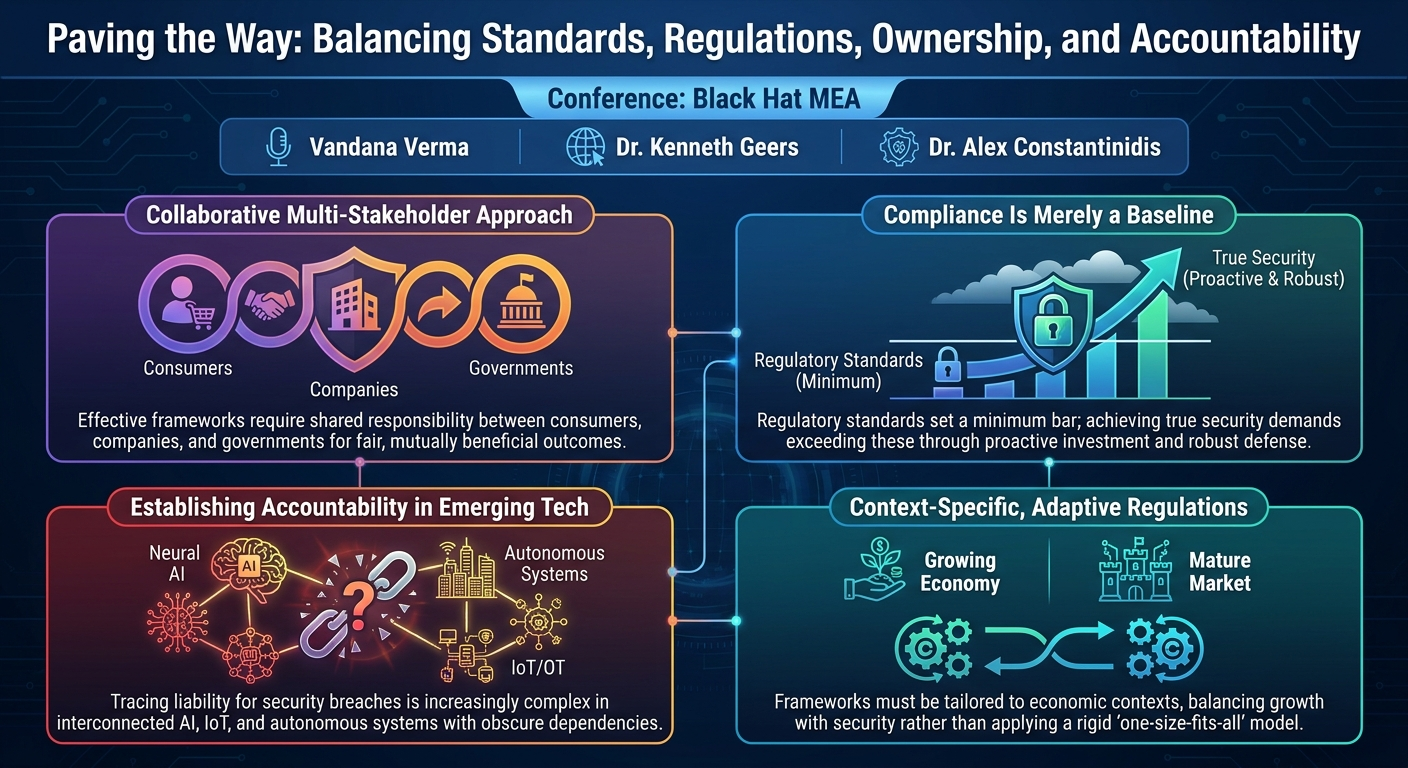
- Multi-Stakeholder Approach is Essential: Dr. Kenneth Geers emphasized that effective regulation, especially across international borders, requires a multi-stakeholder approach involving consumers, companies, and governments. This ensures that diverse perspectives are considered and that regulations are perceived as fair and mutually beneficial.
- Regulation as a Minimum Bar, Not the End Goal: Dr. Alex Constantinidis stressed that compliance with regulatory standards merely sets a minimum security baseline. True security demands exceeding these standards through proactive investment and robust configurations. Organizations must not mistake compliance for comprehensive security.
- Self-Regulation Driven by Trust and Business Value: Panelists noted that organizations, particularly in the financial sector, are increasingly motivated to self-regulate to demonstrate trustworthiness to customers and gain a competitive edge. Dr. Geers added that companies in the US are using security and compliance as a selling point, highlighting their investments in secure practices on their websites. Regulation can also serve as a crucial lever for CISO's to secure budget approvals for new controls, transforming a compliance requirement into a business enabler.
- Collaboration Over Confrontation: The most effective regulatory models involve collaboration between government agencies and organizations. Examples from India (Tata Power's partnership with NCIPPC) and Qatar (QNB Group's experience with a national cybersecurity center offering a "consulting approach") demonstrated that governments acting as supportive partners, rather than just enforcers, lead to better security outcomes, fostering trust and enabling proactive threat intelligence sharing.
- Adaptive and Context-Specific Regulation: A panelist from GoTo highlighted the necessity for regulations to be adaptive to a country's economic context. Developing economies like Indonesia cannot adopt the same stringent rules as mature markets like Singapore without stifling growth. Regulations must be tailored to balance growth incentives with security imperatives, rather than adopting a "copy and paste" approach.
- Accountability for Emerging Technologies is Complex: The panel acknowledged the significant challenge of establishing clear accountability for security breaches in complex, interconnected systems like autonomous smart cities, IoT/OT environments, and especially Artificial Intelligence. The "secret sauce" nature of AI models and the difficulty in regulating their training data (often derived from insecure code) present novel regulatory hurdles that current frameworks are ill-equipped to handle.
Technical Deep Dive
▶ Watch: Collaborative vs. firm government regulation approaches (19:20)
While the talk was a panel discussion rather than a presentation of a specific technical solution, it extensively explored the technical challenges that current regulatory frameworks struggle to address. The discussions highlighted several critical areas where technical advancements are outpacing governance:
- Software Supply Chain Insecurity: Dr. Alex Constantinidis pointed out a fundamental technical vulnerability: "Our developers are not writing better code." He argued that the continuous discovery of new vulnerabilities stems from a lack of regulation on companies that create software and hardware. This implies a systemic issue in the software development lifecycle (SDLC), where security is often an afterthought rather than built-in by design. The absence of mandatory secure coding standards or accountability for vendors means that the entire digital ecosystem is built upon potentially insecure foundations.
- Operational Technology (OT) and Industrial Control Systems (ICS) Security: A panelist who oversees industrial control systems at NEOM emphasized the unique challenges in securing OT environments. He cited the example of green hydrogen projects, which combine petrochemicals, electric sectors, and renewable energies, creating complex, multi-domain systems with no clear existing cyber security regulations. A panelist from Tata Power further elaborated on securing critical infrastructure like power grid lines, transmission, distribution, and generation systems. These systems often involve legacy hardware and proprietary protocols, making patching, monitoring, and applying standard IT security controls extremely difficult. The discussion implicitly touches upon the need for IEC 62443 or similar standards tailored for OT.
- Autonomous Systems, IoT, and Smart Cities: The panel delved into the complexities of securing autonomous smart cities and interconnected IoT/OT systems. Tracing accountability in these highly distributed and interdependent environments is a monumental technical and legal challenge. With countless sensors, devices, and control systems interacting, a single vulnerability in one component can have cascading effects across an entire city's infrastructure, from traffic management to utilities. The technical problem here is attack surface management on an unprecedented scale, coupled with the need for robust identity and access management (IAM) and anomaly detection across diverse device types.
- Artificial Intelligence (AI) Security: The most forward-looking technical challenge discussed was the regulation and security of Artificial Intelligence models. A panelist who oversees industrial control systems at NEOM pointed out the struggle to regulate the "model that's feeding the engine," especially given that the underlying algorithms and data are often considered the "secret sauce" of companies. Dr. Alex Constantinidis further highlighted that current AI models are often "trained by software developers that are publishing code online for the last 20 plus years," and since much of this historical code is insecure, AI engines can inherently create code with security vulnerabilities. This raises critical questions about data poisoning, model integrity, explainable AI (XAI), and how to ensure secure-by-design principles are applied to AI development and deployment. The panel implicitly called for AI security frameworks that address bias, robustness, and adversarial attacks.
- Legacy System Paradox: Dr. Alex Constantinidis offered an interesting counterpoint regarding legacy systems. He noted that some very old, air-gapped systems, such as those used for US nuclear weapons (requiring floppy disks), are paradoxically more secure because they have "no connection to the internet" and are less understood by modern hackers. This highlights that while modernization is generally seen as positive, the security architecture and connectivity of a system are often more critical than its age alone. The technical implication is that simply upgrading systems without understanding their security context may introduce new vulnerabilities.
Overall, the technical discussion revolved around the need for proactive security integration into design and development, adaptive security controls for diverse environments (IT, OT, AI), and holistic risk management that considers the entire digital ecosystem rather than isolated components.
Demo / Proof of Concept
▶ Watch: Rapidly evolving threat landscape and skills obsolescence (29:30)
This session was a panel discussion and, as such, did not include any live demonstrations or proof-of-concept presentations. The format was entirely conversational, focusing on expert insights and perspectives.
Defensive Implications
▶ Watch: Diversity and inclusion to address skill gaps (34:00)
The insights from the panel provide critical guidance for defenders, organizations, and policymakers looking to enhance their cybersecurity posture:
- Prioritize Proactive Security Beyond Compliance: Organizations must view regulatory compliance as a baseline, not the ultimate goal. As Dr. Alex Constantinidis stated, "just being compliant does not mean that you're secure." Defenders should advocate for investments that exceed minimum requirements, focusing on risk-based security strategies and threat intelligence-driven defenses. This includes robust configurations, continuous vulnerability management, and proactive threat hunting.
- Advocate for Multi-Stakeholder Collaboration: Security is a shared responsibility. Defenders should encourage and participate in dialogues with regulators, industry peers, and even consumer groups. This multi-stakeholder approach can help shape more effective and relevant policies, share best practices, and build a collective defense against evolving threats. Organizations like Tata Power's partnership with India's National Critical Information Infrastructure Protection Center (NCIIPC) serve as a model for this collaborative engagement.
- Invest in Secure Software Development and Supply Chain Security: Given the panel's emphasis on insecure software as a root cause of vulnerabilities, defenders must push for secure-by-design principles within their organizations and demand better security from their vendors. This includes implementing Secure SDLCs, conducting regular code reviews, penetration testing, and requiring Software Bill of Materials (SBOMs) from suppliers to understand and manage third-party risks.
- Develop Adaptive Regulatory Frameworks: Policymakers should move away from "one size fits all" regulations. Defenders in different sectors and geographies need frameworks that are tailored to their specific risk profiles, technological maturity, and economic contexts. This requires open communication channels between industry and government to ensure regulations are practical, enforceable, and do not stifle innovation.
- Address the Cybersecurity Skills Gap with Diversity and Continuous Learning: The evolving threat landscape necessitates a highly skilled workforce. Organizations should invest heavily in cybersecurity training and certification programs for their employees. Dr. Kenneth Geers highlighted diversity and inclusion as a crucial strategy to address the skills gap, bringing in varied perspectives to solve complex problems. Companies should also explore partnerships with universities to cultivate new talent, as exemplified by GoTo's efforts in Indonesia.
- Leverage Security as a Business Enabler: Defenders should reframe security not merely as a cost center or compliance burden, but as a competitive differentiator and a driver of customer trust. Highlighting adherence to standards and robust security practices can attract and retain customers, turning security investments into a clear business advantage.
- Prepare for Emerging Technology Risks: For technologies like AI, IoT, and autonomous systems, defenders must proactively identify and mitigate new attack vectors. This involves understanding the unique security implications of AI model training, data integrity, privacy concerns, and the interdependencies of smart city components. Early engagement with these technologies allows for the integration of security controls from the design phase.
Key Takeaways
- Cybersecurity regulation must evolve rapidly to keep pace with technological advancements like AI and IoT, moving beyond reactive "one size fits all" policies.
- Regulation sets a minimum bar, but true security requires exceeding it through proactive investment, robust configurations, and a continuous risk-based approach.
- Self-regulation is driven by customer trust and can be a powerful business differentiator, with companies actively showcasing their security posture.
- Collaboration between government and industry is crucial for effective cybersecurity, fostering trust, sharing threat intelligence, and developing adaptive frameworks.
- Accountability for security breaches in emerging technologies like AI and autonomous systems presents complex challenges that require novel regulatory and technical solutions.
- Addressing the cybersecurity skills gap is paramount, requiring continuous training, partnerships with academia, and a strong focus on diversity and inclusion to bring varied perspectives to complex problems.
About the Speaker(s)
- Vandana Verma: The moderator of the panel, leading the discussion on regulatory compliances and their alignment with evolving standards.
- Dr. Kenneth Geers: A Fellow at the Atlantic Council, with 20 years of experience in the US government and 10 years in cybersecurity startups. He provided insights into multi-stakeholder approaches and government-industry dynamics, particularly from a US perspective.
- Dr. Alex Constantinidis: The CISO of QNB Group, with a background in cybersecurity since age 12. He emphasized the lack of regulation for software/hardware creators and the need for organizations to exceed minimum compliance standards.
- A panelist from GoTo: Representing GoTo, Indonesia's largest tech company, which contributes about 2% of the country's GDP. He offered perspective on balancing regulatory needs with economic growth in developing economies.
- A panelist from Tata Power: Operating in the energy utility sector in India. He shared experiences on government-industry partnerships for developing cyber security frameworks for critical infrastructure.
- A panelist who oversees industrial control systems at NEOM: Focused on the unique challenges of securing large-scale, greenfield industrial projects and the complexities of regulating emerging technologies like AI and autonomous systems.
Reviews
Dr. Zero (Offensive Security Researcher) — WEAK
Six executives on a stage agreeing that compliance isn't security and AI is hard to regulate. Zero concrete frameworks dissected, zero new regulatory levers revealed. Skip this unless you need background noise.
Heather Calloway (CISO) — SOLID
This panel hits the familiar, necessary beats on global cybersecurity regulation, reminding us that compliance is merely a baseline and software liability remains a pipe dream. While the perspectives from critical infrastructure and emerging markets add color, there are no new playbooks here for your risk committee. It is a competent survey of the regulatory landscape, but you won't miss any actionable strategies if your leadership team skips it.
→ Top-rated talks at Black Hat Middle East & Africa 2023 (Executive Summit)
All talks from Black Hat Middle East & Africa 2023 (Executive Summit)