Security During Mergers and Acquisitions
Arvin Bansal (CISO)
Black Hat Middle East & Africa 2023 (Executive Summit) · Day 3 · Executive Summit
Overview
In an insightful presentation at Black Hat MEA, Arvin Bansal, a seasoned Chief Information Security Officer (CISO) with extensive experience in navigating complex corporate landscapes, delivered a critical talk on the often-overlooked yet paramount role of cybersecurity during Mergers and Acquisitions (M&A). Titled "Security During Mergers and Acquisitions," Bansal's session illuminated the profound risks and strategic opportunities that arise when companies combine, emphasizing that cybersecurity is no longer an afterthought but a foundational element that can make or break a deal.
Key moments
- 2:00 Personal M&A experience and talk agenda overview
- 4:10 Major reasons M&A deals fail from a security perspective
- 7:00 Identifying the four critical security mistakes in M&A
- 10:00 Unpreparedness: Verizon-Yahoo's $350M security incident discovery
- 13:00 Mitigating blind risks by focusing on people and technology
- 20:00 Detailed M&A security roadmap for pre, during, and post-close
- 22:00 Concrete security initiatives for pre, during, and post-merger phases
Security During Mergers and Acquisitions
Speakers: Arvin Bansal, CISO
Conference: Black Hat MEA
YouTube: https://www.youtube.com/watch?v=-GbIWMALwWo
Overview
In an insightful presentation at Black Hat MEA, Arvin Bansal, a seasoned Chief Information Security Officer (CISO) with extensive experience in navigating complex corporate landscapes, delivered a critical talk on the often-overlooked yet paramount role of cybersecurity during Mergers and Acquisitions (M&A). Titled "Security During Mergers and Acquisitions," Bansal's session illuminated the profound risks and strategic opportunities that arise when companies combine, emphasizing that cybersecurity is no longer an afterthought but a foundational element that can make or break a deal.
Bansal's discussion transcended traditional M&A considerations, arguing that the financial, legal, and operational success of an acquisition is inextricably linked to the strength and integration of the cybersecurity postures of both entities. He drew upon real-world examples from his career at major corporations like CitiGroup, Experian, and Verizon, illustrating how security missteps can lead to catastrophic data breaches, regulatory penalties, and ultimately, failed integrations that cost billions. The talk served as a clarion call for security professionals to assert their presence early in the M&A lifecycle, moving beyond a reactive stance to proactive engagement that safeguards assets, reputations, and shareholder value.
The core of Bansal's presentation was a practical roadmap designed to equip security leaders with the strategies and initiatives necessary to effectively manage cyber risk throughout the entire M&A journey—from pre-merger due diligence through integration and ongoing post-merger management. By dissecting common pitfalls and offering actionable solutions, Bansal provided a vital framework for organizations seeking to secure their future in an increasingly interconnected and threat-laden business environment.
Background
▶ Watch: Personal M&A experience and talk agenda overview (2:00)
Mergers and Acquisitions are fundamental drivers of corporate growth, market expansion, and competitive advantage. Companies engage in M&A primarily for two overarching reasons: to make more money by expanding market share, acquiring new technologies, or diversifying services, and to reduce costs through synergies, economies of scale, and operational efficiencies. However, while the strategic and financial aspects of M&A are meticulously planned, the cybersecurity implications have historically been relegated to a secondary concern, often addressed belatedly or superficially. This oversight has led to some of the most spectacular and costly failures in corporate history.
Bansal highlighted several high-profile incidents that underscore the critical need for robust cybersecurity in M&A. The infamous Yahoo breach, discovered during its acquisition by Verizon, resulted in a staggering $350 million reduction in the acquisition price and exposed millions of user records, demonstrating the immediate financial and reputational fallout of inadequate pre-merger security due diligence. Similarly, the Marriott-Starwood merger unveiled a breach affecting 50 million guest records, a cyber incident that could have been identified and potentially mitigated had security teams been involved earlier in the process. The speaker also referenced the PayPal-Tio network breach, where millions of records were lost due to integration challenges.
Beyond direct data breaches, regulatory impacts play a significant role. Bansal cited the Facebook-WhatsApp merger, which incurred a $100 million fine for failing to meet data privacy requirements post-acquisition. In other cases, regulatory bodies have even blocked acquisitions outright, such as with Anthem and Cigna, due to concerns over data privacy and potential market impact. These examples emphasize that cybersecurity is not just a technical challenge but a critical compliance and legal imperative.
Furthermore, M&A failures often stem from broader integration issues that encompass IT and cultural clashes, which inherently have cybersecurity dimensions. Bansal pointed to historical examples like the separation of Daimler-Benz and Chrysler, the unraveling of AOL and Time Warner, and HP's disastrous acquisition of Autonomy, which resulted in an $8 billion loss. These cases illustrate that even when significant investments are made in integration, a lack of alignment in IT systems, processes, and security cultures can lead to operational inefficiencies, vulnerabilities, and eventual divestment. Bansal structured the M&A process into three key phases—due diligence, closing, and integration—stressing that security must be an integral part of each, rather than an isolated function.
Key Findings
▶ Watch: Identifying the four critical security mistakes in M&A (7:00)
Arvin Bansal identified four pervasive and costly mistakes that organizations repeatedly make during M&A, leading to significant financial losses, reputational damage, and operational disruptions. These mistakes form the core of his key findings, serving as a cautionary tale and a blueprint for effective cybersecurity strategy in M&A.
The first major mistake is being unprepared. Many companies fail to bring security professionals to the table early in the M&A due diligence phase, often due to confidentiality concerns. This secrecy, however, prevents critical security assessments from being conducted, leaving potential acquirers blind to significant risks. Bansal recounted the Verizon-Yahoo acquisition, where a simple question about prior security incidents during due diligence uncovered a breach that ultimately reduced the deal price by $350 million. Had security not been involved, Verizon would have inherited a massive, undisclosed liability. Similarly, the Marriott-Starwood merger's discovery of 50 million compromised guest records post-acquisition highlighted the severe consequences of not performing minimum security due diligence. Furthermore, a lack of preparedness can lead to data exfiltration by anxious employees who, fearing job loss, may take sensitive information with them, and a failure to complete comprehensive risk assessments, leaving companies unaware of what they need to protect.
The second mistake is taking blind risks. Under pressure to finalize deals quickly, management often pushes for rapid integration without adequate security scrutiny. This can lead to significant financial and business disruptions. Bansal emphasized that security teams must establish and align policies, standards, and controls between the merging entities. Crucially, he highlighted that M&A isn't just about technology; it's about people and culture. Acquiring a company with a lower cybersecurity awareness index requires a deliberate effort to uplift their security posture, rather than assuming superiority. Blind risks manifest in inappropriate handling of sensitive data during the close period, where threat actors actively target the vulnerable transition phase. Integrating disparate cloud environments without unifying configurations, standards, and policies also poses immense risk, as does granting unauthorized access to systems under pressure to accelerate integration.
The third pitfall is integration never works if not done correctly. Even after the merger announcement and initial collaboration, the actual technical integration—bringing together networks, systems, applications, and even HR and finance platforms—is fraught with challenges. Bansal cited the failures at Daimler-Benz, Marriott-Starwood, and PayPal-Tio as examples where flawed integration led to disasters. Common errors include overlooking duplicate IP addresses when merging networks, or systems that simply cannot communicate effectively. Management often underestimates the complexity, seeing it as a simple "plug-and-play" operation. Security's role here is to ensure that policies remain effective post-merger, new risks are identified and managed, and compliance with laws and regulations is maintained throughout the integration process.
Finally, the fourth mistake is insufficient protections in place post-integration. The job doesn't end once systems are integrated. Companies must continuously evaluate their security programs, maintain robust incident response and recovery capabilities, and adapt to evolving threats. Without a clear inventory of assets and a continuous discovery process, organizations risk ending up with overlapping, conflicting solutions and lingering vulnerabilities. Bansal stressed that threat actors are constantly looking for weaknesses, especially after an M&A, making ongoing vigilance and a proactive defense posture absolutely critical to secure both entities as a unified "family."
Technical Deep Dive
▶ Watch: Unpreparedness: Verizon-Yahoo's $350M security incident discovery (10:00)
The technical challenges and solutions in securing M&A are multifaceted, requiring a comprehensive approach that spans infrastructure, data, and operational processes. Bansal laid out a series of technical pillars and considerations essential for effective M&A cybersecurity.
Central to preparedness is a thorough current state cyber security assessment. This involves conducting penetration testing and vulnerability assessments on the target company's systems to identify existing weaknesses. This goes beyond a simple checklist; it requires understanding the depth of their security posture. Concurrently, a deep dive into regulatory and compliance laws is non-negotiable. Whether the acquired entity operates in Europe (GDPR), healthcare (HIPAA), or other regulated sectors, understanding their specific obligations and ensuring alignment with the acquiring company's compliance framework is paramount.
An extensive review of the target's infrastructure is also critical. This includes identifying legacy systems that might introduce vulnerabilities, understanding their current architecture (e.g., on-premise vs. cloud-native, hybrid models), and cataloging their applications mix. For instance, integrating an organization heavily reliant on outdated on-premise systems with a cloud-first acquirer presents significant architectural and security challenges. The speaker also highlighted third-party risk as a major source of breaches today, necessitating an assessment of the target company's vendor management and supply chain security practices. Finally, evaluating the maturity of their incident response capability is crucial; a weak incident response plan in the acquired entity can quickly become a liability for the entire merged organization.
During the "blind risk" phase, where sensitive data exchange occurs, technical controls are vital. This includes establishing secure channels for data transfer and clearly defining roles and responsibilities for access to confidential M&A data. When integrating companies with disparate cloud strategies (e.g., one on-prem, one fully in the cloud), the technical challenge lies in unifying configurations, standards, and policies across these environments. This isn't just about connectivity; it's about ensuring consistent security controls, identity management, and data governance across hybrid or multi-cloud setups. Bansal stressed the importance of not allowing unauthorized access to systems, despite management pressure to expedite integration, emphasizing strict information sharing protocols.
The integration phase presents some of the most complex technical hurdles. Merging two distinct Local Area Networks (LANs), for example, often reveals issues like duplicate IP addresses that can cause network conflicts and downtime. Systems from different organizations may use incompatible protocols or lack the necessary APIs to communicate effectively. To address these challenges, Bansal suggested leveraging modern approaches like Zero Trust Network Architecture (ZTNA). ZTNA allows for the unification of user access and application delivery regardless of network location, potentially streamlining the integration of disparate IT environments and enhancing security by verifying every access request.
Furthermore, standardizing IT environments involves consolidating technologies, rationalizing licenses, and aligning costs. This can be a massive undertaking, requiring careful planning to avoid technical debt and ensure long-term operational efficiency. An essential technical initiative is conducting a thorough asset inventory and discovery process post-merger. This uncovers overlaps in technology solutions (e.g., multiple antivirus products, different SIEMs), identifies conflicts, and ensures that all assets are accounted for and secured. Without this, organizations risk creating new blind spots and inefficiencies. Ultimately, the technical deep dive underscores that M&A cybersecurity is a continuous process of assessment, standardization, integration, and ongoing vigilance against evolving threat actors.
Demo / Proof of Concept
▶ Watch: Detailed M&A security roadmap for pre, during, and post-close (20:00)
The talk focused on strategic guidance and lessons learned from real-world M&A scenarios. It did not include a live demonstration or proof of concept of any specific tools or technical solutions.
Defensive Implications
▶ Watch: Concrete security initiatives for pre, during, and post-merger phases (22:00)
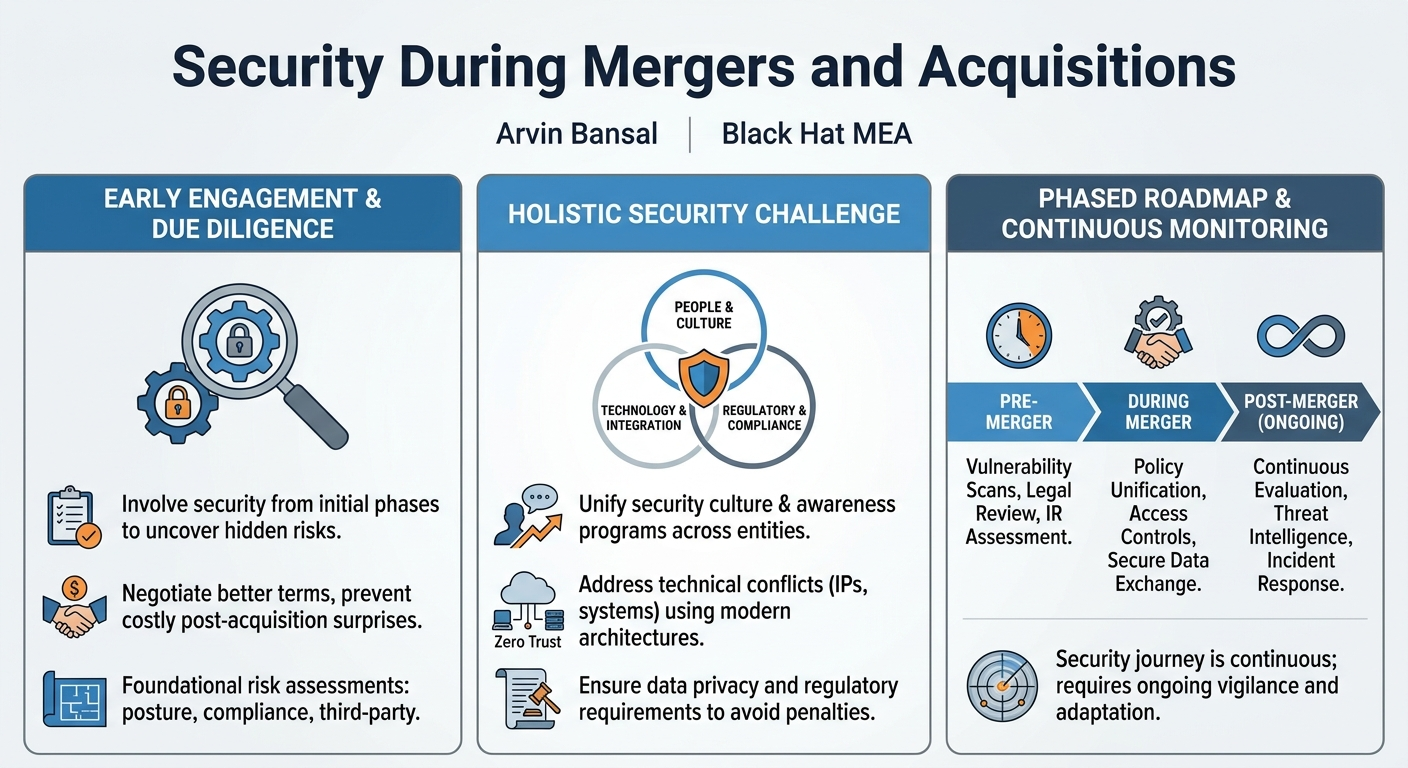
The insights shared by Arvin Bansal provide a clear mandate for cybersecurity professionals, transforming M&A from a potential liability into a controlled strategic maneuver. The defensive implications are structured around a proactive, phased roadmap designed to embed security at every stage of the M&A lifecycle.
1. Pre-Merger (The Moment Merger is Announced):
Defenders must act swiftly upon the announcement of an M&A. Key initiatives include:
- Legal & Regulatory Compliance Review: Immediately identify all applicable laws (e.g., GDPR, HIPAA) and industry-specific regulations that both entities must adhere to. This involves understanding the legal landscape of both organizations' operating regions.
- Vulnerability & Weakness Identification: Conduct rapid but comprehensive security assessments, including vulnerability scans and initial penetration testing, to uncover critical weaknesses in the target company's infrastructure, applications, and processes.
- Third-Party Risk Assessment: Evaluate the target company's third-party vendor ecosystem to identify potential supply chain vulnerabilities that could be inherited.
- Incident Response Capability Assessment: Review the target's existing incident response plans, capabilities, and maturity. This helps gauge their ability to detect, respond to, and recover from cyber incidents, and identifies areas for integration and improvement. Early engagement here is crucial to negotiate security-related terms into the acquisition agreement.
2. During Merger (Day of Close – Approximately 90 Days Post-Close):
This phase is about active integration and unification, with a strong focus on collaboration between security, IT, and business units.
- Policy, Standard, and Control Unification: Develop a unified set of security policies, standards, and controls that govern the merged entity. This requires harmonizing existing frameworks and establishing a common security baseline.
- Integration Planning for IT Systems: Work closely with infrastructure and application teams to plan the secure integration of networks, identity management systems, applications, and data repositories. This includes addressing issues like duplicate IPs, incompatible systems, and secure data migration.
- Access Management & Data Exchange Controls: Implement strict access controls for all sensitive M&A-related data and ensure secure, auditable channels for information exchange. Prevent unauthorized access, especially under pressure to accelerate tasks.
- Cloud Security Alignment: For organizations leveraging cloud environments, unify cloud security configurations, standards, and policies to ensure consistent protection across all cloud assets.
- People and Culture Integration: Recognize that security is also about people. Initiate programs to elevate cybersecurity awareness and foster a unified security culture across both teams, especially if one entity has a lower maturity level.
3. Post-Merger (90 Days Onwards – Ongoing Management):
The work doesn't end after integration; it shifts to continuous improvement and adaptation.
- Continuous Program Evaluation: Regularly evaluate the effectiveness of the unified security program, using metrics and key performance indicators to track progress and identify areas for enhancement.
- Feedback Mechanisms: Establish open channels for feedback, encouraging employees to report security concerns or highlight issues without fear of reprisal. This continuous feedback loop is vital for proactive risk management.
- Threat Intelligence & Actor Analysis: Continuously monitor the evolving threat landscape and adapt defensive strategies to new threat actors and attack methodologies that might target the newly merged entity.
- Incident Response & Recovery Readiness: Maintain and regularly test the integrated incident response and disaster recovery plans to ensure the organization can effectively handle any future security incidents.
- Asset Inventory & Discovery: Implement ongoing processes to discover and inventory all assets within the merged environment, identifying and resolving any overlaps or conflicts in technology solutions.
By adopting this structured and proactive approach, security teams can transform M&A from a period of heightened vulnerability into an opportunity to build a more resilient and secure organization. It emphasizes that cybersecurity is not a one-time fix but an ongoing commitment requiring strategic planning, technical execution, and cultural alignment.
Key Takeaways
- Early Security Engagement is Non-Negotiable: Cybersecurity teams must be involved from the earliest stages of M&A due diligence to uncover hidden risks, negotiate better terms, and prevent costly post-acquisition surprises.
- M&A is a Holistic Security Challenge: It extends beyond technology to encompass people, processes, culture, and regulatory compliance. A unified security culture and awareness program are as critical as technical controls.
- Comprehensive Risk Assessments are Foundational: Thoroughly evaluate the target company's current security posture, regulatory adherence, infrastructure, third-party risks, and incident response capabilities before finalizing any deal.
- Integration Requires Meticulous Planning: Technical integration of networks, systems, and applications must address potential conflicts (e.g., duplicate IPs, incompatible systems) and should leverage modern security architectures like Zero Trust.
- Post-Merger Security is Continuous: The security journey doesn't end with integration. Ongoing program evaluation, continuous monitoring, threat intelligence, and a robust incident response capability are essential for long-term protection.
- Regulatory Compliance and Data Privacy are Deal-Breakers: Failure to meet data privacy and regulatory requirements can result in significant fines, blocked acquisitions, and severe reputational damage.
About the Speaker(s)
Arvin Bansal is a highly experienced Chief Information Security Officer (CISO) with a distinguished career spanning several major global corporations. His expertise lies in navigating the complex security landscapes inherent in large-scale enterprises, particularly during critical business events such as Mergers and Acquisitions. Bansal has held significant security leadership roles at prominent companies, including CitiGroup, Experian, and Verizon, where he played a key part in major acquisitions like that of Yahoo. His professional journey also includes experience with Willis Towers Watson and AmerisourceBergen, a Fortune 10 healthcare company, where he was involved in acquiring a multi-billion dollar business from Europe. This extensive background provides him with a unique perspective on the multifaceted challenges and strategic imperatives of cybersecurity in M&A, making him a credible and authoritative voice on the subject.
Reviews
Dr. Zero (Offensive Security Researcher) — WEAK
We've been hearing about the Verizon-Yahoo and Marriott-Starwood breaches in M&A talks for over half a decade. A CISO with actual battlefield experience at these companies should be giving us the insider playbook on how to find the bodies during diligence, not reading us Wikipedia summaries of public fines. This is a generic awareness session masquerading as a strategic briefing.
Heather Calloway (CISO) — SOLID
Bansal provides a fundamentally correct, if familiar, playbook for managing cyber risk during corporate acquisitions. If your corporate development team still treats security as a post-close IT problem, this is a useful primer to put in front of your CFO. Experienced security leaders, however, will find it retreads known case studies rather than solving the political realities of the deal room.
→ Top-rated talks at Black Hat Middle East & Africa 2023 (Executive Summit)
All talks from Black Hat Middle East & Africa 2023 (Executive Summit)