The Future of Cybersecurity and Generative AI
Kyle Turner (Global Managing Director, Customer Engineering · Google Cloud)
Black Hat Middle East & Africa 2023 (Executive Summit) · Day 3 · Executive Summit
Overview
In an insightful presentation at Black Hat MEA, Kyle Turner, Global Managing Director of Customer Engineering for Google Cloud Security, and a guest from Aramco, explored the transformative potential of generative Artificial Intelligence (AI) in the cybersecurity landscape. The talk, titled "The Future of Cybersecurity and Generative AI," delved into the pressing challenges facing modern security operations – an ever-expanding threat surface, escalating tool complexity, and a critical talent shortage – and posited generative AI as a pivotal solution. The speakers articulated a vision where AI not only automates mundane tasks but also fundamentally reshapes how organizations defend against sophisticated attacks, from enhancing threat intelligence to revolutionizing incident response and vulnerability management.
Key moments
- 0:00 Google's vision: addressing cybersecurity challenges and talent gap
- 2:45 Introducing Sec-PaLM 2: Google's generative AI for security
- 4:00 Aramco's view: new tech brings both opportunities and challenges
- 5:30 AI-driven threats: sophisticated phishing, deepfakes, malware development
- 8:00 AI's benefits: reducing data breach costs and incident response time
- 11:30 Transforming security operations: threat hunting, playbooks, cyber ranges
- 14:00 AI for dynamic governance and intelligent access management
- 18:20 Concluding takeaways: AI is a double-edged sword, invest in talent
The Future of Cybersecurity and Generative AI
Speakers: Kyle Turner (Global Managing Director, Customer Engineering, Google Cloud)
Conference: Black Hat MEA
YouTube: https://www.youtube.com/watch?v=9FPKa4UM4Hs
Overview
In an insightful presentation at Black Hat MEA, Kyle Turner, Global Managing Director of Customer Engineering for Google Cloud Security, and a guest from Aramco, explored the transformative potential of generative Artificial Intelligence (AI) in the cybersecurity landscape. The talk, titled "The Future of Cybersecurity and Generative AI," delved into the pressing challenges facing modern security operations – an ever-expanding threat surface, escalating tool complexity, and a critical talent shortage – and posited generative AI as a pivotal solution. The speakers articulated a vision where AI not only automates mundane tasks but also fundamentally reshapes how organizations defend against sophisticated attacks, from enhancing threat intelligence to revolutionizing incident response and vulnerability management.
The core of the discussion centered on how Google Cloud is leveraging its extensive threat intelligence and AI capabilities, particularly through models like Sec-PaLM 2, to empower security teams. A guest from Aramco further enriched the conversation by sharing Aramco's perspective on the practical applications and future implications of AI, emphasizing its dual nature as both a powerful defensive tool and a potential enabler for adversaries. This article dissects the key arguments, technical innovations, and strategic recommendations put forth by Turner and a guest from Aramco, offering a comprehensive look at how generative AI is poised to redefine the future of cybersecurity.
Background
▶ Watch: Google's vision: addressing cybersecurity challenges and talent gap (0:00)
The cybersecurity domain is currently grappling with a confluence of formidable challenges that threaten to overwhelm traditional defense mechanisms. Kyle Turner highlighted three primary issues: the escalating volume and sophistication of growing threats, the exponential complexity of security tools, and a persistent, widening talent gap. The attack surface has expanded dramatically due to trends like ubiquitous AI integration, widespread remote work, and the proliferation of Operational Technology (OT) and Internet of Things (IoT) devices, demanding a more dynamic and cloud-native approach to protection.
Compounding this, the sheer number of security tools available today has created an intricate, often fragmented, operational environment. Security teams are forced to navigate disparate systems, learn multiple query languages, and manage complex data models, leading to significant operational "toil." This complexity directly contributes to the third critical issue: the global cybersecurity talent gap. Turner cited alarming statistics, noting that in 2011-2012, there were approximately 2 million unfilled cybersecurity roles, a number that has swelled to nearly 3.5 million in 2023. This acute shortage of skilled professionals makes it increasingly difficult for organizations to effectively secure their infrastructures against evolving threats. A guest from Aramco echoed this sentiment, drawing a parallel to the historical adage that "with every new technology comes new challenges," a lesson he learned from Sean Harris's foundational CISSP textbook. He underscored that while AI introduces new risks, its opportunities for defense are far more significant, particularly in addressing these systemic challenges.
Key Findings
▶ Watch: Aramco's view: new tech brings both opportunities and challenges (4:00)
The central finding presented in the talk is that generative AI, despite its inherent risks, offers unprecedented opportunities to mitigate the most pressing challenges in cybersecurity. The speakers highlighted several key areas where AI can drive significant improvements:
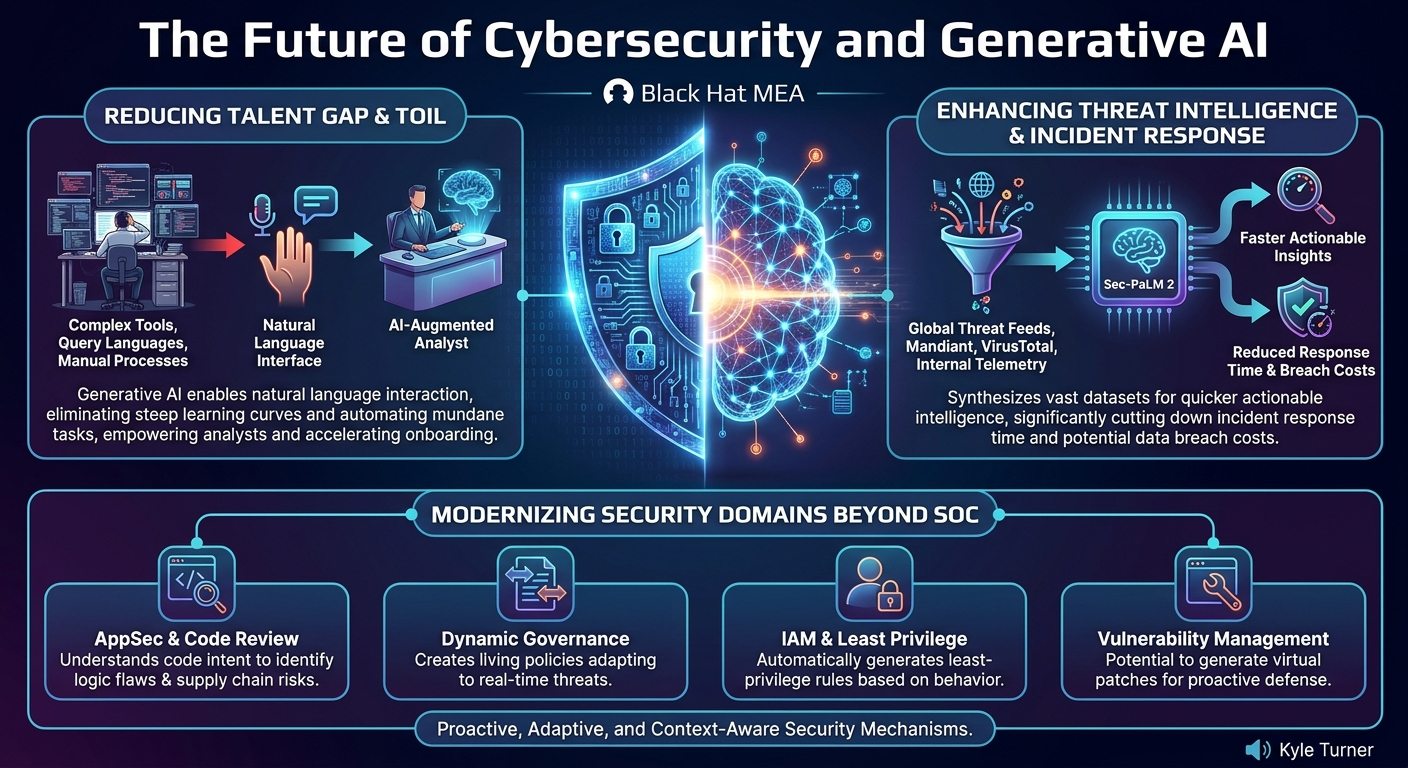
Firstly, generative AI is positioned to drastically reduce the cybersecurity talent gap and operational toil. By enabling natural language interaction with complex security systems, AI eliminates the need for analysts to learn intricate query languages or proprietary data models. This empowers junior analysts, accelerates their onboarding, and allows experienced professionals to focus on higher-value strategic tasks rather than repetitive manual processes.
Secondly, AI significantly enhances threat intelligence and incident response capabilities. Google's approach involves "machines defending machines," with threat intelligence at the core. Generative AI can synthesize vast amounts of data from sources like Mandiant, VirusTotal, and Google's internal threat feeds, providing actionable insights faster. A guest from Aramco cited a significant finding from an IBM Cost of Data Breach report, indicating that in 2022, the average cost of a data breach was reduced by $1.76 million when AI and automation were employed. Furthermore, AI-driven security can reduce the time to respond to an incident by an impressive 108 days, dramatically improving an organization's agility and resilience.
Thirdly, generative AI can modernize and automate various security domains beyond traditional Security Operations Centers (SOCs). This includes revolutionizing application security (AppSec) by understanding code intent, transforming governance by creating dynamic, living documents based on real-time threat landscapes, and improving access management through intelligent, least-privilege authorization rules. The vision extends to even generating virtual patches for vulnerabilities, showcasing the expansive potential of AI to create proactive and adaptive security mechanisms.
Technical Deep Dive
▶ Watch: AI's benefits: reducing data breach costs and incident response time (8:00)
The technical foundation for Google Cloud's vision of AI-powered security lies in its proprietary large language model, Sec-PaLM 2, which operates on top of Vertex AI. Sec-PaLM 2 is purpose-built for the security domain, leveraging an immense corpus of threat intelligence gathered from Google's extensive ecosystem, including data from recent acquisitions like Mandiant and VirusTotal, as well as threat telemetry from Google's nine applications, each serving over a billion users. This massive dataset allows Sec-PaLM 2 to understand and generate security-specific language and insights at an unparalleled scale.
The primary technical innovation is the ability for users to interact with security systems using natural language. Instead of requiring security analysts to master complex query syntaxes (e.g., SQL, KQL, Splunk SPL) or understand diverse data schemas across multiple vendor platforms, Sec-PaLM 2 allows them to pose questions or request actions in plain English. For example, an analyst could ask, "Show me all suspicious login attempts from outside the corporate network in the last 24 hours," and the AI would translate this into the appropriate queries, retrieve, and summarize the relevant data. This capability directly addresses the "toil" and talent gap by lowering the barrier to entry for new analysts and increasing the efficiency of experienced ones.
Beyond natural language querying, the talk touched upon several advanced technical applications:
- Threat Hunting and IOC Development: Generative AI can analyze vast log datasets to identify subtle patterns indicative of advanced persistent threats (APTs) or generate new Indicators of Compromise (IOCs) based on evolving threat intelligence.
- Playbook and Automation Generation: AI can assist in developing Security Orchestration, Automation, and Response (SOAR) playbooks, suggesting optimal response actions based on historical incidents and current threat landscapes.
- Cyber Range Simulation: Instead of relying on static scenarios, generative AI can create realistic, dynamic logs simulating actual incidents. This allows organizations to build sophisticated cyber ranges where SOC analysts can sharpen their skills against evolving threats without waiting for real-world breaches.
- Automated Incident Reporting: A historically tedious task, incident report generation can be largely automated by AI, which can synthesize information from various logs, alerts, and analyst notes into coherent, structured reports.
- Advanced Application Security (AppSec): Traditional Static Application Security Testing (SAST) and Dynamic Application Security Testing (DAST) solutions often rely on signature-based detection or predefined patterns, making them susceptible to missing logical flaws or novel vulnerabilities. Generative AI, by understanding the intended functionality of code, can identify malicious activities that fall outside expected behavior, such as unauthorized data storage or backdoors injected via supply chain attacks. This moves beyond simply identifying OWASP Top 10 vulnerabilities to understanding contextual risks. A guest from Aramco specifically highlighted the risk of malicious code injection via AI-assisted development (e.g., using AI like Stack Overflow alternatives).
- Dynamic Governance and Access Management: Current governance documents are often static and updated infrequently. AI can create "living documents" that dynamically adapt policies and controls (e.g., restricting internet access, proxy access) based on real-time threat intelligence and changing risk levels. Similarly, for Identity and Access Management (IAM), AI can observe user behavior and application interactions to automatically generate and enforce least privilege authorization rules, ensuring users only have the access they truly need, thus preventing over-privileged accounts.
- Vulnerability Management and Patching: The most forward-looking technical vision involved AI's ability to not only identify vulnerabilities but also to automatically develop patches or "virtual patches" even before vendors release official fixes. While acknowledged as an optimistic future scenario, it underscores the potential for AI to move from reactive defense to proactive remediation.
Google Cloud's commitment to "secure by default" and "secure by design" principles, integrating security into every deployment, forms the underlying trust layer for these advanced AI capabilities, ensuring that the infrastructure itself is hardened against common vulnerabilities.
Demo / Proof of Concept
▶ Watch: Transforming security operations: threat hunting, playbooks, cyber ranges (11:30)
While the talk did not feature a live demonstration or a tangible proof of concept of Sec-PaLM 2 in action, the speakers provided extensive conceptual demonstrations and real-world applicability through detailed explanations and use cases. Kyle Turner explained that Sec-PaLM 2, riding on Vertex AI, would soon be available to partners and customers via a simple plugin, allowing them to leverage Google's internal AI capabilities.
A guest from Aramco elaborated on several applications where AI and machine learning are already making a difference or are envisioned to do so:
- Early Attack Identification: Aramco has utilized clustering and classification algorithms to identify attacks earlier in the kill chain, specifically during the reconnaissance phase, where the cost of recovery is significantly lower.
- Natural Language Interaction for SOC Analysts: The ability to use natural language to query security systems was a recurring theme, described as a solution to the "vendor lock-in" and steep learning curves associated with different security tools.
- Business-Specific Threat Detection: A guest from Aramco highlighted a case where machine learning models were fed large datasets from Aramco's business operations (e.g., geology, geophysics, petroleum engineering data). This enabled the development of business-related sentiments that detection tools could then use to identify threats specific to their unique operational context, addressing the challenge of cybersecurity teams often not fully understanding business-specific data.
These descriptions served as a powerful conceptual demonstration, illustrating how generative AI can translate abstract security challenges into practical, implementable solutions across various facets of an enterprise security program. The focus was on the "how it works" and "what it can achieve" rather than a live technical execution.
Defensive Implications
▶ Watch: Concluding takeaways: AI is a double-edged sword, invest in talent (18:20)
The insights shared by Kyle Turner and a guest from Aramco carry profound defensive implications for organizations grappling with the modern threat landscape. Embracing generative AI is no longer an option but a strategic imperative for effective cybersecurity.
- Prioritize AI for Threat Intelligence and Hunting: Organizations must leverage AI to consolidate and analyze vast amounts of threat intelligence. Integrating diverse feeds (e.g., open-source, commercial, internal telemetry) into AI models like Sec-PaLM 2 can enable faster Indicator of Compromise (IOC) generation, more accurate threat detection, and proactive threat hunting. This means moving beyond reactive alerts to predictive and adaptive defense.
- Automate Security Operations (SecOps) and Incident Response: Generative AI should be deployed to automate repetitive and time-consuming SecOps tasks. This includes automating incident report generation, developing dynamic SOAR playbooks, and creating realistic cyber ranges for continuous training. The goal is to reduce manual toil, accelerate incident response times (potentially by 108 days as mentioned), and free up human analysts for complex problem-solving.
- Empower and Scale the Security Workforce: To combat the 3.5 million talent gap, organizations must use AI to democratize access to security tools. By enabling natural language querying, AI can significantly reduce the learning curve for new SOC analysts, making them productive faster. It also allows experienced professionals to perform their duties more efficiently, effectively multiplying the impact of the existing workforce. Investment in talent, coupled with AI tools, is crucial.
- Modernize Application Security (AppSec) and Code Review: Integrate AI into the software development lifecycle to enhance SAST and DAST. AI models capable of understanding code intent can identify sophisticated vulnerabilities, logical flaws, and potential supply chain attack vectors that traditional tools might miss. This necessitates a shift towards AI-assisted peer review processes.
- Implement Dynamic Governance and Access Management: Static security policies are ill-suited for dynamic threat landscapes. Defenders should explore AI-driven governance models that automatically adapt security controls (e.g., network access, proxy rules) based on real-time threat intelligence and organizational risk posture. For IAM, AI can enforce least privilege by dynamically adjusting authorization rules based on observed user behavior and business context, minimizing the attack surface associated with over-privileged accounts.
- Invest in Business-Contextual Threat Detection: As demonstrated by Aramco, feeding business-specific data into machine learning models can yield highly relevant threat detection capabilities. Cybersecurity teams must collaborate with business units to understand their unique data and operational processes, enabling AI to detect threats that directly impact critical business functions.
- Educate Users on AI-Driven Risks: While AI is a powerful defense tool, it is also a "double-edged sword." Defenders must educate end-users, employees, and the broader community about AI-enabled threats like sophisticated phishing (grammar-perfect emails), deepfakes, and social engineering attacks. Awareness training needs to evolve to address these new attack vectors.
- Adopt a Cloud-First, Secure-by-Design Approach: As highlighted by Google, building security into the foundational cloud infrastructure and adopting a "secure by default" posture is paramount. This provides a robust and resilient environment upon which advanced AI defenses can be effectively deployed.
Ultimately, the defensive implications underscore that organizations must not only adapt to AI but actively leverage it to build more agile, intelligent, and proactive security programs. There is "no silver bullet" in cybersecurity, but AI offers a significant multiplier effect for human expertise.
Key Takeaways
- Generative AI is a Double-Edged Sword, but a Net Positive for Defenders: While AI can be exploited by adversaries for sophisticated phishing, deepfakes, and malware development, its opportunities for defense (reducing costs by $1.76 million and incident response by 108 days) significantly outweigh the challenges.
- AI Addresses Critical Cybersecurity Gaps: Generative AI is crucial for combating the growing 3.5 million cybersecurity talent gap and reducing operational "toil" by automating mundane tasks and simplifying complex workflows.
- Natural Language Interaction Revolutionizes Security Operations: Platforms like Google's Sec-PaLM 2 on Vertex AI allow security analysts to interact with complex systems using natural language, eliminating the need to learn multiple query languages and data models, thereby empowering junior staff and increasing efficiency.
- AI Transforms Diverse Security Domains: Beyond traditional SOC functions, generative AI can fundamentally enhance application security (identifying intent-based flaws), governance (creating dynamic policies), identity and access management (enforcing least privilege), and vulnerability management (potentially developing virtual patches).
- Proactive and Contextual Security is Key: AI enables earlier detection of attacks (e.g., during reconnaissance), and by integrating business-specific data, it can develop highly relevant threat detection capabilities tailored to an organization's unique operational context.
- Adaptation and Education are Imperative: Organizations must adapt to the AI era by investing in AI tools and educating their workforce and users about both the defensive benefits and the new risks associated with generative AI. Human expertise remains vital, augmented by AI.
About the Speaker(s)
Kyle Turner serves as the Global Managing Director of Customer Engineering for Google Cloud Security. In this role, he leads the team responsible for interacting with customers, understanding their security needs, and guiding them in leveraging Google Cloud's security capabilities. His expertise lies in integrating cloud dynamics with robust security frameworks, and he is deeply involved in Google's vision for incorporating advanced technologies like generative AI into cybersecurity solutions.
A guest from Aramco is affiliated with Aramco, a global energy and chemical company. While his specific title was not provided in the talk metadata, his contributions clearly indicate a senior role in cybersecurity, likely within security operations, application security, or governance. He brings a practical, enterprise-level perspective to the discussion, drawing on Aramco's experiences in applying machine learning and AI to address complex industrial security challenges, particularly in understanding business-specific data for effective threat detection.
Reviews
Dr. Zero (Offensive Security Researcher) — HARD PASS
This is a Google Cloud vendor pitch wearing a Black Hat badge. Kyle Turner and a guest from Aramco spent the session pitching Sec-PaLM 2 as a magic wand for the cybersecurity talent gap, all without a single live demo. Pure marketing theater disguised as a research talk.
Heather Calloway (CISO) — WEAK
This is largely a Google Cloud product pitch for Vertex AI, heavily padded with generic industry statistics rather than primary research. While the Aramco co-speaker provides a brief glimpse into real enterprise machine learning, the bulk of the session relies on hypothetical AI capabilities. Do not waste your leadership team's time.
→ Top-rated talks at Black Hat Middle East & Africa 2023 (Executive Summit)
All talks from Black Hat Middle East & Africa 2023 (Executive Summit)