How CISOs Can Ask for the Budget They Need and Show ROI
Ira Winkler
Black Hat Middle East & Africa 2023 (Executive Summit) · Day 3 · Executive Summit
Overview
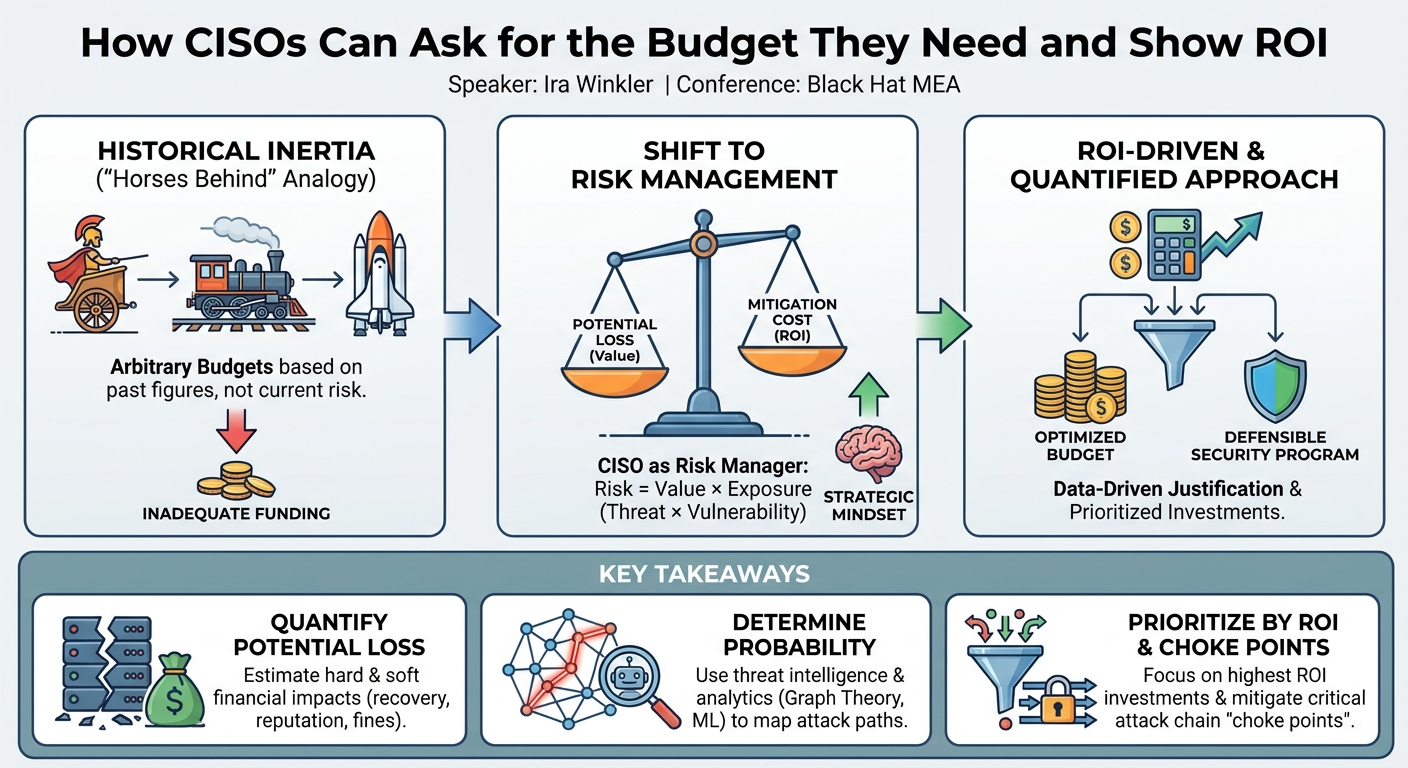
In his Black Hat MEA talk, "How CISOs Can Ask for the Budget They Need and Show ROI," Ira Winkler tackles a pervasive and often debilitating challenge for Chief Information Security Officers: securing adequate funding for their cybersecurity programs. Winkler argues that many CISOs receive budgets that reflect historical inertia and inadequate justification, rather than the actual needs dictated by the evolving threat landscape and technological advancements. He colorfully illustrates this point with an analogy of the space shuttle's dimensions being indirectly constrained by the width of a horse's behind—a relic of ancient Roman chariot design that persisted through railroad tracks. Similarly, cybersecurity budgets, he contends, are often based on arbitrary figures from a decade ago, with minor adjustments, rather than a strategic assessment of current risk.
Key moments
- 0:00 The 'Horses Behind' Analogy for Budgeting
- 3:55 Problem: CISO Budgets Based on History, Not Need
- 5:50 Learning from Other Departments: Show ROI
- 8:50 CISO as Risk Manager: Value, Threat, Vulnerability
- 11:00 Finding Your Risk Optimization Point & Ideal Budget
- 13:50 Calculating Potential Loss & Obtaining Value Data
- 15:50 Quantifying Risk: Probability, Assets, Mathematical Formulas
- 18:50 Prioritizing Countermeasures, Choke Points & Final Advice
How CISOs Can Ask for the Budget They Need and Show ROI
Speakers: Ira Winkler, LinkedIn
Conference: Black Hat MEA
YouTube: https://www.youtube.com/watch?v=-5M7mT_3-28
Overview
In his Black Hat MEA talk, "How CISOs Can Ask for the Budget They Need and Show ROI," Ira Winkler tackles a pervasive and often debilitating challenge for Chief Information Security Officers: securing adequate funding for their cybersecurity programs. Winkler argues that many CISOs receive budgets that reflect historical inertia and inadequate justification, rather than the actual needs dictated by the evolving threat landscape and technological advancements. He colorfully illustrates this point with an analogy of the space shuttle's dimensions being indirectly constrained by the width of a horse's behind—a relic of ancient Roman chariot design that persisted through railroad tracks. Similarly, cybersecurity budgets, he contends, are often based on arbitrary figures from a decade ago, with minor adjustments, rather than a strategic assessment of current risk.
Winkler's core thesis is that CISOs must transition from merely requesting funds to proactively demonstrating the Return on Investment (ROI) of their security initiatives. He emphasizes that security professionals are fundamentally risk managers and should present their budgetary needs in a language that resonates with business leaders: monetary terms, cost-benefit analyses, and quantifiable risk reduction. By adopting methodologies akin to those used in operations, finance, or safety science, CISOs can move beyond reactive spending and arbitrary allocations to build robust, defensible cybersecurity programs that are aligned with organizational objectives and adequately resourced to manage contemporary threats.
This talk is critical for any cybersecurity leader struggling to justify their budget, demonstrating a clear path to strategic financial discussions with executive leadership and boards. It highlights a fundamental disconnect between technical security needs and business financial planning, offering practical frameworks to bridge this gap. Winkler’s insights empower CISOs to articulate the value of cybersecurity not as a cost center, but as a critical enabler of business resilience and a protector of organizational assets, ultimately securing the budgets they need rather than just what they deserve based on historical precedent.
Background
▶ Watch: The 'Horses Behind' Analogy for Budgeting (0:00)
The pervasive problem of inadequate cybersecurity budgeting, as highlighted by Ira Winkler, stems from a deeply ingrained historical inertia within many organizations. Winkler vividly illustrates this with his "horses behind" analogy, tracing the lineage of the space shuttle's component dimensions back to the width of ancient Roman chariots, dictated by the most efficient use of horsepower on dirt roads. This seemingly unrelated historical anecdote serves as a powerful metaphor for how current cybersecurity budgets are often determined: not by contemporary threats, technological advancements, or actual organizational risk, but by incremental adjustments to figures established decades ago. As Winkler states, "most organizations that I see essentially have the same budget that they had more than a decade ago," despite the radical transformation of the cyber landscape. This results in CISOs receiving "the budgets they deserve, not the budgets that they need," because they often fail to make a compelling business case for increased or reallocated funds.
To contextualize this failure, Winkler draws parallels with other business departments that successfully secure their budgets. In operations, a Chief Operating Officer (COO) proposing a factory retooling will meticulously calculate the cost of downtime, new equipment, training, and lost income, then weigh it against the projected higher profit margins and a clear ROI timeline. Similarly, a Chief Financial Officer (CFO) advocating for a new financial system will present its costs (system acquisition, staff retraining, interface development) alongside its benefits (enabling new business areas, improved organizational efficiency). Most pertinently, safety science professionals, dealing with human error and potential injuries, quantify the cost of an injury or death, then propose countermeasures with a clear financial argument for mitigation. These departments succeed because they translate their needs into quantifiable financial terms, demonstrating a clear cost-benefit analysis and return on investment.
In contrast, cybersecurity professionals often struggle to articulate their value in these business-centric terms. The dictionary definition of "security" as "being free from risk" is a fantasy, according to Winkler. He asserts that security professionals are, in reality, risk managers. Their role is to identify, assess, and mitigate risks, acknowledging that organizations must accept a certain level of risk to conduct business (e.g., collecting data inherently carries risk of compromise). The fundamental definition of risk is presented as **Value Exposure, where Exposure itself is a product of Threat Vulnerability. A cybersecurity program, then, is the implementation of countermeasures designed to mitigate these threats or vulnerabilities. The challenge, therefore, lies in quantifying the ROI of these countermeasures – a task many CISOs currently find elusive, leading to arbitrary budgets and, consequently, arbitrary risk reduction. Winkler argues that the ideal scenario involves a conscious acceptance of an acceptable level of risk, followed by a conscious determination of the cost of countermeasures to achieve that level, thereby establishing an optimized budget**. This is a stark contrast to the prevalent "horses behind" approach.
Key Findings
▶ Watch: Learning from Other Departments: Show ROI (5:50)
Ira Winkler’s talk unveils several critical findings that challenge the conventional wisdom of cybersecurity budgeting and offer a transformative approach for CISOs:
- The Budgeting Disconnect: The most significant finding is that CISOs are currently receiving "the budgets they deserve not the budgets that they need." This is because existing budgeting processes are largely arbitrary, based on historical precedent (the "horses behind" analogy) rather than a dynamic assessment of current cyber threats, technological shifts, and organizational risk. Winkler argues that these budgets often reflect figures from a decade ago, rendering them irrelevant to today's complex security landscape.
- ROI as the Business Language: Winkler asserts that the fundamental problem is the CISO's inability to articulate cybersecurity investments in terms of Return on Investment (ROI). Unlike other business functions (operations, finance, safety science) that successfully justify expenditures by demonstrating clear financial benefits, CISOs often fail to quantify the monetary value of risk reduction or the cost avoidance achieved through security measures.
- Security Professionals as Risk Managers: A crucial reframing is that security professionals are not tasked with achieving absolute security (being "free from risk," which is impossible), but rather with managing risk. This perspective shifts the focus from an unattainable ideal to a practical, business-aligned objective: optimizing the balance between potential loss and the cost of mitigation.
- The Risk Optimization Point: Winkler introduces the concept of a risk optimization point. This is the ideal state where an organization consciously accepts a specific, tolerable level of risk, and the cybersecurity budget is precisely determined by the cost of the countermeasures required to achieve and maintain that level. This contrasts sharply with current practices where arbitrary budgets lead to arbitrary, often insufficient, risk reduction.
- Prioritization by ROI: A key finding for effective resource allocation is to prioritize security countermeasures based on their highest ROI. By consciously selecting initiatives that yield the greatest risk reduction for the investment, organizations can achieve significantly better security outcomes, even if the overall cybersecurity program cost is slightly higher. This strategic approach ensures that every dollar spent contributes maximally to risk posture improvement.
- Monetary Quantification is Paramount: To make a compelling business case, CISOs must translate potential losses and the benefits of security investments into monetary figures. This involves quantifying hard losses (e.g., direct financial impact of a breach, recovery costs), soft losses (e.g., reputational damage, customer trust, operational outages), and potential regulatory fines. Without this financial translation, security arguments remain abstract and fail to resonate with executive decision-makers.
These findings collectively call for a paradigm shift in how cybersecurity is perceived, funded, and managed, moving it from a technical cost center to a strategic business function that protects and enables the organization through intelligent risk management.
Technical Deep Dive
▶ Watch: Finding Your Risk Optimization Point & Ideal Budget (11:00)
Ira Winkler’s framework for effective cybersecurity budgeting hinges on a robust, quantifiable approach to risk management. He defines risk at a high level as **Value Exposure, further breaking down Exposure into Threat Vulnerability**. This foundational equation underpins the entire technical deep dive, guiding CISOs on how to assess and articulate their security needs in financially relevant terms.
1. Determining Potential Loss (Value):
The first step in quantifying risk is to establish the "value" at stake, or the potential loss. Winkler categorizes losses into:
- Hard Losses: These are direct, quantifiable financial impacts. Examples include the monetary cost of data compromise, the expense of incident response and recovery (e.g., forensic investigations, system restoration), legal fees, and credit monitoring for affected individuals.
- Soft Losses: These are more intangible but equally damaging. They encompass loss of customer trust, damage to brand reputation, prolonged operational outages (and the associated revenue loss), and diminished market valuation. While harder to quantify directly, these must be estimated.
- Fines: Regulatory penalties imposed by authorities (e.g., GDPR, CCPA, or in the US, potential criminal charges from the SEC as mentioned by Winkler at 20:00) can be substantial and must be factored into potential loss calculations, especially for international operations.
- Variable Factors: The potential loss can also be influenced by contextual factors such as geography (different regulatory environments), the specific industry (some industries are more targeted or hold more valuable data), and the current economic or political climate.
To obtain these value figures, Winkler suggests several practical approaches:
- CFO Consultation: The Chief Financial Officer's department might have already conducted cyber risk quantification studies or possess methodologies for valuing organizational assets and potential liabilities.
- Industry Incident Data: Analyzing past cyber incidents within the same industry can provide benchmarks for potential financial losses. If a competitor suffered a breach with a known financial impact, this can serve as a starting point.
- Insurance Company Data: Cybersecurity insurance providers often possess extensive actuarial data on incident costs and probabilities, which can be invaluable for estimating potential losses.
- Cyber Risk Quantification Tools: Specialized software tools exist to assist in the complex process of quantifying cyber risk, often leveraging various data inputs and statistical models.
**2. Determining Probability (Threat * Vulnerability):**
The second component of risk is exposure, which is determined by the likelihood of a threat exploiting a vulnerability.
- Threat Intelligence: Understanding the threat actors targeting the organization is paramount. This involves assessing their skill level, motivations, and typical targets. Winkler provides an example: North Korea actively targets crypto organizations for financial gain, whereas China might not be interested in compromising such entities. Effective threat intelligence helps refine the probability assessment.
- Vulnerability Assessment: Identifying weaknesses in systems, applications, and processes is a standard security practice. However, Winkler emphasizes that mere identification is insufficient; the focus must be on the relevance of the vulnerability to the specific organization and its assets, not just a high CVSS score (20:00).
- Mathematical Principles: To combine threat and vulnerability into a quantifiable probability, Winkler advocates for leveraging advanced mathematical concepts:
- Flow Theory: This can be applied to understand the movement of information or control within a system, identifying critical paths that attackers might exploit.
- Machine Learning (ML): Winkler describes ML as "a form of advanced mathematics" that can analyze vast datasets of past incidents, vulnerabilities, and threat behaviors to predict the likelihood of future attacks or successful exploitation.
- Graph Theory: This is a particularly powerful tool for visualizing and analyzing complex interconnections. Winkler illustrates its application for attack path visualization (17:00). By mapping assets, vulnerabilities, and potential threat movements, Graph Theory can help determine the probability of an attacker reaching a specific asset through a chain of exploits.
Example Calculation (Illustrative):
Winkler provides a concrete example using Graph Theory:
- Identify Vulnerability: A misconfigured database.
- Determine Probability of Exploitation: Through mathematical analysis (e.g., historical data, ML models), this database is assigned a 72% probability of being exploited (18:00).
- Identify Assets at Risk: This database is linked to two types of assets with a combined total value of $100 million.
- Calculate Potential Loss from this Vulnerability: Multiply the asset value by the exploitation probability: $100,000,000 * 0.72 = $72,000,000.
This $72 million represents the quantifiable risk associated with that specific misconfigured database. This figure then forms the basis for a legitimate Return on Investment (ROI) argument: "What is the cost of the countermeasure to mitigate this $72 million loss?"
3. Prioritization and Optimization:
With quantified risks, CISOs can then:
- Prioritize Countermeasures by ROI: Implement security controls that offer the highest risk reduction per dollar spent. This ensures efficient allocation of limited resources.
- Identify Choke Points: Using attack path visualization (e.g., derived from Graph Theory), CISOs can identify "choke points" – single vulnerabilities or controls that, if mitigated, can disrupt an entire attack chain (19:00). For example, in a linear supply chain of vulnerabilities, addressing just one critical link can break the entire path, offering significant cost savings. This strategic focus contrasts with indiscriminately patching every high-CVSS vulnerability, irrespective of its actual relevance to the organization's specific attack surface and assets.
By integrating these technical and mathematical principles, CISOs can transition from arbitrary budgeting to a data-driven, ROI-centric approach, making compelling business arguments for the resources they truly need.
Demo / Proof of Concept
▶ Watch: Calculating Potential Loss & Obtaining Value Data (13:50)
Ira Winkler's presentation is primarily conceptual and strategic, focusing on the methodologies and arguments CISOs should employ to secure adequate budgets. As such, the talk did not feature a live demo or proof of concept of any specific tool or technology.
Winkler did, however, walk through a hypothetical scenario to illustrate the mathematical principles he advocates. He described how one might calculate the potential loss from a misconfigured database by multiplying the value of associated assets ($100 million) by the probability of its exploitation (72%), arriving at a $72 million risk figure (18:00). While this provides a clear example of the quantitative analysis he promotes, it was an illustrative walkthrough rather than a live demonstration of a cyber risk quantification platform or an attack path visualization tool. He explicitly stated that more detailed mathematical explanations and slides could be provided upon request, indicating the depth of the underlying methodologies without performing a live technical demonstration during the conference session.
Defensive Implications
▶ Watch: Prioritizing Countermeasures, Choke Points & Final Advice (18:50)
Ira Winkler's talk offers profound defensive implications, fundamentally reshaping how CISOs should approach their role and interact with organizational leadership regarding cybersecurity investments. The core message empowers defenders to move beyond a reactive, compliance-driven mindset to a proactive, business-aligned strategy.
- Embrace the Risk Manager Identity: CISOs and their teams must fully internalize that their primary function is risk management, not absolute security. This paradigm shift means continuously identifying, assessing, mitigating, and communicating risk, acknowledging that some level of risk is inherent to doing business. Defenders should focus on optimizing risk to an acceptable level rather than striving for an impossible state of zero risk.
- Quantify Everything in Monetary Terms: The most critical defensive implication is the imperative to translate cybersecurity needs, risks, and benefits into monetary figures. This involves:
- Valuing Assets: Understand the financial, reputational, and operational value of all critical data, systems, and processes.
- Calculating Potential Loss: Estimate hard losses (e.g., recovery costs, legal fees, fines), soft losses (e.g., brand damage, customer churn, operational downtime), and regulatory penalties (e.g., potential SEC criminal charges mentioned at 20:00).
- Determining ROI for Countermeasures: For every proposed security investment, articulate the expected Return on Investment (ROI) by demonstrating how it reduces a quantifiable financial risk. This is the language that resonates with CFOs, CEOs, and boards.
- Leverage Data for Probabilistic Assessments: Defenders need to move beyond qualitative risk assessments. This requires:
- Threat Intelligence Integration: Actively use threat intelligence to understand specific threat actors, their motivations, capabilities, and likelihood of targeting the organization (e.g., North Korea targeting crypto firms). This refines the probability component of risk.
- Vulnerability Relevance over Raw Scores: Don't just chase high CVSS scores. Prioritize vulnerabilities based on their actual exploitability in the organization's specific context and their relevance to critical assets, as identified through attack path visualization.
- Adopting Advanced Analytics: Explore and implement tools and methodologies based on Graph Theory, Flow Theory, and Machine Learning to map attack paths, calculate exploitation probabilities, and identify critical "choke points" where mitigation efforts yield maximum impact.
- Strategic Prioritization and Optimization: With quantified data, defenders can make strategic decisions:
- ROI-Driven Spending: Allocate budget to countermeasures that offer the highest ROI, ensuring that resources are deployed where they will have the greatest impact on risk reduction.
- Focus on Choke Points: Identify single points of failure or critical vulnerabilities that, if mitigated, can break entire attack chains. This allows for highly efficient and cost-effective risk reduction, as mitigating one "choke point" can protect against multiple potential attack vectors.
- Proactive Communication and Business Alignment: CISOs must become adept communicators, translating complex technical security issues into clear business implications. They should proactively engage with financial and operational leadership, presenting security as an enabler of business objectives and a protector of the bottom line, rather than a necessary evil or an unquantifiable cost center. This proactive stance helps to secure the optimized budget needed to effectively manage risk.
By adopting these defensive implications, cybersecurity teams can transform their budgeting process from an arbitrary, historical exercise into a strategic, data-driven initiative that effectively secures the organization and justifies its crucial role in business success.
Key Takeaways
- Cybersecurity budgets must transition from arbitrary, historically-based allocations to data-driven, ROI-centric justifications. CISOs need to move beyond what they "deserve" to what they "need" by making strong business cases.
- CISOs are fundamentally risk managers, not purveyors of absolute security. Their role is to identify, quantify, and mitigate risk to an "acceptable level," known as the risk optimization point, balancing potential loss against mitigation costs.
- Quantifying potential financial losses (Value) is critical for effective budgeting. This involves assessing hard losses (e.g., recovery costs, fines), soft losses (e.g., reputational damage, outages), and utilizing data from CFOs, industry incidents, and insurance companies.
- **Probability of exploitation (Exposure = Threat * Vulnerability) must be determined using advanced analytical methods. This includes leveraging threat intelligence to understand specific actors and adopting mathematical principles like Graph Theory and Machine Learning** to map attack paths and calculate likelihoods.
- Prioritize security investments based on their highest Return on Investment (ROI) and identify "choke points" in attack chains. This strategic approach ensures that resources are allocated efficiently to achieve maximum risk reduction, rather than indiscriminately addressing all vulnerabilities.
- CISOs must communicate their needs in monetary terms to executive leadership, demonstrating how security investments directly reduce quantifiable financial risk and protect the organization's bottom line. This business-oriented language is essential for securing adequate and justified funding.
About the Speaker(s)
Ira Winkler is an acclaimed and highly experienced cybersecurity professional, renowned for his expertise in security strategy and risk management. Throughout his talk, Winkler demonstrates a deep understanding of both the technical intricacies of cybersecurity and the critical business context in which it operates. He positions himself as an advisor to CISOs, guiding them on how to effectively communicate their needs to executive leadership. Winkler also alludes to his extensive body of work, encouraging the audience to "get my books," indicating his authorship of influential literature in the field. His confident and analytical delivery underscores his authority and practical experience in helping organizations bridge the gap between technical security challenges and strategic business objectives.
Reviews
Dr. Zero (Offensive Security Researcher) — WEAK
This is a CISO 101 lecture masquerading as a strategic revelation. Winkler is telling security executives to use basic risk equations and ROI—concepts that have been standard doctrine for over two decades. It's not an actionable framework, just FAIR methodology watered down with a space shuttle anecdote.
Heather Calloway (CISO) — SOLID
A competent conceptual primer for new security leaders on moving away from historical budgeting, but veterans will find the financial modeling naive. The core message—aligning security spend with acceptable business risk—is correct, but the proposed execution relies on pseudo-precise math that a seasoned finance team will immediately dismantle. Worth a watch for directors stepping up, but not a playbook for an established CISO.
→ Top-rated talks at Black Hat Middle East & Africa 2023 (Executive Summit)
All talks from Black Hat Middle East & Africa 2023 (Executive Summit)