Ransomware Preparedness and the Ecosystem Response
Vinayak Godse (CEO · Data Security Council of India)
Black Hat Middle East & Africa 2023 (Executive Summit) · Day 3 · Executive Summit
Overview
In this insightful Black Hat MEA presentation, Vinayak Godse, CEO of the Data Security Council of India (DSCI), addressed the critical and evolving challenge of ransomware preparedness. The talk emphasized that traditional, internal organizational security measures are increasingly insufficient against the sophisticated, polymorphic nature of modern ransomware attacks. Godse argued for a fundamental shift towards an ecosystem-driven response, highlighting that the potency and widespread ramifications of ransomware necessitate coordinated efforts beyond the boundaries of individual enterprises. Drawing from the Indian ecosystem's experiences, the discussion explored how national strategies, collaborative initiatives, and collective capabilities are essential to build resilience and effectively respond to these advanced threats.
Key moments
- 0:00 Introduction: Need for ecosystem ransomware response
- 3:00 Understanding two types of ransomware groups
- 6:00 Transitioning to real-time security management
- 10:00 Complex challenges in ransomware response and recovery
- 12:30 Beyond organizational control: need for ecosystem support
- 14:00 Introducing the ecosystem-driven response and recovery
- 16:00 Building skills and competence for recovery
- 18:00 Importance of police and law enforcement
Ransomware Preparedness and the Ecosystem Response
Speakers: Vinayak Godse, CEO, Data Security Council of India
Conference: Black Hat MEA
YouTube: https://www.youtube.com/watch?v=h4JWn7V81aU
Overview
In this insightful Black Hat MEA presentation, Vinayak Godse, CEO of the Data Security Council of India (DSCI), addressed the critical and evolving challenge of ransomware preparedness. The talk emphasized that traditional, internal organizational security measures are increasingly insufficient against the sophisticated, polymorphic nature of modern ransomware attacks. Godse argued for a fundamental shift towards an ecosystem-driven response, highlighting that the potency and widespread ramifications of ransomware necessitate coordinated efforts beyond the boundaries of individual enterprises. Drawing from the Indian ecosystem's experiences, the discussion explored how national strategies, collaborative initiatives, and collective capabilities are essential to build resilience and effectively respond to these advanced threats.
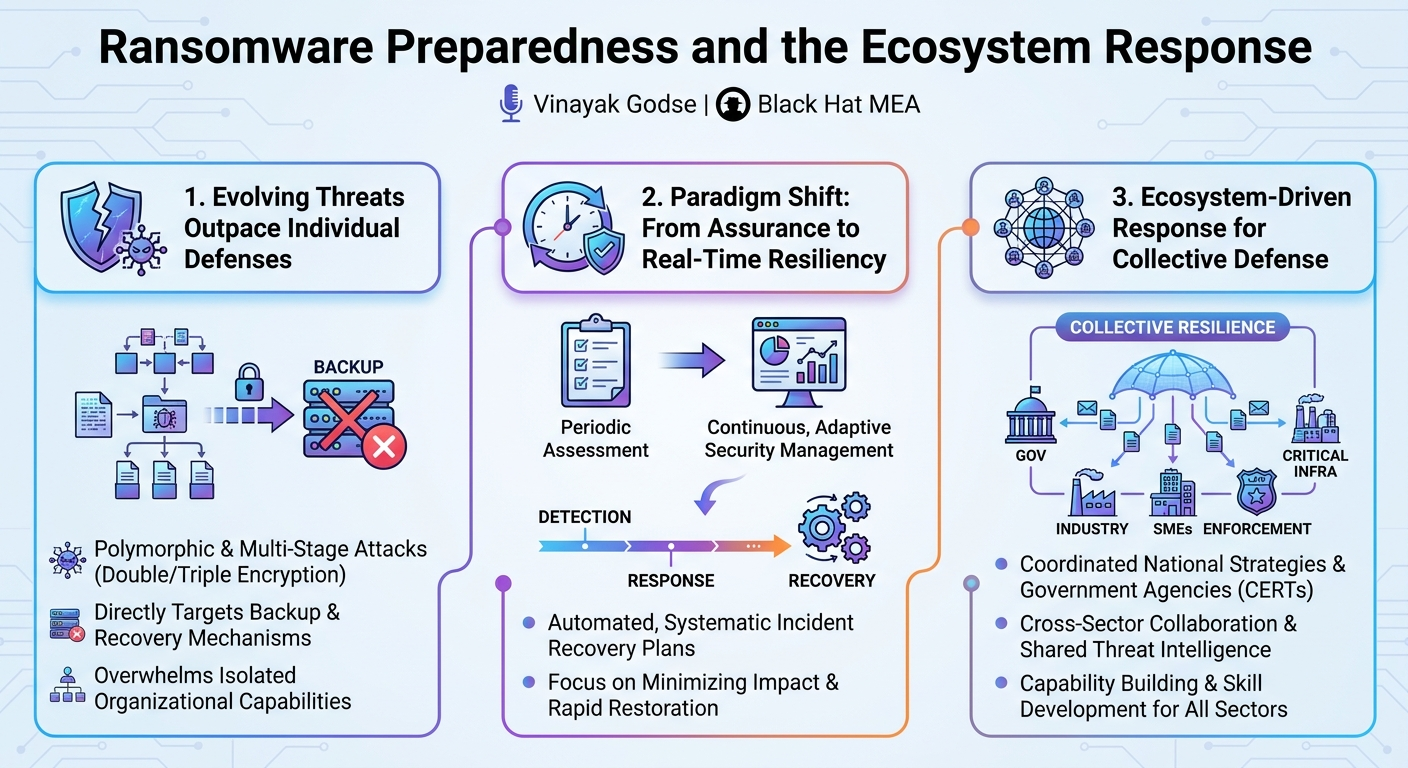
The core premise of Godse's presentation is that ransomware has matured into a complex, multi-faceted threat that actively targets an organization's ability to recover. Attackers are not only encrypting data but are also compromising backups, exfiltrating sensitive information for double and triple extortion, and employing advanced techniques like simultaneous execution and polymorphic behavior to evade detection. This escalating threat landscape demands a paradigm shift in security posture, moving from mere assessment and assurance to real-time security management, and ultimately, to a robust, coordinated response and recovery framework that leverages a broader support ecosystem.
The talk provided a comprehensive analysis of the ransomware threat, detailing common attack vectors, the evolving professionalism (or lack thereof) of attacker groups, and the inherent challenges organizations face during a ransomware incident. Crucially, Godse outlined how the Data Security Council of India is working with the Indian government and various industry sectors to foster this aggregate-level capability, ensuring that organizations of all sizes, especially critical infrastructure and small-to-medium enterprises (SMEs), can benefit from a collective defense and recovery strategy.
Background
▶ Watch: Introduction: Need for ecosystem ransomware response (0:00)
The landscape of ransomware has undergone a significant transformation since 2020, evolving from opportunistic attacks to highly sophisticated, targeted campaigns. Vinayak Godse detailed several key advancements that underscore this shift. Modern ransomware exhibits polymorphic behavior, constantly changing its code to evade signature-based detection, and is often associated with other forms of malware for initial compromise and persistence. Attackers are now meticulously identifying and targeting critical files, data, and media within an organization, maximizing the impact of their encryption efforts. Furthermore, the encryption itself has become more complex, with attackers employing double and triple encryption schemes, making recovery without their keys virtually impossible.
A critical evolution is the speed and sophistication of execution. Ransomware now boasts simultaneous and very fast execution, rapidly encrypting vast swathes of an organization's network. This is often orchestrated through advanced Command and Control (C2) centers, centralizing the attackers' operations. A particularly insidious development is the direct targeting of an organization's recovery mechanisms, especially backups. Attackers actively seek to compromise or delete backups to prevent recovery, thereby increasing the likelihood of a ransom payment. The threat is further compounded by data exfiltration, where sensitive data is stolen before encryption, leading to double extortion tactics – threatening to leak the data if the ransom isn't paid.
Godse also highlighted the shifting nature of ransomware operators themselves. He described two distinct groups: one that is "very professional" and "committed" to supporting recovery once a ransom is paid, offering a form of "service." The other group, however, is "very unpredictable," "unreliable," "exploitative," and "expansive," often extending their demands beyond the initial compromise and offering no guarantee of data recovery even after payment. This unpredictability adds another layer of complexity for victim organizations.
Common delivery channels for these sophisticated attacks include phishing emails, malicious websites, compromised plugins, infected documents, vulnerable applications, and connected devices. The attack mechanisms are diverse, ranging from social engineering and the distribution of cracked software to malicious advertisements, infected PDFs, brute-force attempts, compromised gaming applications, and widespread malware spam. Fundamentally, these attacks continue to exploit OS vulnerabilities, leverage malicious PowerShell commands, and increasingly, exploit Remote Desktop Protocol (RDP) compromises as a primary entry point, especially with the rise of remote work.
In response to this escalating threat, the approach to security preparedness has also evolved. Traditionally, organizations focused on periodic security assessments and assurance activities, such as penetration testing and compliance verification. However, the dynamic nature of ransomware has forced a transition towards real-time security management. This involves establishing security operations that are contextual, situational, adaptive, policy-governed, automated, orchestrated, predictive, and agile. The latest and most crucial phase of this evolution, as emphasized by Godse, is the investment in response and resiliency, moving beyond prevention and detection to systematically and effectively recover from an attack, minimizing damage and ensuring business continuity.
Key Findings
▶ Watch: Transitioning to real-time security management (6:00)
The talk presented several critical findings that challenge conventional approaches to cybersecurity and underscore the necessity of an ecosystem-wide response to ransomware.
Firstly, a central finding is that individual organizational preparedness is fundamentally insufficient against the current generation of ransomware attacks. The speaker repeatedly stressed that "the lot of the preparation that you do inside the organization would not be enough to address the kind of threats that we see in terms of ransomware." The advanced potency, polymorphic nature, and targeted methodologies of modern ransomware, coupled with the sophisticated efforts to impact recovery time and compromise backups, overwhelm the resources and capabilities of even well-resourced individual entities.
Secondly, there is a clear and urgent need for organizations to transition their security posture from mere assessment and assurance to real-time security management, and crucially, to robust incident response and resiliency. This evolution is not just about adopting new technologies but about fundamentally changing how security is perceived and managed—making it contextual, adaptive, automated, and orchestrated. The ultimate goal is to enable systematic and rapid recovery, limiting damage and meeting stringent reporting requirements (e.g., within 3 or 6 hours).
Thirdly, modern ransomware actively attacks the recovery process itself. Attackers are not just encrypting data; they are specifically designed to corrupt or delete backups and prolong recovery times. This necessitates a multi-dimensional, coordinated, and often automated approach to recovery, recognizing that traditional backup strategies may be directly targeted and compromised.
Fourthly, the challenges faced by organizations during a ransomware incident extend far beyond technical remediation. These include complex reporting requirements to multiple regulatory bodies, the significant panic created at executive and board levels, the sheer diversity of attack vectors and payloads, the involvement of multiple triggers and agencies in heavily regulated sectors, and the uncertainty of recovery possibilities. Organizations often face the dilemma of whether to attempt decryption (if a reliable decryptor exists) or to undertake a full system rebuild, each path fraught with its own complexities and efforts.
Finally, a significant portion of the response and recovery effort falls beyond an organization's own control. This is where the concept of an ecosystem-driven response becomes paramount. Many organizations, particularly small and medium-sized enterprises (MSMEs) and those in critical sectors like manufacturing, oil, energy, and power, lack the internal capabilities and resources to effectively respond. Furthermore, challenges such as securing local support in non-metro areas and navigating public policies regarding ransom payments (especially for public sector organizations) highlight the need for external, aggregated support. The speaker emphasized that a comprehensive ecosystem approach must involve national strategies, dedicated government agencies (like CERTs and critical infrastructure protection agencies), capability building, skill development (e.g., through "ransomware responder bootcamps"), the creation of playbooks and drills, cross-sector information sharing, core research and innovation, and robust law enforcement engagement.
Technical Deep Dive
▶ Watch: Beyond organizational control: need for ecosystem support (12:30)
The talk delved into the technical intricacies of modern ransomware, highlighting the sophisticated methods employed by attackers and the corresponding evolution required in defensive strategies. The speaker underscored that ransomware has moved beyond simple encryption to become a highly adaptive and destructive force.
A key technical advancement is the polymorphic behavior of ransomware. This characteristic allows the malware to constantly change its identifiable features, such as file hashes or code signatures, making it difficult for traditional antivirus (AV) and endpoint detection and response (EDR) solutions to detect and block. This necessitates more advanced behavioral analysis and heuristic detection capabilities.
The attack chain often involves malware association, where ransomware is not a standalone threat but rather the final stage of a broader attack. Initial access might be gained through other malware, such as info-stealers or loaders, which then facilitate the deployment of ransomware. This complex interplay requires defenders to understand the entire kill chain, not just the final payload.
Ransomware operators are increasingly intelligent in their targeting, seeking out critical important files or data or media to encrypt. This strategic targeting maximizes the impact on business operations, forcing organizations into a position where data recovery is paramount. Coupled with this, attackers ensure that access to data is limited, networks are unavailable, and data is exfiltrated prior to encryption, enabling double or triple extortion schemes. This exfiltration tactic adds a significant layer of pressure, as victims face not only data loss but also potential regulatory fines and reputational damage from public disclosure.
The encryption methodologies themselves have advanced, with attackers employing double triple encryption. This means that data might be encrypted multiple times with different keys or algorithms, making decryption without the attacker's key significantly more complex and time-consuming, if not impossible. Furthermore, the simultaneous execution of encryption across multiple systems and fast execution speeds are designed to rapidly cripple an organization's IT infrastructure, minimizing the window for detection and response. This rapid propagation is often facilitated by sophisticated Command and Control (C2) centers that orchestrate the attack.
A particularly damaging technical strategy is the direct assault on backup systems. Attackers understand that robust backups are an organization's last line of defense. Therefore, modern ransomware often includes modules designed to locate, encrypt, or delete backups, or to compromise backup servers and snapshots, effectively crippling an organization's ability to recover without paying the ransom.
The talk also detailed common attack vectors that facilitate these sophisticated ransomware deployments. OS vulnerabilities remain a primary entry point, underscoring the critical importance of timely patching and vulnerability management. In recent times, RDP compromises have become a highly prevalent vector. Attackers gain access to RDP services, often through brute-force attacks or stolen credentials, and then use this access to move laterally within the network and deploy ransomware. Malicious PowerShell commands are frequently injected for execution, persistence, and to carry out various stages of the attack without relying on traditional executables, further complicating detection.
Other significant delivery mechanisms include phishing and social engineering campaigns, distributing malicious attachments or links; cracked software containing hidden malware; malicious advertisements (malvertising); malware-laden PDFs and documents; brute force attacks against various services; exploitation of plugins in web applications; and ransomware embedded within gaming applications or spread via malware spam.
In terms of defensive evolution, the speaker highlighted the transition from traditional, assessment-driven security to real-time security management. This involves deploying advanced solutions like Security Information and Event Management (SIEM), Security Orchestration, Automation, and Response (SOAR), and Extended Detection and Response (XDR) platforms. These systems aim to provide contextual, situational, and adaptive security by continuously monitoring, analyzing, and automating responses to threats. The ultimate goal is to achieve an agile security posture where issues are identified and enforcement actions are taken in a policy-governed, automated, orchestrated, and predictive manner.
This real-time management then feeds into the paramount focus on response and resiliency. Technically, this translates to developing and implementing systematic recovery processes that are automated where possible to bring systems back online quickly. Recovery plans must be multi-dimensional, addressing various aspects of the IT infrastructure, and coordinated across different departments. The technical solutions must be geared towards limiting damage and facilitating remediation, ensuring that the root cause of the compromise is addressed to prevent recurrence. This requires robust forensic capabilities and the ability to rebuild systems securely.
Demo / Proof of Concept
▶ Watch: Introducing the ecosystem-driven response and recovery (14:00)
The talk by Vinayak Godse did not include a live demonstration or a specific proof of concept of ransomware attacks or recovery tools. Instead, the presentation focused on a high-level strategic and ecosystem-driven approach to ransomware preparedness and response, drawing on broad observations and policy recommendations from the Data Security Council of India's perspective.
Defensive Implications
▶ Watch: Importance of police and law enforcement (18:00)
The detailed analysis of evolving ransomware threats presented by Vinayak Godse carries profound implications for cybersecurity defenders. The central message is clear: isolated, internal defenses are no longer sufficient. Organizations must adopt a multi-layered, ecosystem-aware strategy that prioritizes real-time management and robust recovery.
Firstly, organizations must fundamentally shift from periodic security assessment to continuous, real-time security management. This necessitates significant investment in advanced security technologies such as SIEM (Security Information and Event Management), SOAR (Security Orchestration, Automation, and Response), and XDR (Extended Detection and Response) platforms. These tools enable contextual, adaptive, and automated threat detection and response, allowing security teams to identify and neutralize threats more rapidly and effectively than traditional, reactive approaches. Implementing strong security governance, policy-driven enforcement, and orchestrated automation will be key to managing security in an agile and predictive manner.
Secondly, response and resiliency must become a core pillar of an organization's cybersecurity strategy, moving beyond prevention and detection. This involves developing and rigorously testing comprehensive incident response (IR) plans and disaster recovery (DR) strategies. These plans must be systematic, automated where possible, multi-dimensional, and coordinated across all relevant departments, including IT, legal, communications, and executive leadership. The goal is to minimize recovery time objectives (RTOs) and recovery point objectives (RPOs), ensure damage limitation, and facilitate swift remediation. Crucially, these plans must account for stringent reporting requirements, such as those mandating disclosure within 3 or 6 hours, as highlighted by Godse.
Thirdly, given that ransomware actively targets recovery mechanisms, organizations must re-evaluate and strengthen their backup and recovery strategies. It is no longer enough to simply have backups; they must be isolated, immutable, and regularly tested for integrity and recoverability. Implementing off-site, air-gapped, or cloud-based immutable backups can protect against ransomware that attempts to compromise local backup systems. Diversifying backup strategies and ensuring multiple recovery points are essential to mitigate the risk of attackers corrupting all available recovery options.
Fourthly, organizations need to focus on mitigating common and evolving attack vectors. This includes:
- Vulnerability Management: Prioritizing the patching of operating systems and critical applications to address known OS vulnerabilities.
- RDP Security: Implementing strong security controls around Remote Desktop Protocol (RDP), including multi-factor authentication (MFA), strong password policies, network segmentation, and continuous monitoring for suspicious RDP activity. Given the rise of RDP compromises, this is a critical area.
- Email Security: Deploying advanced email security solutions capable of detecting sophisticated phishing and malware spam campaigns.
- Endpoint Protection: Utilizing EDR solutions that can detect polymorphic malware, malicious PowerShell commands, and anomalous behavioral patterns indicative of ransomware execution.
- User Awareness Training: Continuously educating employees on identifying and reporting social engineering attempts, malicious links, and suspicious attachments.
Finally, defenders must acknowledge the limitations of internal capabilities and actively engage with the broader cybersecurity ecosystem. This means:
- National Agencies: Understanding and collaborating with national Computer Emergency Response Teams (CERTs), critical infrastructure protection agencies, and national cyber coordinator offices for guidance, threat intelligence, and support during incidents.
- Industry Collaboration: Participating in threat intelligence sharing groups and sector-specific information sharing and analysis centers (ISACs) to gain insights into emerging threats and TTPs.
- Skill Development: Investing in specialized training for incident responders, potentially leveraging programs like the "ransomware responder bootcamps" mentioned, to build internal competence in dealing with complex ransomware scenarios.
- Policy Awareness: For public sector organizations, understanding and navigating public policies regarding ransom payments is crucial. All organizations should be aware of legal and regulatory frameworks surrounding data breaches and reporting.
- Core Research and Innovation: Staying abreast of the latest cybersecurity research and leveraging innovative security products from the growing ecosystem of cybersecurity startups to enhance defensive capabilities.
Key Takeaways
- Evolving Threat Requires Ecosystem Response: Modern ransomware has advanced significantly, employing polymorphic behavior, double/triple encryption, and direct attacks on recovery systems, making individual organizational preparedness insufficient. A coordinated, multi-stakeholder ecosystem response is now critical.
- Shift from Assurance to Resiliency: Organizations must transition their security posture from traditional assessment and compliance to real-time, adaptive security management, culminating in robust, systematic, and automated incident response and recovery capabilities.
- Recovery is Under Attack: Ransomware actively targets and compromises backup systems and recovery processes, necessitating diversified, immutable, and regularly tested backup strategies alongside multi-dimensional and coordinated recovery plans.
- Complex Challenges Beyond Technical Fixes: Ransomware incidents present a myriad of non-technical challenges, including complex regulatory reporting, executive panic, diverse attacker professionalism, multiple agency involvement, and dilemmas regarding decryption versus system rebuild.
- National Strategy and Capability Building are Essential: An effective ecosystem response requires national cybersecurity strategies, dedicated government agencies (e.g., CERTs), capability building for vulnerable sectors (MSMEs, critical infrastructure), skill development programs, shared playbooks, cross-sector collaboration, and robust law enforcement engagement.
- Prioritize Foundational Security for Evolving Vectors: While holistic, ecosystem-level defense is crucial, organizations must continue to address foundational security hygiene, particularly against prevalent attack vectors like OS vulnerabilities, RDP compromises, and malicious PowerShell commands, through patching, MFA, and advanced endpoint protection.
About the Speaker(s)
Vinayak Godse is the Chief Executive Officer (CEO) of the Data Security Council of India (DSCI). The DSCI functions as an industry body and a prominent think tank for cybersecurity in India. In his role, Mr. Godse is instrumental in guiding and supporting Indian organizations through their cybersecurity journeys. His work focuses on developing and implementing aggregate-level capabilities across diverse industry sectors, including financial services, energy, power, and healthcare, to enhance their collective resilience against advanced cyber threats like ransomware.
Reviews
Dr. Zero (Offensive Security Researcher) — HARD PASS
Vinayak Godse walked onto a Black Hat stage to tell us ransomware is bad, it targets backups, and we need to 'collaborate'. It’s a 101-level awareness brief dressed up in a policy suit. If you've been in a coma since the Conti leaks, this might be useful—otherwise, skip it.
Heather Calloway (CISO) — SOLID
Godse outlines the shift from preventative defense to institutional resilience in the face of modern ransomware operations. It is a competent policy overview that accurately diagnoses the asymmetry between private companies and threat syndicates, though it treads familiar ground for mature security programs.
→ Top-rated talks at Black Hat Middle East & Africa 2023 (Executive Summit)
All talks from Black Hat Middle East & Africa 2023 (Executive Summit)