Mental Health & Burnout: How Does Empathy Power Security
Lance James (Founder & CEO · Unit 221B), Gram Ludlow (SVP & CISO · Marriott Vacations Worldwide), Sam Curry (CISO · Zscaler), Stephen Bennett (Global CISO · Domino's Pizza Enterprises)
Black Hat Middle East & Africa 2023 (Executive Summit) · Day 3 · Executive Summit
Overview
In an era where cybersecurity professionals face relentless threats and immense pressure, the Black Hat MEA panel "Mental Health & Burnout: How Does Empathy Power Security" delivered a crucial message: empathy is not merely a "soft skill" but a foundational power skill essential for building resilient security teams and robust defenses. Moderated by Lance James, Founder & CEO of Unit 221B, the discussion featured an esteemed panel of CISOs—Gram Ludlow, Sam Curry, and Stephen Bennett—who shared their pragmatic strategies for integrating emotional intelligence into cybersecurity leadership. The talk highlighted that safeguarding systems is intrinsically linked to supporting the people behind them, particularly in a field notorious for high stress and burnout.
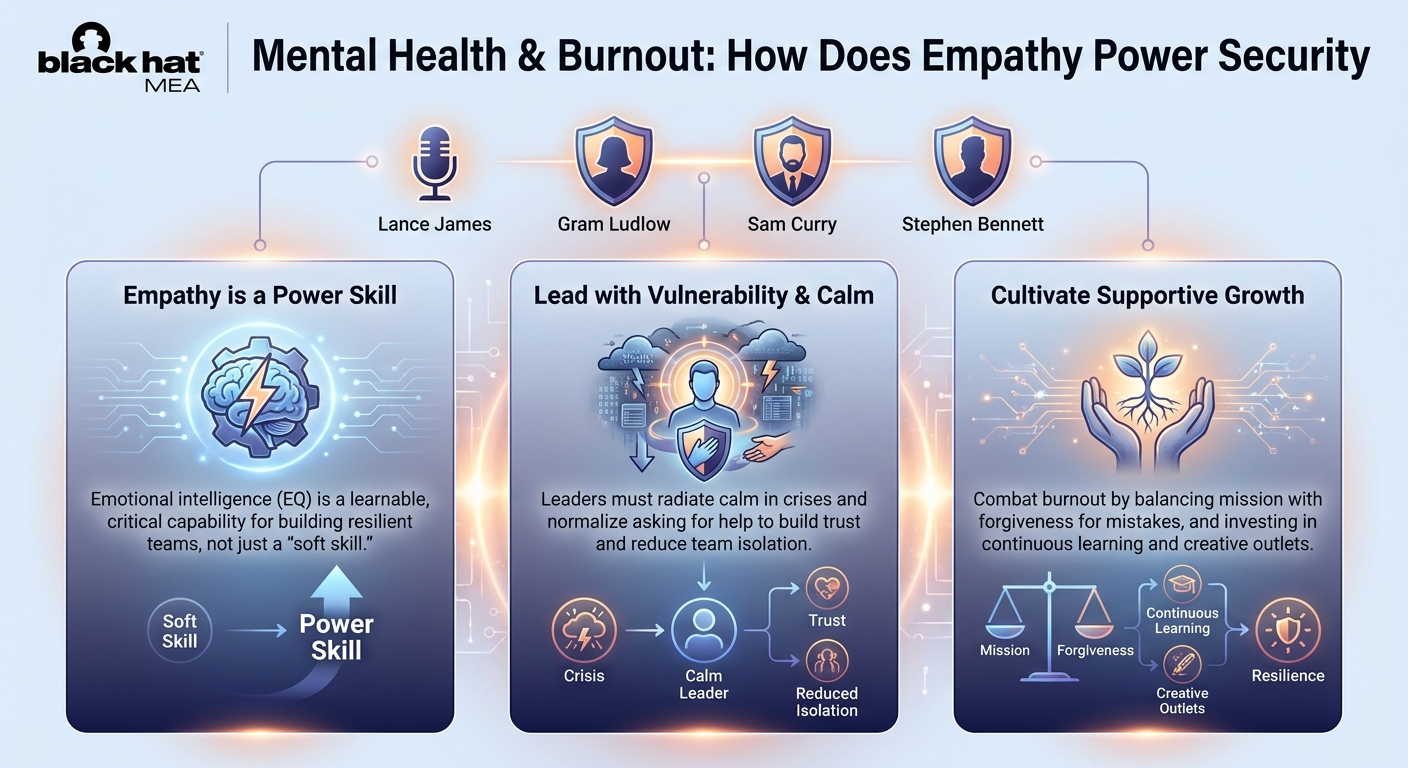
Key moments
- 0:00 Introduction and panelist welcomes
- 3:00 Mission-driven work, stress, and forgiveness
- 8:10 Power skills: EQ, radiating calm in crisis
- 15:40 Hands-on leadership and the 'nerd day'
- 22:00 Empathy debt and leaders asking for help
- 28:00 Leaders inadvertently modeling burnout for teams
- 30:00 Adopting emotional intelligence frameworks for teams
- 32:50 Culture of seeking help and cross-training
Mental Health & Burnout: How Does Empathy Power Security
Speakers: Lance James (Founder & CEO, Unit 221B), Gram Ludlow (SVP & CISO, Marriott Vacations Worldwide), Sam Curry (CISO, Zscaler), Stephen Bennett (Global CISO, Domino's Pizza Enterprises)
Conference: Black Hat MEA
YouTube: https://www.youtube.com/watch?v=0PwZgG7rjSA
Overview
In an era where cybersecurity professionals face relentless threats and immense pressure, the Black Hat MEA panel "Mental Health & Burnout: How Does Empathy Power Security" delivered a crucial message: empathy is not merely a "soft skill" but a foundational power skill essential for building resilient security teams and robust defenses. Moderated by Lance James, Founder & CEO of Unit 221B, the discussion featured an esteemed panel of CISOs—Gram Ludlow, Sam Curry, and Stephen Bennett—who shared their pragmatic strategies for integrating emotional intelligence into cybersecurity leadership. The talk highlighted that safeguarding systems is intrinsically linked to supporting the people behind them, particularly in a field notorious for high stress and burnout.
The panelists collectively argued that cultivating empathy within security organizations is paramount for fostering a supportive culture, striking a healthy work-life balance, and implementing effective strategies to combat burnout. They emphasized that mental and emotional vulnerability in individuals can translate directly into organizational security vulnerabilities. By sharing personal anecdotes and actionable insights, the speakers demonstrated how empathetic leadership, forgiveness for mistakes, active listening, and a willingness to be vulnerable can significantly enhance team dynamics, collaboration across departments, and ultimately, the overall security posture of an enterprise. This discussion served as a powerful reminder that the human element remains at the heart of effective cybersecurity.
Background
▶ Watch: Introduction and panelist welcomes (0:00)
The cybersecurity landscape is characterized by constant evolution, sophisticated threats, and a perpetual state of vigilance, leading to an inherently high-stress environment. Professionals in this field often operate under immense pressure, with the stakes ranging from data breaches and financial loss to reputational damage and even, as Gram Ludlow succinctly put it, "defending people's lives against hackers who are going to try to steal their identities." This mission-driven ethos, while motivating, also significantly elevates stress levels. The consequence is a pervasive issue of burnout, a state of chronic physical and emotional exhaustion that many in the audience, and indeed the panel, openly acknowledged experiencing.
Historically, the cybersecurity industry has prioritized technical prowess, focusing on certifications, coding skills, and threat intelligence, often overlooking the critical importance of emotional intelligence (EQ) and human-centric leadership. The traditional mindset often views security as a purely technical domain, creating silos and fostering a culture where vulnerability or asking for help might be perceived as weakness. Sam Curry highlighted how CISOs often project an "almost cyber perfection" veneer, which, while intended to inspire confidence, can lead to isolation and exacerbate burnout among leaders and their teams. This gap between the technical demands of the role and the human capacity to sustain it underscores the urgent need for a paradigm shift, recognizing that a secure enterprise requires not only strong technology but also a mentally resilient and emotionally supported workforce. The panel aimed to bridge this gap by advocating for empathy as a strategic imperative.
Key Findings
▶ Watch: Power skills: EQ, radiating calm in crisis (8:10)
The panel discussion unveiled several critical findings regarding the role of empathy in strengthening cybersecurity teams and defenses:
- Empathy as a "Power Skill," Not a "Soft Skill": Sam Curry strongly advocated for renaming "soft skills" to "power skills," emphasizing that abilities like communication, presentation, and understanding human interaction are challenging to master and critically important. He highlighted that emotional intelligence is a learnable skill, not an inherent trait, and can be developed through study and practice, much like technical skills.
- Balancing Mission-Driven Ethos with Forgiveness: Gram Ludlow shared his approach of inspiring teams with a mission-driven purpose ("good versus bad") while simultaneously balancing it with empathy and forgiveness for imperfections and mistakes. He emphasized that in high-stress environments, allowing people to be imperfect and not being overly critical when tasks aren't executed flawlessly is crucial for managing stress and building resilience.
- Active Listening and 360-Degree Feedback: Another panelist underscored the importance of active and authentic listening to team members and stakeholders. He also advocated for a 360-degree feedback mechanism to understand diverse perspectives. Crucially, he stressed that leaders must empower their teams by owning errors and mistakes, creating a safe space for innovation and exploration without fear of punitive consequences.
- Leading by Example through Vulnerability and Calm: Sam Curry shared a profound lesson from a former boss: radiating calm during a crisis. He explained that a leader's body language and demeanor set the tone for the entire team, and consciously projecting calm can be incredibly reassuring. He also emphasized the power of asking for help as an executive, stating it builds trust and removes isolation, thereby setting an example for team members to do the same.
- Hands-On Involvement and "Nerd Days": Stephen Bennett highlighted the importance of leaders maintaining technical skills and walking in the shoes of their team members. His personal practice of working tier one and tier two support calls for half a day a month provided invaluable insight into the daily struggles of his team, revealing discrepancies between perceived metrics and actual operational realities. He also introduced the concept of "nerd days"—monthly offsite sessions where team members can explore technical interests outside their daily tasks, fostering passion, bonding, and unexpected innovation.
- Creating a Supportive "Fraternity" and Talent Pipeline: Another panelist stressed the need for a "fraternity" or supportive ecosystem within the security community, extending beyond the CISO function to include other departments like technology and finance. He also detailed a strategy for combating the talent shortage by dedicating 20-25% of team members' current KRA (Key Result Area) to cross-skill learning, allowing them to explore new technologies and roles. This approach combats monotony, upskills the team, and creates an internal fallback mechanism, fostering a positive, empathetic environment.
These findings collectively illustrate that empathy is not a peripheral concern but a core strategic lever for effective cybersecurity leadership, directly impacting team mental health, productivity, and the resilience of an organization's defenses.
Technical Deep Dive
▶ Watch: Empathy debt and leaders asking for help (22:00)
While this panel focused on human-centric aspects rather than specific code or protocol vulnerabilities, the discussion offered a "technical deep dive" into the methodologies, frameworks, and operational strategies for integrating empathy and emotional intelligence into security leadership and team management. These approaches, though not involving traditional technical tools, are systematic and actionable, akin to applying engineering principles to human systems.
One of the most significant "technical" contributions was Gram Ludlow's description of adopting an emotional intelligence (EQ) framework within his leadership team. He explicitly likened this to cybersecurity frameworks and standards, emphasizing that EQ is a set of skills that can be learned, studied, and practiced. This involves identifying specific situations, applying appropriate tools and techniques (e.g., active listening, conflict resolution, self-awareness), and continuously developing these competencies. This structured approach to human development provides a repeatable and measurable way to enhance team members' ability to manage their own emotions and understand others, directly mitigating stress and fostering collaboration.
The concept of leadership-by-example was presented as a critical operational tactic. Sam Curry's anecdote about his boss radiating calm during a crisis illustrates a deliberate behavioral strategy. Instead of mirroring the team's anxiety, a leader consciously projects a reassuring demeanor, which significantly influences team morale and effectiveness during high-pressure incidents. Similarly, Stephen Bennett's practice of engaging in Tier 1 and Tier 2 support calls for half a day each month is a direct, hands-on operational strategy. This isn't just about empathy; it's about gaining real-time, ground-level intelligence on the effectiveness of implemented security controls and processes. By experiencing the "horrific" reality of juggling four screens and searching through playbooks under pressure, Stephen gained invaluable insights that raw metrics could not provide, allowing for more informed and empathetic adjustments to operational workflows.
Another panelist's approach to talent development and cross-skilling represents a strategic workforce management framework. By dedicating 20-25% of team members' Key Result Areas (KRAs) to learning new skills outside their primary domain, he institutionalizes continuous learning and addresses the perennial challenge of monotony and skill stagnation. This structured allocation of time and resources for exploration, akin to an internal R&D budget for human capital, serves a dual purpose: it upskills the team, making them more adaptable to evolving threats, and significantly boosts morale by offering fluid career paths and intellectual stimulation. This mechanism also builds internal redundancy and fallback expertise, strengthening the team's collective resilience.
Finally, the panel highlighted the strategic use of vulnerability as a leadership "protocol." Sam Curry noted that "the rarest thing you see at the sea level and the people who tend to get trusted the most and accomplished the most are the ones that demonstrate an ability to ask for help when they need it." This is a conscious decision to break down the "veneer of almost cyber perfection" that CISOs often adopt. By openly admitting uncertainty or asking for assistance, leaders create an environment where sharing challenges and seeking support is normalized, thus combating isolation and fostering a culture of mutual aid within and across departments. This shifts the organizational "architecture" from hierarchical and siloed to more collaborative and interconnected, enabling faster problem-solving and collective resilience.
Demo / Proof of Concept
▶ Watch: Leaders inadvertently modeling burnout for teams (28:00)
This session was a panel discussion focused on leadership strategies and human factors in cybersecurity. As such, no technical demonstration or proof of concept was presented. The insights shared were based on the speakers' extensive professional experiences and anecdotal evidence.
Defensive Implications
▶ Watch: Culture of seeking help and cross-training (32:50)
The insights shared by the panel have profound defensive implications for cybersecurity organizations, extending beyond traditional technical controls to encompass human resilience and operational effectiveness.
- Reduced Burnout, Enhanced Retention, and Improved Alertness: By fostering empathetic leadership and a supportive culture, organizations can significantly reduce burnout rates. Stephen Bennett's "nerd days" and another panelist's cross-skilling initiatives directly combat monotony and provide outlets for professional growth. A less stressed, more engaged workforce is inherently more alert and effective in identifying and responding to threats, reducing the likelihood of human error that often leads to breaches. This also directly addresses the critical issue of talent retention in a highly competitive field, ensuring continuity of expertise.
- Stronger Incident Response and Crisis Management: Sam Curry's emphasis on leaders radiating calm during crises and Gram Ludlow's advocacy for forgiveness for mistakes are crucial for incident response (IR). In high-stakes situations, panic and fear of reprisal can hinder effective problem-solving. A culture that supports learning from mistakes, rather than punishing them, enables teams to act decisively, conduct thorough post-incident analyses (retrospectives) without judgment, and implement improvements more effectively. This leads to faster containment and recovery times.
- Breaking Down Silos and Fostering Cross-Functional Collaboration: Sam Curry highlighted the "biggest problem in security is the gap between cyber security and the business." The panel's strategies, such as departmental rotations and leaders demonstrating empathy for other business units, directly address this. When security teams understand the operational pressures of IT or business functions, it fosters better cooperation, leading to faster vulnerability remediation and more secure system deployments. Gram Ludlow's experience with IT teams being overstrained underscores that empathy helps mitigate security professionals' stress and fosters collaboration rather than withdrawal.
- Proactive Risk Management through Human Understanding: By prioritizing emotional intelligence, CISOs gain a deeper understanding of human behavior, motivations, and stressors. This allows for a more holistic approach to risk management, moving beyond purely technical vulnerabilities to address human factors that contribute to risk, such as shadow IT, phishing susceptibility, or insider threats. Understanding team dynamics also enables leaders to proactively identify and mitigate potential points of failure arising from low morale or interpersonal conflicts.
- Cultivating a Culture of Continuous Learning and Innovation: Another panelist's strategy of dedicating 20-25% of KRA to new learning and Stephen Bennett's "nerd days" are powerful mechanisms for continuous learning. This proactive investment in skill development ensures that security teams remain adaptable to the ever-evolving threat landscape. It also creates a fertile ground for innovation, as team members are encouraged to explore new tools and techniques (e.g., new GPT models, malware analysis), potentially leading to novel security solutions developed organically from within the team.
- Enhanced Trust and Psychological Safety: Sam Curry's point about executives asking for help and sharing vulnerability builds trust and psychological safety within the team. When team members feel safe to admit errors, ask questions, and propose unconventional ideas without fear of judgment, it unleashes creativity and critical thinking. This environment is essential for effective threat intelligence analysis, security architecture reviews, and robust security awareness programs, as people are more likely to engage authentically and share critical information.
In essence, the panel argued that investing in empathy and human well-being is not a luxury but a strategic imperative that directly translates into a more resilient, adaptable, and ultimately, more secure organization.
Key Takeaways
- Empathy is a "Power Skill": Emotional intelligence and related human-centric abilities are critical, learnable "power skills" for cybersecurity professionals, not mere "soft skills."
- Combat Burnout through Forgiveness and Support: Leaders must balance mission-driven security work with empathy, offering forgiveness for mistakes and actively supporting team members to prevent and mitigate burnout.
- Lead by Example with Vulnerability: Executives and CISOs should demonstrate vulnerability by asking for help and radiating calm during crises, setting a precedent that encourages team members to do the same and fosters trust.
- Hands-On Engagement is Crucial: Leaders benefit from immersing themselves in their team's day-to-day operational challenges (e.g., working Tier 1/2 support) to truly understand pain points and inform better strategic decisions.
- Invest in Continuous Learning and Creative Outlets: Structured programs for cross-skilling (e.g., 20-25% KRA for new learning) and dedicated "nerd days" or similar creative exploration opportunities are vital for team morale, skill development, and innovation.
- Build a Supportive Ecosystem: Creating a "fraternity" or network of support that extends beyond the immediate security team to other departments (IT, business) is essential for effective collaboration and overall enterprise security.
About the Speaker(s)
Lance James: The founder and CEO of Unit 221B, Lance moderated the panel discussion. He is a seasoned cybersecurity leader known for his extensive experience and ability to facilitate insightful conversations, emphasizing the human element in security.
Gram Ludlow: As the SVP and CISO of Marriott Vacations Worldwide, Gram is recognized as a strategic thinker who adeptly integrates emotional intelligence with technical expertise to lead his teams. He champions a mission-driven approach balanced with empathy and forgiveness.
Sam Curry: CISO at Zscaler, Sam is a prominent figure in cybersecurity, known for his diverse contributions to the field and his consistent emphasis on the human element in security. He is a strong advocate for "power skills" and leadership through vulnerability.
Stephen Bennett: The Global CISO of Domino's Pizza Enterprises, Stephen is known for his innovative strategies and a hands-on approach to leadership. He actively engages with his teams' daily challenges and promotes initiatives like "nerd days" to support mental health and foster creativity.
Reviews
Dr. Zero (Offensive Security Researcher) — SOLID
A CISO panel on burnout that almost drowned in HR platitudes, saved by a handful of concrete operational metrics. When they tried to rebrand soft skills as 'power skills,' it was standard LinkedIn fodder, but Stephen Bennett actually shadowing Tier 1 queues is the kind of grounded leadership this industry desperately needs.
Heather Calloway (CISO) — STRONG ACCEPT
A deceptively rigorous look at managing security team burnout. Instead of generic wellness advice, this panel treats retention and incident response fatigue as structural program risks and offers operational levers to mitigate them.
→ Top-rated talks at Black Hat Middle East & Africa 2023 (Executive Summit)
All talks from Black Hat Middle East & Africa 2023 (Executive Summit)