From Automation to Autonomy - The Birth of AI SecOps
Faiz Shuja (Co-Founder & CEO · SIRP Labs Inc.)
Black Hat Middle East & Africa 2025 (Executive Summit) · Executive Summit
Overview
In his compelling Black Hat MEA keynote, Faiz Shuja, Co-Founder and CEO of SIRP Labs Inc., unveiled a transformative vision for cybersecurity operations: the self-driving SOC. This talk, titled "From Automation to Autonomy - The Birth of AI SecOps," addresses the critical shortcomings of traditional Security Operations Centers (SOCs) that are drowning in alerts and struggling to keep pace with machine-speed, AI-driven attacks. Shuja argues that the industry must evolve beyond static automation to embrace true autonomy, enabling security systems to reason, adapt, and act independently.
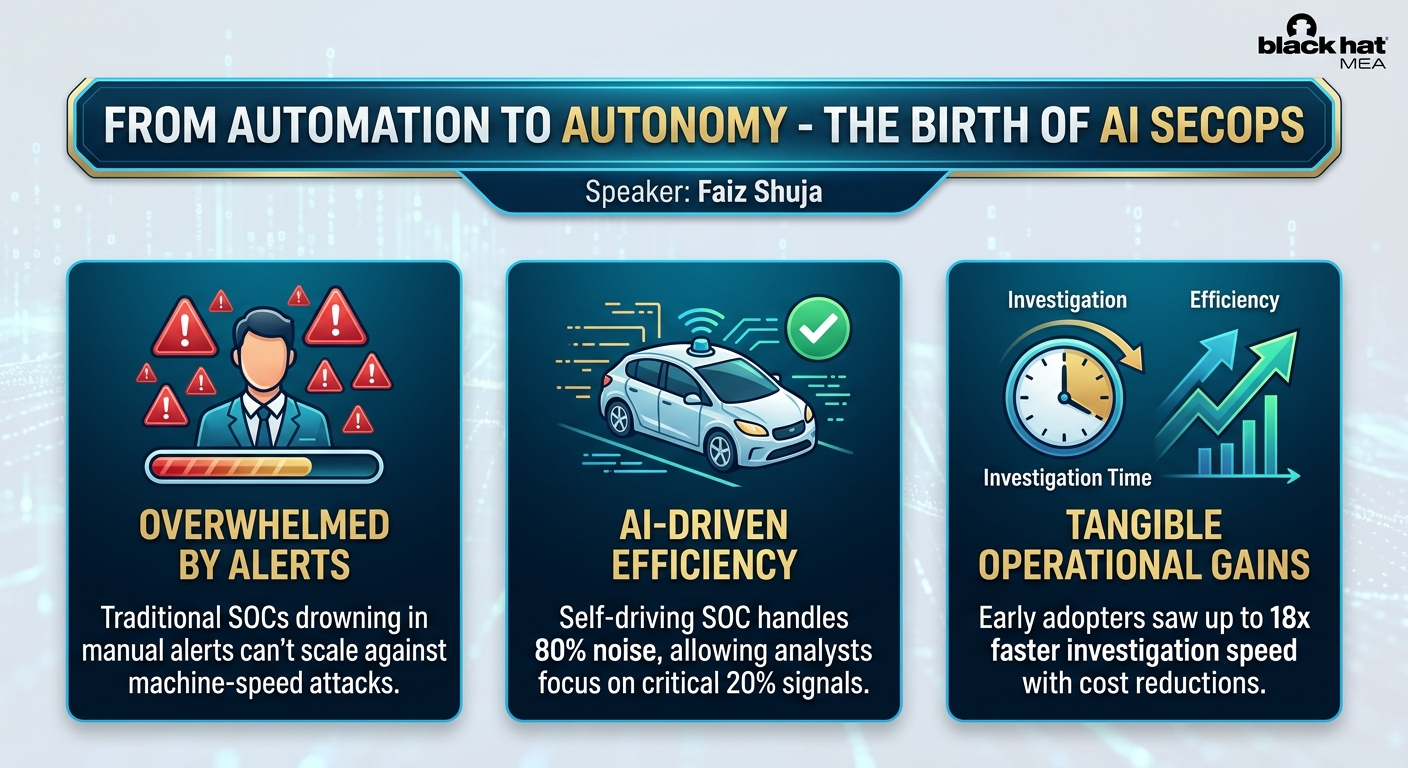
Key moments
- 0:40 Humans overwhelmed; traditional SecOps failing.
- 4:20 Tesla cars inspire self-driving SOC vision.
- 4:50 AI handles 80% noise, humans focus critical signals.
- 6:00 Key technical building blocks of self-driving SOC.
- 8:30 Guardrails: human in loop, autonomous learning.
- 10:10 Benefits: 18x faster investigations, major cost savings.
- 14:00 The birth of self-driving SOC: beyond augmentation.
From Automation to Autonomy - The Birth of AI SecOps
Speakers: Faiz Shuja, Co-Founder & CEO, SIRP Labs Inc.
Conference: Black Hat MEA
YouTube: https://www.youtube.com/watch?v=ALJJmohEBYc
Overview
In his compelling Black Hat MEA keynote, Faiz Shuja, Co-Founder and CEO of SIRP Labs Inc., unveiled a transformative vision for cybersecurity operations: the self-driving SOC. This talk, titled "From Automation to Autonomy - The Birth of AI SecOps," addresses the critical shortcomings of traditional Security Operations Centers (SOCs) that are drowning in alerts and struggling to keep pace with machine-speed, AI-driven attacks. Shuja argues that the industry must evolve beyond static automation to embrace true autonomy, enabling security systems to reason, adapt, and act independently.
The core premise of the presentation is that while automation has provided some relief, it lacks the intelligence and adaptability required to combat sophisticated, evolving threats. Drawing parallels to the advent of self-driving cars, SIRP Labs has pioneered a solution that leverages advanced AI capabilities—including Large Language Models (LLMs), real-time context retrieval (RAG), graph reasoning, and reinforcement learning—to create a new paradigm for security. This shift is presented not as an optional upgrade, but as a fundamental requirement for survival in an increasingly complex and adversarial digital landscape, empowering human analysts to focus on strategic threats rather than alert fatigue.
Background
▶ Watch: Humans overwhelmed; traditional SecOps failing. (0:40)
The current state of security operations is characterized by an overwhelming volume of alerts, leading to significant alert fatigue among security analysts. Faiz Shuja highlighted that human analysts are frequently "drowning in alerts," struggling to differentiate genuine threats from noise, resulting in critical incidents slipping through the cracks. This isn't a failure of skill or dedication, but a fundamental limitation of human capacity to scale against the sheer volume and speed of modern cyberattacks.
Traditional approaches, particularly SOAR (Security Orchestration, Automation, and Response) platforms, have attempted to address this with automation. However, Shuja critically pointed out that "automation is not equal to intelligence." These systems are often reactive and static, relying on predefined playbooks and scripts that lack adaptability. He used the analogy of a pilot following a checklist: while effective in routine conditions, it becomes dangerous in a storm with turbulence and lightning, where human judgment and adaptability are paramount. Similarly, advanced threats do not follow scripts; they adapt and evolve, rendering static playbooks ineffective. Reports indicate that APT (Advanced Persistent Threat) attackers can remain undetected within organizations for an average of 17 to 20 days, underscoring the inadequacy of current defenses.
The problem is exacerbated by the fact that attackers are already leveraging AI for sophisticated attacks, including deep fakes, polymorphic malware, and large-scale phishing campaigns. These attacks operate at machine speed, demanding an equally rapid and intelligent response from defenders. This sets the stage for the inevitable evolution of security operations: from manual SOCs to automated SOCs (with playbooks and scripts), and finally to the autonomous SOC. The vision, inspired by the likes of Tesla and its self-driving cars, is to create a SOC that doesn't just automate, but can "reason, adapt, and act." This transformation, Shuja asserted, is not merely optional but essential for survival, aiming to offload 80% of alert noise to AI, allowing human analysts to focus on the critical 20% of true signals and complex investigations.
Key Findings
▶ Watch: AI handles 80% noise, humans focus critical signals. (4:50)
The central finding presented by Faiz Shuja is the successful conceptualization and implementation of a self-driving SOC. This represents a significant leap from traditional security automation, moving beyond mere augmentation to achieve true operational autonomy. SIRP Labs Inc. has brought this vision to life by integrating a suite of advanced AI technologies that work in coherence to create an intelligent, adaptive, and self-evolving security system.
Key findings and contributions include:
- A New Paradigm: The talk fundamentally shifts the conversation from how AI can assist humans to how AI can autonomously respond without direct human intervention for routine tasks. This change in perspective was born from the realization that tools and AI agents have matured sufficiently to go "beyond augmentation into autonomy."
- Integrated AI Architecture: The self-driving SOC is built upon a sophisticated architecture comprising several interconnected components: an LLM (Large Language Model) for analyst-level reasoning, RAG (Retrieval-Augmented Generation) for real-time context, an in-memory Graph DB for connecting dots and blast radius analysis, and advanced learning mechanisms like Reflex Learning (from local environment) and Federated Learning (from global threats).
- Tangible Operational Benefits: SIRP Labs has already demonstrated significant improvements in operational efficiency and effectiveness with early adopters. Customers have reported an 18x faster investigation speed, reducing typical investigation times from 6 minutes to a matter of seconds. This translates into substantial operational cost reductions across SIM, SOAR, and human resource expenditures.
- Reduced Human Effort: The self-driving SOC drastically cuts down the manual effort required from analysts. Shuja cited figures where analyst hours, typically ranging from 100 to 150 hours per day, could be reduced to as little as 1 hour per day for supervision alone. This allows human experts to focus on complex, high-value tasks rather than being overwhelmed by noise.
- Enhanced Risk Control and Compliance: The system incorporates robust guardrails and human-in-the-loop mechanisms, allowing granular control over autonomous actions (e.g., single or dual approvals). It also natively supports compliance requirements, including local regulations in Saudi Arabia like BEIDPL, SAMA, NCA, and SADAYAH, by enabling deployment in local cloud, on-prem, or hybrid/air-gapped environments.
- Evolutionary and Adaptive Intelligence: Unlike static automation, the self-driving SOC is designed to be learning, acting, and adapting. It continuously evolves, much like a junior analyst gaining experience and becoming senior within a specific environment, through both internal and external learning mechanisms.
- Vision for a Unified Security Fabric: The future of AI SecOps, as envisioned, is a single fabric encompassing the detection, protection, and response layers. This includes the automatic generation of detection rules and playbooks for new attacks, enabling proactive hunting and rapid response.
These findings collectively underscore the potential for AI to fundamentally transform cybersecurity operations, making them more resilient, efficient, and responsive to the escalating threat landscape.
Technical Deep Dive
▶ Watch: Key technical building blocks of self-driving SOC. (6:00)
The architecture of SIRP Labs' self-driving SOC is a sophisticated integration of cutting-edge AI technologies designed to operate autonomously while maintaining human oversight. The system commences with the ingestion layer, where alerts and security signals flow in from diverse sources such as SIM (Security Information and Event Management) platforms, EDR (Endpoint Detection and Response), NDR (Network Detection and Response), identity systems, cloud environments, and email gateways. These feeds are consolidated into a data pipeline, typically a data lake or existing SIM infrastructure, forming the raw input for the AI engine.
At the core of the self-driving SOC are several interconnected building blocks:
- Large Language Model (LLM): This is the "brain" of the system, specifically trained to understand and reason like a security analyst. Its primary function is analyst-level thinking, enabling it to interpret alerts, identify patterns, and propose courses of action. A critical design choice for SIRP Labs was to ensure this LLM could operate in-country, on-prem, or even in air-gapped environments, avoiding reliance on external cloud-based LLM services for data privacy and security.
- Retrieval-Augmented Generation (RAG): To provide the LLM with relevant context, the RAG component retrieves specific information pertinent to an incident. This context includes details about the organization's environment, historical alerts, predefined workflows, and past incident responses. RAG ensures that the LLM's reasoning is grounded in the organization's unique operational reality, rather than generic knowledge.
- Graph Database (Graph DB): An in-memory graph database plays a crucial role in connecting disparate data points and understanding relationships. When an alert is received, the Graph DB rapidly fetches additional context, mapping affected users, assets, and other artifacts within the environment. This capability is vital for calculating the blast radius of an attack, providing immediate insight into its potential impact and scope.
- Chatbot Interface: The system includes a natural language chatbot, similar to popular AI assistants. This allows security analysts to interact with the self-driving SOC by asking questions such as "What is this attack?", "How can I respond to it?", "How many alerts do I have?", or "What are the critical investigations I need to focus on?". The chatbot processes these queries and provides intelligent, context-aware responses in natural language.
- Guardrails and Human in the Loop: Despite its autonomous nature, the self-driving SOC is designed with explicit guardrails to ensure human control and oversight. Organizations can define policies for what actions are fully autonomous, semi-automatic (requiring a single approval), or critical (requiring dual approvals). This configurable human-in-the-loop mechanism ensures that AI actions align with organizational risk tolerance and regulatory requirements.
- Reflex Learning: This learning mechanism enables the SOC to adapt to the specific nuances of its operational environment. It continuously learns from the organization's historical behavior, the types of attacks it has experienced, and the effectiveness of past responses. This makes the self-driving SOC increasingly proficient and tailored to the unique threat landscape of its deployment.
- Federated Learning: To keep pace with the global threat landscape, the system incorporates federated learning. This allows the LLM to learn from global threat intelligence and new attack methodologies without sharing sensitive local data. By leveraging collective intelligence, the self-driving SOC can anticipate and respond to emerging threats that may not yet have been observed in the local environment.
- Agentic Mesh: The architecture utilizes an agentic mesh comprising multiple specialized AI agents. These agents work in parallel or sequence, depending on the task, to perform various functions such as analysis, investigation, and response. This modular approach enhances the system's flexibility and scalability.
The combination of these components allows the self-driving SOC to be learning, acting, and adapting rather than remaining static. Shuja likened this evolution to a junior L1 analyst who joins a team, learns best practices, and then gains seniority and expertise specific to the organization's environment. The long-term vision extends to creating a "one fabric" approach across detection, protection, and response layers, where the system can automatically generate new detection rules and playbooks for novel attacks, proactively hunt for threats, and execute precise responses. This represents a complete, intelligent security lifecycle managed autonomously.
Demo / Proof of Concept
▶ Watch: Benefits: 18x faster investigations, major cost savings. (10:10)
While the transcript does not provide specific details about a live demonstration, Faiz Shuja explicitly stated that the self-driving SOC was being showcased live at the SIRP Labs booth during the Black Hat MEA conference. He invited attendees to "see it with your own eyes how self-driving SOC works" and observe the differentiation between generic agentic AI and their specific implementation. This indicates that a functional proof of concept was available for hands-on viewing, demonstrating the system's capabilities in real-time.
Defensive Implications
▶ Watch: The birth of self-driving SOC: beyond augmentation. (14:00)
The advent of the self-driving SOC carries profound implications for cybersecurity defenders, necessitating a fundamental re-evaluation of current security strategies and operational models.
- Embrace AI as a Strategic Imperative: Defenders can no longer afford to view AI as merely a supplementary tool. With attackers increasingly leveraging AI for sophisticated, machine-speed attacks, deploying AI-driven security operations becomes a survival requirement. Organizations must actively integrate AI into their defense mechanisms to match and exceed adversarial capabilities.
- Shift from Static Automation to Adaptive Autonomy: The limitations of traditional SOAR playbooks are evident. Defenders must move beyond rigid, predefined workflows to systems that can reason, adapt, and evolve in response to novel and dynamic threats. This requires investing in platforms that incorporate LLMs, graph reasoning, and continuous learning.
- Reallocate Human Talent: The primary benefit of a self-driving SOC is its ability to handle 80% of alert noise autonomously. This frees human analysts from mundane, repetitive tasks, allowing them to focus on the 20% of critical signals, complex investigations, threat hunting, and strategic security initiatives. Organizations should plan for upskilling their human teams to leverage these higher-order analytical and strategic roles.
- Achieve Machine-Speed Response: To combat machine-speed attacks, defenders need machine-speed responses. Autonomous systems can significantly reduce investigation and response times, minimizing the window of opportunity for attackers and reducing dwell time (e.g., from 6 minutes to seconds, as observed).
- Enhance Context and Threat Intelligence: Leveraging Graph DBs for real-time context and blast radius analysis is crucial. Defenders gain immediate, comprehensive insights into the impact of an attack, enabling more informed and targeted remediation efforts. Integrating federated learning ensures that defenses are continuously updated with global threat intelligence without compromising local data.
- Implement Robust Guardrails and Human Oversight: While autonomous, these systems are not "set and forget." Defenders must design and implement strong human-in-the-loop mechanisms and configurable guardrails. This ensures that autonomous actions align with organizational policies, risk appetite, and regulatory compliance, maintaining trust and accountability.
- Prioritize Data Residency and Compliance: For organizations operating under strict regulatory frameworks (e.g., KSA's BEIDPL, SAMA, NCA, SADAYAH), the ability to deploy AI security solutions in local cloud, on-prem, or air-gapped environments is paramount. This ensures data sovereignty and compliance with national cybersecurity mandates.
- Evaluate and Plan for SOC Maturity: Organizations should assess their current SOC maturity level (on a spectrum from 0 to 4) to understand their readiness for autonomy. This self-assessment can inform a roadmap for gradual adoption, starting with awareness and progressively building the necessary infrastructure and capabilities.
- Foster a Learning Environment: The self-driving SOC thrives on continuous learning. Defenders should establish processes to feed local threat intelligence and incident response outcomes back into the system (via reflex learning), making the AI more effective and tailored over time.
By embracing these defensive implications, organizations can transform their SOCs from reactive, overwhelmed centers into proactive, intelligent, and highly efficient defense strongholds capable of combating the most advanced cyber threats.
Key Takeaways
- The shift from static automation to autonomous, AI-driven Security Operations Centers (SOCs) is an inevitable and necessary evolution to combat machine-speed, AI-powered cyberattacks.
- A self-driving SOC leverages a synergistic blend of advanced AI components, including Large Language Models (LLMs), Retrieval-Augmented Generation (RAG), Graph Databases (Graph DB), and continuous learning mechanisms, to reason, adapt, and act independently.
- Implementing a self-driving SOC delivers tangible benefits, such as 18x faster investigation times, significant operational cost reductions, and a drastic decrease in human analyst effort, allowing them to focus on strategic threats.
- Human-in-the-loop guardrails and configurable approval workflows are integral to the autonomous SOC, ensuring control, accountability, and alignment with organizational risk policies and compliance requirements.
- The system's ability to learn from both the local environment (Reflex Learning) and global threat intelligence (Federated Learning) ensures it continuously evolves and adapts to emerging threats, much like a maturing security analyst.
- The vision extends to creating a unified security fabric that spans detection, protection, and response, capable of automatically generating rules and playbooks, and supporting deployment in various environments, including on-prem and air-gapped for data sovereignty.
About the Speaker(s)
Faiz Shuja is the Co-Founder and CEO of SIRP Labs Inc., a company at the forefront of cybersecurity innovation. Under his leadership, SIRP Labs Inc. has developed what he proudly describes as the "world's first self-driving SOC." Shuja's expertise lies in pioneering advanced security solutions that address the scale and complexity challenges faced by modern security operations. His vision extends beyond mere technological advancement, aiming to build the "brain of a national cybersecurity or an organization," particularly emphasizing the potential for countries like Saudi Arabia to lead in autonomous digital defense. His passion is to enable organizations and nations to possess intelligent, civilian, and unstoppable cybersecurity capabilities, effectively building a "self-driving kingdom."
Reviews
Dr. Zero (Offensive Security Researcher) — WEAK
This is a vendor keynote dressed as a vision talk. Shuja pitches SIRP's 'self-driving SOC' with buzzword-dense slides and zero technical substance — no architecture details, no threat model, no evaluation methodology, no honest discussion of failure modes. The 18x speed claim floats without methodology or baseline.
Heather Calloway (CISO) — WEAK
This is a vendor keynote dressed as a vision talk. The framing is compelling — SOCs are drowning, attackers move at machine speed, autonomy is inevitable — but the substance is product positioning, not operational insight. No failure modes discussed, no deployment friction, no honest treatment of where this breaks down.
→ Top-rated talks at Black Hat Middle East & Africa 2025 (Executive Summit)
All talks from Black Hat Middle East & Africa 2025 (Executive Summit)