Strike first in the AI War - Rewiring the Internet with Zero Trust
David Redekop (CEO & Founder · ADAMnetworks)
Black Hat Middle East & Africa 2025 (Executive Summit) · Executive Summit
Overview
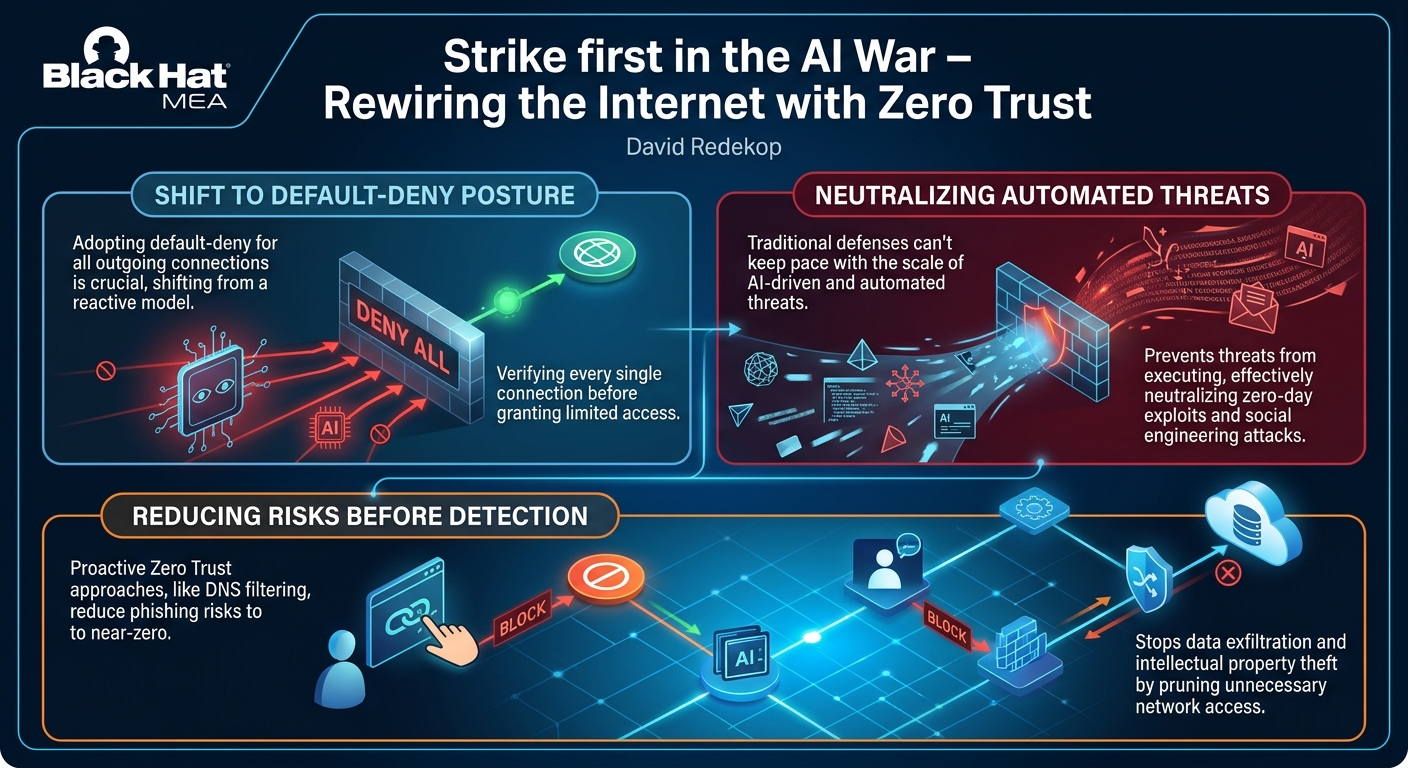
In an increasingly automated and AI-driven threat landscape, the traditional reactive security posture is proving insufficient. David Redekop, CEO and Founder of ADAMnetworks, presented a compelling case at Black Hat MEA for a paradigm shift: "Strike first in the AI War - Rewiring the Internet with Zero Trust." This talk argues that waiting to respond to cyber threats, especially those orchestrated by AI, is no longer a viable strategy. Instead, Redekop advocates for a default denial Zero Trust approach, powered by deep visibility and proactive controls like "don't talk to strangers" and Zero Trust DNS.
Key moments
- 0:00 Introduction: AI threats outpace traditional controls
- 4:30 The domain numbers game: 1% essential, 85% suspicious
- 8:00 Adversaries leverage AI faster than defenders
- 10:45 "What if": A new default-deny zero trust approach
- 14:30 Introducing Zero Trust Connectivity and Resolver
- 16:00 Seven key values of Zero Trust Connectivity
- 18:30 Real-world examples of DNS Harmony threat blocking
Strike first in the AI War - Rewiring the Internet with Zero Trust
Speakers: David Redekop, CEO & Founder, ADAMnetworks
Conference: Black Hat MEA
YouTube: https://www.youtube.com/watch?v=8SGgKGghptI
Overview
In an increasingly automated and AI-driven threat landscape, the traditional reactive security posture is proving insufficient. David Redekop, CEO and Founder of ADAMnetworks, presented a compelling case at Black Hat MEA for a paradigm shift: "Strike first in the AI War - Rewiring the Internet with Zero Trust." This talk argues that waiting to respond to cyber threats, especially those orchestrated by AI, is no longer a viable strategy. Instead, Redekop advocates for a default denial Zero Trust approach, powered by deep visibility and proactive controls like "don't talk to strangers" and Zero Trust DNS.
The core premise is to block threats before they can execute, drastically reducing phishing risks and restoring sovereign control over data and network traffic. Redekop detailed how current defensive strategies are outmatched by the rapid adoption of AI by adversaries, leading to persistent vulnerabilities and escalating cybercrime costs. His presentation offered a vision for a rewired internet where every network connection is verified, resource-bound, and time-bound, effectively neutralizing zero-day exploits and preventing data exfiltration at its earliest stages. This article delves into the critical insights and technical solutions proposed to achieve this proactive security stance.
Background
▶ Watch: Introduction: AI threats outpace traditional controls (0:00)
The current state of cyber security is characterized by a persistent and accelerating growth in threats, despite significant investments in defensive technologies. Redekop highlighted several alarming trends that underscore the urgency for a new approach. Phishing, malware, and AI-generated malicious domains are growing "faster and faster than traditional controls can react" (00:00). This isn't a new problem; Redekop recalled believing 10 years ago that cybercrime would soon peak, yet "we still see this growth" (03:00-04:00). The cost of cybercrime continues to escalate, defying earlier predictions.
A significant contributor to this vulnerability is the infrastructure used by small to medium-sized businesses (SMBs), which power "80% of the world's economic engine" (02:00). Many of these regional internet service providers lack the infrastructure for easy multi-factor authentication (MFA) onboarding and still rely on outdated protocols like POP3 and IMAP, leaving them highly susceptible to compromise. Attackers are leveraging this vulnerability, automating everything from discovery to deception, often following complex frameworks like the MITRE ATT&CK matrix (04:00). A critical flaw in current defense strategies is that "exfiltration happens before we get to the respond phase" (04:00), indicating a fundamental failure in proactive protection.
The sheer scale of the internet also plays into the attackers' hands. With approximately one billion registered internet domain names, only 60% are active, and a mere 1% are essential for a broad range of businesses (05:00). For an individual enterprise, this figure drops to an almost imperceptible 0.15% (06:00). This means defenders are searching for threats in a vast ocean of irrelevant or malicious domains. Data from Infoblox suggests "85% of new domains are suspicious or malicious," while Interle reports "14 to 17% of domains registered in 2025 already show evidence of malicious behavior" (06:00). The number of maliciously registered domains grew "149% year-over-year" (06:00), indicating an uncontained problem. Furthermore, the Public Suffix List, which tracks registerable domain names, now exceeds 10,000 records, making comprehensive tracking a monumental challenge (08:00).
A critical factor exacerbating this situation is the asymmetric adoption of artificial intelligence. Adversaries have adopted AI "much faster than the defensive side" (08:00), making attacks "even more effective than our ability to detect" (08:00). Redekop cited the "very first report of AI orchestrated espionage" uncovered by Anthropic (08:00) as a stark warning, noting that capabilities once exclusive to nation-states are now accessible to anyone with a small budget. Bruce Schneier's wisdom was invoked: "Attacks always get better... Attackers have a natural advantage because they can concentrate their expertise on the one thing they're trying to attack while defenders have to protect against everything" (10:00). The disparity is quantified by a staggering "4,151% increase" in the offensive use of generative AI versus defensive deployment (10:00), highlighting the immense catching up required by defenders. Adding to the complexity, modern threats often bypass traditional malware, relying on social engineering to execute "PowerShell scripts" (13:00) or other legitimate tools, making detection even harder. Even visiting a typical news website can reveal dozens of unneeded DNS inquiries for "ads and trackers that don't serve you" (14:00).
Key Findings
▶ Watch: Adversaries leverage AI faster than defenders (8:00)
The central finding of Redekop's talk is that the prevailing reactive cybersecurity model is fundamentally broken in the face of automated and AI-driven threats. The attackers' natural advantage, coupled with the sheer volume of malicious or irrelevant internet infrastructure, necessitates a radical shift. The key solution proposed is Zero Trust Connectivity, built upon a default-deny-all approach for every outgoing network connection.
Redekop challenged the audience with a series of "what if" questions: What if connections were limited to only verified and known good destinations? What if all network states were resource-bound and time-bound? What if every TCP or UDP connection was accounted for before permission was granted, ideally at the nearest Layer 3 gateway, with or without endpoint agents (10:00-12:00)? The answer to these questions forms the foundation of Zero Trust Connectivity.
The talk highlighted that this proactive stance enables organizations to:
- Neutralize zero-days before they can even be detected (16:00).
- Prevent exfiltration of private data and intellectual property theft (17:00).
- Reduce phishing risks to "near zero," specifically "less than 1%" (17:00).
- Operate effectively with IoT and OT devices, often in an agentless manner (17:00).
- Provide shadow IT mitigation by controlling all network egress (17:00).
- Ensure sovereign custody over data and traffic, avoiding deep packet inspection or shipping traffic to external points of presence (18:00).
Redekop also noted that Microsoft, just two weeks prior at Ignite, announced the general availability of Zero Trust DNS, which uses a secure DNS client for Windows 11 Enterprise devices managed with Intune (14:00). This validation from a major industry player underscores the growing recognition of this proactive DNS-centric approach. ADAMnetworks’ own Zero Trust Resolver takes this concept further, effectively "rewiring the Internet" by treating every IP address as a stranger until explicitly verified and allowed for a short, defined period (15:00).
Technical Deep Dive
▶ Watch: "What if": A new default-deny zero trust approach (10:45)
The technical core of Redekop's solution lies in moving protective steps "lower in the OSI model" (12:00), specifically at Layer 2 and Layer 3, rather than solely relying on Layer 7 application security. This approach redefines network interactions from a default-allow to a default-deny posture for all outgoing connections.
The fundamental principles include:
- Default Deny All: Every outgoing network connection is denied by default (10:00).
- Verified Destinations Only: Connections are permitted only to destinations that are explicitly verified as known and good (11:00).
- Resource-bound and Time-bound States: All network states are constrained by resources and time, ensuring that even permitted connections are not open-ended (11:00).
- Connection Accountability: Every TCP or UDP connection is accounted for and granted explicit permission before being established (11:00).
- Gateway-level Enforcement: This enforcement occurs at the nearest Layer 3 gateway, offering flexibility with or without endpoint agents (11:00). While agents provide additional value, the core protection can be agentless, crucial for IoT/OT environments and shadow IT mitigation (17:00).
- Context-aware Protective DNS: Beyond organizational-wide protection, the system can narrow down controls to smaller groups, departments, roles, or even individual devices (12:00).
- Principle of Least Privilege: This foundational security concept is applied rigorously to all network traffic (12:00).
Redekop provided a practical example of this granular control: "What if something like GitHub was accessible in your company designated browser but not in PowerShell?" (13:00). This capability directly addresses modern, malware-less threats where social engineering can lead users to copy and paste malicious PowerShell scripts. Instead of detecting and shutting down an incident post-execution, the Zero Trust system prevents it "at execution attempt" (14:00).
The ADAMnetworks Zero Trust Resolver is presented as a concrete implementation of these principles. It operates on the premise that "every IP address is a stranger until and if that verified endpoint is allowed to even resolve that destination" (15:00). When a verified device requests to resolve a legitimate domain, the resolver dynamically creates a short-lived outbound allow rule for the corresponding IP addresses. This rule is automatically destroyed once its Time To Live (TTL) expires. This mechanism ensures that connections are only permitted for necessary resources, from authorized sources, and only for the duration they are actively needed (15:00-16:00).
Crucially, this system avoids the need for deep packet inspection, eliminating issues with technologies like Encrypted Client Hello (ECH) or reliance on Server Name Indication (SNI). Instead, permissions are granted or denied based on the source query, maintaining privacy and sovereign control over traffic (18:00).
Another technical component discussed is DNS Harmony, which involves "aggregated DNS threat intelligence in real time" (18:00). Redekop demonstrated this by querying a problematic Canadian website (OCS) using multiple public protective resolvers: Cloudflare for Families, Canadian Shield, Agile, and Quad9. The results showed that different resolvers blocked different threats, illustrating the variable coverage of even reputable services (18:00-19:00). He also highlighted a zero-day threat uncovered last week, where only Quad9 among the public resolvers was blocking the domain (19:00), and how Adguard blocked third-party ad networks that others missed (20:00). This variability underscores the strength of a default-deny approach: if a destination isn't explicitly known and allowed, it's blocked, regardless of whether a particular threat intelligence feed has flagged it. This renders traditional Indicators of Compromise (IOCs) largely irrelevant, as threats are prevented "before they can be detected" (20:00) by simply not being on the allow list.
Demo / Proof of Concept
▶ Watch: Seven key values of Zero Trust Connectivity (16:00)
David Redekop illustrated the practical application of the Zero Trust Resolver with a clear, concise demonstration (or a simulated one based on screenshots) of its core functionality. The scenario involved attempting to access a well-known, legitimate website.
First, Redekop attempted to ping an IP address owned by Akamai, which hosts example.com. The initial attempt resulted in a "destination unreachable" message, indicating that the system, under its default-deny posture, refused to establish a connection to an unknown IP address (16:00).
Next, from a "verified device" with permission to visit example.com, he performed a DNS resolution using the dig command for example.com. This query was allowed by the Zero Trust Resolver. Upon successful resolution, the system dynamically created a temporary, short-lived outbound allow rule for the IP addresses associated with example.com.
Following this, Redekop was able to successfully ping the Akamai IP address. He noted that this connection would remain open only for the duration of its Time To Live (TTL), after which it would be "shut down again" (16:00). This demonstration effectively showcased how the Zero Trust Resolver dynamically grants permissions only after a verified DNS query, and only for a limited time, effectively implementing the "don't talk to strangers" principle at the network layer.
Defensive Implications
▶ Watch: Real-world examples of DNS Harmony threat blocking (18:30)
The implications of adopting a Zero Trust Connectivity model are profound for defenders, necessitating a fundamental shift from reactive incident response to proactive threat prevention.
- Proactive Threat Neutralization: Defenders must move beyond detection and response. By implementing default-deny-all policies and verifying every outgoing connection, organizations can "neutralize zero days before they can even be detected" (16:00). This paradigm shift prevents threats from executing in the first place, rather than attempting to contain them after a breach.
- Drastic Reduction in Attack Surface: Given that only a minuscule fraction (0.15%) of internet domains are essential for any given enterprise, defenders can drastically reduce their attack surface. By explicitly allowing only known-good destinations, the vast majority of malicious or irrelevant internet infrastructure is automatically blocked, including AI-generated malicious domains and emerging threats (00:00).
- Elimination of Exfiltration and IP Theft: A primary benefit is the pre-emptive prevention of data exfiltration and intellectual property theft. If unauthorized command-and-control (C2) channels or data staging servers are never allowed to resolve or connect, sensitive information cannot leave the network (17:00).
- Near-Zero Phishing Risk: The Zero Trust DNS approach can reduce phishing risks to "near zero" (less than 1%) (17:00). Even if a user falls victim to a phishing attempt and clicks a malicious link, the attempt to resolve or connect to the attacker's domain will be denied, preventing the next stage of the attack.
- Comprehensive Coverage for IoT/OT and Shadow IT: The ability to implement an agentless solution is critical for securing IoT (Internet of Things) and OT (Operational Technology) environments, which often cannot accommodate endpoint agents. This also provides effective mitigation for shadow IT by controlling all network egress regardless of device management status (17:00).
- Enhanced Visibility and Actionable Intelligence: Instead of sifting through logs of detected incidents, Security Operations Centers (SOCs) gain "the visibility to see the threats that were prevented" (12:00). This shifts focus from post-mortem analysis to understanding the efficacy of preventative controls, streamlining incident response efforts by reducing the sheer volume of events requiring investigation.
- Sovereign Control and Privacy: Organizations, especially in regions prioritizing data sovereignty, can maintain complete custody over their traffic. Since the system operates by verifying DNS queries and dynamically creating allow rules, there is "no deep packet inspection" and no need to decrypt traffic or send it to external points of presence (18:00).
- Moving Protection Lower in the OSI Model: Defenders should advocate for and implement security controls at lower layers (Layer 2/3) of the OSI model. While Layer 7 application security remains vital, foundational network-level protection provides a more robust and pervasive defense against a broader range of threats, including malware-less attacks and those bypassing traditional application-layer controls (12:00-13:00).
Key Takeaways
- Traditional reactive security models are failing: The rapid automation and adoption of AI by adversaries, coupled with an explosion of malicious domains, mean waiting to respond to threats is no longer a viable strategy.
- The vast majority of the internet is irrelevant or malicious: For any given enterprise, less than 0.15% of all registered domains are truly essential. This vast, unneeded attack surface needs to be aggressively pruned.
- Zero Trust Connectivity is the imperative: Adopting a default-deny-all posture for all outgoing network connections is crucial. Every connection must be explicitly verified, resource-bound, and time-bound.
- Zero Trust DNS resolvers are key enablers: Solutions like ADAMnetworks' Zero Trust Resolver or Microsoft's Zero Trust DNS dynamically allow connections only for verified, known-good destinations from authorized sources, for a limited time. This effectively implements the "don't talk to strangers" principle.
- Proactive defense neutralizes threats before execution: This approach drastically reduces phishing risks to near-zero, prevents data exfiltration, and neutralizes zero-day exploits by blocking them at the earliest possible stage, often before detection.
- Shift protection lower in the OSI model: Moving security controls to Layer 2/3 provides foundational protection, making modern, malware-less attacks and AI-orchestrated espionage significantly harder to execute effectively.
About the Speaker(s)
David Redekop is the CEO and Founder of ADAMnetworks. With a background in the cybersecurity defense space, Redekop has observed the persistent growth of cybercrime over the past decade, recognizing the need for innovative and proactive security solutions (03:00). He is a proponent of the Zero Trust model, particularly its application at the network's foundational layers to combat evolving threats. Redekop delivered this talk at Black Hat MEA, marking his first visit to Riyadh, where he expressed appreciation for the local culture and hospitality (00:00).
Reviews
Dr. Zero (Offensive Security Researcher) — WEAK
This is a vendor pitch dressed up as a conference talk. Redekop spends 20 minutes building a threat landscape everyone already knows, then pivots to selling ADAMnetworks' Zero Trust DNS product. The 'technical deep dive' is a ping demo. Nothing here couldn't be gleaned from the product page.
Heather Calloway (CISO) — WEAK
This is a vendor pitch dressed as thought leadership. The 'rewire the internet' framing is grandiose, the threat statistics are recycled, and the solution conveniently maps to the speaker's product. There's a kernel of a defensible idea—default-deny DNS—but it's buried under marketing language and overclaimed impact.
→ Top-rated talks at Black Hat Middle East & Africa 2025 (Executive Summit)
All talks from Black Hat Middle East & Africa 2025 (Executive Summit)