Exercising the CCPA Opt-out Right on Android: Legally Mandated but Practically Challenging
Sebastian Zimmeck (Paper author · Wesleyan University), Nishant Aggarwal (Paper author · Wesleyan University), Zachary Liu (Paper author · Wesleyan University), Sage Altman (Paper author · Wesleyan University), Konrad Kollnig (Paper author · Law & Tech Lab, Maastricht University)
Privacy Enhancing Technologies Symposium (PETS) 2026 · Day 2 · Caribou
Overview
This talk, presented by Sebastian Zimmeck and Konrad Kollnig, delves into the significant disconnect between legal mandates for consumer privacy and their practical implementation within the Android mobile ecosystem. Specifically, it examines the California Consumer Privacy Act (CCPA) and its provision for an opt-out right, particularly as it relates to the Global Privacy Control (GPC) signal. The researchers from Wesleyan University and Maastricht University highlight the challenges users face in exercising their legally enshrined rights to prevent the sale or sharing of their personal information, especially on mobile applications.
Key moments
- 0:00 Introduction to Global Privacy Control (GPC) and CCPA
- 2:00 GPC vs. Do Not Track: Key difference is legal support
- 3:50 Study's two research questions on Android app opt-out
- 4:40 Shocking finding: 52% of top Android apps lack CCPA opt-out
- 5:50 GPC signal has minimal impact on app data processing
- 8:00 Proposing to repurpose Android's existing Ad ID setting for GPC
- 9:00 2027 browser GPC mandate, but mobile OS mandate removed
Exercising the CCPA Opt-out Right on Android: Legally Mandated but Practically Challenging
Speakers: Sebastian Zimmeck (Paper author, Wesleyan University); Nishant Aggarwal (Paper author, Wesleyan University); Zachary Liu (Paper author, Wesleyan University); Sage Altman (Paper author, Wesleyan University); Konrad Kollnig (Paper author, Law & Tech Lab, Maastricht University)
Conference: PETS
YouTube: https://www.youtube.com/watch?v=CoI0gE8O5XM
Overview
This talk, presented by Sebastian Zimmeck and Konrad Kollnig, delves into the significant disconnect between legal mandates for consumer privacy and their practical implementation within the Android mobile ecosystem. Specifically, it examines the California Consumer Privacy Act (CCPA) and its provision for an opt-out right, particularly as it relates to the Global Privacy Control (GPC) signal. The researchers from Wesleyan University and Maastricht University highlight the challenges users face in exercising their legally enshrined rights to prevent the sale or sharing of their personal information, especially on mobile applications.
The core of their investigation revolves around two critical questions: how Android app users can exercise their CCPA opt-out right, and whether sending a GPC signal actually results in any observable change in data handling practices. Their findings reveal a troubling landscape where a substantial number of top Android apps either offer no clear mechanism for opting out or demonstrably fail to honor GPC signals, rendering legal protections largely ineffective in practice. This research is crucial for understanding the current state of privacy compliance in mobile advertising and data brokering, offering vital insights for policymakers, developers, and privacy advocates alike.
The implications of this research extend beyond California, as GPC is gaining traction globally, with similar legislative efforts in the EU and other US states. The talk underscores the urgent need for standardized, robust, and enforceable mechanisms to ensure that privacy rights are not merely theoretical but practically achievable for everyday users. It particularly points to the role of platform providers like Google in facilitating compliance by integrating GPC directly into the operating system.
Background
▶ Watch: Introduction to Global Privacy Control (GPC) and CCPA (0:00)
The landscape of digital privacy has been significantly reshaped by landmark legislation such as the General Data Protection Regulation (GDPR) in Europe and the California Consumer Privacy Act (CCPA) in the United States. These laws aim to grant individuals greater control over their personal data, including the right to opt out of the sale or sharing of their information. However, the practical enforcement of these rights often falls short, leading to user fatigue from constant consent banners and complex privacy settings.
In response to these challenges, the concept of Global Privacy Control (GPC) emerged. GPC is a proposed technical standard designed to allow users to express their privacy preferences once, typically through a browser setting or an operating system-level control, which then automatically communicates this preference to websites and applications. The idea is to automate the opt-out process, acting like a "little robot" that pushes the opt-out button on behalf of the user, thereby simplifying compliance and enhancing user autonomy. Unlike its predecessor, Do Not Track (DNT), which largely failed due to a lack of legal backing and industry adoption, GPC is explicitly supported by law in several jurisdictions, including California, Colorado, and Connecticut, with similar initiatives underway in the EU. The CCPA, for instance, specifically states that consumers have a right to opt out on a device, whether through a user interface or by sending a signal, and the effect should be the same.
Technically, GPC operates by sending an HTTP header (Sec-GPC: 1) or setting a DOM property (navigator.globalPrivacyControl = true) to signal a user's opt-out preference. This signal is intended to be recognized and respected by websites and applications, prompting them to adjust their data processing practices accordingly. The researchers involved in this talk have been actively working on standardizing GPC at the W3C (World Wide Web Consortium) for five years, anticipating that full standardization might take another two to three years. The goal is to embed GPC into the fundamental structure of the web, ensuring widespread and consistent adoption rather than it being an optional add-on. The problem that GPC seeks to solve is the asymmetry of power between data subjects and data collectors, where the onus is currently on the individual to navigate a labyrinth of settings and policies to protect their privacy, despite legal rights to the contrary. This talk investigates the efficacy of GPC and other opt-out mechanisms specifically within the Android app ecosystem, where the complexities of third-party data sharing are particularly pronounced.
Key Findings
▶ Watch: Study's two research questions on Android app opt-out (3:50)
The research presented in this talk focused on two central questions concerning the exercise of CCPA opt-out rights on Android applications: first, how users can claim their opt-out right within these apps, and second, whether sending a Global Privacy Control (GPC) signal actually leads to any tangible changes in data handling. The findings paint a stark picture of non-compliance and practical barriers to privacy.
For their first question, the researchers analyzed 100 top Android applications to identify available opt-out mechanisms. The results were alarming:
- 45% of the apps provided only a link to a privacy policy, with no direct in-app setting or user interface to exercise an opt-out right. This forces users to navigate potentially complex and lengthy documents, often on external websites, to understand and attempt to invoke their rights.
- Even more concerning, 7% of the apps had no privacy policy link whatsoever, offering absolutely no discernible way for users to exercise their opt-out right.
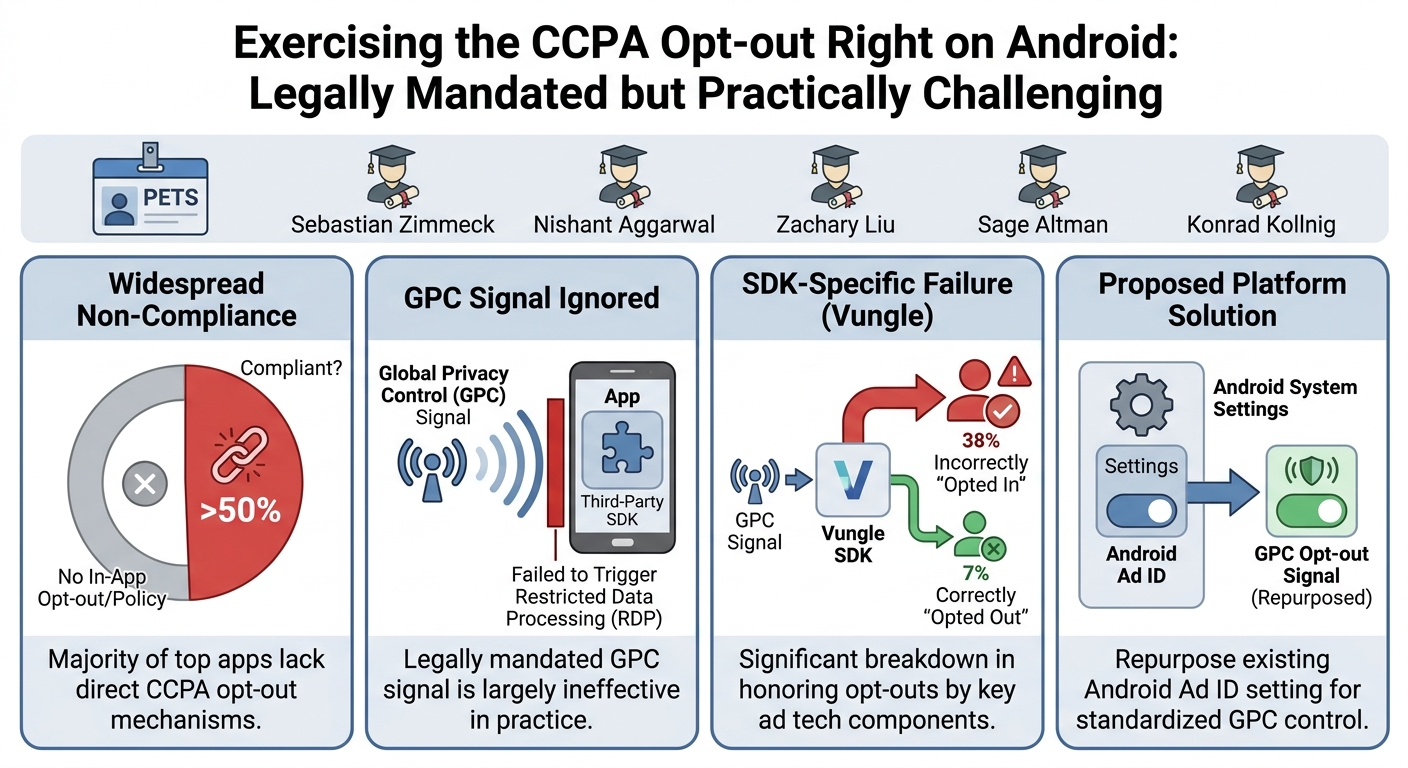
- Cumulatively, 52% of the examined apps offered no practical means for users to opt out of the sale or sharing of their personal information directly within the application, effectively rendering their CCPA rights moot. This statistic alone highlights a widespread failure among app developers to meet basic legal requirements.
Regarding the second question—the effectiveness of the GPC signal—the researchers conducted an experimental study. They simulated user behavior by injecting a GPC signal into the network traffic of these apps. The expected behavior, particularly for third-party data processors like Google, is that a first-party app receiving a GPC signal would translate this into a specific privacy preference, such as Google's Restricted Data Processing (RDP) flag. RDP is designed to inform Google that data from a particular user should be processed with restrictions, acknowledging their opt-out right. The findings, however, showed minimal impact:
- Overall, "not a whole lot" happened. The GPC signal largely failed to trigger the expected RDP flag or any other observable change in data processing for most third-party services.
- The study also examined the existing Android system-wide opt-out setting (which has been present for 15 years) and found that it similarly "doesn't really do anything" in practice, with no observable impact on data sharing.
- A specific deep dive into the Vungle SDK, a popular advertising SDK, revealed particularly problematic results. Despite the researchers explicitly attempting to opt out, 38% of apps using the Vungle SDK claimed the user was still opted in. Only a mere 7% of apps correctly registered the opt-out preference. This specific example underscores a fundamental breakdown in how opt-out signals are processed and honored by third-party ad tech components.
These findings collectively demonstrate a significant gap between the legal intent of privacy regulations like CCPA and the actual user experience on Android. The combination of absent or inadequate opt-out UIs and the widespread disregard for automated GPC signals means that, for a majority of popular apps, legally mandated privacy rights remain practically unenforceable.
Technical Deep Dive
▶ Watch: Shocking finding: 52% of top Android apps lack CCPA opt-out (4:40)
The technical core of this research revolves around the mechanics of Global Privacy Control (GPC) and its interaction with the Android app ecosystem, particularly in the context of third-party advertising and data processing. GPC is designed to be a clear, unambiguous signal of a user's opt-out preference, communicated either via an HTTP header (Sec-GPC: 1) for web-based interactions or a DOM property (navigator.globalPrivacyControl = true) for JavaScript environments. The expectation, under laws like the CCPA, is that any entity receiving this signal must honor the user's request not to sell or share their personal information.
The researchers' methodology involved a sophisticated man-in-the-middle (MITM) attack scenario to rigorously test GPC compliance. They intercepted network traffic from 100 Android applications and programmatically injected the GPC signal into the outbound requests. This allowed them to precisely control the presence of the GPC signal and observe the subsequent behavior of the apps and their integrated third-party services.
The ideal technical flow, as envisioned by GPC and mandated by regulations, is as follows:
- A user enables GPC in their browser or operating system settings.
- When the user interacts with a first-party application or website, the GPC signal (HTTP header or DOM property) is automatically included in the communication.
- The first-party app/website receives this signal.
- Crucially, the first-party is then responsible for translating this user preference into a signal that its integrated third-party services can understand and respect. For example, Google provides a mechanism called Restricted Data Processing (RDP). An app developer, upon receiving a GPC signal, should enable RDP when interacting with Google's ad services (e.g., AdMob, Google Analytics). This tells Google to limit its processing of that user's data to comply with their opt-out.
However, the research revealed a significant breakdown in this intended flow. After injecting the GPC signal, the researchers monitored the outgoing traffic for evidence that the apps or their third-party SDKs were adjusting their behavior. They looked for the activation of RDP or similar privacy flags. The results were largely negative:
- Lack of RDP Activation: For the vast majority of apps, the GPC signal did not lead to the activation of Google's RDP flag. This indicates that app developers are either not configured to detect and translate the GPC signal, or they are actively choosing not to honor it by informing their ad partners.
- Pre-existing Android Opt-out: The study also evaluated the effectiveness of the Android operating system's built-in advertising opt-out setting, which has been available for approximately 15 years. Despite its long-standing presence, this setting also showed no observable impact on tracking or data sharing in the tested apps. This suggests a systemic failure at both the platform and application levels to respect user privacy preferences.
- Vungle SDK Specifics: The investigation into the Vungle SDK, a widely used mobile advertising SDK, provided a concrete example of non-compliance. When the GPC signal was sent, a staggering 38% of apps using Vungle still reported the user as "opted in" for data sharing. Only 7% correctly indicated an "opted out" status. This specific finding highlights that even when a GPC signal is technically delivered, the internal logic of advertising SDKs often fails to correctly interpret or enforce it. This could be due to buggy implementations, intentional disregard, or a lack of clear guidance from SDK providers on how to integrate GPC compliance.
The technical implications are profound: without robust implementation at the application layer and strict enforcement by third-party SDKs, GPC remains an aspirational standard rather than an effective privacy control. The current state suggests that the burden of compliance is not being adequately met by the ecosystem's key players, leaving users' legally mandated rights unenforced.
Demo / Proof of Concept
▶ Watch: Proposing to repurpose Android's existing Ad ID setting for GPC (8:00)
While the talk did not feature a live, interactive "demo" in the traditional sense, the entire research methodology served as a robust proof of concept (PoC) to demonstrate the practical challenges of exercising CCPA opt-out rights on Android. The researchers' experimental setup, involving the injection of Global Privacy Control (GPC) signals into app traffic, effectively acted as a controlled demonstration of GPC's intended function and the real-world response (or lack thereof) from mobile applications and their integrated advertising SDKs.
The core of this PoC was the use of a man-in-the-middle (MITM) technique. By intercepting the network communications between the Android apps and their backend servers or third-party ad services, the researchers were able to programmatically inject the Sec-GPC: 1 HTTP header. This simulated a user having GPC enabled at the operating system or browser level, sending the legally mandated opt-out signal. The subsequent observation of the modified network traffic allowed the team to assess whether apps were honoring this signal by, for instance, activating Google's Restricted Data Processing (RDP) flag or adjusting their data collection and sharing practices.
Specifically, the demonstration of how the Vungle SDK responded (or failed to respond) to the GPC signal was a critical part of this PoC. By showing that 38% of apps using Vungle still reported users as opted-in despite the GPC signal, the researchers provided concrete, quantifiable evidence of non-compliance. This wasn't merely theoretical; it was a direct observation of how a prevalent ad tech component practically disregards a legally significant privacy signal. This practical demonstration underscores the urgency for better technical integration and enforcement mechanisms to make privacy regulations effective on mobile platforms.
Defensive Implications
▶ Watch: 2027 browser GPC mandate, but mobile OS mandate removed (9:00)
The findings of this research carry significant defensive implications for various stakeholders within the mobile ecosystem: users, app developers, platform providers, and regulators. The current state of non-compliance and the ineffectiveness of existing opt-out mechanisms necessitate a multi-faceted approach to bolster consumer privacy.
For Platform Providers (e.g., Google):
The most impactful defensive measure could come from platform providers like Google. The research highlights that Android already has an existing system-wide opt-out setting for advertising, which has been in place for 15 years but is largely ineffective. The speakers propose a straightforward, yet powerful, solution: repurpose the existing Android Ad ID setting to also function as a GPC signal. This would involve a minimal technical change—"like a one-string change on Android"—leveraging existing infrastructure. By renaming this setting to explicitly reflect GPC and ensuring it broadcasts the GPC signal, Google could empower millions of users to exercise their legal rights effectively and uniformly across the Android ecosystem. This would shift the burden of compliance from individual app developers to the platform, ensuring a baseline level of privacy protection.
For App Developers:
App developers must take proactive steps to ensure their applications honor GPC signals and provide clear opt-out mechanisms.
- Implement GPC Recognition: Apps that use webviews or make direct HTTP requests should be configured to detect and respect the
Sec-GPC: 1HTTP header ornavigator.globalPrivacyControl = trueDOM property. - Integrate with Third-Party SDKs: Developers need to ensure that the third-party advertising and analytics SDKs they integrate (like Vungle, Google AdMob, etc.) are correctly configured to receive and act upon GPC signals. This includes activating Restricted Data Processing (RDP) or equivalent flags when a GPC signal is present. Developers should actively pressure SDK providers for clear documentation and robust GPC compliance.
- Provide Clear Opt-Out UIs: Beyond GPC, apps should offer intuitive and easily accessible in-app user interfaces for exercising opt-out rights, rather than merely linking to lengthy privacy policies. This aligns with legal requirements for transparent and accessible privacy controls.
- Regular Audits: Developers should regularly audit their apps and their integrated third-party services to verify that opt-out mechanisms, including GPC, are functioning as intended and are compliant with relevant privacy laws.
For Regulators:
The research provides strong evidence that current enforcement mechanisms are insufficient. Regulators in jurisdictions with GPC mandates (e.g., California, Colorado, Connecticut, and potentially the EU) should:
- Increase Enforcement: Actively enforce GPC compliance, imposing penalties on non-compliant apps and platform providers. The widespread non-compliance identified in this study suggests that current enforcement is lacking.
- Provide Clear Guidance: Issue clear, actionable guidance for app developers and platform providers on how to technically implement and legally honor GPC.
- Mandate Platform-Level GPC: Consider mandating that mobile operating systems (Android, iOS) integrate GPC directly at the platform level, similar to the provisional law that was considered but later removed. The current requirement for browsers to have a GPC setting by January 2027 should be extended to mobile OS.
For Users:
While the burden of compliance primarily rests with industry, users should be aware of these challenges:
- Enable GPC: If available, users should enable GPC in their browsers and any supporting operating system settings.
- Exercise Direct Opt-Outs: Where GPC is not honored, users may still need to resort to manual opt-out processes within apps or through company websites, though this research shows these are often inadequate.
- Advocate for Stronger Protections: Support privacy advocacy groups and policies that push for robust, platform-level privacy controls and stronger enforcement of existing laws.
The key defensive strategy is to move beyond fragmented, app-specific opt-out mechanisms towards a standardized, platform-level GPC implementation, enforced by both technology and regulation, thereby making legally mandated privacy rights practically achievable for every user.
Key Takeaways
- Widespread Non-Compliance: Over half (52%) of top Android apps either provide no in-app mechanism for users to exercise their CCPA opt-out rights or lack any privacy policy link whatsoever, rendering legal rights practically unenforceable.
- GPC Signal Largely Ignored: The Global Privacy Control (GPC) signal, despite being legally mandated in several jurisdictions, is largely ineffective in practice on Android apps, failing to trigger observable changes in data processing like Google's Restricted Data Processing (RDP).
- Existing Android Opt-out is Ineffective: The long-standing, system-wide Android opt-out setting for advertising, present for 15 years, also has no observable impact on data sharing, highlighting a systemic failure at the platform level.
- Ad Tech SDKs are Non-Compliant: Specific ad tech components, such as the Vungle SDK, actively disregard GPC signals, with 38% of apps using it claiming users were opted-in despite the signal, demonstrating a critical breakdown in third-party compliance.
- Urgent Need for Platform-Level Integration: A simple and highly effective solution would be for Google to repurpose the existing Android Ad ID setting into a GPC control, standardizing and centralizing the opt-out mechanism across the operating system.
- Enforcement and Standardization are Crucial: The research underscores the critical need for stronger regulatory enforcement of GPC and continued efforts to standardize GPC at the W3C to ensure that privacy rights are not just legal theories but practical realities for consumers.
About the Speaker(s)
The talk was primarily presented by Sebastian Zimmeck and Konrad Kollnig. Sebastian Zimmeck is affiliated with Wesleyan University, where he is a paper author on this research. Konrad Kollnig is a paper author from the Law & Tech Lab at Maastricht University, bringing expertise in the legal and regulatory aspects of privacy. The full research paper also lists Nishant Aggarwal, Zachary Liu, and Sage Altman as paper authors, all from Wesleyan University. Their collective work focuses on the intersection of technology, law, and privacy, particularly in the context of mobile applications and web standards.
Reviews
Dr. Zero (Offensive Security Researcher) — SOLID
They MITM'd 100 Android apps, injected the GPC privacy header, and proved that ad-tech SDKs like Vungle completely ignore it. Solid measurement study that proves privacy legislation is just compliance theater until someone actually enforces it at the code level.
Heather Calloway (CISO) — MUST SEE
This research proves that standard Android ad SDKs routinely ignore CCPA opt-out signals, exposing the consumer apps that host them to immediate regulatory action. If you have a B2C app in your portfolio, your General Counsel and privacy teams need to see this immediately to adjust how you audit mobile vendor compliance.
→ Top-rated talks at Privacy Enhancing Technologies Symposium (PETS) 2026
All talks from Privacy Enhancing Technologies Symposium (PETS) 2026