Managing complexity
Fredrik Strömberg (Co-CEO · Mullvad VPN)
Privacy Enhancing Technologies Symposium (PETS) 2026 · Day 3 · Moose
Overview
In this keynote address at PETS, Fredrik Strömberg, Co-CEO of Mullvad VPN and Head of Research at the Amagicom group, dissects the pervasive challenge of managing complexity in the design and construction of trustworthy computer systems. Drawing from Mullvad's 17-year journey in the fight against mass surveillance and censorship, Strömberg argues that while complexity is an inevitable byproduct of advanced technology, it is the management of this complexity that determines a system's security, privacy, and ultimately, its trustworthiness. The talk transcends typical technical discussions, weaving in philosophical models of strategy, creativity, and human interaction, demonstrating how these abstract concepts directly inform robust system design.
Key moments
- 0:00 Welcome and Mullvad's vision
- 4:20 The problem is managing complexity
- 10:00 Separating creative and analytical discussions
- 16:00 Divergence of intended and actual behavior
- 29:00 System Transparency and Sigsum transparency log
- 32:00 Using measured boot as key derivation
- 37:00 Mullvad's marketing activism against surveillance
Managing complexity
Speakers: Fredrik Strömberg, Co-CEO, Mullvad VPN
Conference: PETS
YouTube: https://www.youtube.com/watch?v=FZy20hw4uok
Overview
In this keynote address at PETS, Fredrik Strömberg, Co-CEO of Mullvad VPN and Head of Research at the Amagicom group, dissects the pervasive challenge of managing complexity in the design and construction of trustworthy computer systems. Drawing from Mullvad's 17-year journey in the fight against mass surveillance and censorship, Strömberg argues that while complexity is an inevitable byproduct of advanced technology, it is the management of this complexity that determines a system's security, privacy, and ultimately, its trustworthiness. The talk transcends typical technical discussions, weaving in philosophical models of strategy, creativity, and human interaction, demonstrating how these abstract concepts directly inform robust system design.
Strömberg's presentation highlights Mullvad's foundational commitment to privacy, exemplified by features like RAM-only servers, anonymous payment options, and a no-logs audit. He emphasizes that the goal is to make mass surveillance and censorship ineffective, not just for individual benefit, but for the net positive impact on society. The talk serves as a profound reflection on the evolution of security engineering, from early VPN implementations to cutting-edge research in open-source silicon, hardware roots of trust, and system transparency.
The core message resonates deeply within the privacy and security communities: as systems grow more intricate, the divergence between intended behavior and actual behavior inevitably increases, leading to bugs and expanded attack surfaces. Strömberg presents a holistic framework for mitigating this divergence, advocating for the strategic application of well-defined abstractions, hardware defenses, cryptographic defenses, and a deep understanding of the entire supply chain. His insights are not merely theoretical but are grounded in Mullvad's practical experience of pioneering solutions like WireGuard support, post-quantum secure tunnels, and innovative transparency logs like Sigsum.
Background
▶ Watch: Welcome and Mullvad's vision (0:00)
The genesis of Mullvad VPN in 2008 was a direct response to the Swedish Parliament's approval of a law on mass surveillance. Co-founders Fredrik Strömberg and Daniel Berntsson viewed their endeavor as a form of "direct political action through entrepreneurship," aiming to build a profitable business that could actively counter government overreach and protect fundamental freedoms. This foundational motivation underscored an early realization: trustworthiness in VPNs is inextricably linked to trust, security, and privacy. The central problem they sought to address was how to demonstrate competence and consistent values over the long term, thereby building organizational trustworthiness that transcends mere assertions.
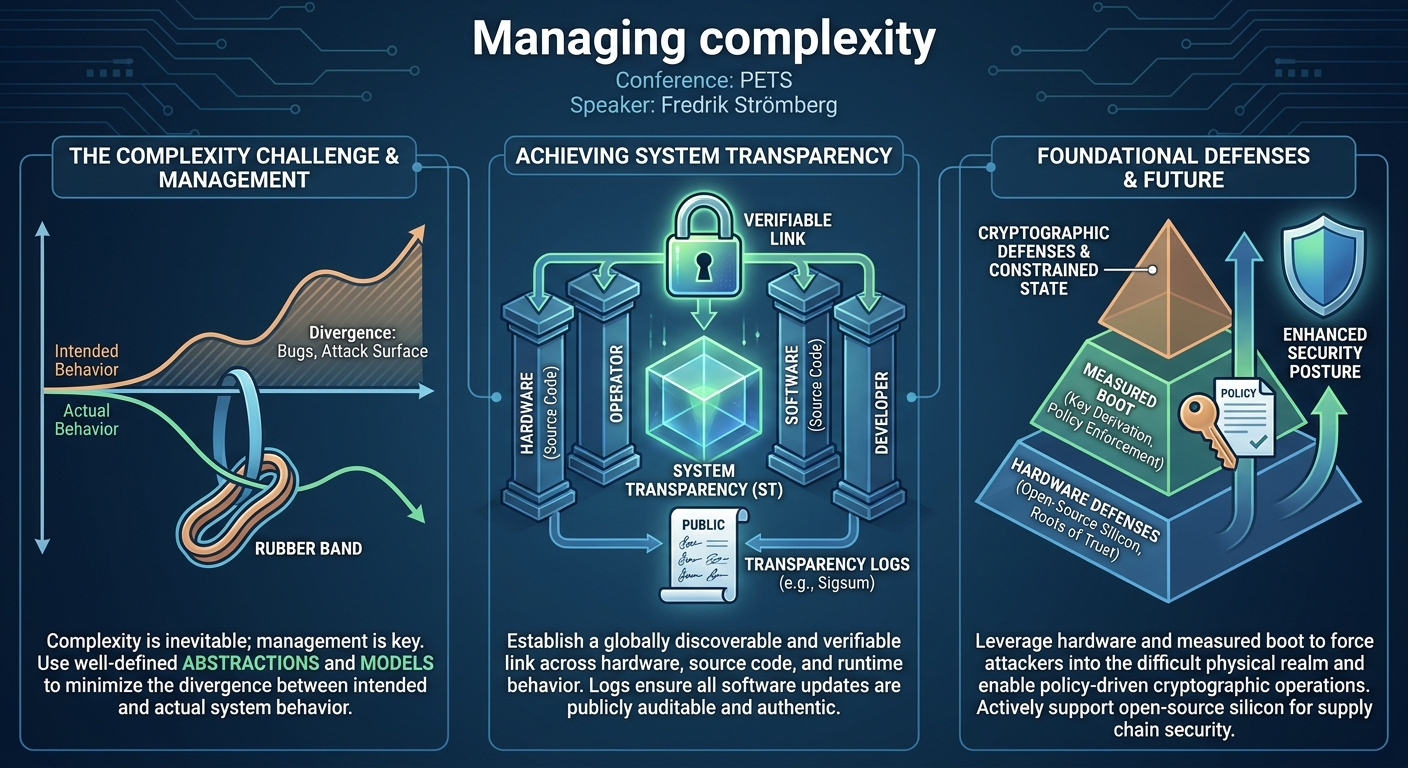
Strömberg posits that the problem in modern computing is not complexity itself, but the difficulty in managing it. As systems become more powerful, performant, and feature-rich, their underlying complexity increases exponentially. This complexity inevitably leads to a gap between what a system is intended to do and what it actually does, creating vulnerabilities and attack surfaces. To bridge this gap, Strömberg advocates for the deliberate definition and application of abstractions and models. These "maps of the territory" are critical tools for emphasizing what is important, hiding irrelevant details, and providing useful frameworks for understanding and solving problems across various contexts.
The talk builds upon a philosophical approach to problem-solving, emphasizing the utility of viewing challenges from multiple perspectives, much like how two eyes provide depth perception. This approach is applied to everything from organizational dynamics to hardware design. Strömberg highlights the importance of understanding human biases, fostering high-trust relationships, and distinguishing between creative and analytical discussions—all of which, he argues, directly influence the success of technical projects. This multidisciplinary perspective forms the bedrock for Mullvad's quest to build more trustworthy systems, specifically by tackling the inherent complexities of hardware, software, and the human elements involved in their creation and operation.
Key Findings
▶ Watch: Separating creative and analytical discussions (10:00)
Strömberg's talk presents several key findings and overarching principles derived from Mullvad's extensive experience:
- Complexity is Inevitable, Management is Key: The fundamental insight is that complexity in computer systems will continue to increase due to demands for performance, features, and efficiency. The critical challenge is not to eliminate complexity, which is often impossible, but to develop effective strategies and tools for managing it to prevent systems from becoming unnecessarily complicated or insecure.
- The Power of Abstractions and Models: Effective problem-solving hinges on defining the "right abstractions" or "models." These are conceptual frameworks that simplify reality, highlight essential aspects, hide irrelevant details, and remain useful across different contexts and over time. Strömberg provides a list of models he frequently employs, including strategy, creativity, and various system design paradigms.
- Divergence of Intended and Actual Behavior: As system complexity grows, the gap between intended behavior and actual behavior widens. This delta represents mistaken assumptions, bugs, and the system's attack surface. The goal of trustworthy system design is to minimize this divergence through robust "rubber bands" that keep the two lines together.
- A Four-Pillar Trust Model: At its limit, trust must be placed in four fundamental entities: the hardware, the operator who provisions it, the software, and the developer who provides the source code. This model forms the basis for designing systems where each pillar can be cryptographically linked and verified.
- Evaluation Criteria for Trustworthy Designs: Strömberg outlines a short but powerful checklist for evaluating new designs:
- Hardware Defenses: Leveraging physical properties to force attackers into the more difficult physical realm.
- Cryptographic Defenses: Employing quantifiable security mechanisms (e.g., AES strength).
- Constraining the Reachable State Space: Designing systems such that certain classes of bugs or undesirable behaviors are impossible to express.
- Distributing Trust Assumptions: Avoiding single points of failure by requiring multiple independent entities for trust.
- Understanding Spec, Implementation, and Supply Chain: A thorough grasp of the entire ecosystem.
- System Transparency (ST): This is a cornerstone concept, defined as the existence of a globally discoverable and verifiable link between a system's hardware source code and runtime behavior. It aims to cryptographically connect every phase of hardware and software development and deployment, from initial intent to the running system.
- Measured Boot as a Key Derivation Mechanism: A novel application where the boot process, by measuring successive stages, can be used to derive cryptographic keys. This allows for conditional signing, where a hardware token (like the Tillitis T-Key) only performs actions if the measured boot state meets specific, transparently verifiable criteria.
- Sigsum for Global Discoverability: Sigsum is presented as a specialized transparency log that provides not only authenticity (who signed it) but also global discoverability (which signatures exist for a given public key). This allows for security models where software updates are only accepted if their signatures are publicly logged and verifiable.
These findings collectively illustrate a comprehensive, multi-layered approach to building systems that can withstand sophisticated attacks, even in the face of escalating complexity and persistent surveillance threats.
Technical Deep Dive
▶ Watch: Divergence of intended and actual behavior (16:00)
Strömberg's talk delves into several specific technical projects and conceptual frameworks that exemplify Mullvad's approach to managing complexity and building trustworthy systems.
At the heart of his philosophy is the idea of connecting the intent of a system designer to its running behavior through a series of deterministic transformations. The process moves from intent (in the brain) to formalization (blueprint, Verilog, source code), then to machine-usable artifacts, and finally to the running system. Strömberg emphasizes that while the latter three stages are deterministic (compilers, synthesizers, place and route), the crucial gap lies between human intent and its formalization. This is where formal languages, abstractions, and strategies are vital to ensure what is expressed matches what was truly intended. The subsequent stages, from formalization to the running system, can then be cryptographically linked using techniques like reproducible builds, measured boot, verified boot, remote attestation, and transparency logging.
This framework underpins System Transparency (ST), a concept developed by Mullvad. ST aims to provide a globally discoverable and verifiable link between a system's hardware source code and its runtime behavior. This implies that if we can identify four public keys—one for the hardware, one for the operator, one for the software, and one for the developer—we can cryptographically secure the entire chain of trust.
A key component in achieving System Transparency is Sigsum, a novel transparency log designed to provide global discoverability for signatures. Unlike standard digital signatures (e.g., RSA, ED25519) that only provide authenticity ("who signed it?"), Sigsum adds the crucial property of "which signatures exist for this public key." This enables a security model where an updating mechanism will refuse to accept a signature unless it has been globally discovered and included in the Sigsum log. Rasmus Dahlberg, a collaborator, was tasked with extensively researching transparency logs, leading to the enumeration of the design parameter space for Sigsum, which is now undergoing formalization with Elena Pagani of Chalmers University.
On the hardware front, Strömberg highlights the Tillitis T-Key, a project that leverages measured boot as a key derivation mechanism. The T-Key is envisioned as a hardware security module (HSM) that goes beyond simple button-press signatures (like a YubiKey). Instead, it can be programmed to only sign data if its measured boot state (i.e., the software it's currently running) is transparent (verifiable via Sigsum) and meets specific temporal or other policy conditions (e.g., "only sign between 9 AM and 5 PM, Monday to Friday"). This chaining of Sigsum inclusion proofs with verified boot creates a powerful, policy-driven signing device. The T-Key incorporates a custom-designed True Random Number Generator (TRNG) implemented digitally using ring oscillators, which has successfully passed Diehard tests on 100 GB of raw entropy, demonstrating excellent randomness. A crypto co-processor core is also in development, designed for a small area footprint.
Mullvad's commitment to hardware integrity extends to open-source silicon. Strömberg underscores the three major challenges in this domain: access to tooling, Process Design Kits (PDKs), and tape-out services. The cessation of Efabless's multi-project wafer service, which provided access to SkyWater 130 nanometer technology, was a significant setback for the open-source silicon community. In response, Mullvad has sponsored work to enable open-source silicon designs on GlobalFoundries 180 MCU, aiming to reduce barriers to entry and combat hardware backdoors. They have successfully produced a test chip and plan further iterations with flash memory.
Finally, Strömberg touches upon timeago, a project enabling the Go language runtime to run bare metal on hardware. This allows systems to boot directly from UEFI into a Go environment, even within micro-VMs or AMD SEV SNP VMs. The Go runtime, with its scheduler, IPC, and memory management, functions akin to a microkernel, making it a promising platform for building highly controlled and auditable low-level systems. Mullvad has funded efforts to port timeago to AMD64, with hopes for its eventual upstreaming into the official Go project.
These diverse technical initiatives—from cryptographic logs and hardware security modules to open-source silicon and bare-metal language runtimes—all share the common thread of meticulously managing complexity to achieve a higher degree of transparency, verifiability, and trustworthiness in critical computing infrastructure.
Demo / Proof of Concept
▶ Watch: Using measured boot as key derivation (32:00)
While Fredrik Strömberg's keynote did not include a live, interactive demonstration in the traditional sense, the talk itself served as a comprehensive exposition of several advanced research and development projects that function as proofs of concept for Mullvad's overarching vision of managing complexity and fostering trustworthiness.
The Tillitis T-Key project, for instance, is a tangible proof of concept for leveraging measured boot as a key derivation mechanism. Although not a live demo, Strömberg described its capabilities, such as conditional signing based on verifiable boot states and Sigsum inclusion proofs. The successful design and testing of its True Random Number Generator (TRNG), confirmed by Diehard tests on 100 GB of entropy, further validates the feasibility of building high-quality cryptographic primitives into custom open hardware.
Similarly, the efforts in open-source silicon, including the successful fabrication of a test chip on GlobalFoundries 180 MCU technology, demonstrate the practical viability of their approach to mitigating hardware backdoors and increasing supply chain transparency. This ongoing work, while not a user-facing demo, represents critical foundational research and development that underpins future trustworthy systems.
The discussion of Sigsum and System Transparency also outlined working models and ongoing formalization efforts, showcasing a concrete architectural approach rather than a mere theoretical aspiration. These initiatives, along with the funding of timeago for Go bare metal on AMD64, illustrate a continuous commitment to developing and proving out novel technical solutions to complex security and privacy challenges.
Defensive Implications
▶ Watch: Mullvad's marketing activism against surveillance (37:00)
Fredrik Strömberg's talk offers profound implications for defenders seeking to build and maintain secure and private systems in an increasingly complex digital landscape:
- Prioritize and Define Abstractions: Defenders must actively engage in defining clear abstractions and models for their systems. This means consciously identifying what is important, simplifying reality, and creating "maps of the territory" that guide design, implementation, and security analysis. Without well-defined models, complexity becomes unmanageable, leading to hidden vulnerabilities.
- Embrace System Transparency: The concept of System Transparency (ST) should be a guiding principle. Defenders should strive to create a globally discoverable and verifiable link between their hardware, source code, and runtime behavior. This involves implementing reproducible builds, measured boot, verified boot, and remote attestation. The goal is to ensure that the actual running system precisely matches its intended and auditable state.
- Leverage Transparency Logs (e.g., Sigsum): Implement or integrate with transparency logs like Sigsum for critical software updates and configurations. This ensures that all authenticated changes are publicly recorded and auditable, preventing malicious or unauthorized updates from being silently deployed. Updates should only be accepted if they have been globally discovered and verified.
- Shift Trust to Hardware Defenses: Whenever possible, defenders should architect systems to rely on hardware defenses. By moving security anchors into physical hardware (e.g., hardware roots of trust, custom silicon, secure enclaves), attackers are forced into the more costly and difficult realm of physical attacks, significantly raising the bar for compromise.
- Strategically Apply Cryptographic Defenses: Employ robust, quantifiable cryptographic defenses throughout the system. Understand the security guarantees offered by different cryptographic primitives and use them to protect data in transit, at rest, and during computation.
- Constrain the Reachable State Space: Design systems using methodologies and languages that inherently constrain the reachable state space, making certain classes of bugs or undesirable behaviors impossible by design. This can include formal methods, memory-safe languages, or strict architectural patterns.
- Distribute Trust Assumptions: Avoid single points of failure by distributing trust assumptions across multiple independent components or entities. Examples include multi-signature schemes for software updates, lockstep hardware components for fault injection resistance, or geographically dispersed verification services.
- Deep Supply Chain Awareness: Cultivate a meticulous understanding of the entire supply chain, from hardware manufacturing (chips, components) to software development (libraries, compilers) and deployment. This includes scrutinizing specifications, implementations, and the trustworthiness of vendors and operators. The efforts in open-source silicon directly address this by promoting verifiable hardware.
- Utilize Measured Boot for Policy Enforcement: Explore using measured boot as a key derivation mechanism for enhanced security policies. This allows for the creation of hardware tokens or systems that can enforce highly granular, context-aware signing or access policies based on the verifiable integrity of the entire boot chain.
- Combine Technical Prowess with Advocacy: Mullvad's example demonstrates that technical defenses are amplified when coupled with proactive advocacy and political action. Defenders should not shy away from engaging in public discourse and challenging policies that undermine privacy and security, as these external factors significantly influence the threat landscape.
Key Takeaways
- Complexity Management is Paramount: The core challenge in modern security is not complexity itself, but effectively managing it through well-defined abstractions and models to minimize the divergence between intended and actual system behavior.
- System Transparency is the Goal: Strive for System Transparency by creating a globally discoverable and verifiable link across hardware, source code, and runtime behavior, secured through cryptographic means like reproducible builds, measured boot, and remote attestation.
- Hardware Defenses are Foundational: Leveraging hardware defenses correctly forces attackers into the more difficult physical realm, significantly enhancing security posture.
- Transparency Logs are Essential for Trust: Implement transparency logs like Sigsum to provide global discoverability and verifiability for all authenticated software signatures, ensuring that updates are auditable and cannot be silently manipulated.
- Measured Boot as a Powerful Policy Enforcer: Utilize measured boot not just for integrity verification, but as a key derivation mechanism to enable highly conditional and policy-driven cryptographic operations, as demonstrated by the Tillitis T-Key.
- Open-Source Silicon Critical for Supply Chain Security: Actively support and engage with open-source silicon initiatives to overcome challenges in tooling, PDKs, and tape-outs, thereby reducing the risk of hardware backdoors and increasing trust in the foundational layers of computing.
- Holistic Approach to Trust: Building trustworthy systems requires a holistic approach that integrates technical solutions (hardware, crypto, software design) with strategic thinking, effective communication, and a deep understanding of human factors and the supply chain.
About the Speaker(s)
Fredrik Strömberg is the Co-CEO of Mullvad VPN and the Head of Research at the Amagicom group. He co-founded Mullvad VPN 17 years ago with a clear vision: to make mass surveillance and censorship ineffective. His primary interest over the past decade has been dedicated to the design and construction of more trustworthy computer systems. Known for his incredible architectural knowledge and insatiable curiosity, Fredrik has been a driving force behind many of Mullvad's innovative privacy and security features, including their early adoption of WireGuard and post-quantum secure tunnels. His work extends to cutting-edge research in areas such as System Transparency, open-source silicon, and novel hardware security modules. He describes himself as an inventor, much like his father, with a background in designing composite materials, propeller shapes, and production methods, bringing a diverse and creative problem-solving approach to the cybersecurity domain.
Reviews
Dr. Zero (Offensive Security Researcher) — MUST SEE
This is how you do a vendor keynote without making the audience want to walk into traffic. Strömberg doesn't pitch a SaaS dashboard; he pitches taping out open-source silicon and running bare-metal Go to cryptographically strangle supply chain attacks. It’s a masterclass in architectural paranoia that actually ships hardware.
Heather Calloway (CISO) — SOLID
Strömberg outlines a rigorous, hardware-backed framework for system transparency that aims to remove blind trust from the software supply chain. While most enterprises won't be building custom open-source silicon, the core principles here—transparency logs, measured boot, and verifiable intent—are exactly where high-assurance procurement is heading.
→ Top-rated talks at Privacy Enhancing Technologies Symposium (PETS) 2026
All talks from Privacy Enhancing Technologies Symposium (PETS) 2026